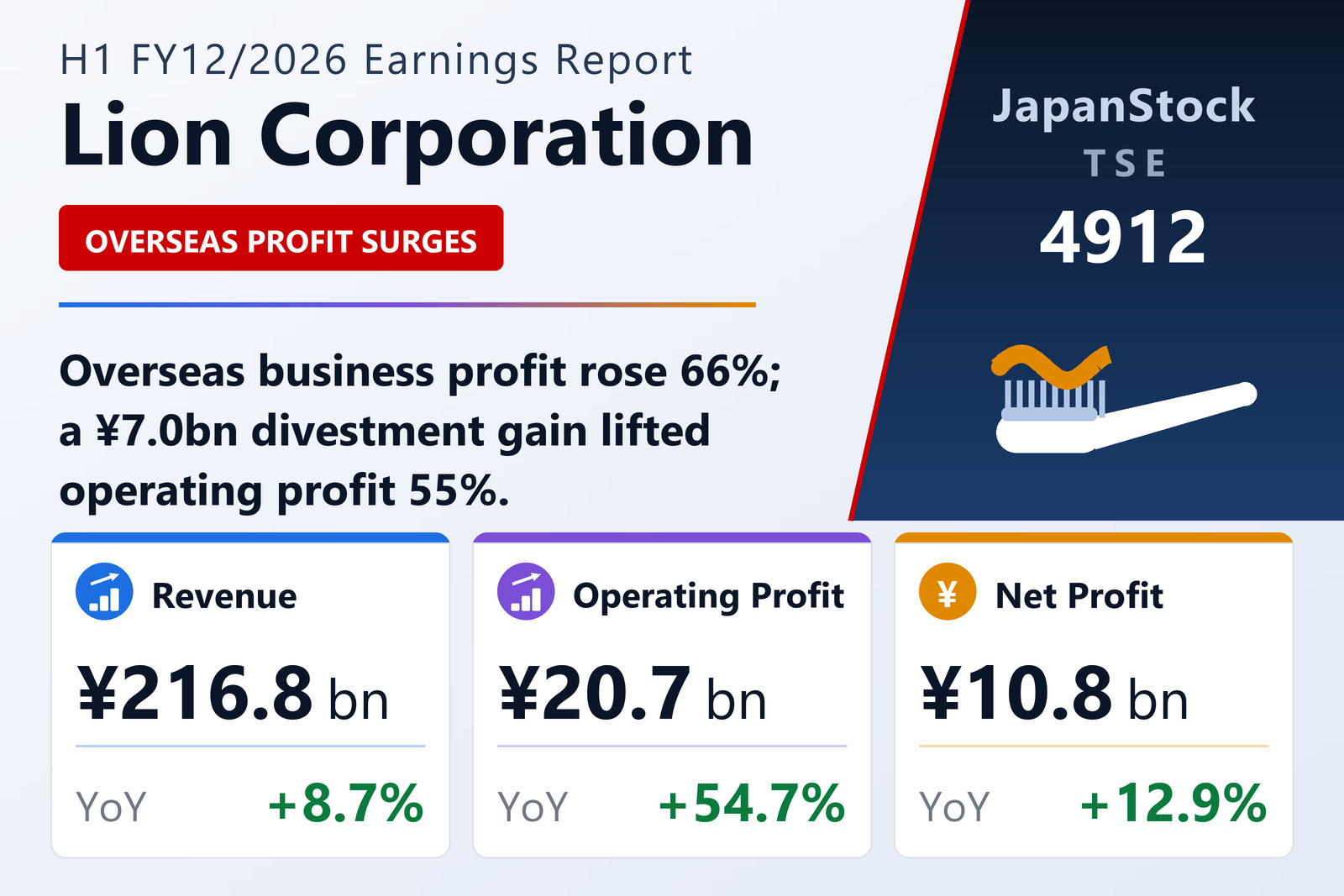
Three profit lines, three different growth rates
Lion Corporation (TSE: 4912), the Tokyo-based maker of the Clinica, Systema, NONIO, Top, NANOX, Kirei Kirei and hadakara brands, published results for the first half of the fiscal year ending December 2026 on August 7, 2026, prepared under IFRS on a consolidated basis. Led by President and Representative Director Masayuki Takemori, the group reported, for the six months from January 1 to June 30, 2026, revenue of ¥216,836 million, up 8.7% from ¥199,459 million, operating profit of ¥20,703 million, up 54.7% from ¥13,379 million, profit before tax of ¥22,504 million, up 53.6% from ¥14,650 million, and profit attributable to owners of parent of ¥10,844 million, up 12.9% from ¥9,609 million. Basic earnings per share rose to ¥39.20 from ¥34.75, with diluted EPS of ¥39.16 against ¥34.71.
The spread between those growth rates is the story of the half. Operating profit grew 54.7%; the company's preferred measure, business profit — gross profit less selling, general and administrative expenses, which Lion uses to gauge the performance of its recurring operations — grew 21.3% to ¥15,334 million from ¥12,639 million. Attributable profit grew only 12.9%. A reader who takes the 54.7% at face value will materially overstate how much better Lion's business got in twelve months.
What sits between business profit and operating profit is the answer. Other income leapt to ¥7,975 million from ¥1,034 million, against other expenses of ¥2,606 million versus ¥294 million. Inside that other-income line is a ¥7,016 million gain on sales of shares of subsidiaries and associates, disclosed in the cash flow reconciliation, arising from the share transfer of two chemicals subsidiaries completed at the end of June. Strip that gain out and operating profit lands close to the business-profit trajectory. Revenue growth carries a similar caveat: of the reported 8.7%, only 4.5% was real growth excluding currency movements.
The gap at the bottom is a tax gap. Income tax expense rose to ¥9,802 million from ¥3,513 million, taking the effective rate to 43.6% from 24.0% — the divestment gain came with a disproportionate tax charge, which is why a 53.6% rise in pre-tax profit converted into a 12.9% rise in attributable profit. Comprehensive income, by contrast, more than doubled to ¥15,937 million, up 140.6% from ¥6,624 million, helped by a swing in foreign currency translation to a positive ¥1,396 million from a negative ¥5,024 million a year earlier.
Overseas is now nearly half the business and most of the growth
Lion runs three reportable segments plus an Other bucket, and the growth is concentrated in one of them.
Overseas — Thailand, Malaysia and Australia in Southeast and South Asia/Oceania, plus China and South Korea in Northeast Asia — grew revenue 19.7% to ¥100,859 million from ¥84,237 million, or 9.0% excluding currency effects, and business profit 66.1% to ¥5,276 million from ¥3,176 million. Segment margin widened to 5.2% from 3.8%. Southeast and South Asia/Oceania grew revenue 25.9% to ¥64,871 million (13.4% ex-currency) and profit 46.0% to ¥4,023 million; Northeast Asia grew revenue 10.1% to ¥35,987 million (2.1% ex-currency) and profit 196.8% to ¥1,253 million from ¥422 million.
The country detail is more mixed than the yen figures suggest. Thailand's revenue rose 7.1% to ¥35,733 million in yen but fell 3.6% in local terms, as laundry detergent exports to neighbouring countries were hit by geopolitical disruption. China's revenue rose 8.4% to ¥15,896 million in yen but fell 4.6% in local terms, after a first quarter spent normalising distributor inventory levels — second-quarter toothpaste and toothbrush sales did exceed the prior year. Malaysia was the genuine standout, up 28.2% to ¥15,525 million and 9.2% ex-currency, on Top liquid detergent and Shokubutsu Monogatari body soap. South Korea rose 6.3% to ¥10,449 million, 3.5% ex-currency, on BEAT capsule detergent and Kyusoku Jikan foot-cooling sheets.
Consumer Products, the domestic core, grew revenue just 1.6% to ¥123,646 million and business profit 7.1% to ¥9,787 million, lifting margin to 7.9% from 7.5%. Within it, Oral Care — the group's declared top-priority business — grew 9.6% to ¥40,535 million on Clinica Advantage toothpaste and the April relaunch of the premium Systema Haguki Plus Premium line. Pharmaceuticals grew 4.0% to ¥11,392 million and Other, mainly pet products, 2.9% to ¥20,324 million. Beauty Care was flat at ¥13,111 million, up 0.2%. Two fields fell: Fabric Care declined 2.2% to ¥28,280 million as Soflan Aroma Rich softener slipped, and Living Care fell 17.0% to ¥10,001 million — partly a reaction against last year's Look Plus toilet fumigant launch, partly the loss of the Lead cooking-goods brand transferred to another company in October 2025.
Industrial Products fell revenue 3.9% to ¥27,579 million with business profit essentially flat at ¥1,459 million, down 0.2%. Conductive carbon for secondary batteries rose sharply on market recovery and tyre-rubber release agents grew, but the same Lead brand transfer pulled the institutional-detergent field down. The Other segment, mainly construction contracting, fell 27.2% to ¥3,832 million with a business loss of ¥77 million against a loss of ¥33 million.
A reshaped portfolio: eight companies in, two out
The scope of consolidation changed materially. Eight companies were added, headed by PNB Consolidated Pty Ltd, an Australian natural beauty care manufacturer and distributor that Lion took to 100% ownership in January and which brought Oceania into the overseas footprint for the first time — the company renamed its regional disclosure from "Southeast and South Asia" to "Southeast and South Asia/Oceania" as a result. Two companies were removed: Lion Specialty Chemicals Co., Ltd. and PT. Ipposha Indonesia, the chemicals subsidiaries whose share transfer closed at the end of June and generated the ¥7,016 million gain.
Both transactions are visible on the balance sheet. Goodwill nearly doubled to ¥38,569 million from ¥19,580 million — the ¥18,989 million increase is essentially the PNB acquisition — while property, plant and equipment fell to ¥118,195 million from ¥125,239 million as the chemicals assets left the group. Total assets rose 0.8% to ¥532,799 million from ¥528,596 million, total equity rose 2.9% to ¥358,565 million from ¥348,419 million, and the ratio of equity attributable to owners of parent improved to 62.5% from 61.1%. Cash and cash equivalents eased to ¥83,401 million from ¥88,092 million.
The cash flow statement shows the two deals almost cancelling. Investing activities consumed ¥3,674 million against ¥15,107 million a year earlier, because ¥15,341 million of proceeds from the sale of subsidiary shares nearly offset ¥13,664 million paid to acquire subsidiary shares, alongside ¥4,582 million of capital expenditure. Operating cash flow improved sharply to ¥9,539 million from ¥1,848 million, though the reported figure is struck after deducting the ¥7,016 million non-cash gain and after ¥3,807 million of income tax paid against a ¥9,254 million payment a year earlier.
Guidance held, but the currency assumption moved
Full-year guidance for the year to December 2026, first published on February 12, 2026, is unchanged. Lion targets revenue of ¥430,000 million, up 1.9%, operating profit of ¥40,000 million, up 10.0%, business profit of ¥35,000 million, and profit attributable to owners of parent of ¥25,000 million, down 9.4%, for full-year EPS of ¥90.38.
What did change is the assumption underneath it. Reflecting recent currency movements, Lion revised its full-year average rate assumptions to ¥160 per US dollar from ¥155, and ¥4.9 per Thai baht from ¥4.7. Given how much of the reported revenue growth is translation rather than volume, that revision matters more than its single line in the release suggests.
Measured against the unchanged targets, the first half delivered 50.4% of guided revenue, 51.8% of guided operating profit, 43.8% of guided business profit and 43.4% of guided attributable profit. Revenue and operating profit are past halfway; business profit and net profit are not, which is consistent with a first half that borrowed from a one-off disposal and a full-year plan that expects net profit to fall 9.4% against a prior year that itself contained gains.
The dividend is the clearest signal of management's own reading. Against ¥30.00 paid for the year to December 2025 (¥15.00 interim plus ¥15.00 year-end), the forecast for 2026 is ¥34.00 — a ¥17.00 interim and a ¥17.00 year-end, an increase of ¥4.00, or 13.3% — and is unrevised from the previously announced dividend forecast. Payment of the interim dividend begins September 2, 2026.
Management framed the half against a harder backdrop than the numbers alone convey: escalating Middle East tensions drove raw material prices higher and disrupted supply chains, and Lion acknowledged higher procurement costs on some inputs, saying it prioritised stable product supply and moved quickly on additional mitigation measures. Strategically, the half advanced the "Vision 2030 2nd STAGE" medium-term plan launched last year, under the theme of strengthening earnings resilience: premium relaunches in the priority oral care business, the PNB acquisition in beauty care, a decision to build a new pharmaceuticals plant in Vietnam, and the exit from chemicals. Three accounting notes complete the picture: there were no changes in accounting policies or estimates, the issued share count was unchanged at 279,782,746 with treasury shares of 3,082,287, and this second-quarter report is not subject to audit or review by a certified public accountant or audit firm.
| Metric | H1 FY12/2026 | H1 FY12/2025 | Change |
|---|---|---|---|
| Revenue (¥ million) | 216,836 | 199,459 | +8.7% |
| Business profit (¥ million) | 15,334 | 12,639 | +21.3% |
| Operating profit (¥ million) | 20,703 | 13,379 | +54.7% |
| Profit before tax (¥ million) | 22,504 | 14,650 | +53.6% |
| Profit for the period (¥ million) | 12,702 | 11,137 | +14.1% |
| Profit attrib. to owners of parent (¥ million) | 10,844 | 9,609 | +12.9% |
| Comprehensive income (¥ million) | 15,937 | 6,624 | +140.6% |
| Basic EPS (¥) | 39.20 | 34.75 | +12.8% |
| Diluted EPS (¥) | 39.16 | 34.71 | +12.8% |
| Business profit — Consumer Products (¥ million) | 9,787 | 9,136 | +7.1% |
| Business profit — Industrial Products (¥ million) | 1,459 | 1,462 | −0.2% |
| Business profit — Overseas (¥ million) | 5,276 | 3,176 | +66.1% |
| Overseas revenue (¥ million) | 100,859 | 84,237 | +19.7% |
| Operating cash flow (¥ million) | 9,539 | 1,848 | +416.2% |
| Total assets (¥ million; vs Dec 31, 2025) | 532,799 | 528,596 | +0.8% |
| Total equity (¥ million; vs Dec 31, 2025) | 358,565 | 348,419 | +2.9% |
| Equity attrib. to owners ratio (vs Dec 31, 2025) | 62.5% | 61.1% | +1.4 pt |
| Goodwill (¥ million; vs Dec 31, 2025) | 38,569 | 19,580 | +97.0% |
| Annual dividend forecast (¥) | 34.00 | 30.00 | +¥4.00 |
JapanStockPulse provides informational content only and does not constitute investment advice. Figures are taken from the company's published earnings short report and may be subject to subsequent revision.