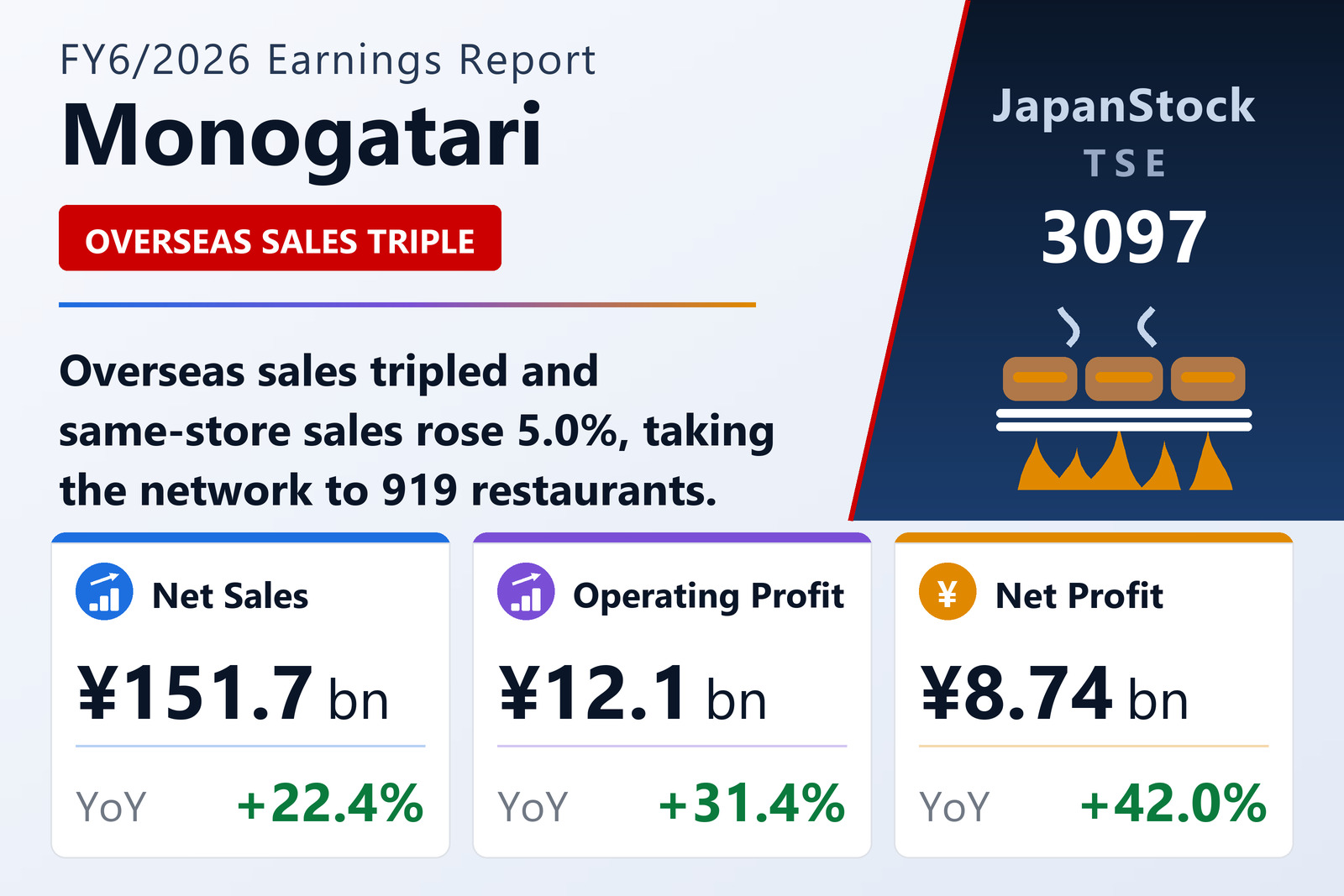
Monogatari Corporation (TSE: 3097) published its full-year earnings report for the twelve months to June 30, 2026 on August 10 — a year-end kessan tanshin under Japanese GAAP, not a quarterly update. The restaurant group, whose June fiscal year-end makes it one of the earliest large food-service names to close its books each summer, reported net sales of ¥151,689 million, up 22.4%, operating profit of ¥12,145 million, up 31.4%, ordinary profit of ¥12,122 million, up 34.1%, and profit attributable to owners of the parent of ¥8,743 million, up 42.0%. Earnings per share came to ¥227.23 against ¥163.09 a year earlier, with diluted EPS of ¥227.09. Comprehensive income rose 42.1% to ¥8,801 million. Return on equity climbed to 20.0% from 17.7%, and the operating margin widened to 8.0% from 7.4%. It was the first year the company crossed ¥150 billion of sales.
A 122-restaurant building year, and same-store sales up 5.0%
Store openings did most of the work. Monogatari opened 63 restaurants in Japan (50 directly operated, 13 franchised) and 59 overseas (42 directly operated, 17 franchised or joint-venture), a combined 122 openings in twelve months. The network finished the year at 919 restaurants — 621 directly operated and 298 franchised or otherwise held — of which 808 are in Japan and 111 abroad. Underneath that expansion, the existing estate also grew: sales at domestic stores open for at least 18 months rose 5.0% at directly operated restaurants and 3.3% at franchised ones. Management attributes the gain to sharper signature menus, limited-time fairs, extended trading hours, refurbishments and television advertising, alongside price revisions that included the introduction of urban pricing. Investment in store digitalisation continued, with new high-speed conveyor lanes and a larger fleet of serving robots. From this fiscal year the company also reorganised its disclosure categories, collapsing the previous seven departments into six categories — Yakiniku, Ramen, Yuzuan, Specialty & New Formats, Franchise and Overseas.
Yuzuan grows fastest; Yakiniku King remains the anchor
The Yakiniku category, built around the all-you-can-eat grill chain Yakiniku King, added 21 restaurants (15 directly operated, 6 franchised) to end the year at 369 stores (238 directly operated, 131 franchised), with directly operated sales of ¥69,599 million, up 12.8% — still comfortably the group's largest revenue pool. The Ramen category — Marugen Ramen, Nidaime Marugen and Kyabeton — opened 20 restaurants and closed at 251 stores (143 directly operated, 108 franchised) on directly operated sales of ¥25,088 million, up 15.2%. The fastest grower was Yuzuan, the sushi-and-shabu-shabu format, which opened 10 restaurants to reach 116 stores (99 directly operated, 17 franchised) and lifted directly operated sales 23.8% to ¥25,609 million. The Specialty & New Formats category — including Okonomiyaki Honpo, the fast-casual yakiniku brand Yakitate no Karubi, the roadside café Kajitsuya Coffee and the newly launched udon format Niku Sanuki Mocchiri Udon Genjiro, whose first restaurant opened in May 2026 — reached 72 stores and ¥9,351 million of directly operated sales, up 20.2%. The Franchise category, which books royalties, initial fees and management contracts, grew revenue 6.3% to ¥7,809 million from a domestic franchise base of 260 restaurants.
Overseas revenue triples as four new markets open
The standout line was overseas revenue of ¥14,230 million, up 202.1% — roughly a tripling, and now 9.4% of group sales. Part of that is a consolidation effect: Storytellers USA, Inc. and its six subsidiaries were consolidated on a balance-sheet basis only in the prior year, and their income statements enter the accounts for the first time in FY6/2026. The rest is genuine expansion. The group opened 59 restaurants abroad to reach 111 overseas stores (73 directly operated, 38 franchised or joint-venture), pushing into Singapore in August 2025, Taiwan in October 2025 and Thailand in March 2026, while Yakiniku King opened its first-ever overseas restaurant in the Philippines in August 2025. The hamburg-steak brand Niku Niku Dai Mai was rolled out aggressively in China, and in April 2026 Monogatari brought the U.S. teppanyaki chain HIBACHI STEAK HOUSE into the group. Greater China, Southeast Asia and North America are the three priority regions named under the company's "Monogatari Vision 2030" long-term plan and its Medium-Term Three-Year Management Plan 2026–2028. Notwithstanding the HIBACHI transaction, the company reports no material change to the scope of consolidation during the year.
Margins improve on price, not on cost restraint
The profit improvement came from the gross line rather than from overheads. Cost of sales rose 20.3% to ¥52,068 million — slower than the 22.4% sales increase — so the cost-of-sales ratio eased to 34.3% from 34.9% and gross profit reached ¥99,620 million. Selling, general and administrative expenses, by contrast, grew 22.5% to ¥87,474 million, holding steady at 57.7% of sales, with salaries and allowances up 21.9% to ¥37,329 million, rent up 21.8% to ¥9,024 million and depreciation up 20.0% to ¥5,959 million. In other words, food-cost inflation was recovered through pricing while labour and rent simply scaled with the store count. Below the operating line, extraordinary losses of ¥582 million — including impairment charges of ¥368 million, ¥162 million of fixed-asset retirements and ¥51 million of store-closure costs — were partly offset by ¥148 million of extraordinary gains, leaving pre-tax profit of ¥11,687 million. A deferred tax credit of ¥701 million pulled the effective tax rate down to about 25.5% from roughly 30.9%, which is the main reason net profit grew far faster than operating profit.
Balance sheet, cash flow and a 43-yen dividend
Total assets ended the year at ¥86,997 million, up ¥12,971 million, split between current assets of ¥27,792 million (cash and deposits up ¥4,472 million, trade receivables up ¥1,079 million) and non-current assets of ¥59,205 million (property, plant and equipment up ¥4,837 million on the new-store programme). Current liabilities rose ¥3,737 million to ¥22,548 million and non-current liabilities ¥2,382 million to ¥17,233 million, mainly on a ¥2,100 million increase in long-term borrowings. Net assets grew ¥6,851 million to ¥47,215 million on ¥7,279 million of retained-earnings growth, leaving the equity ratio essentially unchanged at 54.1% (54.3% a year earlier) and net assets per share at ¥1,227.09. Operating cash flow rose to ¥16,033 million from ¥11,839 million, comfortably funding ¥10,039 million of capital spending on new restaurants within investing outflows of ¥10,927 million; financing was a modest ¥494 million outflow after ¥1,458 million of dividends and ¥554 million of share buybacks. Cash and equivalents closed 37.7% higher at ¥16,993 million. The interest-coverage ratio fell to 57.1 times from 127.1 times as borrowing costs rose, while interest-bearing debt equalled just 1.0 year of operating cash flow. The annual dividend rises to ¥43.00 from ¥36.00 (¥20.00 interim plus a ¥23.00 year-end payment), a payout ratio of 18.9%, under a progressive dividend policy targeting a consolidated payout ratio of at least 20%. Payment is scheduled to begin on September 28, 2026, following the annual general meeting on September 25.
FY6/2027: 14% growth on the top line, flat at the bottom
For the year to June 2027 Monogatari guides to net sales of ¥173,084 million (+14.1%), operating profit of ¥13,864 million (+14.1%), ordinary profit of ¥13,619 million (+12.3%) and profit attributable to owners of the parent of ¥8,756 million — a rise of just 0.1%, with EPS of ¥228.02. The flat bottom line is the arithmetic consequence of the current year's tax benefit not repeating rather than any expected deterioration in trading. First-half guidance calls for sales of ¥83,736 million (+15.8%), operating profit of ¥6,496 million (+18.7%) and net profit of ¥4,042 million (+12.0%). The annual dividend is forecast to rise again, to ¥46.00 (¥23.00 interim and ¥23.00 final), implying a 20.1% payout. Management expects domestic consumption to hold up on the back of continued wage increases, while flagging international uncertainty, U.S. trade policy and currency swings as risks, and continued pressure from raw-material and personnel costs. On a parent-only basis, sales rose 15.3% to ¥137,524 million and net profit 33.5% to ¥8,486 million. The company reports no material subsequent events, and will hold an earnings briefing for institutional investors and analysts on August 19, 2026.
| Metric | FY6/2026 | FY6/2025 | YoY |
|---|---|---|---|
| Net sales (¥ million) | 151,689 | 123,921 | +22.4% |
| Operating profit (¥ million) | 12,145 | 9,242 | +31.4% |
| Ordinary profit (¥ million) | 12,122 | 9,035 | +34.1% |
| Profit attrib. to owners (¥ million) | 8,743 | 6,157 | +42.0% |
| Basic EPS (¥) | 227.23 | 163.09 | +39.3% |
| Operating margin (%) | 8.0 | 7.4 | +0.6 pt |
| Return on equity (%) | 20.0 | 17.7 | +2.3 pt |
| Total assets (¥ million) | 86,997 | 74,026 | +17.5% |
| Equity ratio (%) | 54.1 | 54.3 | −0.2 pt |
| Operating cash flow (¥ million) | 16,033 | 11,839 | +35.4% |
| Cash & equivalents, year-end (¥ million) | 16,993 | 12,338 | +37.7% |
| Annual dividend per share (¥) | 43.00 | 36.00 | +19.4% |
| Overseas category revenue (¥ million) | 14,230 | — | +202.1% |
| Restaurants at year-end (total) | 919 | — | +122 openings |
| — of which overseas | 111 | — | +59 openings |
JapanStockPulse provides informational content only and does not constitute investment advice. Figures are taken from the company's published earnings short report and may be subject to subsequent revision.