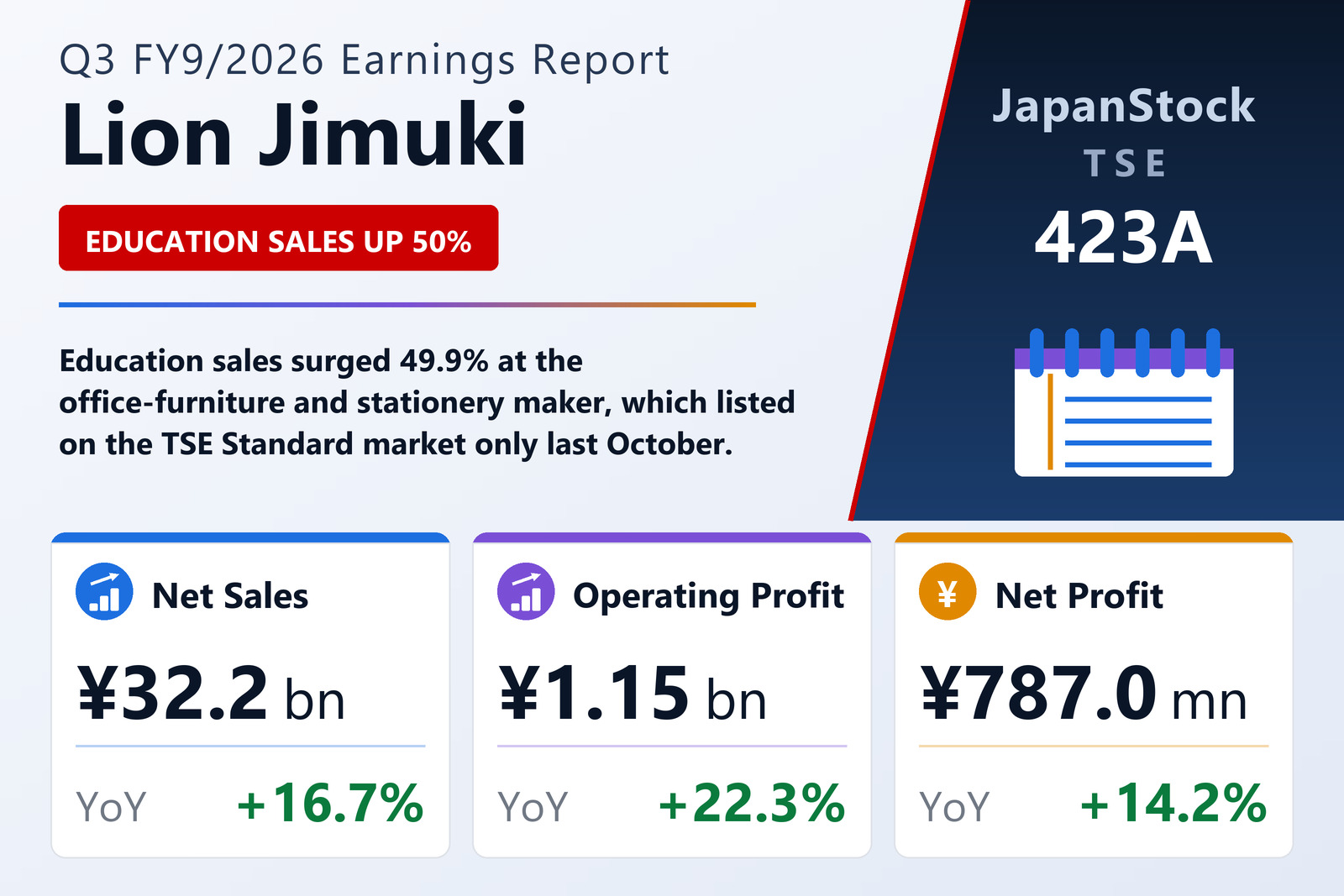
Lion Jimuki Co., Ltd. (TSE: 423A) published its third-quarter earnings report for the financial year ending September 30, 2026 on August 10. The figures below cover the nine months from October 1, 2025 to June 30, 2026 on a cumulative consolidated basis under Japanese GAAP — this is neither a first-quarter statement nor a full-year result, and the company's fiscal year still has one quarter to run. Net sales rose 16.7% to ¥32,171 million, operating profit 22.3% to ¥1,152 million, ordinary profit 19.8% to ¥1,211 million and profit attributable to owners of the parent 14.2% to ¥787 million. Comprehensive income, which was flattered by currency translation and securities revaluation swings, climbed 43.8% to ¥901 million.
Margins hold up even as the sales mix shifts
Growth came with a mix cost. Cost of sales rose faster than revenue, to ¥24,656 million from ¥20,718 million, so gross profit advanced a more modest 9.8% to ¥7,514 million and the gross margin narrowed to 23.4% from 24.8% a year earlier. What rescued the operating line was restraint below it: selling, general and administrative expenses grew only 7.8% to ¥6,362 million, well behind the top line, in an environment the company describes as one of rising minimum wages, higher personnel costs and climbing distribution expenses. Management says it has been leaning on operational efficiency and a review of trading terms to absorb that pressure. Below operating profit, non-operating income of ¥95 million comfortably outweighed non-operating expenses of ¥36 million — the latter inflated by ¥15 million of listing-related costs that did not exist a year ago. Extraordinary losses were negligible at ¥10 million, leaving pre-tax profit of ¥1,200 million against ¥1,009 million, and income taxes of ¥412 million. Basic earnings per share came to ¥24.00 against ¥23.09, with diluted EPS of ¥23.32 disclosed for the first time — the prior year has no diluted figure because the company was not yet listed.
Education does the heavy lifting; the dealer channel stalls
Lion Jimuki reports a single reportable segment — the manufacture and sale of office equipment and related services — so no segment table is published, but the company does break out sales by business unit. The education (bunkyo) unit was the engine of the quarter, with sales up 49.9% to ¥10,573 million on renewal work tied to Japan's GIGA School digital-classroom programme, municipal FY2026 budget projects, electronic whiteboards and PC-classroom orders. Metropolitan-area GIGA contracts in particular drove the first half; from the second half onward the unit ran into the post-deployment lull, supply anxiety and price inflation, with maintenance and operational support work cushioning the fall. The enterprise unit grew 12.4% to ¥9,149 million, helped by co-selling arrangements with large partner companies from outside the office-furniture industry, office relocation and renewal projects, and renewal proposals into the nursing-care market. The dealer unit was essentially flat, up 0.6% to ¥12,447 million despite securing large fixture contracts in the Tokyo and Kansai regions and a sizeable private-sector order built around private booths. Separately, the e-commerce unit rose 13.5% to ¥2,527 million on its NAVILION platform — though the company notes those sales are already counted inside the three units above, so they cannot simply be added to the total.
Product-level commentary points to where the company is placing its bets. The DelicaBooth type S single-occupancy booth continues to draw demand for web conferencing and one-on-one meetings, and a multi-person model was shown as a reference exhibit at the Orgatec Tokyo 2026 trade fair in June. With Japan set to ban the manufacture and import of fluorescent lamps in 2027, the group is pushing LED replacement as a cost-saving proposition, and it is reselling the PoPoHu Mini portable battery as both an in-office power source and an emergency supply. On the consumer side, the compact pimmy stationery line — aimed at a Gen Z audience preoccupied with "space performance" — and the sumafy frame holder for children's artwork widen the addressable audience from students to seniors. In May the company relocated its Nishi-Shinjuku office to serve as a live showcase for its "whole-office proposal" pitch and as an internal testbed for activity-based working.
The IPO reshapes the balance sheet
The balance sheet at June 30 looks materially different from the one at the September 2025 year-end, and most of the change traces back to the listing. Total assets fell 2.7%, or ¥685 million, to ¥24,370 million: notes and accounts receivable dropped ¥1,935 million and inventories ¥1,885 million, while cash and deposits rose ¥2,147 million and long-term advance payments ¥963 million. Total liabilities fell far more sharply — down 14.2%, or ¥1,823 million, to ¥11,005 million — driven by a ¥3,160 million reduction in notes and accounts payable, partly offset by a ¥1,191 million increase in long-term advances received. Interest-bearing debt was cut 8.4%, or ¥103 million, to ¥1,130 million. Net assets meanwhile rose 9.3%, or ¥1,137 million, to ¥13,364 million, lifting the equity ratio to 54.8% from 48.8%. That improvement is part earnings and part equity issuance: the October 14, 2025 public offering of 1,469,000 new shares plus the disposal of 31,700 treasury shares added ¥143 million each to common stock and capital reserve, a November 12 third-party allotment of 639,900 over-allotment shares added ¥62 million each, and exercises of share subscription rights a further ¥118 million each. Common stock now stands at ¥3,001 million and capital surplus at ¥2,466 million, with shares issued rising to 33,773,400 from 29,900,000 and treasury stock reduced to just 75 shares.
No cash flow statement — and a dividend that triples
Readers looking for cash-flow detail will not find it: the company states plainly that no quarterly consolidated statement of cash flows has been prepared for the nine months, a permitted omission under Japan's quarterly disclosure rules. The only cash-adjacent figure supplied is depreciation, including amortisation of intangibles, of ¥286 million against ¥245 million a year earlier. The quarterly financial statements were also not subject to review by a certified public accountant or audit firm. On distributions, the picture is unusually generous for a first year as a listed company: an interim dividend of ¥8.00 per share was paid — explicitly designated a listing-commemorative payment — against ¥0.00 at the same point last year, and the company forecasts a year-end dividend of ¥7.00 for an annual total of ¥15.00, three times the ¥5.00 paid for FY9/2025. That forecast is unchanged from the company's previous announcement. Dividends paid during the nine months absorbed ¥419 million of retained earnings, which still rose to ¥6,294 million from ¥5,926 million.
Full-year guidance untouched, and running ahead of it
Lion Jimuki reaffirmed the full-year FY9/2026 consolidated forecast it issued on May 14, 2026, with no revision: net sales of ¥40,723 million (+10.0%), operating profit of ¥1,400 million (+17.7%), ordinary profit of ¥1,442 million (+13.1%) and profit attributable to owners of the parent of ¥989 million (+8.5%), for full-year EPS of ¥29.94 — a figure the company notes has been calculated using the enlarged share count following stock-option exercises through June 30. Measured against those targets, nine-month progress runs at 79.0% of the sales target, 82.3% of operating profit, 84.0% of ordinary profit and 79.6% of net profit. With three-quarters of the year elapsed, the profit lines are therefore comfortably ahead of a straight-line run rate, though the company's own commentary flags a tougher final quarter for the education unit now that the GIGA deployment year has passed. There were no changes to the scope of consolidation, no changes in accounting policy or estimates, no going-concern note, and no material subsequent events disclosed in the report.
| Metric | 9M FY9/2026 | 9M FY9/2025 | YoY |
|---|---|---|---|
| Net sales (¥ million) | 32,171 | 27,563 | +16.7% |
| Gross profit (¥ million) | 7,514 | 6,845 | +9.8% |
| Operating profit (¥ million) | 1,152 | 942 | +22.3% |
| Ordinary profit (¥ million) | 1,211 | 1,010 | +19.8% |
| Profit attrib. to owners (¥ million) | 787 | 689 | +14.2% |
| Comprehensive income (¥ million) | 901 | 626 | +43.8% |
| Basic EPS (¥) | 24.00 | 23.09 | +3.9% |
| Dealer unit sales (¥ million) | 12,447 | — | +0.6% |
| Enterprise unit sales (¥ million) | 9,149 | — | +12.4% |
| Education unit sales (¥ million) | 10,573 | — | +49.9% |
| E-commerce unit sales (¥ million, incl. above) | 2,527 | — | +13.5% |
| Total assets (¥ million) | 24,370 | 25,056 | −2.7% |
| Net assets (¥ million) | 13,364 | 12,226 | +9.3% |
| Equity ratio (%) | 54.8 | 48.8 | +6.0pt |
| Annual dividend per share (¥) | 15.00 (f) | 5.00 | +200.0% |
JapanStockPulse provides informational content only and does not constitute investment advice. Figures are taken from the company's published earnings short report and may be subject to subsequent revision.