What the filing says, plainly
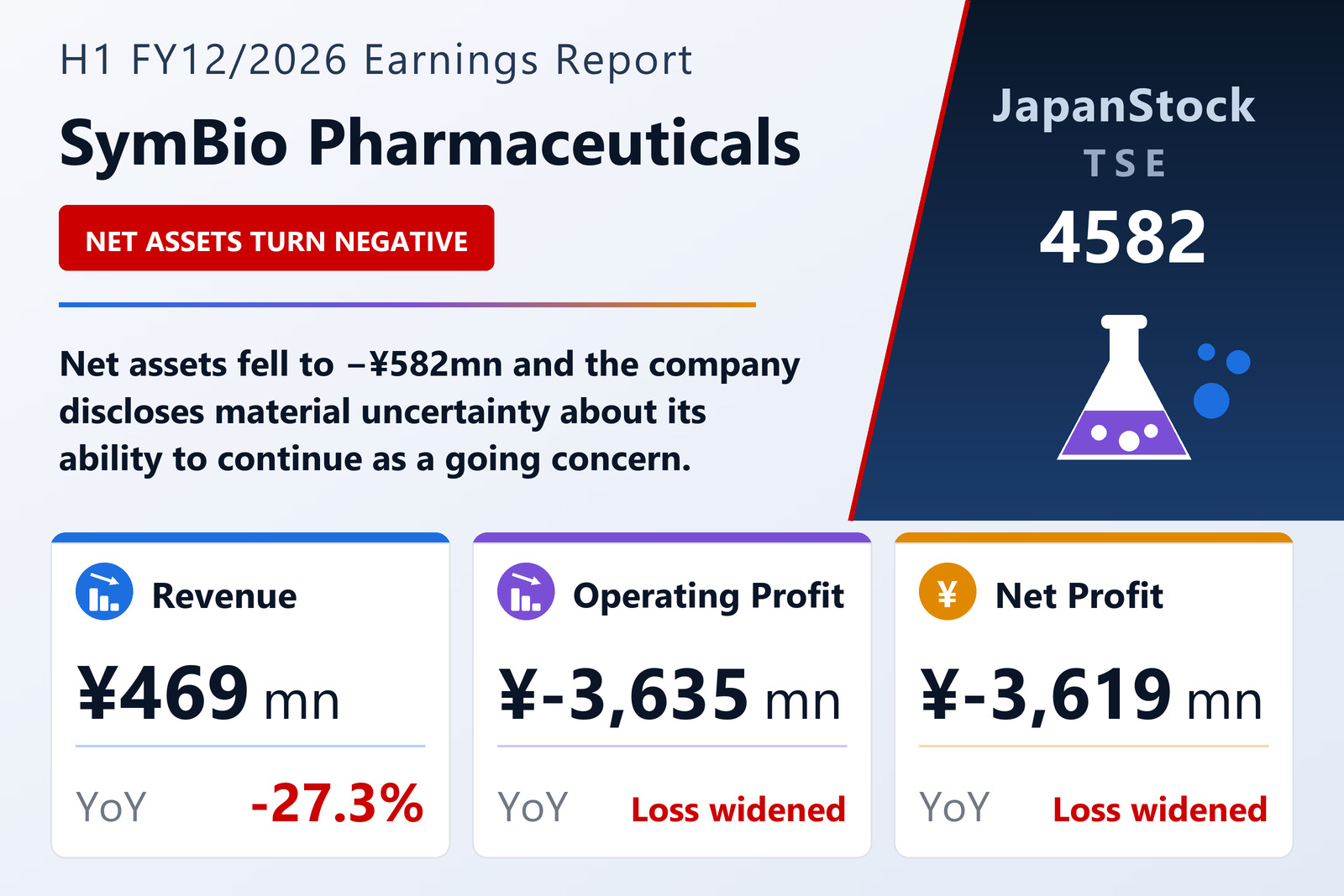
SymBio Pharmaceuticals Limited (TSE: 4582), a development-stage drug company, published consolidated results for the six months to June 30, 2026 on August 10, 2026 under Japanese GAAP. Net sales fell 27.3% to ¥469 million. The operating loss widened to ¥3,635 million from ¥2,154 million, the ordinary loss to ¥3,608 million from ¥2,340 million and the net loss to ¥3,619 million from ¥2,369 million, for a loss per share of ¥50.89 against ¥49.35.
The balance sheet is where the position changed in kind rather than degree. Total assets halved to ¥1,907 million from ¥3,867 million, and net assets turned negative at −¥582 million against ¥1,272 million at the December year-end. Shareholders' equity is −¥850 million against ¥924 million, and the equity ratio is −44.6% against 23.9%. That state — liabilities exceeding assets — is what the filing calls 債務超過, and it is the trigger the company itself names.
The company states that it had already recognised events or conditions raising substantial doubt about the going-concern assumption, having posted operating, ordinary and net losses for three consecutive years through the prior financial year, with a loss of material size in that year. In this half it continued to post losses at all three levels and, at the interim balance-sheet date, fell into negative net assets. It concludes that material uncertainty regarding the going-concern assumption exists, and states that the interim consolidated financial statements are prepared on a going-concern basis and do not reflect the effects of that uncertainty.
The pipeline the company is spending on
The programme at the centre of the spending is BCV (brincidofovir), which the company describes as having broad antiviral and anticancer activity and which it is developing across three priority areas: post-transplant viral infections, blood and solid cancers, and neurodegenerative disease. Two clinical milestones were reached in the half. The global Phase III trial of intravenous BCV in adenovirus infection after haematopoietic stem-cell transplantation achieved first patient in during March 2026, and enrolment is accumulating. The NIH-led Phase II trial in progressive multifocal leukoencephalopathy (PML), a rare neurodegenerative disease with no approved treatment, achieved first patient in during June 2026.
The company also secured use patents on IV BCV for multiple indications — adenovirus infection in the United States and Europe in February and May 2026, and malignant lymphoma in Japan in March 2026. Its second business is IVD, an in-vitro diagnostic platform based on an ultra-high-sensitivity immunochromatography patent held jointly with Nippon Steel Chemical & Material, aimed at point-of-care testing and at non-medical industrial uses; partnering discussions for commercialisation are under way.
The measures listed, and what is not yet settled
Against this the company lists four responses: continuing the BCV clinical programme and protecting its intellectual property through orphan-drug exclusivity and use patents; equity financing, on which it says discussions and studies are continuing so that it can raise funds flexibly as development and cash needs require; partnering — licensing European and US commercialisation rights for BCV in adenovirus infection, granting an option on North American rights in oncology, and a technology-transfer tie-up with a global IVD company, each intended to bring in upfront or milestone income and share future development cost; and cost reduction plus a review of payment terms to lower the burn rate and improve cash flow.
The company is explicit about the limits of all this. Uncertainty exists over the progress of BCV development, over whether specific partnering and alliances succeed, and over the amount that can be raised. On financing and alliances it says efforts continue but that nothing is settled fact, and the timing of resolving the negative net assets is undetermined at present. Guidance for the full year to December 2026 is unchanged: net sales of ¥3,891 million (+197.5%), an operating loss of ¥4,231 million, an ordinary loss of ¥4,291 million and a net loss of ¥4,331 million, for a loss per share of ¥72.81. The half has produced 12.1% of that revenue target and 83.6% of the full-year loss. No dividend is paid or forecast.
| Metric | H1 FY12/2026 | H1 FY12/2025 | Change |
|---|---|---|---|
| Net sales (¥ million) | 469 | 646 | −27.3% |
| Operating profit (¥ million) | −3,635 | −2,154 | loss widened |
| Ordinary profit (¥ million) | −3,608 | −2,340 | loss widened |
| Net profit (¥ million) | −3,619 | −2,369 | loss widened |
| EPS (¥) | −50.89 | −49.35 | loss widened |
| Total assets (¥ million) | 1,907 | 3,867 | −50.7% |
| Net assets (¥ million) | −582 | 1,272 | −145.8% |
| Equity ratio | −44.6% | 23.9% | −68.5 pt |
| FY12/2026 guidance — revenue (¥ million) | 3,891 | — | +197.5% |
| FY12/2026 guidance — operating profit (¥ million) | −4,231 | — | n.m. |
| FY12/2026 guidance — ordinary profit (¥ million) | −4,291 | — | n.m. |
| FY12/2026 guidance — net profit (¥ million) | −4,331 | — | n.m. |
| FY12/2026 guidance — EPS (¥) | −72.81 | — | n.m. |
| Annual dividend per share (¥) | 0.00 | 0.00 | unchanged |
JapanStockPulse provides informational content only and does not constitute investment advice. Figures are taken from the company's published earnings short report and may be subject to subsequent revision.