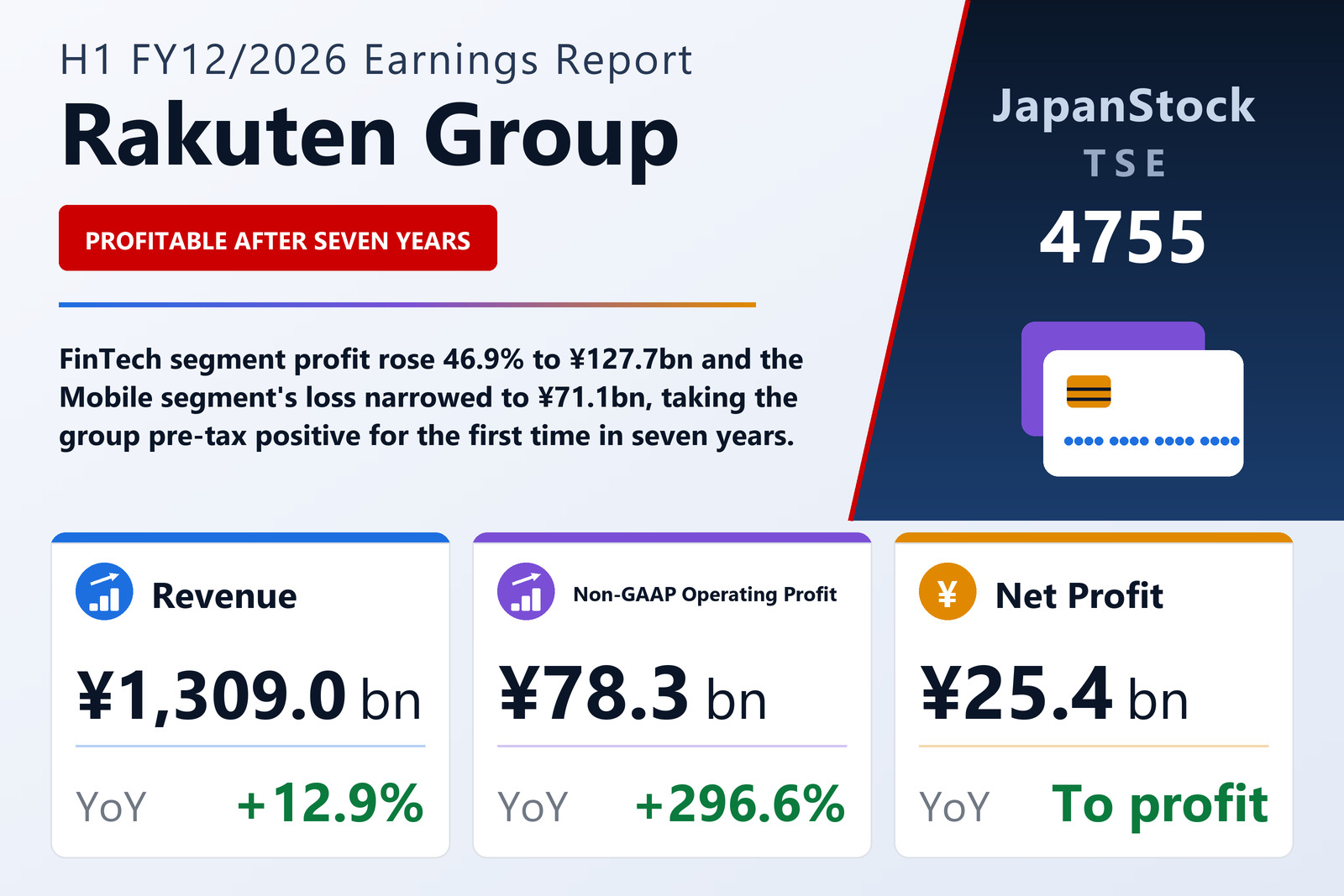
Rakuten Group, Inc. (TSE: 4755) reported consolidated results under IFRS on August 10. This is an interim, six-month result covering January 1 to June 30, 2026 — Rakuten runs a December fiscal year-end, not the March year-end common among Japanese blue chips, so these are half-year cumulative figures for FY12/2026 rather than a first quarter or a March-year result. Revenue rose 12.9% to ¥1,309,052 million, IFRS operating profit swung to ¥50,440 million from a ¥6,610 million loss, and profit before tax reached ¥17,883 million against a ¥66,247 million loss a year earlier. Profit for the period was ¥25,429 million against a ¥101,957 million loss. Management flagged the milestone explicitly: pre-tax profit and profit for the period were positive for the first time in seven years — the first interim period in the black since the six months to June 2019.
One qualifier belongs immediately next to that milestone. Because so much of Rakuten's earnings power sits inside partly owned listed financial subsidiaries, ¥36,370 million of the period's profit belonged to non-controlling interests, leaving a loss of ¥10,941 million attributable to owners of the parent. That is still a dramatic improvement on the ¥124,435 million parent-level loss of a year earlier — basic loss per share narrowed to ¥5.03 from ¥57.64, and diluted to ¥5.05 from ¥57.65 — but the parent line has not yet crossed zero. On the group's own preferred measure, Non-GAAP operating profit nearly quadrupled, up 296.6% to ¥78,334 million from ¥19,751 million. EBITDA rose 22.4% to ¥224,057 million, and total comprehensive income reached ¥87,828 million against a negative ¥95,529 million.
FinTech is now the group's profit engine
FinTech is where the money is. Segment revenue jumped 25.1% to ¥570,751 million, and segment profit — reported on a Non-GAAP basis and after the group's internal "mobile ecosystem contribution" charge — rose 46.9% to ¥127,708 million, comfortably more than the entire group's Non-GAAP operating profit. Before that internal charge, FinTech earned ¥140,598 million, up 46.6% from ¥95,893 million. Every major domestic FinTech line improved. Rakuten Card kept expanding its cardholder base with steady growth in shopping transaction value, lifting fee income. The banking business was the standout: a larger customer base grew assets under management just as the Bank of Japan's policy-rate increases lifted investment yields, so net investment income expanded sharply and scale efficiencies compounded it. Securities posted a large gain on a growing account base and an active equity market; insurance improved profitability by concentrating its product portfolio; and Rakuten Pay grew transaction value alongside user numbers with more efficient marketing. In the June quarter alone, FinTech segment profit was ¥69,176 million against ¥43,217 million.
Mobile's loss narrows again — but no subscriber count is disclosed
Mobile revenue rose 13.3% to ¥252,541 million and the segment loss narrowed to ¥71,080 million from ¥88,457 million, a ¥17,377 million improvement. Before the mobile ecosystem contribution — the internal credit Rakuten assigns to the mobile business for the incremental spending its MNO subscribers do elsewhere across the group's 18 measured services — the loss was ¥92,235 million against ¥104,841 million. The credit itself grew 29.1% to ¥21,155 million, and it is worth understanding what that implies: the amount other segments are charged for the cross-selling benefit of mobile subscribers rose by nearly a third, which is in itself evidence that the subscriber base and its cross-use are expanding. Management attributed the improvement to continued network-quality investment and awareness campaigns, ecosystem-linked marketing through Rakuten Ichiba and Rakuten Card, and a resulting steady rise in contracted lines. The tanshin does not disclose a subscriber number; it states only that contracted lines continued to increase. In the June quarter the segment loss was ¥33,054 million against ¥37,112 million. Rakuten said it will keep investing in 4G and 5G base stations, broaden its handset line-up and enterprise solutions, and is pursuing direct smartphone-to-low-earth-orbit-satellite connectivity to reach areas previously outside coverage and to keep service running during disasters.
Internet Services earns far more on modest growth — then writes down a warehouse
Internet Services revenue grew only 4.1% to ¥655,760 million, the slowest of the three segments, but segment profit rose 67.2% to ¥44,227 million — and, before the ecosystem charge, 54.8% to ¥52,492 million from ¥33,909 million. Rakuten Ichiba grew both gross merchandise sales and revenue while improving marketing efficiency; Rakuten Travel posted sharply higher revenue and profit as inbound demand kept expanding and domestic bookings held firm; and the loss-making "growth investment" businesses narrowed their deficits. Overseas, the International division improved despite a temporary revenue hit from closing some services: Rakuten Rewards and the wider open-commerce business gained from cost control and the absence of prior-year restructuring charges, while video service Rakuten Viki turned more profitable after a plan-price revision. The offset came below the segment line. Non-recurring items of ¥18,022 million were deducted in reconciling Non-GAAP to IFRS operating profit, including ¥1,019 million of fixed-asset impairment on the exit from part of the European marketplace business and roughly ¥17,000 million tied to the logistics business, where Rakuten converted a warehouse-space rental service to its own use. Within that, ¥15,739 million of property, plant and equipment was written down inside the Internet Services segment, with the recoverable amount assessed at zero because no future cash flows are expected from the asset.
Finance costs halve, and a depreciation change adds ¥17.3 billion
Two items below the segment line did meaningful work. Net finance costs almost halved to ¥31,522 million from ¥54,664 million: financial income doubled to ¥20,047 million from ¥10,111 million, driven by a ¥17,591 million derivative valuation gain on currency swaps attached to foreign-currency perpetual subordinated bonds, while financial expenses fell to ¥51,569 million from ¥64,775 million. Interest expense itself was essentially flat at ¥42,758 million against ¥43,097 million. Separately — and this one deserves to sit right beside the headline swing — Rakuten revised the useful lives of part of its network equipment after re-examining actual utilisation and revisiting its capital-expenditure plan. The change lifted both operating profit and pre-tax profit by ¥17,277 million relative to the previous method, so roughly a third of the reported ¥50,440 million operating profit is attributable to it. The operating-cost breakdown is consistent: depreciation and amortisation fell to ¥148,938 million from ¥166,278 million, while advertising and promotion rose to ¥184,107 million from ¥158,687 million, and interest paid by the financial businesses nearly doubled to ¥48,816 million from ¥24,968 million as deposit and funding costs followed policy rates higher.
A ¥31 trillion balance sheet, heavy cash outflows, and an October FinTech reorganisation
Total assets reached ¥31,135,930 million at June 30, up ¥2,331,530 million from ¥28,804,400 million at the December 2025 year-end, driven by a ¥2,983,897 million increase in securities-business financial assets and a ¥550,016 million rise in banking loans, partly offset by a ¥1,347,089 million fall in cash. Liabilities rose ¥2,367,546 million to ¥29,817,714 million, almost entirely mirroring the securities book — financial liabilities up ¥2,937,950 million — while bank borrowings fell ¥633,032 million. Total equity slipped ¥36,016 million to ¥1,318,216 million: ¥36,370 million of profit attributable to non-controlling interests and a ¥62,699 million rise in other components of equity, from higher fair values on equity instruments and a weaker yen, were outweighed by an ¥80,811 million reduction in other equity instruments transferred into bonds and a ¥36,099 million cut in capital surplus. The equity ratio eased to 4.2% from 4.7%, with equity attributable to owners of the parent at ¥915,291 million against ¥992,402 million, a 2.9% ratio. Cash flow was negative across all three activities, though the drivers are largely mechanical financial-business flows: operating cash flow was an outflow of ¥301,671 million (¥2,937,815 million in from securities financial liabilities and ¥392,644 million from deposit growth, against ¥2,983,984 million out on securities financial assets, ¥548,028 million on bank lending and ¥246,000 million on call loans); investing an outflow of ¥82,825 million, far below the prior year's ¥454,975 million; and financing an outflow of ¥967,419 million, dominated by ¥586,600 million of bank long-term borrowing repayment and a ¥269,796 million reduction in bank short-term borrowings. Cash ended at ¥4,490,477 million.
Guidance was left unrevised. For the full year to December 2026, Rakuten targets high-single-digit consolidated revenue growth against FY12/2025 and aims to stay in the black at the Non-GAAP operating level while also turning profit before tax and profit for the year positive. No numeric target is published, and no dividend has been decided for FY12/2026 — the FY12/2025 annual dividend was ¥0.00. The company reported no material subsequent events, but one dated corporate action is already on the calendar: effective October 1, 2026, Rakuten will reorganise its FinTech businesses, with Rakuten Bank acting as share-delivery parent for Rakuten Card and Rakuten Securities Holdings. Management expects the structure to make funding more flexible and cheaper and to strengthen cross-marketing and product design across the personal-customer base — but has flagged that reorganisation-related costs will be booked in the third quarter, with synergy benefits targeted only from the fourth. The financial impact has not been quantified. Shares issued stood at 2,181,203,900 at period-end, against 2,169,972,100 at the previous year-end.
| Metric | H1 FY12/2026 | H1 FY12/2025 | YoY |
|---|---|---|---|
| Revenue (¥ billion) | 1,309.05 | 1,159.07 | +12.9% |
| Non-GAAP operating profit (¥ billion) | 78.33 | 19.75 | +296.6% |
| IFRS operating profit / loss (¥ billion) | 50.44 | −6.61 | To profit |
| EBITDA (¥ billion) | 224.06 | 183.09 | +22.4% |
| Profit / loss before tax (¥ billion) | 17.88 | −66.25 | To profit |
| Profit / loss for the period (¥ billion) | 25.43 | −101.96 | To profit |
| Loss attrib. to owners of the parent (¥ billion) | −10.94 | −124.44 | Loss narrowed |
| Basic loss per share (¥) | −5.03 | −57.64 | Loss narrowed |
| Total comprehensive income (¥ billion) | 87.83 | −95.53 | To profit |
| Total assets (¥ billion, vs Dec 31, 2025) | 31,135.93 | 28,804.40 | +8.1% |
| Total equity (¥ billion, vs Dec 31, 2025) | 1,318.22 | 1,354.23 | −2.7% |
| Segment | Revenue (¥ billion) | YoY | Segment P/L (¥ billion) | Prior-year P/L (¥ billion) |
|---|---|---|---|---|
| Internet Services | 655.76 | +4.1% | 44.23 | 26.46 |
| FinTech | 570.75 | +25.1% | 127.71 | 86.96 |
| Mobile | 252.54 | +13.3% | −71.08 | −88.46 |
| Segment total (before eliminations) | 1,479.05 | +13.0% | 100.86 | 24.96 |
| Consolidated (after eliminations) | 1,309.05 | +12.9% | 78.33 | 19.75 |
JapanStockPulse provides informational content only and does not constitute investment advice. Figures are taken from the company's published earnings short report and may be subject to subsequent revision.