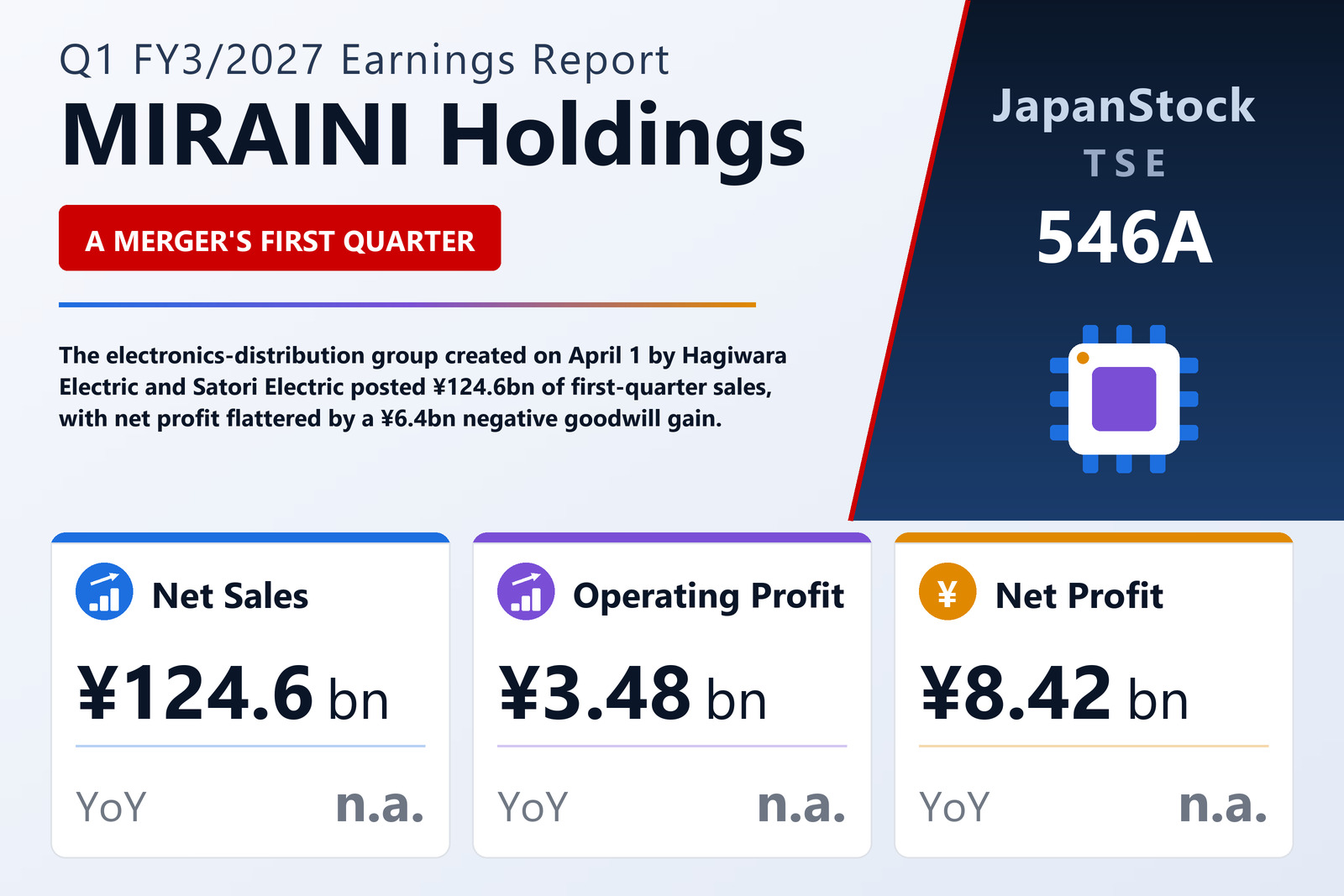
MIRAINI Holdings Corporation (TSE: 546A) published its first-ever quarterly report on August 10, covering the three months to June 30, 2026 under Japanese GAAP. Consolidated net sales came to ¥124,622 million, operating profit to ¥3,479 million, ordinary profit to ¥3,162 million, and profit attributable to owners of the parent to ¥8,422 million, or ¥243.42 per share. Comprehensive income was ¥9,792 million. Every percentage-change column in the filing is blank, and deliberately so: the company only came into existence on April 1, 2026, when Hagiwara Electric Holdings Co., Ltd. and Satori Electric Co., Ltd. combined under a jointly established holding company. This is the first quarter of the first fiscal year, and there are no year-earlier figures to measure it against.
Two electronics distributors, one holding company — and an unusual first accounting period
MIRAINI is a pure holding company formed by joint share transfer, not an operating business in its own right. Its two subsidiaries sell semiconductors and electronic components with technical support, develop embedded software and design semiconductor circuits, and separately build DX and IoT solutions, IT platforms and systems for industry and social infrastructure, alongside factory-automation and measurement equipment. Management has framed the combination around a stated vision of becoming a "global solution partner that takes on the challenge of creating new value," with expansion into India and other overseas markets, higher value-added solutions and a broader base of stable earnings as the stated priorities. Under the share-transfer ratios, each Hagiwara Electric share became two shares in the new company and each Satori Electric share 1.02 shares; 35,481,762 shares were issued, of which 882,802 sat in treasury at quarter-end, leaving a weighted average of 34,599,402 shares for the EPS calculation. For accounting purposes Hagiwara Electric is treated as the acquirer and Satori Electric as the acquired company, with the purchase method applied. One quirk deserves attention before comparing these numbers with either predecessor's history: because the deemed acquisition date is February 28, 2026, the quarter consolidates Satori Electric's results for March 1 to May 31, 2026 alongside Hagiwara Electric's for April 1 to June 30, 2026. Roughly half the group is reported on a one-month offset.
Device Solutions supplies 88% of sales
The Device Solutions segment — device sales and technical support centred on semiconductors and electronic components, plus embedded software development and semiconductor circuit design — booked external sales of ¥109,327 million and segment profit of ¥3,241 million, a 3.0% margin on total segment sales. That is 88% of group revenue and 93% of segment profit. Three demand strands drove it: mobility-related orders on the back of vehicle electrification and increasing vehicle sophistication, expanding volumes and rising prices in the semiconductor memory market, and growing demand for electronic components used in electric two-wheelers in India. System Solutions — DX and IoT solutions, IT platform construction, design and build of systems for industrial and social infrastructure, and sales of factory-automation, measurement and related equipment — contributed external sales of ¥15,294 million and segment profit of ¥237 million, a much thinner 1.5% margin. Manufacturing-sector DX and automation investment held firm there and demand for control components used in semiconductor production equipment showed signs of recovery, but tight supply of some products — itself a side-effect of the memory upcycle — and rescheduled investment programmes in automotive-related fields weighed on the segment, even as order intake stayed solid. Inter-segment sales of ¥138 million were eliminated. A yen that stayed on the weak side through the period was an additional tailwind for both units.
A ¥6.4 billion negative goodwill gain does the heavy lifting
The operating line is an ordinary distribution business: gross profit of ¥11,010 million on sales of ¥124,622 million and cost of sales of ¥113,611 million works out at an 8.8% gross margin, against which selling, general and administrative expenses of ¥7,531 million left ¥3,479 million of operating profit. Net non-operating expense of ¥317 million — income of ¥121 million including ¥35 million of interest received, against expense of ¥438 million of which ¥342 million was interest paid — brought ordinary profit to ¥3,162 million. Everything below that line is merger accounting. Extraordinary income of ¥6,398 million was almost entirely the ¥6,395 million negative goodwill gain, which arose because the ¥30,339 million acquisition cost — settled wholly in newly issued holding-company shares — came in below the net amount allocated to the assets and liabilities taken on. After ¥1 million of extraordinary loss, pre-tax profit was ¥9,559 million, tax ¥1,044 million, quarterly profit ¥8,514 million and non-controlling interests ¥92 million, leaving ¥8,422 million for the parent's shareholders. Strip the negative goodwill out and the parent-level result would be roughly ¥2.0 billion. It is a non-cash, non-recurring item, it was not allocated to either reporting segment, and it will not appear again.
Guidance raised on the day, with a 13-month wrinkle
Alongside the results the company revised upward the first-half and full-year forecasts it had issued on June 29, 2026, in a separate release published the same day. For the six months to September it now guides to sales of ¥278,000 million, operating profit of ¥8,500 million, ordinary profit of ¥7,500 million and net profit of ¥11,300 million (¥326.48 per share). For the full year to March 2027 it guides to sales of ¥548,000 million, operating profit of ¥15,500 million, ordinary profit of ¥13,500 million and net profit of ¥15,300 million (¥441.90 per share). Two caveats sit behind those numbers. First, the full-year forecast incorporates 13 months for Satori Electric and some consolidated subsidiaries — March 1, 2026 through March 31, 2027 — so the annual sales figure is not a clean twelve-month total. Second, the implied second half of ¥270.0 billion of sales and ¥7.0 billion of operating profit runs close to the first half at the operating line, but the implied second-half net profit of only ¥4.0 billion looks weak purely because the negative goodwill gain lands entirely in the first quarter. On distributions, no first-quarter dividend was paid; the company forecasts ¥48.00 at the interim and ¥48.00 at the year-end, for ¥96.00 annually, unchanged from its previous announcement. There is no prior-year dividend record, for the same reason there are no prior-year earnings.
Balance sheet at the starting line, and no cash-flow statement yet
Total assets stood at ¥237,471 million at June 30. Current assets of ¥210,903 million dominate the picture, as they should at a distributor: notes and accounts receivable and contract assets of ¥81,078 million, merchandise and finished goods of ¥69,221 million, cash and deposits of ¥26,897 million and electronically recorded receivables of ¥12,691 million. Non-current assets of ¥26,567 million comprise property, plant and equipment of ¥10,816 million, goodwill of ¥307 million and investments and other assets of ¥13,991 million. Total liabilities of ¥147,360 million include notes and accounts payable of ¥44,210 million, short-term borrowings of ¥41,140 million, the current portion of long-term borrowings at ¥10,174 million, bonds of ¥10,000 million and long-term borrowings of ¥18,230 million. Net assets of ¥90,111 million break down into capital stock of ¥10,000 million, capital surplus of ¥33,342 million, retained earnings of ¥43,039 million, treasury stock of minus ¥1,350 million, accumulated other comprehensive income of ¥3,846 million and non-controlling interests of ¥1,234 million. Shareholders' equity was ¥88,877 million for an equity ratio of 37.4%. No consolidated statement of cash flows was prepared for the first quarter, as quarterly reporting permits; the company disclosed depreciation of ¥263 million and goodwill amortisation of ¥6 million for the period instead. There was no going-concern note, no change in the scope of consolidation during the quarter and no change in accounting policies or estimates, and the attached quarterly consolidated financial statements have not been reviewed by an accounting auditor. Supplementary explanatory material was prepared, but no earnings briefing was held.
| Metric | Q1 FY3/2027 | FY3/2027 Forecast |
|---|---|---|
| Net sales (¥ million) | 124,622 | 548,000 |
| Operating profit (¥ million) | 3,479 | 15,500 |
| Ordinary profit (¥ million) | 3,162 | 13,500 |
| Profit attributable to owners of parent (¥ million) | 8,422 | 15,300 |
| Earnings per share (¥) | 243.42 | 441.90 |
| Comprehensive income (¥ million) | 9,792 | — |
| Negative goodwill gain (¥ million) | 6,395 | — |
| Device Solutions — external sales (¥ million) | 109,327 | — |
| Device Solutions — segment profit (¥ million) | 3,241 | — |
| System Solutions — external sales (¥ million) | 15,294 | — |
| System Solutions — segment profit (¥ million) | 237 | — |
| Total assets (¥ million) | 237,471 | — |
| Net assets (¥ million) | 90,111 | — |
| Equity ratio (%) | 37.4 | — |
| Annual dividend per share (¥) | — | 96.00 |
JapanStockPulse provides informational content only and does not constitute investment advice. Figures are taken from the company's published earnings short report and may be subject to subsequent revision.