A contract that did not repeat
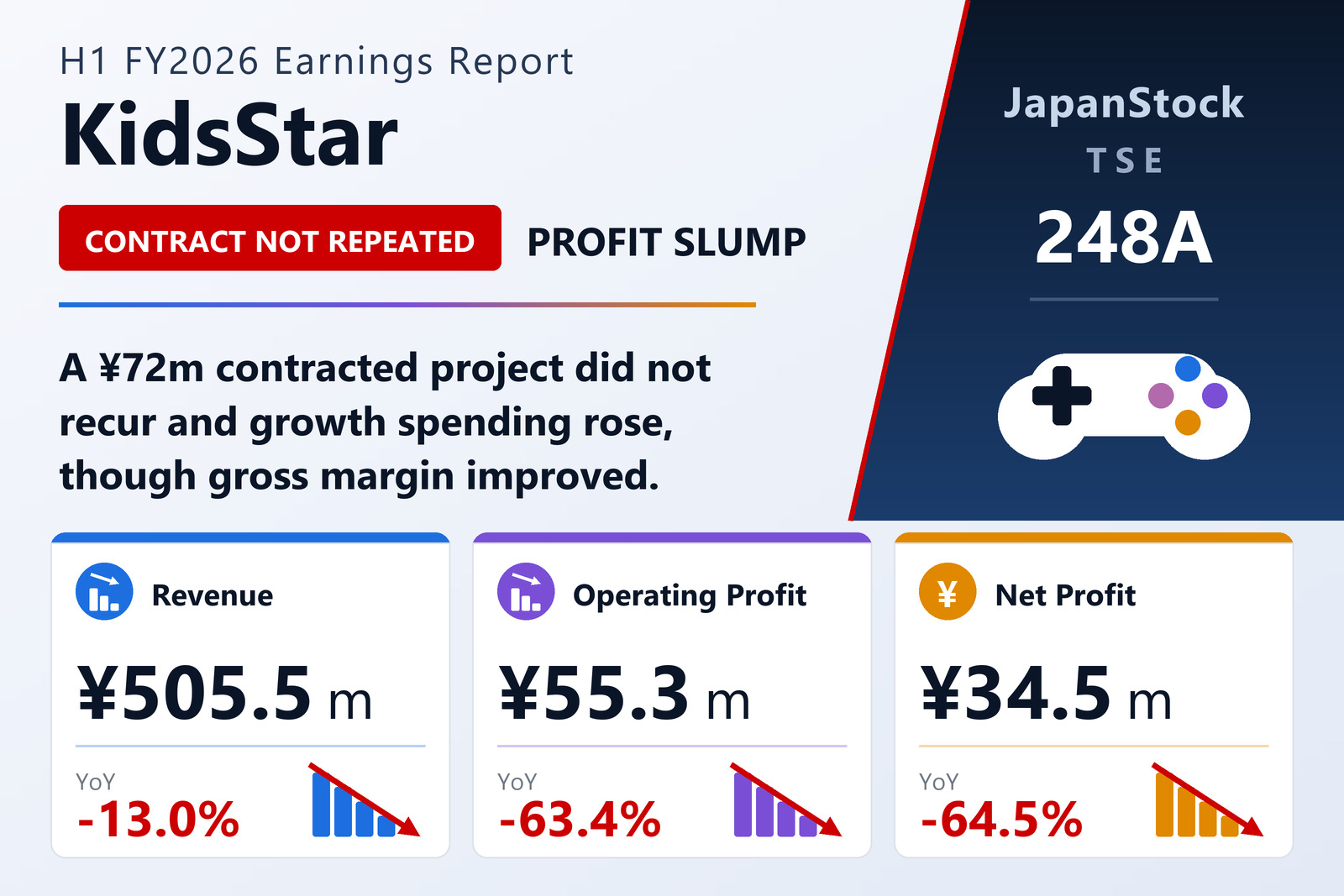
KidsStar Inc. (TSE: 248A), the operator of the family social-experience app Gokko Land, reported consolidated results for the first half of the year to December 2026 — January 1 to June 30 — under Japanese GAAP. Revenue fell 13.0% to ¥505.5 million, operating profit dropped 63.4% to ¥55.3 million, ordinary profit fell 57.2% to ¥64.7 million, and net profit attributable to owners of the parent declined 64.5% to ¥34.5 million. Basic earnings per share came to ¥13.20 against ¥38.25 a year earlier, diluted EPS to ¥13.18 against ¥37.48, and comprehensive income fell 61.8% to ¥37.2 million.
The revenue decline has one identifiable cause. The comparable half a year earlier included a ¥72 million contracted development project for a single specific client that did not recur this year. Excluding that item, the company says revenue was broadly level with the prior-year period — which reframes the top line as a base effect rather than a loss of underlying business. The results were disclosed on August 12, 2026, the same day the semi-annual report was filed; as a second-quarter statement it is not subject to review by an accounting auditor. KidsStar reports a single segment, internet media, so no segment breakdown is provided.
The margin improved; the cost line did not
The profit collapse was not a gross-margin problem. Cost of sales fell to ¥185.4 million from ¥222.5 million, so gross profit slipped only 10.7% to ¥320.1 million and the gross margin actually improved to 63.3% from 61.7%.
The damage sits below that line. Selling, general and administrative expenses rose ¥57.4 million to ¥264.8 million, an increase of 27.7%, which the company attributes to higher personnel costs, depreciation and advertising undertaken to restore profitability and growth. That single swing more than accounts for the ¥95.7 million fall in operating profit, and it took the operating margin down to 10.9% from 26.0%.
Below operating profit the picture is friendlier. Non-operating income more than quadrupled to ¥11.9 million — interest income of ¥3.9 million, subsidy income of ¥7.4 million and a small foreign-exchange gain — from ¥2.9 million, which is why ordinary profit fell 57.2% rather than 63.4%. Non-operating expenses of ¥2.5 million were almost entirely share-issuance costs. A ¥0.2 million gain on the reversal of subscription rights and a ¥2.8 million loss on the disposal of fixed assets left pre-tax profit at ¥62.1 million, against which income taxes of ¥27.6 million were charged — an effective rate of 44.4%, up from 34.8%, which compressed the net line further than the ordinary line.
Gokko Land: nine million downloads, three fewer pavilions
The core product is Gokko Land, a free app in which children role-play at real companies' businesses, each participating client operating a branded "pavilion" that doubles as advertising. Cumulative downloads passed 9 million during the half. Pavilions, however, ended the period at 93 — three fewer than at the end of December 2025: five new pavilions were won while eight closed.
The company attributes the closures to advertising-policy reviews at some client companies, prompted by the weaker yen and higher raw-material prices — a budget squeeze rather than a product failure. Its answer is to widen what a pavilion is worth, extending the value proposition from brand advertising into customer acquisition and sales promotion, including in-store terminals and large tablets at the point of sale. In May it substantially rebuilt the app's home screen to steer children toward a wider range of pavilions, and in July, after the balance-sheet date, it launched a collaboration with the global children's property PAW Patrol. Previous collaborations have lifted play counts roughly 20% around launch, and management expects a recovery from the third quarter on that basis.
Real-world events and a fast-growing Asian footprint
Gokko Land EXPO, the physical version of the app staged at malls and commercial facilities, ran at 10 venues in the half — exactly as planned — drawing 22,308 visitors. A new brand, Gokko COLLECTION, has been scheduled for its first outing in September 2026, and the company will also take part in running a 10,000-person family event in Hyogo Prefecture that month. The purpose is the same as the app's: to give pavilion clients a physical touchpoint with families alongside the digital one.
Overseas, Gokko World — the international edition, launched first in Vietnam in August 2023 — reached 2.94 million cumulative downloads, with monthly average play counts of 4.23 million during the half; a May 2026 tie-up with Doraemon lifted both sharply from that month. Indonesian, Thai and English editions went live in December 2025 and have reached 830,000 cumulative downloads in Indonesia and 420,000 in Thailand. The company frames Indonesia as a demographic play — a young population and a high birth rate feeding an expanding education market — and Thailand as the more mature marketing environment where monetisation should come faster.
Cash builds, guidance holds, and a second chief executive
Total assets stood at ¥2,889.6 million at June 30, 2026, up ¥78.8 million from the end of December 2025. Current assets rose ¥74.4 million to ¥2,503.9 million as cash and deposits gained ¥103.9 million while trade receivables and contract assets fell ¥26.5 million. Non-current assets edged up ¥7.0 million to ¥379.7 million, with software down ¥12.4 million and software in progress up ¥18.5 million — capitalised development moving through the pipeline rather than shrinking. Current liabilities rose ¥34.3 million to ¥480.1 million, driven by a ¥98.9 million increase in deferred revenue, partly offset by a ¥20.3 million fall in income taxes payable and a ¥45.6 million decline in other liabilities. Net assets rose ¥44.5 million to ¥2,407.4 million, almost entirely through retained earnings. The equity ratio eased to 83.3% from 84.0% — still a balance sheet carrying essentially no leverage.
Cash and equivalents ended the half at ¥2,446.3 million, up ¥103.9 million. Operating cash flow was a positive ¥202.1 million, down from ¥367.5 million a year earlier, built on pre-tax profit of ¥62.1 million, depreciation of ¥94.6 million and the ¥98.9 million rise in deferred revenue, less ¥64.1 million of income taxes paid. Investing used ¥108.8 million, almost all of it the ¥108.5 million spent acquiring intangible assets — the app itself. Financing brought in ¥7.5 million from shares issued on the exercise of subscription rights. Depreciation of ¥94.6 million against operating profit of ¥55.3 million is the single clearest measure of how much of this business sits on the balance sheet as capitalised software.
Guidance for the full year to December 2026, first published on February 13, 2026, is unchanged: revenue of ¥1,176 million, up 1.6%, operating profit of ¥119 million, down 51.7%, ordinary profit of ¥122 million, down 51.0%, and net profit attributable to owners of ¥71 million, down 54.8%, for EPS of ¥27.47. The half therefore represents 43.0% of the revenue target and 46.5% of the operating-profit target. The company describes FY2026 as the first year of a medium-term management plan and an explicit strategic investment phase: on its own account the guided profit decline is the cost of stabilising the core app, scaling the real-world events business, accelerating overseas expansion and preparing new ventures. Priorities named in the plan include membership businesses, public-education initiatives, M&A and alliances, a direct sales organisation in Vietnam, and decisions on the sales model and mode of entry in Thailand and Indonesia. No dividend was paid for FY12/2025 and none is forecast for FY12/2026.
To run that programme the company changed its leadership structure. On August 1, 2026 — after the balance-sheet date — director Kentaro Matsumoto was additionally appointed representative director, giving KidsStar two. Masahiro Hirata, the incumbent, retains development and sales; Matsumoto takes management strategy, new domestic ventures, the overseas business and corporate functions. Shares outstanding rose to 2,621,000 from 2,598,500 at the end of December 2025, with a weighted average of 2,616,486 for the half.
| Metric | H1 FY12/2026 | H1 FY12/2025 | YoY |
|---|---|---|---|
| Revenue (¥ thousand) | 505,501 | 580,885 | −13.0% |
| Cost of sales (¥ thousand) | 185,394 | 222,518 | −16.7% |
| Gross profit (¥ thousand) | 320,107 | 358,366 | −10.7% |
| Gross margin | 63.3% | 61.7% | +1.6 pt |
| SG&A expenses (¥ thousand) | 264,780 | 207,373 | +27.7% |
| Operating profit (¥ thousand) | 55,326 | 150,992 | −63.4% |
| Operating margin | 10.9% | 26.0% | −15.1 pt |
| Ordinary profit (¥ thousand) | 64,719 | 151,368 | −57.2% |
| Net profit attrib. to owners (¥ thousand) | 34,546 | 97,411 | −64.5% |
| Comprehensive income (¥ thousand) | 37,206 | 97,411 | −61.8% |
| Basic EPS (¥) | 13.20 | 38.25 | −65.5% |
| Diluted EPS (¥) | 13.18 | 37.48 | −64.8% |
| Operating cash flow (¥ thousand) | 202,141 | 367,463 | −45.0% |
| Depreciation (¥ thousand) | 94,553 | 75,653 | +25.0% |
| Total assets (¥ thousand; vs Dec 31, 2025) | 2,889,576 | 2,810,760 | +2.8% |
| Net assets (¥ thousand; vs Dec 31, 2025) | 2,407,436 | 2,362,899 | +1.9% |
| Equity ratio (vs Dec 31, 2025) | 83.3% | 84.0% | −0.7 pt |
| Gokko Land pavilions (vs Dec 31, 2025) | 93 | 96 | −3 |
| FY12/2026 revenue guidance (¥ million) | 1,176 | — | +1.6% |
| FY12/2026 operating profit guidance (¥ million) | 119 | — | −51.7% |
| FY12/2026 ordinary profit guidance (¥ million) | 122 | — | −51.0% |
| FY12/2026 net profit guidance (¥ million) | 71 | — | −54.8% |
| Annual dividend per share (¥; FY26 forecast vs FY25 actual) | 0.00 | 0.00 | — |
JapanStockPulse provides informational content only and does not constitute investment advice. Figures are taken from the company's published earnings short report and may be subject to subsequent revision.