A double-digit top line built on more shifts filled
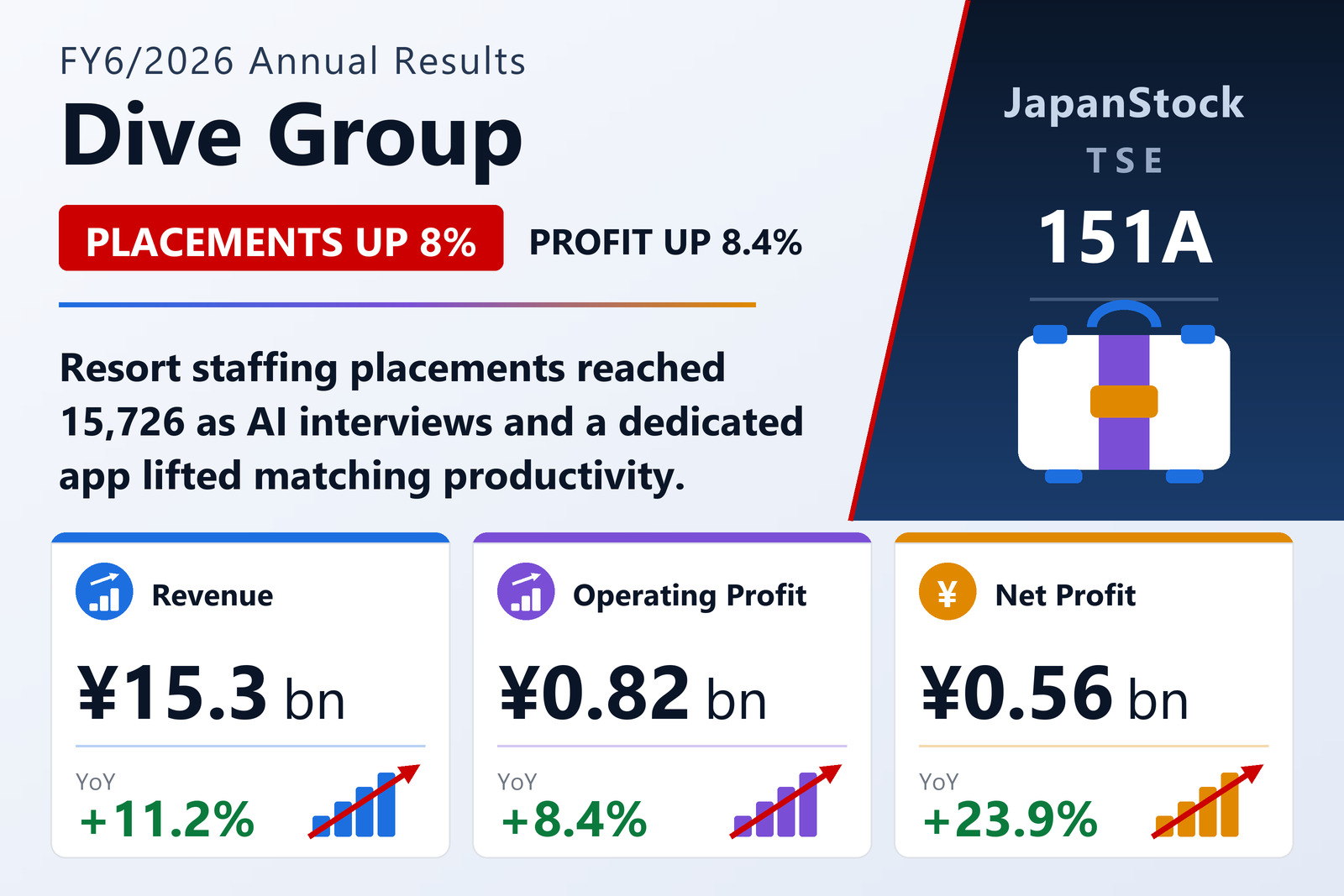
Dive Group Inc. (TSE: 151A), which runs Japan's leading platform for resort baito — seasonal and short-term work at hotels, inns and other hospitality businesses in tourist regions — reported non-consolidated results for the full year to June 30, 2026 under Japanese GAAP. Revenue rose 11.2% to ¥15,325 million from ¥13,781 million, operating profit gained 8.4% to ¥819 million from ¥755 million, and ordinary profit advanced 8.0% to ¥830 million from ¥769 million. Net profit outpaced all of them, climbing 23.9% to ¥563 million from ¥454 million. The results were disclosed on August 13, 2026. Exact figures were revenue of ¥15,325,418 thousand, operating profit of ¥819,147 thousand, ordinary profit of ¥830,465 thousand and net profit of ¥563,426 thousand.
Per-share earnings rose 24.6% to ¥67.41 from ¥54.11, with diluted EPS of ¥65.89 against ¥52.10. Return on equity improved to 22.4% from 21.8%, and ordinary profit to total assets held steady at 17.6%. The one metric that went the other way is the operating margin, which eased to 5.3% from 5.5% — the arithmetic of a company choosing to spend on advertising, brand and technology while its revenue compounds at a double-digit rate. Per-share figures are restated throughout as if the 1-for-3 share split that took effect on January 1, 2025 had occurred at the start of FY6/2025.
The operating engine is the tourism HR segment, which supplies almost the entire business. Its revenue rose 11.8% to ¥14,505 million (¥14,505,330 thousand) and segment profit rose 6.8% to ¥1,360 million (¥1,359,794 thousand). The volume number underneath is the one that matters most for a staffing platform: the company placed 15,726 people in work over the year, an increase of 8.0%. Revenue grew faster than headcount placed, which points to a mix of longer assignments, higher billing rates or both.
Inbound spending flat, labour shortage anything but
The demand backdrop is unusual in that the two halves of it are moving in opposite directions. Inbound tourism spending reached ¥2.5096 trillion, up just 0.2% year on year, as gains from other countries offset a decline in Chinese travellers; accommodation was the single largest spending category at 37.0%. Foreign visitor arrivals in June came to 3,148,600, down 6.8% year on year, although 15 markets including Taiwan, South Korea, the United States and India set June records. The company cites the Japan Tourism Agency and the Japan National Tourism Organization's estimated visitor arrivals for June 2026.
Dive Group is explicit that the softer headline visitor count barely touched it. Although monthly foreign arrivals have run below the prior year since January 2026, the impact on its accommodation-provider clients was described as extremely limited: inbound demand centred on lodging stayed strong, and the staffing demand attached to it remained very solid. The reason is on the supply side of labour rather than the demand side of travel. Accommodation and food service carries the highest turnover rate of any industry at 25.1% (Ministry of Health, Labour and Welfare, FY2024 Employment Trends Survey), and 72.7% of businesses report feeling short of staff (Japan Chamber of Commerce and Industry and Tokyo Chamber of Commerce and Industry survey, September 5, 2024). Hospitality work is also comparatively resistant to substitution by generative AI, so the structural need for these workers is not going away.
AI is being used to match workers, not to replace them
The company's response is to spend on the funnel and to automate the matching. Over the year it continued to invest in advertising, appointed a brand ambassador, formed alliances with three major firms to support placed staff, and built a next-generation strategy around "AI OverView / LLMO" — optimising for the way large language models surface information — all under the stated goal of becoming the number-one resort-work platform. Alongside ongoing SEO work it released what it describes as the industry's first official app dedicated to resort work.
On the matching side the changes are more concrete. The company introduced AI interviews and AI-driven job sending and explanation, aimed principally at students, and linked an AI agent to those interviews so that job introductions and enquiry handling run around the clock without staff. Management reports that AI interviews took hold quickly among students and young people already comfortable with the technology, raising productivity. For a platform whose economics turn on the cost of converting an applicant into a placed worker, automating the top of that funnel is where operating leverage comes from — and it is what will have to fund the guided step-up in profit next year.
Regional revitalisation moves into profit
The second, much smaller regional revitalisation segment posted revenue of ¥818 million (¥817,588 thousand), up 3.2%, and segment profit of ¥17 million (¥17,415 thousand), up 201.7% from a very low base. The company positions it as having entered a revenue-generating phase. The measures behind the improvement are operational rather than structural: stronger customer acquisition ahead of the peak season through optimised web advertising, social media updates and influencer marketing; optimisation of listing pages and plans on online travel agents; and flexible price revisions in line with market conditions. At 5.3% of revenue the segment is not yet material to group earnings, but it now contributes rather than consumes.
A stronger balance sheet and a step change in cash
Total assets rose to ¥4,981 million at June 30, 2026 from ¥4,439 million a year earlier, while net assets grew to ¥2,776 million from ¥2,272 million, of which shareholders' equity was ¥2,764 million. The equity ratio strengthened to 55.5% from 51.2% and book value per share rose to ¥329.11 from ¥271.03.
Cash generation improved sharply. Operating cash flow came in at positive ¥800 million against positive ¥268 million a year earlier — roughly three times the prior year, and comfortably ahead of net profit. Investing cash flow was negative ¥219 million against negative ¥210 million, and financing cash flow negative ¥161 million against negative ¥30 million. Cash and equivalents ended the year at ¥2,485 million, up from ¥2,065 million, giving the company a cash balance close to its full-year revenue run rate in reserve.
FY6/2027 guidance: ¥17 billion of revenue, and still no dividend
For the year to June 2027 the company guides to revenue of ¥17,000 million, up 10.9%, operating profit of ¥950 million, up 16.0%, ordinary profit of ¥950 million, up 14.4%, and net profit of ¥630 million, up 11.8%, for EPS of ¥73.25. That plan asks profit to grow faster than revenue for the first time in two years — implying an operating margin of about 5.6%, back above this year's 5.3% — which puts the weight of the forecast on the AI-driven matching efficiencies rather than on further volume alone.
Shareholders receive nothing in cash. The company paid ¥0.00 for FY6/2025 and FY6/2026 and forecasts ¥0.00 again for FY6/2027, retaining all earnings for growth — a stance consistent with a recently listed TSE Growth company compounding revenue at more than 10% a year and generating a 22.4% return on equity.
| Metric | FY6/2026 | FY6/2025 | Change |
|---|---|---|---|
| Revenue (¥ million) | 15,325 | 13,781 | +11.2% |
| Operating profit (¥ million) | 819 | 755 | +8.4% |
| Ordinary profit (¥ million) | 830 | 769 | +8.0% |
| Net profit (¥ million) | 563 | 454 | +23.9% |
| EPS (¥) | 67.41 | 54.11 | +24.6% |
| ROE | 22.4% | 21.8% | +0.6 pt |
| Total assets (¥ million) | 4,981 | 4,439 | +12.2% |
| Equity ratio | 55.5% | 51.2% | +4.3 pt |
| Workers placed | 15,726 | — | +8.0% |
JapanStockPulse provides informational content only and does not constitute investment advice. Figures are taken from the company's published earnings short report and may be subject to subsequent revision.