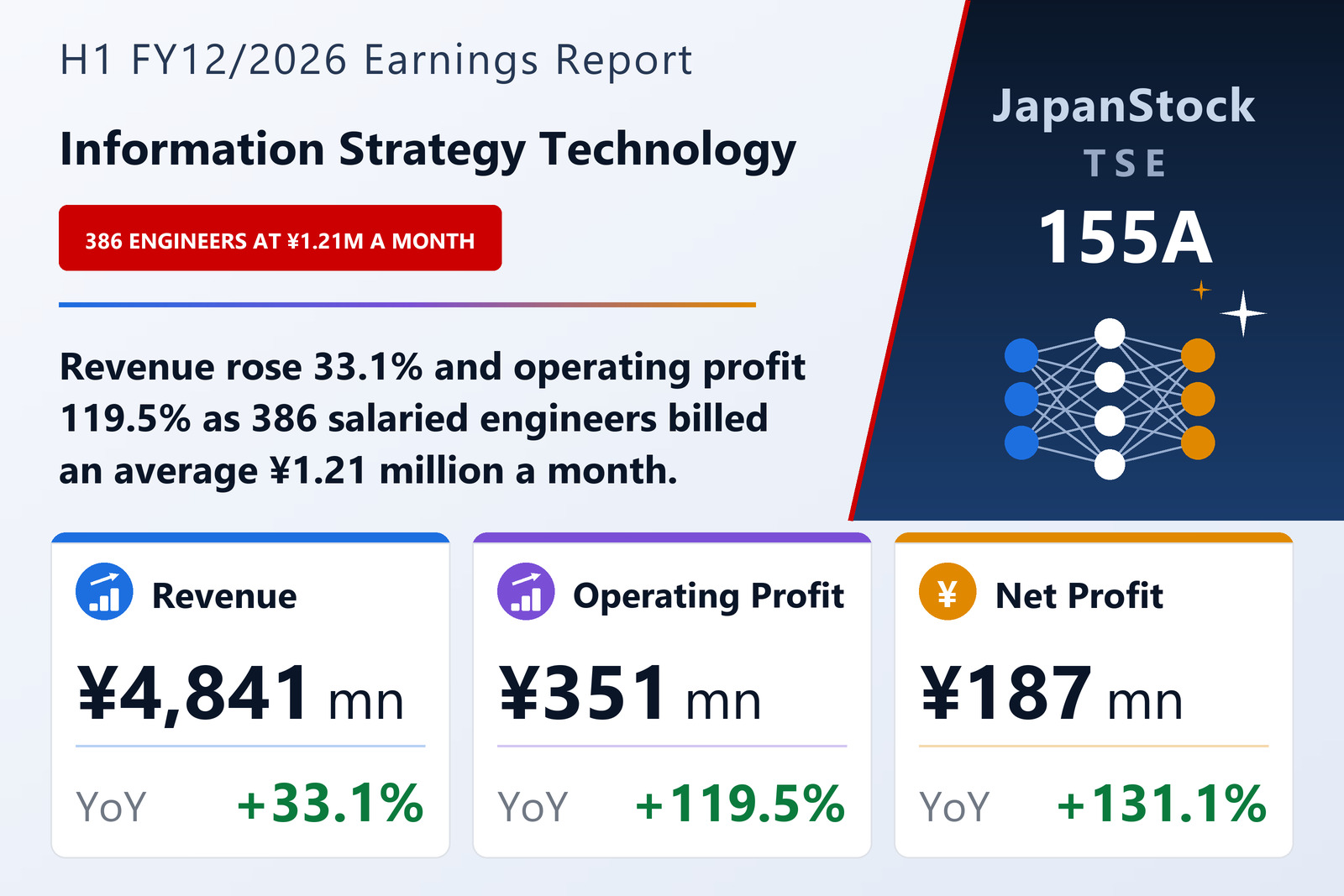
A 33% revenue rise turns into a 120% profit rise
Information Strategy Technology Co., Ltd. (TSE: 155A), a Tokyo-based IT services group that helps large Japanese enterprises bring system development in-house, published consolidated results for the six months to June 30, 2026 on August 13, 2026 under Japanese GAAP. Revenue rose 33.1% to ¥4,841 million, operating profit 119.5% to ¥351 million, ordinary profit 120.7% to ¥337 million and interim net profit attributable to owners of the parent 131.1% to ¥187 million, for earnings per share of ¥18.20 against ¥7.81. One caveat belongs at the top: the company only began preparing interim consolidated financial statements in the first half of FY12/2025, so it discloses no year-on-year change rates for that prior interim period.
The leverage shows line by line. Gross profit rose 35.7% to ¥1,342 million, a little faster than revenue, lifting the gross margin to 27.7% from 27.2%. Selling, general and administrative expenses rose only 19.5% to ¥990 million, and that gap is the whole of the profit story: the operating margin widened to 7.3% from 4.4%. Below the operating line the picture is less flattering. Interest expense roughly doubled to ¥11.3 million and a ¥9.1 million loss on an investment partnership appeared, which is why ordinary profit of ¥337 million came in below operating profit. Tax of ¥156.6 million against pre-tax profit of ¥338.5 million is an effective rate of 46.3%, leaving group net profit of ¥181.9 million; a ¥5.2 million loss attributable to non-controlling interests then lifted the parent-attributable figure above it, to ¥187 million.
The engine is 386 engineers billing ¥1.21 million a month
The model is narrow and legible. The company describes itself as a DX general trading house and sells what it calls 0-ji DX — support for large enterprises that want to lead system development themselves rather than hand it to a vendor. It defines in-house development as the operating company driving the work rather than leaving it entirely to a systems vendor, and calls its own role zeroth-tier rather than the usual first-tier contractor, because it works alongside the client through repeated consultation and proposal instead of at arm's length. Two disclosed numbers carry the economics: at period end the average monthly billing rate for salaried engineers, excluding new graduates still in their training period, was ¥1.21 million, across 386 salaried engineers.
What scales the model beyond that payroll is the consolidated subsidiary WhiteBox Inc., which runs a platform of the same name for SES and contract work. Its total member companies rose from 3,188 at the end of the previous fiscal year to 3,424 at June 30, and the closed beta of its payment platform, WhiteBox PayAssist, saw its outstanding balance grow rapidly. A WhiteBox team won the AI-DLC hackathon at AWS Summit Japan 2026, hosted by Amazon Web Services Japan, and the parent's own Lab Development Department team also placed in the final — external validation the company cites for its AI-driven development practice. During the half it also formed a business alliance with DXHR Inc., which supplies generative-AI training and AI-driven-development talent programmes, and launched a next-generation accompaniment-style development solution called 0-ji ACE.
Growth bought with debt, and the next deal signed on results day
Total assets rose 21.6% to ¥4,951 million, and ¥615 million of the ¥878 million increase sits in a single line: goodwill more than doubled, from ¥468 million to ¥1,083 million. The cause is People Dot Inc., consolidated from April 1, 2026 — 80.0% of it bought for ¥719.9 million in cash, of which ¥676.9 million became goodwill, to be amortised straight-line over seven years. That goodwill is provisional; the purchase-price allocation was not complete at the balance-sheet date. Goodwill amortisation of ¥61.6 million was already charged in the half, and because People Dot was consolidated for only three of the six months, that charge steps up from here. It also means part of the 33.1% revenue rise is inorganic, and the company does not quantify the contribution. The purchase was funded with debt: short-term borrowings went from nil to ¥300 million and long-term borrowings rose ¥265 million, taking interest-bearing debt to about ¥1,889 million from ¥1,270 million. Net assets rose 12.0% to ¥1,947 million on retained earnings alone, but assets grew faster, so the equity ratio fell to 39.2% from 42.7%.
Cash generation lagged the profit. Operating cash flow was ¥156.5 million against pre-tax profit of ¥338.5 million, held back by ¥166.1 million of tax paid and helped by the ¥61.6 million of non-cash goodwill amortisation. Investing used ¥649.0 million, of which ¥593.8 million was the net cash cost of the acquisition, and financing supplied ¥521.8 million — ¥300 million of short-term and ¥450 million of long-term borrowing against ¥243.6 million of repayment. Cash and equivalents ended the half at ¥1,697.0 million, up ¥29.3 million.
The company names M&A as a core strategy, and it is not finished. At a board meeting held on August 13, 2026 — the day these results were published — it resolved to acquire Flyby Inc. and Flyby Management Inc., for ¥158 million and ¥671 million in cash respectively, taking Flyby to full ownership; the combination is scheduled for January 2027, will not affect FY12/2026 earnings, and carries contingent consideration tied to Flyby's future results. Full-year guidance is unchanged: revenue of ¥10,702 million (+33.5%), operating profit of ¥757 million (+37.0%), ordinary profit of ¥731 million (+37.3%) and net profit of ¥431 million (+41.9%), for earnings per share of ¥42.20. The half delivered 45.2% of guided revenue and 46.5% of guided operating profit, so the plan leans on the second half. No dividend is paid: FY12/2025 was ¥0.00 and FY12/2026 is guided at ¥0.00.
| Metric | H1 FY12/2026 | H1 FY12/2025 | Change |
|---|---|---|---|
| Revenue (¥ million) | 4,841 | 3,635 | +33.1% |
| Gross profit (¥ million) | 1,342 | 989 | +35.7% |
| Gross margin | 27.7% | 27.2% | +0.5 pt |
| SG&A expenses (¥ million) | 990 | 829 | +19.5% |
| Operating profit (¥ million) | 351 | 160 | +119.5% |
| Operating margin | 7.3% | 4.4% | +2.9 pt |
| Ordinary profit (¥ million) | 337 | 153 | +120.7% |
| Net profit attrib. to owners of parent (¥ million) | 187 | 80 | +131.1% |
| EPS (¥) | 18.20 | 7.81 | +133.0% |
| Diluted EPS (¥) | 17.47 | 7.47 | +133.9% |
| Operating cash flow (¥ million) | 156 | 98 | +58.1% |
| Total assets (¥ million) | 4,951 | 4,072 | +21.6% |
| Goodwill (¥ million) | 1,083 | 468 | +131.4% |
| Interest-bearing debt (¥ million) | 1,889 | 1,269 | +48.8% |
| Cash and equivalents at period end (¥ million) | 1,697 | 1,667 | +1.8% |
| Net assets (¥ million) | 1,947 | 1,739 | +12.0% |
| Shareholders' equity (¥ million) | 1,942 | 1,739 | +11.6% |
| Equity ratio | 39.2% | 42.7% | −3.5 pt |
| Salaried engineers at period end | 386 | — | — |
| Average monthly billing rate per engineer (¥ thousand) | 1,210 | — | — |
| WhiteBox platform member companies | 3,424 | 3,188 | +7.4% |
| FY12/2026 guidance — revenue (¥ million) | 10,702 | — | +33.5% |
| FY12/2026 guidance — operating profit (¥ million) | 757 | — | +37.0% |
| FY12/2026 guidance — ordinary profit (¥ million) | 731 | — | +37.3% |
| FY12/2026 guidance — net profit (¥ million) | 431 | — | +41.9% |
| FY12/2026 guidance — EPS (¥) | 42.20 | — | n.m. |
| Annual dividend per share (¥) | 0.00 | 0.00 | unchanged |
JapanStockPulse provides informational content only and does not constitute investment advice. Figures are taken from the company's published earnings short report and may be subject to subsequent revision.