Operating profit up almost fourfold on a 43% revenue jump
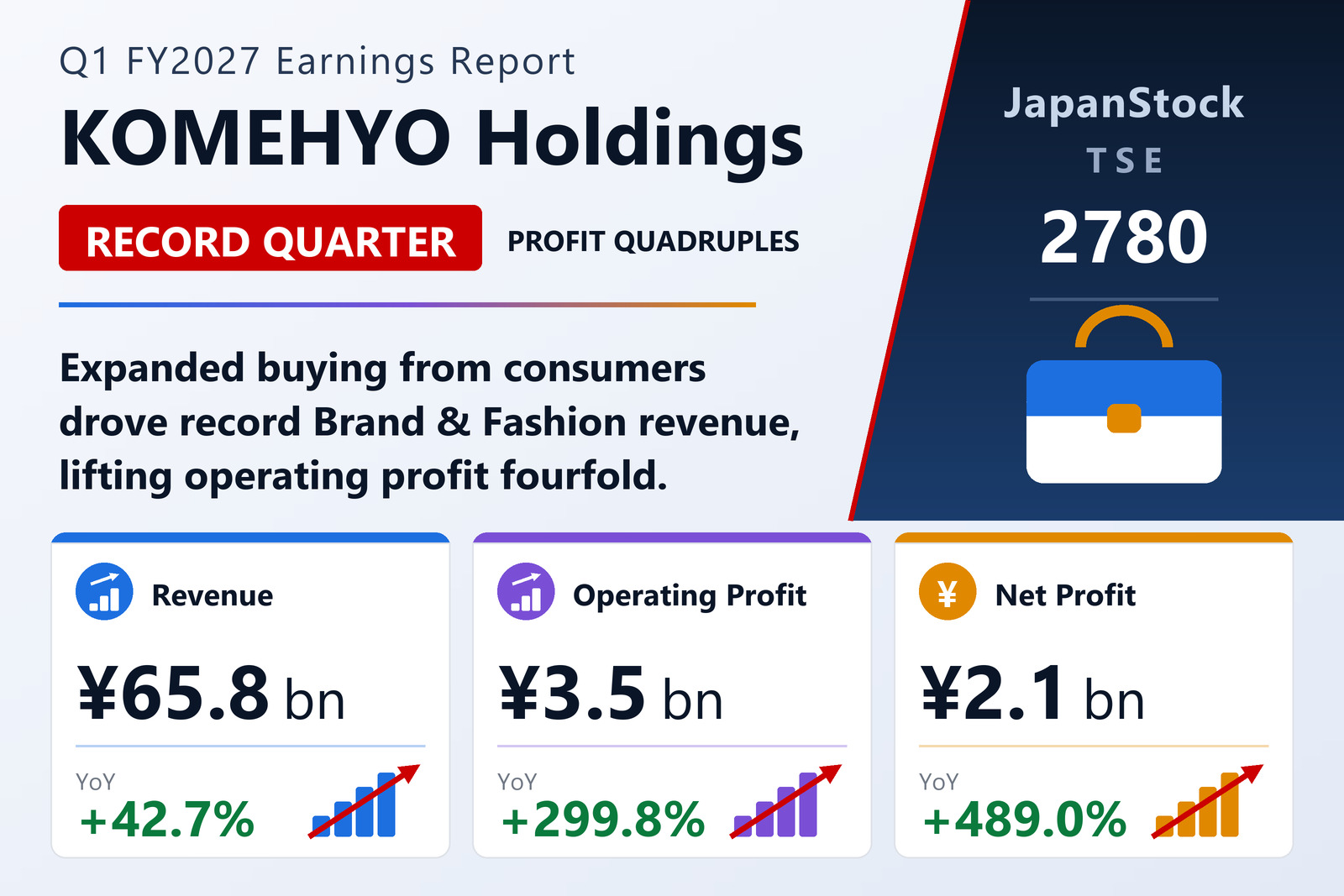
KOMEHYO Holdings Co., Ltd. (TSE: 2780), Japan's largest listed secondhand-luxury — or "reuse" — retailer and a company listed on both the Tokyo and Nagoya stock exchanges, reported consolidated results for the first quarter of the year to March 2027, covering April 1 to June 30, 2026, under Japanese GAAP. Revenue rose 42.7% to ¥65,820 million from ¥46,120 million, an increase of ¥19,700 million in a single quarter. Operating profit climbed 299.8% to ¥3,533 million from ¥883 million, ordinary profit rose 411.2% to ¥3,334 million from ¥652 million, and profit attributable to owners of parent surged 489.0% to ¥2,081 million from ¥353 million. Earnings per share came in at ¥189.39 against ¥32.24 a year earlier. The results were disclosed on August 13, 2026; the group is led by president Takuji Ishihara.
The improvement runs all the way down the statement. Comprehensive income was a positive ¥2,217 million against a comprehensive loss of ¥92 million a year earlier. The operating margin widened to 5.4% from 1.9%, which is the single most telling number in the release: revenue grew 43% while operating profit grew 300%, so the incremental sales arrived at a far higher contribution than the base business. Ordinary profit sat ¥199 million below operating profit, a gap consistent with the financing and other non-operating costs a working-capital-intensive retailer carries; the equivalent gap a year earlier was ¥231 million, so the drag narrowed even as the balance sheet grew.
A weak base year makes the percentages look bigger than the improvement
The triple- and quadruple-digit growth rates deserve a caveat. The comparison quarter was itself a poor one: in the first quarter of the year to March 2026, KOMEHYO's operating profit had fallen 58.7% and its net profit 75.0% year on year. Percentage gains measured off that depressed base are mechanically flattering, and a reader who takes "operating profit up 300%" at face value will overestimate how far the business has travelled.
The absolute numbers, however, hold up on their own. Operating profit is ¥2,649 million higher than a year ago and revenue ¥19,700 million higher, and the quarter's ¥3,533 million operating profit is a genuinely large figure for a company guiding to ¥10,800 million for the full year. The right reading is that this was a strong quarter measured against a weak one — a real recovery amplified by an easy comparison, rather than either an illusion or a step-change.
Buying from the public, not selling to it, is what drives the model
Brand & Fashion, the group's core business in secondhand luxury goods, was the driver and recorded its highest-ever quarterly revenue. The company's own account of how that happened is worth reading closely, because it inverts the usual retail narrative: growth started with an expansion of purchasing from individual consumers, and that larger flow of goods then fed through to both retail sales and wholesale and corporate channels.
That sequencing is the essential mechanic of a reuse business. Unlike a conventional retailer, which can order more inventory from a manufacturer whenever demand appears, a resale operator has to source each item from a member of the public before it can be sold at all. Supply, not demand, is the binding constraint. Expanding buying capacity therefore lifts every downstream channel simultaneously — the strongest pieces go to the group's own retail floors, and the remainder clears through wholesale and business-to-business auction, which is why revenue can rise across the segment rather than in one channel at the expense of another.
Ten new outlets in three months, nine of them buying counters
The store programme reflects that priority. In the quarter, group company KOMEHYO Inc. opened four purchase-specialty stores, while K-Brand Off Co., Ltd. opened the flagship "BRAND OFF SHIBUYA" together with five franchised purchase-specialty stores. That is ten new outlets in three months, of which nine exist primarily to acquire goods rather than to sell them. Routing part of the expansion through franchising also lets the buying network widen without the group funding every fit-out and lease itself.
The smaller Tyre & Wheel segment also grew its top line, helped by tyre sales and by a strong showing from wheels of the group's own design. In-house design matters more than the revenue line suggests: a proprietary product carries a margin that pure distribution of third-party tyres cannot, giving the segment a second lever alongside volume.
A balance sheet that grows with the inventory
Total assets stood at ¥116,132 million at June 30, 2026, up ¥6,951 million, or 6.4%, from ¥109,181 million at March 31 — a fast expansion for a single quarter, and the arithmetic signature of a business that must pay cash for goods before it can sell them. Net assets rose to ¥39,462 million from ¥37,827 million, and shareholders' equity to ¥39,002 million from ¥37,354 million. Because the asset side grew faster than equity, the equity ratio eased to 33.6% from 34.2%. That is a modest slippage and an unsurprising one while purchasing is being scaled up, but it is the metric to watch if buying volume keeps compounding: in this model, growth consumes balance sheet first and returns it later.
Guidance untouched, dividend nudged up to ¥108
KOMEHYO left both its half-year and full-year forecasts unchanged from the figures published previously. For the six months to September 2026 it guides to revenue of ¥122,000 million, up 27.6%, operating profit of ¥4,500 million, up 155.8%, ordinary profit of ¥3,900 million, up 192.0%, net profit of ¥2,330 million, up 244.1%, and EPS of ¥212.03. For the full year it guides to revenue of ¥252,000 million, up 13.7%, operating profit of ¥10,800 million, up 16.3%, ordinary profit of ¥9,680 million, up 13.7%, net profit of ¥5,850 million, up 6.6%, and EPS of ¥532.34.
Set the quarter against those targets and the conservatism is plain. The ¥3,533 million booked in three months already covers about a third — 32.7% — of the full-year operating-profit forecast and 78.5% of the half-year figure, well ahead of a straight-line path. Guidance also implies a sharp deceleration in the top line, to 13.7% growth for the year against the 42.7% just delivered, which is what happens when the easy comparisons run out after the first half. Management has chosen to bank the beat rather than to raise on one quarter.
The dividend moves up. Against FY3/2026's actual ¥106.00 (¥53.00 interim plus ¥53.00 year-end), the group forecasts ¥54.00 and ¥54.00 for a full-year ¥108.00 in FY3/2027 — a raise, and likewise unchanged from the previous forecast. On guided EPS of ¥532.34 that implies a payout ratio of roughly 20%, leaving the bulk of earnings inside the business to fund the inventory the growth strategy requires.
Reuse as a culture, not just a channel
The group frames all of this in unusually explicit terms. Its stated mission is to create empathy for a circular society by respecting those who make, thanking those who connect, and delivering emotion to those who receive; its vision is to turn "relay-use" from a philosophy into a culture, building a healthy reuse market in Japan and overseas and making reuse feel familiar and convenient. Stripped of the corporate register, that is a description of the same supply-side strategy the numbers show: the more comfortable ordinary consumers are with selling what they own, the more inventory reaches the group's counters, and the more there is to sell. The first quarter suggests the mechanism is working; the unchanged guidance suggests management wants to see it hold through a tougher second half before saying so.
| Metric | Q1 FY3/2027 | Q1 FY3/2026 | Change |
|---|---|---|---|
| Revenue (¥ million) | 65,820 | 46,120 | +42.7% |
| Operating profit (¥ million) | 3,533 | 883 | +299.8% |
| Ordinary profit (¥ million) | 3,334 | 652 | +411.2% |
| Net profit attrib. to owners of parent (¥ million) | 2,081 | 353 | +489.0% |
| Comprehensive income (¥ million) | 2,217 | −92 | Turned positive |
| EPS (¥) | 189.39 | 32.24 | +487.4% |
| Total assets (¥ million; vs Mar 31, 2026) | 116,132 | 109,181 | +6.4% |
| Shareholders' equity (¥ million; vs Mar 31, 2026) | 39,002 | 37,354 | +4.4% |
| Equity ratio (vs Mar 31, 2026) | 33.6% | 34.2% | −0.6 pt |
| Metric | H1 (cumulative) | YoY | Full year | YoY |
|---|---|---|---|---|
| Revenue (¥ million) | 122,000 | +27.6% | 252,000 | +13.7% |
| Operating profit (¥ million) | 4,500 | +155.8% | 10,800 | +16.3% |
| Ordinary profit (¥ million) | 3,900 | +192.0% | 9,680 | +13.7% |
| Net profit attrib. to owners of parent (¥ million) | 2,330 | +244.1% | 5,850 | +6.6% |
| EPS (¥) | 212.03 | — | 532.34 | — |
| Dividend per share (¥; vs FY3/2026 actual ¥106.00) | 54.00 | — | 108.00 | +¥2.00 |
JapanStockPulse provides informational content only and does not constitute investment advice. Figures are taken from the company's published earnings short report and may be subject to subsequent revision.