Gross margin does the work
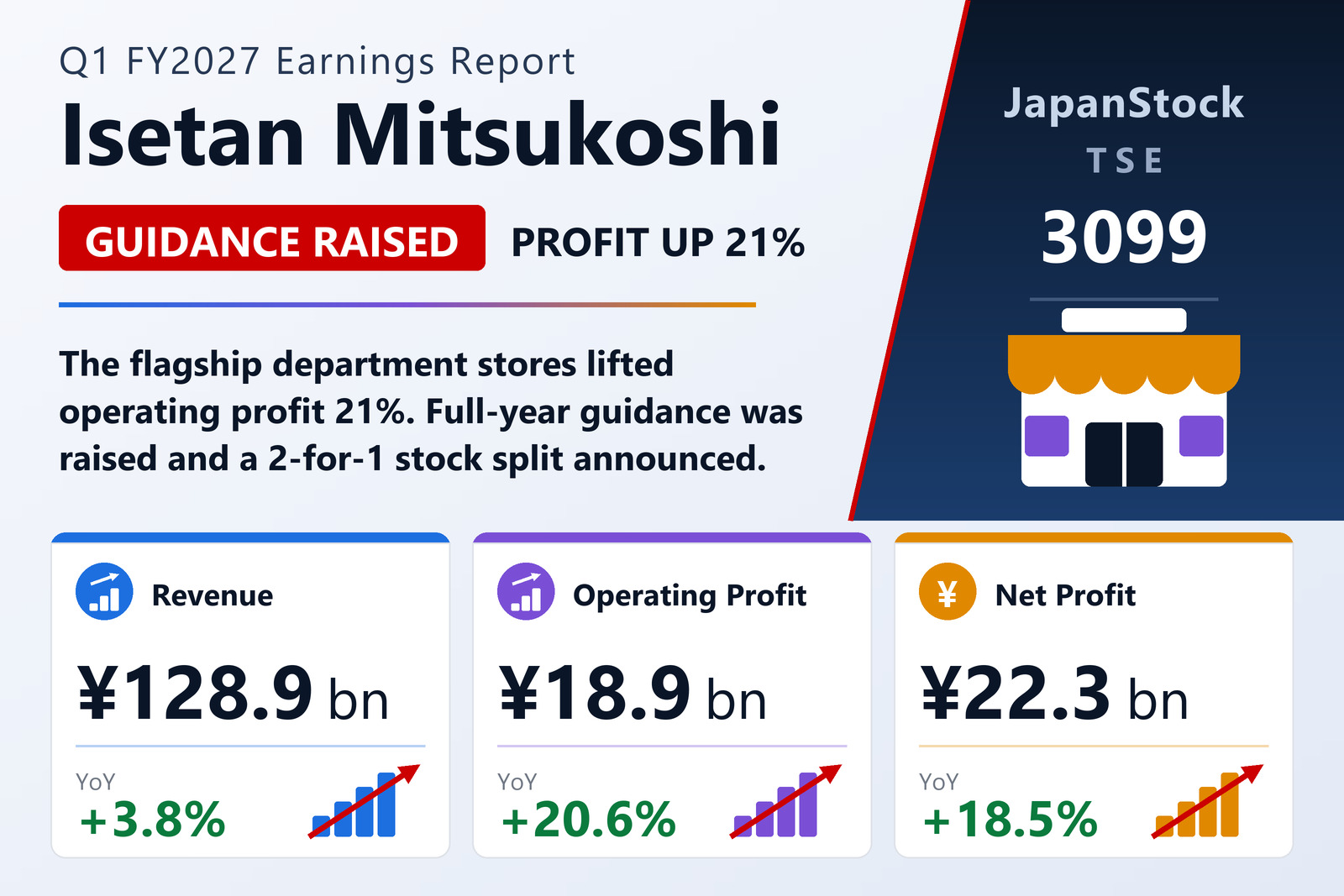
Isetan Mitsukoshi Holdings Ltd. (TSE: 3099), the operator of the Isetan and Mitsukoshi department store chains and Japan's largest department store group, reported consolidated results for the first quarter of the year to March 2027 — April 1 to June 30, 2026 — under Japanese GAAP. Revenue rose 3.8% to ¥128,912 million from ¥124,193 million. Operating profit advanced 20.6% to ¥18,877 million from ¥15,650 million, ordinary profit rose 16.7% to ¥19,927 million from ¥17,079 million, and net profit attributable to owners of parent gained 18.5% to ¥22,316 million from ¥18,838 million. Basic earnings per share came in at ¥63.80 against ¥51.86 a year earlier, with diluted EPS of ¥63.75 against ¥51.81. Comprehensive income nearly doubled, up 98.6% to ¥9,903 million from ¥4,987 million. The results were disclosed on August 13, 2026.
What makes the quarter unusual is that operating profit grew more than five times faster than the top line. Gross profit rose 5.8% to ¥81,402 million from ¥76,952 million — lifting the gross margin to 63.1% from 62.0% — while selling, general and administrative expenses were held to a 2.0% increase, at ¥62,525 million against ¥61,302 million. A ¥4,450 million improvement in gross profit against a ¥1,223 million rise in costs is what produced the ¥3,227 million increase in operating profit. This is an operating leverage story rather than a volume one: the group sold a slightly richer mix at a slightly better margin, and very little of the extra gross profit leaked into the cost base.
The flagship stores carry the department store segment
Department stores remain the overwhelming bulk of the group. External revenue in the segment rose to ¥104,130 million from ¥101,722 million, an increase of 2.4% and roughly 81% of consolidated revenue. Management attributes the improvement to work at the three flagship stores — Isetan Shinjuku, Mitsukoshi Nihombashi and Mitsukoshi Ginza — where the group pushed high-value merchandise proposals and distinctive content designed to give customers a reason to visit and to raise the appeal of the stores themselves. The quarter carried the "think good" sustainability campaign and the "Summer Palette" summer-trend campaign, and the Western confectionery zone of the food floor at Isetan Shinjuku was remodelled.
The three smaller segments all grew faster than the core in percentage terms, though from a much lower base. Credit, finance and Tomonokai — the group's membership savings scheme — produced external revenue of ¥5,367 million against ¥5,096 million, up 5.3%. Real estate was the standout on growth, up 19.7% to ¥5,348 million from ¥4,468 million. The other segment contributed ¥14,065 million against ¥12,905 million, an increase of 9.0%. Together the three non-department-store segments supplied ¥24,780 million of external revenue, or about 19% of the group, and accounted for roughly half of the ¥4,719 million increase in consolidated revenue.
A ¥10.5 billion securities sale flatters the net line — but so did last year's
Below the operating line, non-operating income of ¥2,324 million comprised interest income of ¥184 million, dividend income of ¥501 million, equity-method investment gains of ¥1,129 million and other items of ¥509 million. Non-operating expenses of ¥1,273 million comprised interest expense of ¥234 million, a ¥470 million loss on retirement of fixed assets and ¥569 million of other items. The net ¥1,051 million contribution carried operating profit up to the ¥19,927 million ordinary profit line.
The larger item sits one level further down. Extraordinary gains of ¥10,884 million consisted almost entirely of a ¥10,479 million gain on the sale of investment securities — the continuing unwind of cross-shareholdings that has become standard practice among Japanese corporates under governance pressure — plus a ¥404 million gain on the sale of affiliate shares. Extraordinary losses of ¥395 million comprised a ¥376 million store closure loss, which includes a ¥376 million impairment booked in the department store segment, and a ¥19 million loss on disposal of fixed assets. That left pre-tax profit of ¥30,416 million and income taxes of ¥8,102 million. Importantly, the prior-year quarter also carried large extraordinary gains of ¥10,958 million, so the 18.5% increase in net profit is a broadly like-for-like comparison rather than a one-off flattering an otherwise flat result — the underlying operating improvement is genuine.
Full-year guidance raised on every profit line
The group lifted its FY3/2027 forecast across the board. Revenue guidance moved up ¥2,000 million, or 0.4%, to ¥562,000 million; operating profit up ¥2,500 million, or 3.1%, to ¥84,000 million; ordinary profit up ¥3,000 million, or 3.8%, to ¥83,000 million; and net profit up ¥1,500 million, or 2.4%, to ¥63,000 million. Forecast EPS is shown as ¥92.48 against a previous ¥184.27, but the two are not comparable — the new figure is stated on a post-split basis. Gross transaction value, the revenue figure that would have been reported had the revenue recognition standard not been applied, is guided to ¥1,360,000 million, up 4.7%.
Measured against the prior year's actuals, the new guidance implies revenue up 3.0% from ¥545,626 million and operating profit up 5.0% from ¥80,020 million, but ordinary profit down 4.1% from ¥86,587 million and net profit down 17.2% from ¥76,096 million. Those two declines are an artefact of the comparison base rather than a forecast of weaker trading: FY3/2026 carried large one-off gains below the operating line. The line that reflects the business itself — operating profit — is guided higher. At ¥18,877 million, the first quarter represents 22.5% of the raised full-year operating profit target, a normal-looking start for a retailer whose profit is weighted towards the second half.
A two-for-one split and a dividend that is larger than it looks
The board resolved on August 13, 2026 to carry out a two-for-one stock split, with one ordinary share divided into two, effective October 1, 2026. The intent of such a split is straightforward: halving the unit price lowers the barrier to entry for individual investors and widens the shareholder base, and it is a common step for Japanese companies whose share price has run up.
The dividend forecast was revised at the same time, and the split makes it look smaller than it is. Against FY3/2026's actual payout of ¥70.00 — ¥30.00 at the interim and ¥40.00 at the year-end — the company now forecasts ¥40.00 at the interim and ¥20.00 at the year-end for FY3/2027, with the annual total shown as a dash because pre-split and post-split figures cannot simply be added. On a like-for-like pre-split basis the year-end dividend would be ¥40.00 and the annual total ¥80.00, an increase of ¥10.00 on the ¥70.00 paid last year. Shareholders are therefore receiving a raise, not a cut; the presentation is a mechanical consequence of the October split date falling between the two payment dates.
A smaller balance sheet, a steady equity ratio
Total assets stood at ¥1,173,932 million at June 30, 2026, down ¥44,043 million, or 3.6%, from ¥1,217,975 million at March 31 — a contraction consistent with the securities disposals and the seasonal unwind of year-end working capital. Net assets fell ¥21,376 million to ¥598,780 million, of which shareholders' equity was ¥597,576 million against ¥618,932 million. Because assets fell slightly faster than equity, the equity ratio edged up to 50.9% from 50.8%, leaving the group financed roughly half by equity.
The picture that emerges is of a department store operator getting more profit out of each yen of sales while continuing to convert legacy cross-shareholdings into cash. Under president and chief executive officer Toshiyuki Hosoya, the flagship-led strategy of high-value merchandise and event-driven footfall is showing up in margin rather than in volume, which is the harder and more durable of the two. The questions for the remaining three quarters are whether the gross margin gain holds as the comparison base toughens, and whether inbound and domestic luxury demand at the three flagships stays firm through the autumn and the December peak.
| Metric | Q1 FY3/2027 | Q1 FY3/2026 | Change |
|---|---|---|---|
| Revenue (¥ million) | 128,912 | 124,193 | +3.8% |
| Gross profit (¥ million) | 81,402 | 76,952 | +5.8% |
| Operating profit (¥ million) | 18,877 | 15,650 | +20.6% |
| Ordinary profit (¥ million) | 19,927 | 17,079 | +16.7% |
| Net profit attrib. to owners of parent (¥ million) | 22,316 | 18,838 | +18.5% |
| EPS (¥) | 63.80 | 51.86 | +23.0% |
| Total assets (¥ million; vs Mar 31, 2026) | 1,173,932 | 1,217,975 | −3.6% |
| Equity ratio | 50.9% | 50.8% | +0.1 pt |
| Metric | Previous | Revised | Change |
|---|---|---|---|
| Revenue (¥ million) | 560,000 | 562,000 | +0.4% |
| Operating profit (¥ million) | 81,500 | 84,000 | +3.1% |
| Ordinary profit (¥ million) | 80,000 | 83,000 | +3.8% |
| Net profit (¥ million) | 61,500 | 63,000 | +2.4% |
| EPS (¥) | 184.27 | 92.48 | post-split |
JapanStockPulse provides informational content only and does not constitute investment advice. Figures are taken from the company's published earnings short report and may be subject to subsequent revision.