A half-year that is deliberately not a run rate
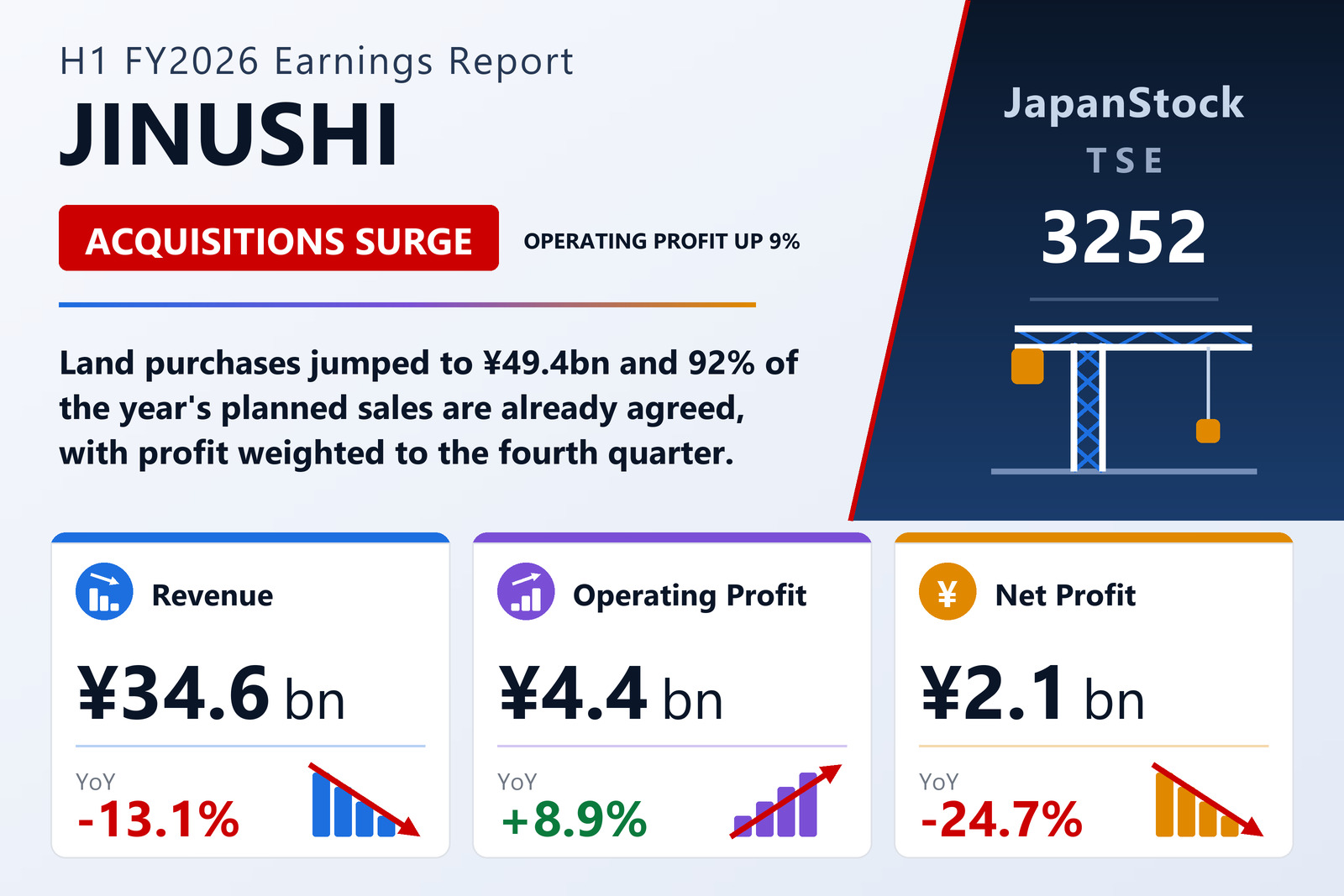
JINUSHI Co., Ltd. (TSE: 3252), the TSE Prime-listed real-estate company led by President Hirofumi Nishira, reported consolidated interim results for the year to December 2026 — the six months from January 1 to June 30, 2026 — under Japanese GAAP on August 13, 2026. Revenue fell 13.1% to ¥34,592 million from ¥39,816 million, but operating profit rose 8.9% to ¥4,416 million from ¥4,057 million, ordinary profit rose 2.6% to ¥3,258 million from ¥3,174 million, and profit attributable to owners of parent fell 24.7% to ¥2,092 million from ¥2,780 million. Earnings per share came to ¥101.16 against ¥134.99 a year earlier, and comprehensive income eased 1.6% to ¥2,231 million.
The shape of that P&L is the point. A smaller top line produced a larger operating profit, which means the properties sold in the half carried better margins than the ones sold a year earlier — an improvement in mix rather than in volume. Below the operating line the picture narrows: ordinary profit advanced only 2.6%, and the net line fell almost a quarter, reflecting the financing cost of a balance sheet that expanded sharply during the period to fund land purchases. More importantly, the company is explicit that profit for FY12/2026 is planned to land mainly in the fourth quarter. Doubling the half-year figures is therefore the wrong way to read this business; the interim result is a waypoint in a year whose earnings are back-loaded by design.
Own the land, never the building
What JINUSHI does is unusual enough to be worth stating plainly: it invests only in land. Under the "JINUSHI business," a tenant signs a long fixed-term leasehold contract — a teiki shakuchiken — and then builds and owns the building itself. JINUSHI supplies the ground and nothing else, so it never has to fund construction, refurbishment or replacement capital expenditure over the life of the lease. Because the company holds no buildings, it also carries no building risk: fire, earthquake, typhoon and the long grind of physical depreciation sit with the tenant, not the landlord. What is left is a long-dated, contractually fixed income stream that is unusually insulated from both natural disasters and market volatility.
The corporate philosophy the company states for that model is to "create safe real-estate financial products through the JINUSHI business and play a part in protecting people's assets worldwide" — a positioning aimed less at property developers than at institutional capital looking for duration. It is also what makes the acquisition and disposal cycle, rather than rent alone, the engine of reported profit: land is bought, leased to a tenant, and then sold as a finished financial product to investors, with the gross profit on that flow revenue recognised at the point of sale.
Ninety-two percent of the year's sales are already agreed
That timing dependence is why the disclosure's most consequential number is not in the income statement. 92% of the sales planned for FY12/2026 have already been determined — buyer and transaction terms agreed — measured as a share of the gross profit from flow revenue expected for the year. For the entire remainder, letters of intent to purchase have already been received. On that basis management describes the ¥8,000 million full-year net profit target as highly likely to be achieved, notwithstanding an interim result that stands at only 26.2% of it. Against the operating profit target the half-year is 36.8% complete, and against the revenue target 34.6%.
Acquisitions surge to ¥49.4 billion
Land purchases in the first half reached ¥49.4 billion on a contract basis, up ¥20.9 billion year on year — a 73% increase that is the clearest signal of where the company expects the next two years of earnings to come from. Management attributes it to three growth strategies launched around the corporate renaming: diversifying the industries its tenants come from, widening geographic coverage beyond the metropolitan core, and proposing "JINUSHI leaseback" transactions in which a company sells the ground under its own premises and continues to operate on it.
External conditions helped. Tokyo Stock Exchange governance reform and sustained investor pressure on capital efficiency have pushed listed companies to review their corporate real estate strategies and sell property they own but do not need — precisely the supply JINUSHI buys. Rising construction costs have worked in the same direction, since a tenant that must fund an increasingly expensive building has a stronger reason to avoid also funding the land beneath it.
The private REIT closes on ¥300 billion, with ¥500 billion in view
The group's exit channel is JINUSHI Private REIT, the only domestic private REIT specialising in sokochi — land leased to tenants who own the buildings on it. It is well regarded among institutional investors including pension funds and life and non-life insurers, and since beginning operations in January 2017 it has raised capital for ten consecutive years. Assets under management stood at ¥291.3 billion as of July 1, 2026, measured on appraisal value at acquisition. The medium-term AUM target of ¥300 billion is certain to be reached during FY12/2026 as planned — and the company treats that milestone as a waypoint rather than a destination, aiming for ¥500 billion at an early stage.
Segments: leasing more than doubles off a small base
Real estate investment, the sale of completed land products, remains the group by weight: revenue of ¥32,457 million, down 15.9%, with segment profit up 2.1% to ¥5,540 million — the same mix effect visible at group level, and confirmation that the margin story is coming from the core. Real estate leasing, the recurring rent line, more than doubled: revenue rose 109.4% to ¥1,152 million and segment profit 171.5% to ¥739 million, reflecting land held on the balance sheet and earning ground rent ahead of sale. Asset management, the fee stream from the private REIT, saw revenue slip 4.4% to ¥618 million and segment profit fall 18.1% to ¥258 million.
A balance sheet 41% larger, and an equity ratio down nine points
Funding the acquisition surge shows up immediately in the balance sheet. Total assets reached ¥206,644 million at June 30, 2026, against ¥146,354 million at December 31, 2025 — an increase of ¥60,290 million, or 41.2%, in six months, essentially all of it land inventory awaiting sale. Net assets rose to ¥53,331 million from ¥51,906 million and shareholders' equity to ¥50,906 million from ¥49,913 million, gains of only about 2%. The arithmetic consequence is a sharply lower equity ratio of 24.6%, down from 34.1%. The dilution is a function of the denominator rather than of any loss of capital: leverage rises while inventory is held, and reverses as those assets are sold into the REIT and to third-party investors in the second half.
Guidance held, dividend raised to ¥130
JINUSHI left its full-year forecast unchanged. For FY12/2026 it guides to revenue of ¥100,000 million, up 31.0%, operating profit of ¥12,000 million, up 39.5%, ordinary profit of ¥9,000 million, up 25.1%, and profit attributable to owners of parent of ¥8,000 million, up 8.6%, for EPS of ¥386.62. The gap between the 39.5% operating growth and the 8.6% net growth again reflects financing costs on the enlarged balance sheet.
The dividend rises. Against FY12/2025's ¥110.00 — ¥50.00 interim plus ¥60.00 at the year-end — the company forecasts ¥65.00 and ¥65.00 for a full-year ¥130.00, an increase of 18.2% and unchanged from its previous forecast. The interim payment start date is September 14, 2026. The company continues to execute its 2026–2028 medium-term management plan and its ESG policy alongside the three growth strategies.
| Metric | H1 FY12/2026 | H1 FY12/2025 | Change |
|---|---|---|---|
| Revenue (¥ million) | 34,592 | 39,816 | −13.1% |
| Operating profit (¥ million) | 4,416 | 4,057 | +8.9% |
| Ordinary profit (¥ million) | 3,258 | 3,174 | +2.6% |
| Net profit attributable to owners of parent (¥ million) | 2,092 | 2,780 | −24.7% |
| EPS (¥) | 101.16 | 134.99 | −25.1% |
| Total assets (¥ million; vs Dec 31, 2025) | 206,644 | 146,354 | +41.2% |
| Shareholders' equity (¥ million; vs Dec 31, 2025) | 50,906 | 49,913 | +2.0% |
| Equity ratio (vs Dec 31, 2025) | 24.6% | 34.1% | −9.5 pt |
| Item | Current | Prior | Change |
|---|---|---|---|
| Real estate investment — revenue (¥ million) | 32,457 | — | −15.9% |
| Real estate investment — segment profit (¥ million) | 5,540 | — | +2.1% |
| Real estate leasing — revenue (¥ million) | 1,152 | — | +109.4% |
| Real estate leasing — segment profit (¥ million) | 739 | — | +171.5% |
| Asset management — revenue (¥ million) | 618 | — | −4.4% |
| Asset management — segment profit (¥ million) | 258 | — | −18.1% |
| FY12/2026 guidance — revenue (¥ million) | 100,000 | — | +31.0% |
| FY12/2026 guidance — operating profit (¥ million) | 12,000 | — | +39.5% |
| FY12/2026 guidance — ordinary profit (¥ million) | 9,000 | — | +25.1% |
| FY12/2026 guidance — net profit (¥ million) | 8,000 | — | +8.6% |
| FY12/2026 guidance — EPS (¥) | 386.62 | — | — |
| Annual dividend per share (¥; FY12/26 forecast vs FY12/25 actual) | 130.00 | 110.00 | +18.2% |
| Private REIT AUM (¥ billion; as of Jul 1, 2026) | 291.3 | — | — |
| H1 land acquisitions, contract basis (¥ billion) | 49.4 | 28.5 | +¥20.9bn |
JapanStockPulse provides informational content only and does not constitute investment advice. Figures are taken from the company's published earnings short report and may be subject to subsequent revision.