A 28% top line, and every operating measure growing faster than it
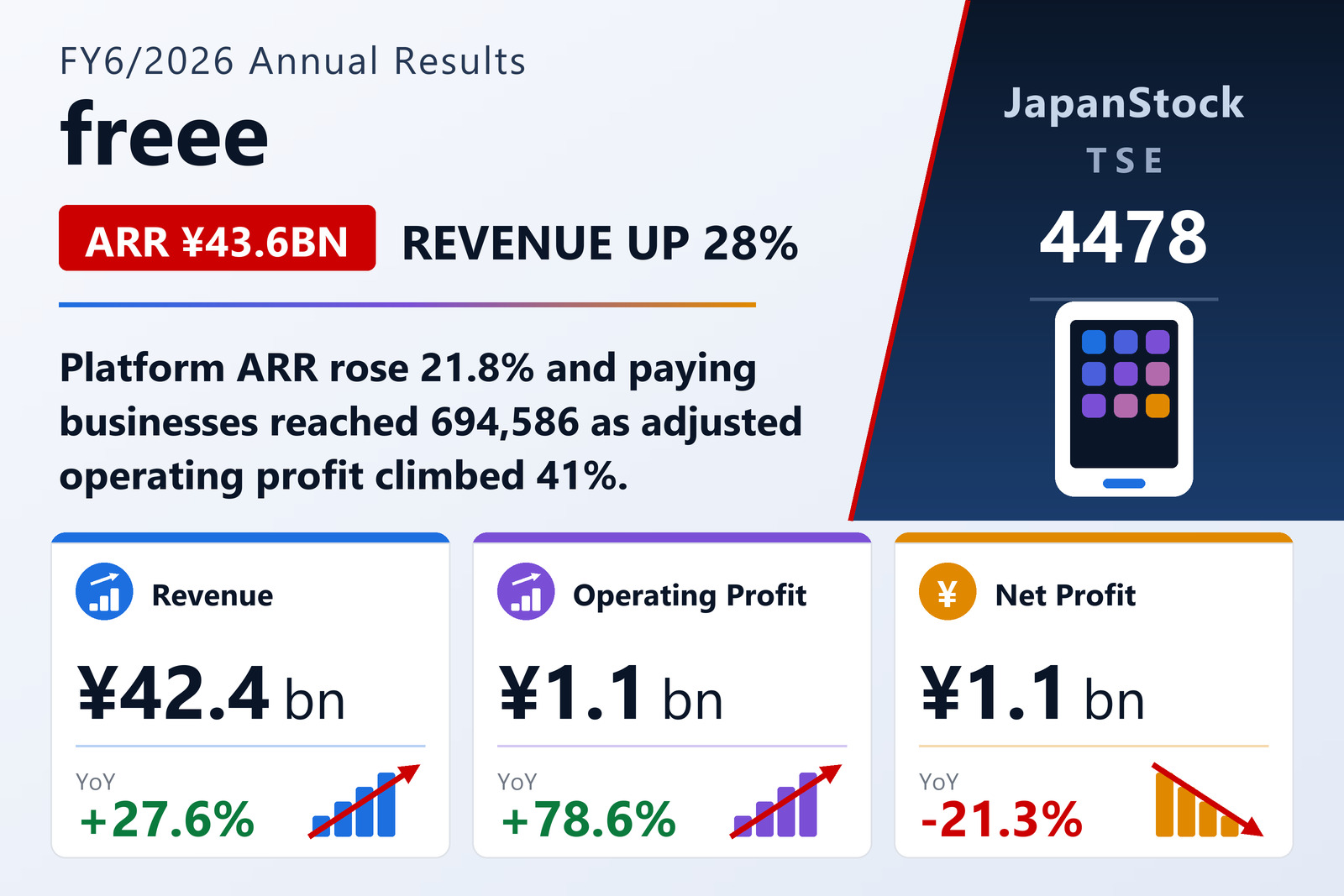
freee K.K. (TSE: 4478), the Tokyo-listed cloud accounting and HR software company led by chief executive Daisuke Sasaki, reported consolidated results for the full year ended June 30, 2026 under Japanese GAAP. Revenue rose 27.6% to ¥42,441 million from ¥33,270 million, and every profit measure above the net line grew faster than the top line: adjusted operating profit up 41.3% to ¥2,663 million, operating profit up 78.6% to ¥1,091 million, and ordinary profit up 81.0% to ¥746 million. The operating margin widened to 2.6% from 1.8%. Results were disclosed on August 13, 2026, covering the twelve months from July 1, 2025.
The company's preferred profit gauge is the adjusted figure, and it is worth being precise about what it contains. freee defines adjusted operating profit as operating profit plus share-based compensation expense, plus amortisation of intangible assets arising from mergers and acquisitions, plus other one-off costs. The gap between the two — ¥2,663 million adjusted against ¥1,091 million reported — is therefore a measure of how much non-cash and acquisition-related expense the company is still carrying. That gap narrowed in percentage terms this year, which is why the statutory operating line grew far faster (78.6%) than the adjusted one (41.3%).
ARR of ¥43.6 billion, 694,586 paying businesses, ARPU of ¥62,772
For a subscription software company the recurring-revenue metrics matter more than the annual profit and loss, and freee's three moved in the right direction together. Platform annual recurring revenue reached ¥43,595 million at the year-end, up 21.8%, which is now slightly above the year's reported revenue — the customary sign that the exit run-rate is ahead of the average rate earned across the twelve months. Paying user businesses rose 14.0% to 694,586, and ARPU rose 6.8% to ¥62,772. Volume and price are therefore contributing in roughly a two-to-one ratio to ARR growth, which is a healthier mix than price alone. The Platform business — the segment comprising cloud ERP for small businesses and financial services — accounted for the whole of revenue at ¥42,441 million, up 27.6%, and for adjusted operating profit of ¥2,663 million, up 41.3%.
Management's framing of the opportunity is that the market is still early. It puts the combined addressable market for cloud accounting and cloud HR and labour software aimed at small businesses at roughly ¥1.7 trillion, against cloud back-office adoption among Japanese small and medium-sized enterprises of 47.7% and cloud accounting adoption among sole proprietors of just 38.4%. During the year the company invested in feature improvements to its two core products, freee Accounting and freee HR, pushed new customer acquisition through accounting firms — the channel that reaches small businesses at the moment they need bookkeeping — and worked on cross-selling into its installed base.
Why the net line fell while everything above it rose
Net profit attributable to owners of parent fell 21.3% to ¥1,077 million from ¥1,370 million, and EPS eased to ¥18.20 from ¥23.28, with diluted EPS at ¥18.11 against ¥23.10. Comprehensive income fell 16.4% to ¥1,125 million, and return on equity slipped to 5.3% from 7.6%. The explanation sits below the ordinary profit line rather than in the business. In both years the net figure exceeded ordinary profit — items below that line added to the result — but the size of that contribution collapsed: a year ago ordinary profit of ¥412 million became a net profit of ¥1,370 million, a lift of ¥958 million, whereas this year ordinary profit of ¥746 million became ¥1,077 million, a lift of only ¥331 million. The operating business improved by roughly ¥334 million at the ordinary line; the below-the-line contribution shrank by about ¥627 million. That is the whole of the decline, and it says nothing adverse about trading. Ordinary profit to total assets nonetheless improved to 1.3% from 0.9%.
From "Done by You" to "Done for You"
The strategic pitch attached to the results is about AI agents rather than about software the customer operates. Management describes the change in customer experience in the AI era as a shift from "Done by You" to "Done for You" — away from "a UI that is easy for humans to use" and towards "an experience where the work itself is entrusted to AI agents." Two products carry that message. freee Agent Hub is an integrated AI agent aimed at accounting firms and optimised for client work, targeting the same professional channel that already supplies freee with small-business customers. freee AI Assistant lets corporate customers build AI agents matched to their own workflows. Both sit on top of the mission the company states for itself — to "make small businesses the stars of the world" by building an integrated management platform.
A ¥61.9 billion balance sheet, financed increasingly from outside
Total assets grew to ¥61,920 million at June 30, 2026 from ¥52,595 million a year earlier. Net assets rose to ¥21,186 million from ¥19,663 million and shareholders' equity to ¥21,096 million from ¥19,512 million, but because assets grew faster the equity ratio fell to 34.1% from 37.1%. Book value per share improved to ¥355.27 from ¥329.82. Shares issued at the year-end stood at 59,781,402 against 59,221,680, with treasury shares rising sharply to 400,014 from 62,551 and the weighted-average count at 59,234,061.
Cash flow tells the financing story more plainly. Operating cash flow fell to ¥1,519 million from ¥3,661 million, investing cash flow used ¥5,898 million against ¥4,601 million, and financing cash flow contributed ¥4,765 million against ¥4,977 million. In other words, investment outflows again exceeded operating inflows by a wide margin and were covered by external financing; cash and equivalents nevertheless ended the year almost flat at ¥36,179 million against ¥35,789 million. There is no dividend — ¥0.00 for both FY6/2025 and FY6/2026 — which is consistent with a company still directing every yen of internal cash into growth.
FY6/2027 guidance implies the margin story finally arrives
For the year to June 2027 freee guides to revenue of ¥52,210 million, up 23.0% against FY6/2026 Platform business revenue, and to adjusted operating profit of ¥5,750 million, up 115.9%. The company attributes the outlook to expansion of the SaaS user base and improvement in customer value. The interesting number is the implied margin: ¥5,750 million on ¥52,210 million is an adjusted operating margin of about 11.0%, against 6.3% this year — a step-up of nearly five percentage points in a single year, and a far more demanding requirement than the 23% revenue target itself. With ARR already at ¥43,595 million entering the year, the revenue line has a large base of visibility behind it; the profit line is where the guidance asks investors to take something on trust.
| Metric | FY6/2026 | FY6/2025 | Change |
|---|---|---|---|
| Revenue (¥ million) | 42,441 | 33,270 | +27.6% |
| Adjusted operating profit (¥ million) | 2,663 | 1,885 | +41.3% |
| Operating profit (¥ million) | 1,091 | 610 | +78.6% |
| Ordinary profit (¥ million) | 746 | 412 | +81.0% |
| Net profit attrib. to owners of parent (¥ million) | 1,077 | 1,370 | −21.3% |
| EPS (¥) | 18.20 | 23.28 | −21.8% |
| Platform ARR (¥ million) | 43,595 | — | +21.8% |
| Paying user businesses | 694,586 | — | +14.0% |
| ARPU (¥) | 62,772 | — | +6.8% |
| Equity ratio | 34.1% | 37.1% | −3.0 pt |
JapanStockPulse provides informational content only and does not constitute investment advice. Figures are taken from the company's published earnings short report and may be subject to subsequent revision.