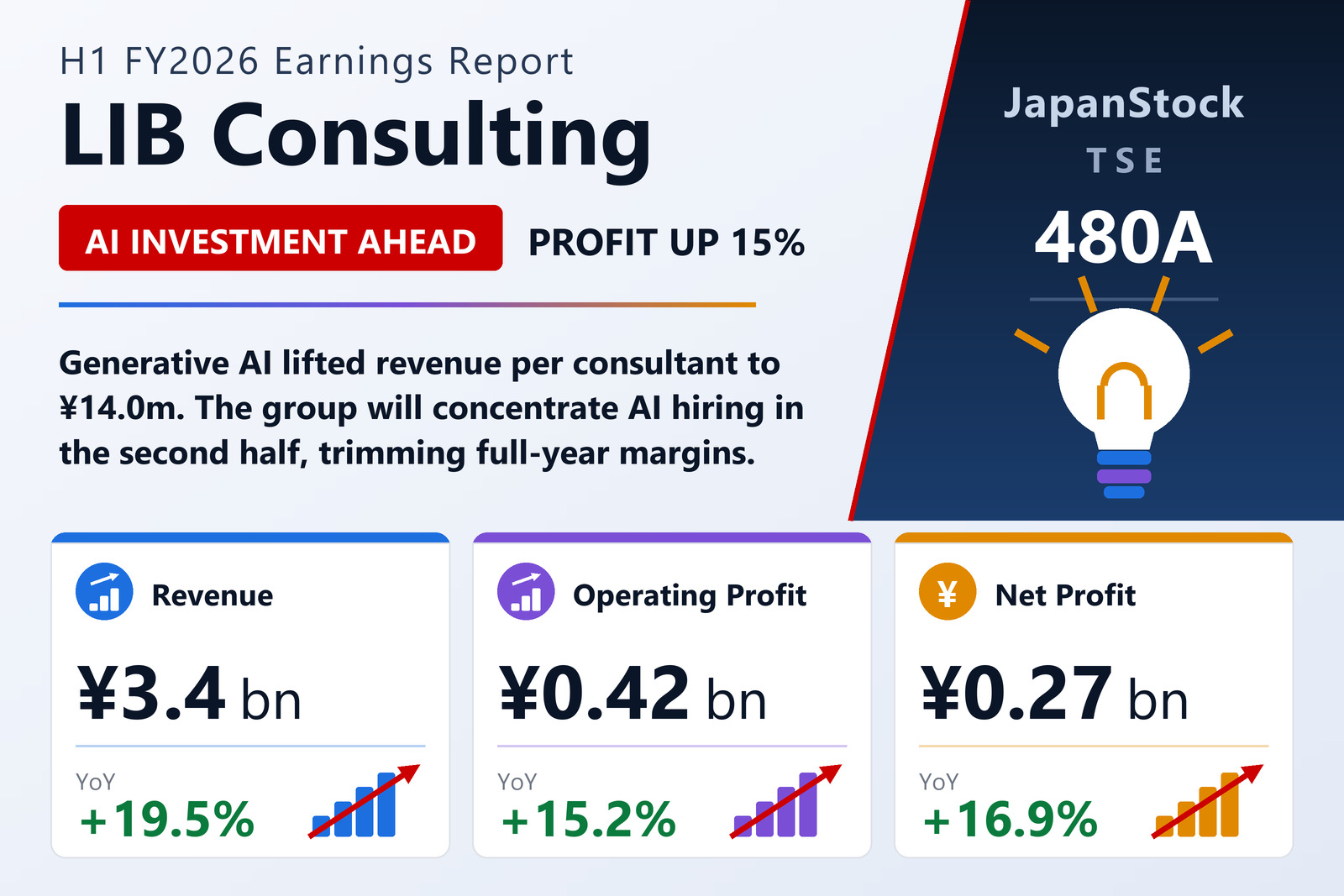
Every line of the income statement grows by double digits
LIB Consulting Co., Ltd. (TSE: 480A), the management-consulting group led by President Gen Seki that serves clients ranging from large corporates to mid-sized companies, SMEs and venture businesses, reported consolidated results for the first half of the year to December 2026 — January 1 to June 30, 2026 — under Japanese GAAP. Revenue rose 19.5% to ¥3,449 million (¥3,449,622 thousand) from ¥2,886 million. EBITDA, which the group defines as operating profit plus depreciation and goodwill amortisation, rose 16.2% to ¥484 million. Operating profit climbed 15.2% to ¥424 million, ordinary profit 16.1% to ¥427 million, and net profit attributable to owners of parent 16.9% to ¥270 million. Comprehensive income rose 19.0% to ¥274 million. The results were disclosed on August 13, 2026.
The demand backdrop the company describes is a structural one rather than a cyclical one. Japanese companies face an urgent need to transform amid rapid and uncertain external change: business-process reform driven by a structural labour shortage, the social implementation of advanced technology such as generative AI, and human-capital investment and new-business development for sustainable growth. Corporate appetite for IT and digital investment stayed strong through the half, and demand across the consulting industry for help solving increasingly complex management problems remained at a high level.
The group treats that transformation demand as its growth opportunity, and the results were led by its subsidiary LIB Consulting Co., Ltd., which accounts for roughly 80% of group revenue. It has broadened high-value-added support in the twin themes of transforming core businesses and creating new ones across a wide client base. "Business consulting" — where the firm works alongside the client from strategy formulation all the way through execution and embedding on the ground, committing deeply to delivering results rather than handing over a deck — performed well.
Generative AI raises what each consultant earns
The most concrete evidence of the medium-term strategy showing up in the numbers is a productivity figure. Company-wide internal adoption of generative AI lifted revenue per consultant to ¥14.0 million from ¥13.1 million year on year, a gain of roughly 7% in output per head, and it is a large part of why revenue grew 19.5% while headcount-driven costs did not grow in step. "Building a new consultant model with generative AI" is a stated pillar of the group's medium-term growth strategy, and the effect is visible at the parent as well: the parent company's standalone operating profit rose 24.1% year on year, well ahead of the consolidated 15.2%.
Demand is moving in the same direction from the client side. The company reports that client appetite for AI-enabled business transformation is increasing and that project wins are progressing well. To deepen its technical footing, it has accelerated a joint development project with Preferred Networks, Inc., one of Japan's domestic front-runners in artificial intelligence — a partnership that gives a consulting firm access to engineering depth it would otherwise have to buy in project by project.
Why earnings per share fell while profit rose
One line in the release moves the opposite way to everything around it. Net profit attributable to owners of parent rose 16.9%, but earnings per share fell to ¥40.93 from ¥45.41, a decline of 9.9%. The explanation is arithmetic rather than operational: the number of shares outstanding increased following the company's listing, so the same rising profit is now divided among materially more shares. Diluted earnings per share came in at ¥36.41; no diluted figure was disclosed for the prior interim period because the shares were not yet listed at that point, leaving no average market price from which to calculate one. Readers comparing this half to last should therefore treat the profit lines, not the per-share lines, as the like-for-like measure.
A deliberate margin dip concentrated in the second half
With this release the group revised its full-year forecast for the year to December 2026. It now guides to revenue of ¥7,168 million, up 17.3%, EBITDA of ¥989 million, up 4.8%, operating profit of ¥876 million, up 4.4%, ordinary profit of ¥881 million, up 6.1%, and net profit attributable to owners of parent of ¥583 million, up 14.2%, for earnings per share of ¥88.04, down 11.6%.
The gap between the first half's 15.2% operating-profit growth and the full year's 4.4% is not a warning about demand — it is a decision. The group says it will deliberately step up growth investment in the second half, concentrating human-capital spending on aggressive hiring and training of AI-related talent. It therefore expects revenue to stay solid while margins dip temporarily as that investment lands in a single six-month window. Management frames this as a strategic upfront investment: capturing rapidly expanding AI-transformation demand, securing market positioning and sustainable growth from next year, and raising corporate value over the medium to long term. The arithmetic bears the framing out — subtracting the first half from guidance leaves implied second-half revenue of about ¥3,719 million against implied second-half operating profit of about ¥452 million, so the guided full-year operating margin of 12.2% sits just below the 12.3% the first half delivered and well below the roughly 13.7% the growth rates imply for the whole of last year.
An 81.5% equity ratio, and a briefing on August 20
The balance sheet strengthened materially over the six months. Total assets stood at ¥4,698 million at June 30, 2026, up from ¥4,377 million at December 31, 2025. Net assets rose to ¥3,838 million from ¥3,336 million, of which shareholders' equity was ¥3,827 million against ¥3,326 million. The equity ratio consequently climbed to 81.5% from 76.0% — an unusually lightly geared position that gives the group room to fund the second-half hiring push from its own resources rather than from borrowing, which is precisely what a people-based business stepping up recruitment needs.
The company plans an earnings briefing for analysts, institutional investors and individual investors on Thursday, August 20, 2026. The question for that session is less about the half just reported — which grew on every line — than about the second one: whether a consulting firm can hire and train AI talent fast enough to convert a temporary margin dip into the market position it is paying for.
| Metric | H1 FY12/2026 | H1 FY12/2025 | Change |
|---|---|---|---|
| Revenue (¥ million) | 3,449 | 2,886 | +19.5% |
| EBITDA (¥ million) | 484 | 417 | +16.2% |
| Operating profit (¥ million) | 424 | 368 | +15.2% |
| Ordinary profit (¥ million) | 427 | 367 | +16.1% |
| Net profit attrib. to owners of parent (¥ million) | 270 | 231 | +16.9% |
| EPS (¥) | 40.93 | 45.41 | −9.9% |
| Total assets (¥ million; vs Dec 31, 2025) | 4,698 | 4,377 | +7.3% |
| Net assets (¥ million; vs Dec 31, 2025) | 3,838 | 3,336 | +15.0% |
| Equity ratio (vs Dec 31, 2025) | 81.5% | 76.0% | +5.5 pt |
| Metric | FY12/2026 forecast | YoY |
|---|---|---|
| Revenue (¥ million) | 7,168 | +17.3% |
| EBITDA (¥ million) | 989 | +4.8% |
| Operating profit (¥ million) | 876 | +4.4% |
| Ordinary profit (¥ million) | 881 | +6.1% |
| Net profit attrib. to owners of parent (¥ million) | 583 | +14.2% |
| EPS (¥) | 88.04 | −11.6% |
JapanStockPulse provides informational content only and does not constitute investment advice. Figures are taken from the company's published earnings short report and may be subject to subsequent revision.