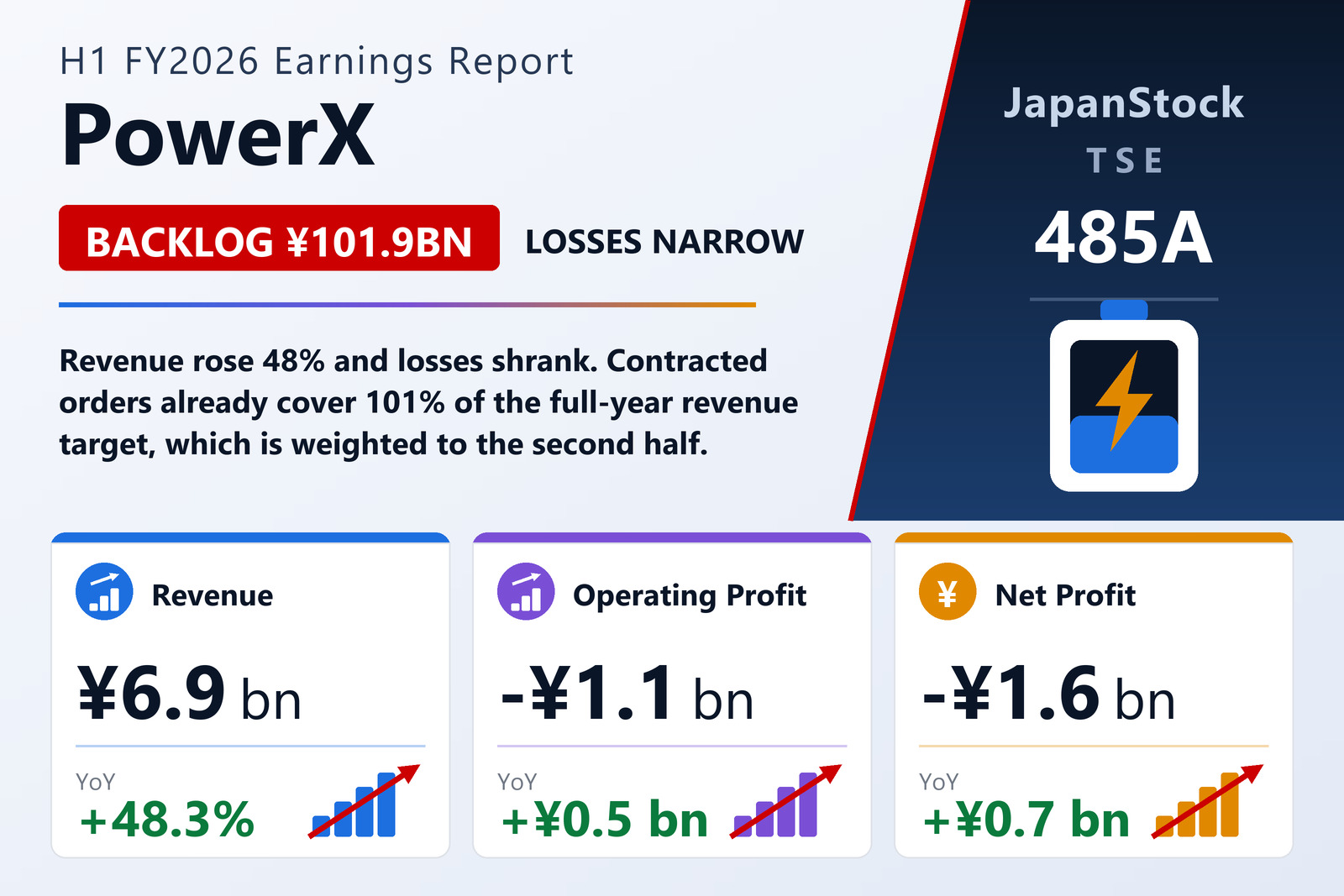
Revenue up 48%, and every loss line narrower
PowerX, Inc. (TSE: 485A), the Tokyo-listed Growth-market company that designs and manufactures grid-scale and commercial battery energy storage systems in Japan, reported consolidated interim results for the first half of the year to December 2026 — January 1 to June 30, 2026 — under Japanese GAAP on August 13, 2026. Revenue rose 48.3% to ¥6,893 million from ¥4,647 million a year earlier, and the company, led by President and CEO Masahiro Ito, closed the gap to break-even on every line it reports.
EBITDA improved to a loss of ¥778 million from a loss of ¥1,308 million. The operating loss narrowed to ¥1,073 million from ¥1,563 million, the ordinary loss to ¥1,518 million from ¥2,205 million, and the net loss attributable to owners of parent to ¥1,551 million from ¥2,230 million. Loss per share improved to ¥13.65 from ¥23.49, and comprehensive loss came in at ¥1,564 million against ¥2,229 million. In other words, PowerX added roughly ¥2.25 billion of revenue while taking about ¥680 million out of its bottom-line loss — operating leverage arriving in the way an early-stage hardware manufacturer needs it to.
Why a first-half loss is the shape of the plan
The interim loss should not be read as deterioration, and the company is explicit about why. PowerX's consolidated results are weighted to the second half of the financial year, because customers' purchases of battery products depend on satisfying the eligibility requirements of subsidy programmes. Projects clear their subsidy conditions and then convert, which pushes deliveries — and therefore revenue recognition — towards the back end of the calendar year while fixed costs accrue evenly across it.
That structural asymmetry is the context for reading the half. A company guiding to ¥40,000 million of full-year revenue that has booked ¥6,893 million by June is not 17% of the way through a stretch target; it is at the point on its own seasonal curve where the loss is expected to be at its widest. The relevant question is not whether the first half was profitable but whether the second-half revenue is contracted — which is where the order book comes in.
A ¥101.9 billion order book, and what 101% coverage does and does not mean
As of August 13, 2026, PowerX reported a total order backlog of ¥101,876 million. Of that, ¥41,560 million is scheduled to be recognised as revenue during FY12/2026, and within that FY2026 portion ¥40,397 million represents formal, contracted orders — equal to 101.0% of the ¥40,000 million full-year revenue guidance. On the company's own definition, this year's revenue target is already fully covered by orders customers have formally placed.
The definition matters, and PowerX supplies it. Backlog is the sum of "formal orders" and "expected orders", including amounts already recognised as revenue. Formal orders are binding orders formally placed by customers under executed sales contracts, including recurring revenue. Expected orders are orders that have either (i) had government subsidy approval granted by the Japanese government, the Tokyo Metropolitan Government or a similar body, or (ii) received the customer's internal approval of PowerX's final proposal on key terms and are in the final stage of contract execution — and are therefore judged highly likely to be placed in the near future.
The caveat is the company's own and deserves equal weight. Orders may still be cancelled, or changed in price or quantity, before a contract is executed; and even where a contract has been executed, there is a risk that some or all of the expected revenue is not recognised. A backlog covering 101% of guidance is a genuinely strong signal of demand conversion, but it is a schedule of intent supported by contracts, not cash in the bank.
BESS: revenue up 34%, segment profit down 23%
The Battery Energy Storage System (BESS) segment, PowerX's core, delivered revenue of ¥5,388 million, up 34.3%, while segment profit fell 23.1% to ¥738 million — the familiar signature of a hardware business scaling volume ahead of margin. Growth in the half came mainly from smooth deliveries of PowerX Mega Power, the company's large stationary storage system; the range also includes PowerX Cube, a mid-size stationary system. Applications span grid-scale storage, storage co-located with renewable generation, and industrial and commercial installations.
The demand backdrop is unusually legible. Japan must make effective use of surplus renewable output and secure balancing capacity that matches variable renewable generation to demand, so the need for large stationary systems connected directly to the grid keeps rising, and orders continue to accumulate — including for next year and beyond. Demand-side customers such as logistics operators are also adopting storage as they add renewable generation to their own facilities to decarbonise.
Policy points the same way. Japanese energy policy envisages renewables supplying roughly 40–50% of electricity, with grid reinforcement and battery deployment identified as the tasks for making renewables the main power source. Applications to connect grid-scale batteries to the network have risen sharply from the prior year, and operators' appetite to invest in grid storage remains strong. From fiscal 2026 the balancing-market rules are being revised and grid-connection rules tightened, which increasingly favours operators with sound project plans and strong operating capability — a screen PowerX intends to pass by pairing domestically produced, cost-competitive battery hardware with the software and services that keep the assets running as long-term, stable energy infrastructure. Deliveries of stationary systems are progressing, orders for storage-plant systems are trending up on the back of national and local subsidy schemes, and power supply contracts are also increasing steadily.
The balance sheet expands, and the equity ratio thins
Total assets grew to ¥33,049 million at June 30, 2026 from ¥26,236 million at December 31, 2025, an increase of 26.0% in six months as the company builds inventory and project assets against that order book. Net assets rose to ¥7,340 million from ¥6,648 million. Because assets expanded faster than equity, the equity ratio fell to 19.5% from 23.7%; shareholders' equity stood at ¥6,230 million at the end of 2025. A sub-20% equity ratio is thin, and it is the number to watch if second-half conversion slips — a balance sheet growing at 26% per half-year on a base this size leaves limited room for a delivery schedule that does not land.
Guidance unchanged, and a first profitable year in view
PowerX left its FY12/2026 forecast unchanged and expects to turn profitable. Guidance calls for revenue of ¥40,000 million, up 107.2%, EBITDA of ¥2,500–3,000 million, operating profit of ¥2,000–2,500 million, ordinary profit of ¥1,000–1,500 million, and net profit attributable to owners of parent of ¥1,000–1,500 million, for earnings per share of ¥8.80 to ¥13.20. The gap between operating and ordinary profit — roughly ¥1,000 million at either end of the range — reflects non-operating costs that the interim numbers also show, where the ordinary loss ran ¥445 million wider than the operating loss.
No dividend is planned. Per-share figures reflect two stock splits — a 1-for-1,000 split on August 9, 2025 and a 1-for-3 split on June 1, 2026 — and are restated as if both had occurred at the start of FY12/2025, so the year-on-year EPS comparison above is like for like.
The investment case reduces to a single question of execution. Doubling revenue in a year is an extraordinary ask, but it is underwritten by ¥40,397 million of formally contracted orders already on the books for this year, against a ¥40,000 million target. What stands between the two is delivery: manufacturing, installing and commissioning that volume of stationary storage in the remaining months, at a segment margin that has been falling even as volume grows. The second half of 2026 will show whether PowerX's seasonality is genuinely a timing effect — or whether the loss is more durable than the order book implies.
| Metric | H1 FY12/2026 | H1 FY12/2025 | Change |
|---|---|---|---|
| Revenue (¥ million) | 6,893 | 4,647 | +48.3% |
| EBITDA (¥ million) | −778 | −1,308 | Loss narrowed 40.5% |
| Operating profit/(loss) (¥ million) | −1,073 | −1,563 | Loss narrowed 31.4% |
| Ordinary profit/(loss) (¥ million) | −1,518 | −2,205 | Loss narrowed 31.2% |
| Net profit/(loss) attrib. to owners of parent (¥ million) | −1,551 | −2,230 | Loss narrowed 30.4% |
| EPS (¥) | −13.65 | −23.49 | Loss narrowed 41.9% |
| BESS segment revenue (¥ million) | 5,388 | 4,013 | +34.3% |
| BESS segment profit (¥ million) | 738 | 960 | −23.1% |
| Total assets (¥ million; vs Dec 31, 2025) | 33,049 | 26,236 | +26.0% |
| Net assets (¥ million; vs Dec 31, 2025) | 7,340 | 6,648 | +10.4% |
| Equity ratio (vs Dec 31, 2025) | 19.5% | 23.7% | −4.2 pt |
| Item | FY12/2026 |
|---|---|
| Revenue (¥ million) | 40,000 (+107.2%) |
| EBITDA (¥ million) | 2,500 – 3,000 |
| Operating profit (¥ million) | 2,000 – 2,500 |
| Ordinary profit (¥ million) | 1,000 – 1,500 |
| Net profit attrib. to owners of parent (¥ million) | 1,000 – 1,500 |
| EPS (¥) | 8.80 – 13.20 |
| Dividend per share (¥) | None |
| Total order backlog at Aug 13, 2026 (¥ million) | 101,876 |
| Of which scheduled as FY12/2026 revenue (¥ million) | 41,560 |
| Of which formal (contracted) orders (¥ million) | 40,397 |
| Formal orders as % of full-year revenue guidance | 101.0% |
JapanStockPulse provides informational content only and does not constitute investment advice. Figures are taken from the company's published earnings short report and may be subject to subsequent revision.