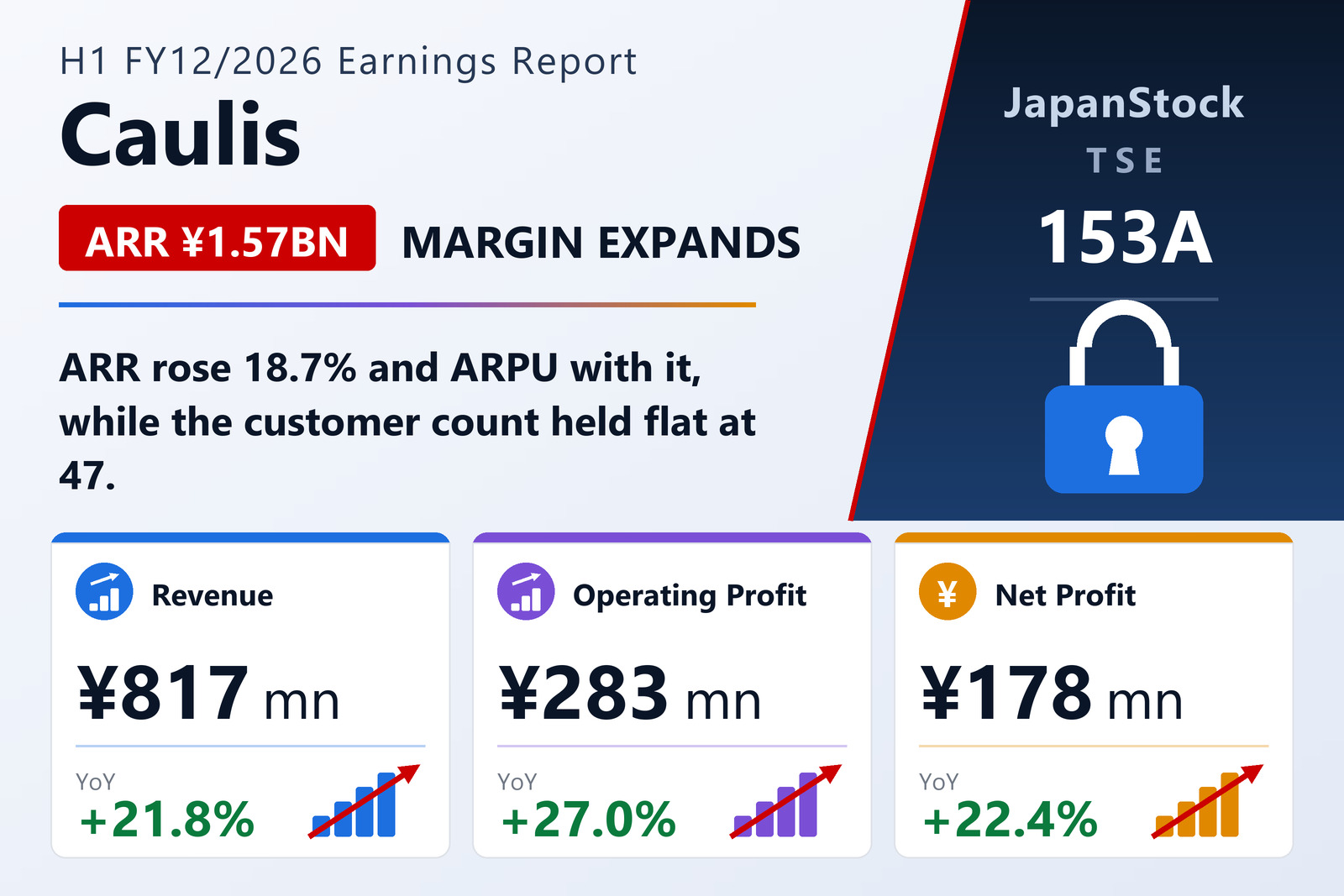
A margin that widened while the top line grew
Caulis Inc. (TSE Growth: 153A) reported non-consolidated results for the first half of the year to December 2026 — January 1 to June 30 — under Japanese GAAP on August 14, 2026. Revenue rose 21.8% to ¥816.6 million from ¥670.6 million. Operating profit rose 27.0% to ¥283.3 million from ¥223.2 million, ordinary profit 28.2% to ¥285.4 million from ¥222.6 million, and interim net profit 22.4% to ¥178.3 million from ¥145.6 million. Profit grew faster than revenue at every line, which lifted the operating margin to 34.7% from 33.3% a year earlier — a rate few Japanese software companies of this size sustain.
The mechanics behind that are worth separating, because they are not all the same quality. Gross profit rose a more modest 13.4% to ¥479.0 million, so the gross margin actually narrowed, to 58.7% from 63.0%. The operating leverage came entirely from below that line: selling, general and administrative expenses fell to ¥195.7 million from ¥199.2 million even as revenue grew by ¥146.0 million. The company is explicit about why. Revenue ran ahead of its own internal plan, and at the same time personnel costs came in under plan because hiring slipped later into the year and because replacements for some departures had not yet been made. That is a timing benefit, not a structural one. Some of it will reverse as those seats are filled, and investors reading the 34.7% margin as a new run rate should discount it accordingly. Caulis also said it stepped up development spending aimed at raising fraud-detection accuracy, and began preparing the ground for serious internal use of generative AI.
The KPIs: ARR up 18.7%, customers flat at 47
Caulis sells Fraud Alert, a cloud fraud- and unauthorised-access-detection service for financial institutions built on cross-industry crime data — the pitch being that pooling fraud signals across an industry solves a problem individual banks cannot solve alone at reasonable cost. Because it is subscription software, the recurring-revenue KPIs matter more than the half-year income statement. At June 30 monthly recurring revenue stood at ¥130.9 million, up 18.7%, giving annual recurring revenue of ¥1,570.7 million on the same 18.7% growth. Contract backlog rose 15.5% to ¥1,009.9 million, and the trailing-twelve-month average monthly gross revenue churn rate improved to 0.5%, 0.2 of a percentage point better than a year earlier. On an annualised basis, roughly 94% of revenue is being retained before any expansion — durable for enterprise software sold into regulated buyers.
The number that does not move is the customer count. Caulis ended the half with 47 contracted companies, exactly where it was a year earlier, and one fewer than at the end of the last fiscal year. Underneath that flat line, three new customers signed — a regional bank, a securities firm and one other financial institution — against four cancellations. The company notes that three of those four were cancellations it initiated, because it discontinued the service concerned, and says the earnings impact was limited. With customers flat and ARR up 18.7%, ARPU rose by the same 18.7%, to ¥2.78 million per customer. This is the central fact about the half: growth was almost entirely upsell and cross-sell into an existing base of 47 institutions, not new-logo acquisition. Management frames that positively — it says upsell used to dominate, whereas in the second quarter new wins, upsell and cross-sell all progressed in balance. Both readings can be true; what a flat count means for a company at this stage is that the addressable list of Japanese financial institutions is finite, and each additional name matters more than it would at a broader software vendor.
Grid Data KYC: revenue-generating, but still small
The newer business is Grid Data KYC, launched in September 2025. It ties into the contract data of ten regional transmission and distribution utilities nationwide, using electricity-contract records to verify identity, block fraudulent account openings and lower the cost of ongoing customer management — an approach that works because an electricity account is one of the hardest records in Japan to fake at scale. In the first half it booked revenue from a handful of proof-of-concept engagements, contributing what the company itself describes as a limited amount to the half's revenue, and it won two further PoC contracts in the second quarter. That is the right stage-appropriate read: Grid Data KYC has crossed from pilot to paid pilot, but it is not yet a second revenue engine. Together with Fraud Alert it gives Caulis coverage across the whole span from unauthorised-access detection through identity verification to continuous customer monitoring, which is the shape regulators are increasingly asking banks to demonstrate.
The company also opened a new sales and recruiting base in Fukuoka Prefecture in March, to support customers and hire across Kyushu, Chugoku and Shikoku as activity in those regions picked up. Caulis operates as a single reportable segment — anti-money-laundering and cybersecurity — with other activities too small to disclose separately, so neither Fraud Alert nor Grid Data KYC is broken out in the financial statements.
Cash flow tripled; net assets fell on a buyback
Operating cash flow was ¥465.6 million, against ¥138.5 million a year earlier — a more than threefold increase, and well above the ¥178.3 million of interim net profit. The gap is mostly working capital rather than earnings quality: pre-tax interim profit of ¥285.4 million was supplemented by a ¥279.5 million increase in contract liabilities, less ¥88.1 million of income taxes paid. Contract liabilities are cash collected in advance of the service being delivered, so that inflow is the balance-sheet mirror of the ¥1,009.9 million backlog — real cash, but revenue that has already been paid for and will be recognised later rather than new money.
Total assets closed at ¥2,375.2 million, up ¥193.0 million from the December year-end, driven by cash (+¥144.1 million) and prepaid expenses (+¥21.0 million). Total liabilities rose ¥328.3 million to ¥854.0 million, almost all of it that ¥279.5 million of contract liabilities plus ¥36.1 million of accrued income taxes. Net assets, unusually for a profitable half, fell ¥135.3 million to ¥1,521.2 million. Retained earnings rose ¥178.3 million on the interim profit and fell ¥31.3 million on dividends paid, but treasury stock increased ¥300.0 million on buybacks and decreased ¥66.4 million on disposals — so the decline is a deliberate return of capital, not a loss. Caulis bought back 242,000 shares under a March 18 board resolution and used them to satisfy stock-option exercises, explicitly to offset the dilution those exercises create, at a time when Growth-market share prices were under pressure from geopolitical risk and rate expectations. Financing cash flow was accordingly −¥314.5 million against +¥8.0 million a year earlier. Cash and equivalents nevertheless ended at ¥1,631.8 million, up ¥144.8 million, with net assets still covering roughly 64% of total assets. After the half closed, on July 15, the board approved a restricted-stock plan for employees hired since the IPO, with an initial issue or disposal of up to 50,000 shares.
The forecast is being revised — and the number is elsewhere
Caulis states in this document that, in light of recent trading, it is revising the FY12/2026 full-year forecast it originally published on February 13, 2026, and directs readers to a separate release titled "Notice Regarding Revision of Full-Year Earnings Forecast" issued the same day, August 14, 2026. Neither the direction of the revision nor the revised figures appears in the earnings report itself, and nothing here should be read as implying which way it went — the numbers are in that companion disclosure.
What this report does supply is the demand backdrop. Losses in Japan from special fraud, SNS-based investment and romance scams and phishing reached roughly ¥334.34 billion in 2025 according to the National Police Agency, with generative AI now being turned to criminal use. On the regulatory side, the FATF's fourth mutual evaluation in August 2021 placed Japan in "enhanced follow-up", and a fifth evaluation is scheduled for 2028 — a deadline that concentrates minds inside Japanese banks. The Financial Services Agency is pressing institutions for multi-layered detection using access environment and customer attributes, real-time risk mitigation and better ongoing customer management, and has noted that the areas requiring system work — real-time detection above all — remain only partly built out. For a vendor selling exactly that capability into a market of finite but well-capitalised buyers, the 2028 date is the more useful thing to watch than any single half's margin.
| Metric | H1 FY12/2026 | H1 FY12/2025 | Change |
|---|---|---|---|
| Revenue (¥ million) | 816.6 | 670.6 | +21.8% |
| Gross profit (¥ million) | 479.0 | 422.3 | +13.4% |
| Operating profit (¥ million) | 283.3 | 223.2 | +27.0% |
| Operating margin | 34.7% | 33.3% | +1.4 pt |
| Ordinary profit (¥ million) | 285.4 | 222.6 | +28.2% |
| Interim net profit (¥ million) | 178.3 | 145.6 | +22.4% |
| MRR at period-end (¥ million) | 130.9 | — | +18.7% |
| ARR at period-end (¥ million) | 1,570.7 | — | +18.7% |
| ARPU (¥ thousand) | 2,784 | — | +18.7% |
| Contract backlog (¥ million) | 1,009.9 | — | +15.5% |
| Contracted companies | 47 | 47 | Unchanged |
| Gross revenue churn (12-month avg.) | 0.5% | 0.7% | −0.2 pt |
| Operating cash flow (¥ million) | 465.6 | 138.5 | +236.2% |
| Financing cash flow (¥ million) | −314.5 | +8.0 | — |
| Total assets (¥ million; vs Dec 31, 2025) | 2,375.2 | 2,182.2 | +8.8% |
| Net assets (¥ million; vs Dec 31, 2025) | 1,521.2 | 1,656.5 | −8.2% |
| Cash and equivalents (¥ million; vs Dec 31, 2025) | 1,631.8 | 1,487.1 | +9.7% |
JapanStockPulse provides informational content only and does not constitute investment advice. Figures are taken from the company's published earnings short report and may be subject to subsequent revision.