A quarter with nothing to compare it to
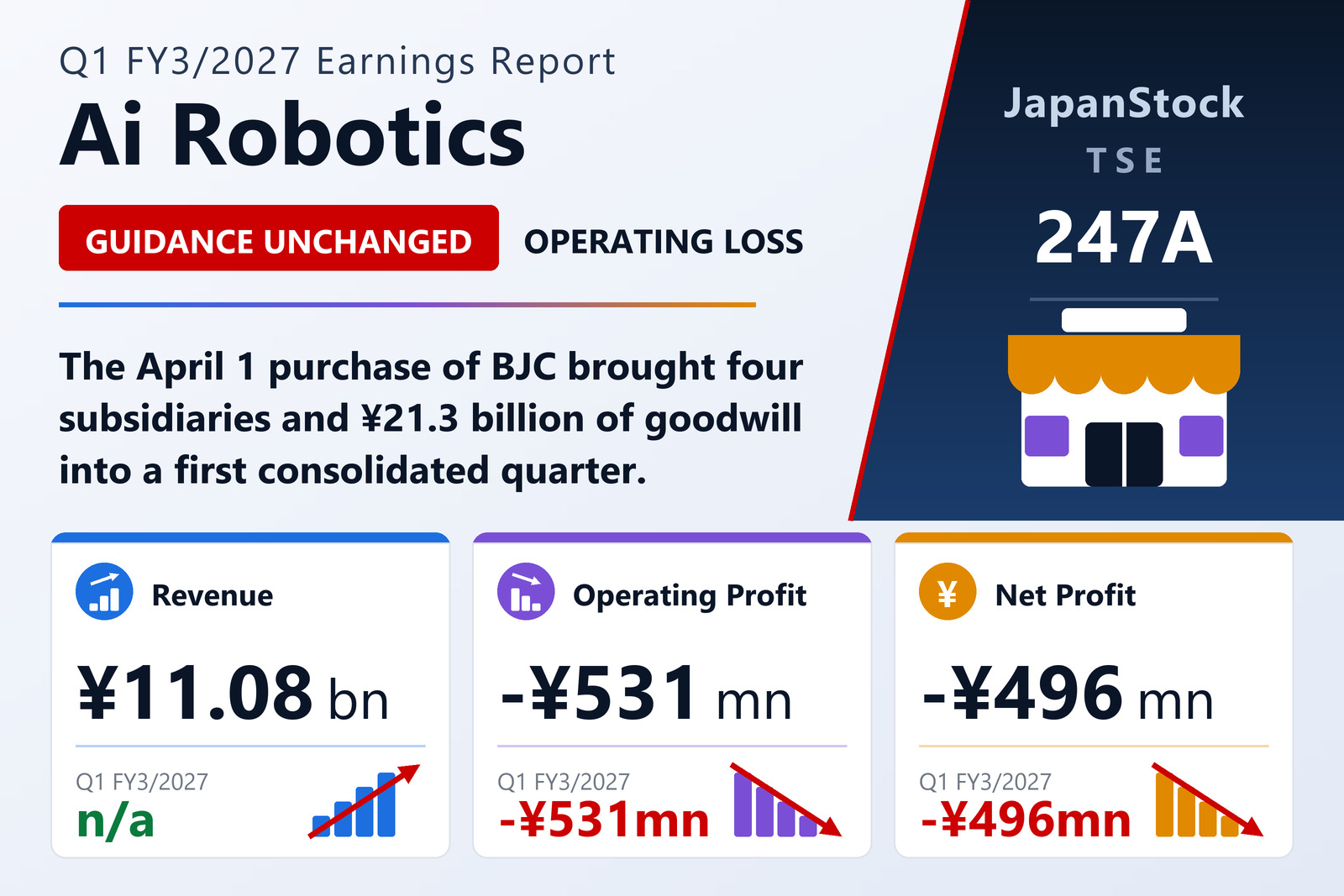
Ai Robotics, Inc. (TSE Growth: 247A), the Tokyo-listed direct-to-consumer brand operator behind the Yunth skincare line, the Brighte beauty-appliance range and the Straine hair-care series, published results for the first quarter of the year to March 2027 — April 1 to June 30, 2026 — under Japanese GAAP on August 14, 2026. Revenue was ¥11,075 million, the operating result a loss of ¥531 million, the ordinary result a loss of ¥737 million, and the net result attributable to owners of parent a loss of ¥495 million. Basic loss per share was ¥7.63. Comprehensive loss was ¥494 million.
The most important thing to understand about those numbers is what sits beside them: nothing. Ai Robotics began preparing consolidated quarterly financial statements only from this quarter, the first quarter of FY3/2027. The tanshin therefore carries no figures at all for the equivalent quarter of FY3/2026, no year-on-year percentage changes, and no comparison against the prior fiscal year-end for the balance sheet. Every change column in the release is a dash. The company states plainly that it has not performed a comparative analysis against the prior-year cumulative period or the prior year-end, and readers should not manufacture one — a parent-only prior quarter would not be measuring the same entity.
That absence is not a disclosure gap so much as a direct consequence of the transaction that defines the quarter. Everything below flows from it.
The BJC acquisition and its balance-sheet footprint
On April 1, 2026 — the first day of the fiscal year — Ai Robotics acquired the entire share capital of BJC Inc., making it a wholly owned subsidiary. BJC arrived with a group of its own, and four companies entered the scope of consolidation at once: BJC Inc., CHARIS & Co., Inc., BEEK Inc. and CHARIS Korea Corporation. Because their fiscal year-ends do not align with the parent's — October 31 for the three Japanese entities and December 31 for the Korean one — the group used provisional closing statements drawn up as at June 30 to consolidate them.
The footprint on the balance sheet is unmistakable. Total assets stood at ¥48,184 million at June 30, of which goodwill alone accounts for ¥21,273 million — roughly 44% of everything the group owns. Cash and deposits were ¥7,287 million, accounts receivable ¥5,175 million, and merchandise and supplies ¥9,728 million, the last of these a reminder that this is a physical-product business carrying real inventory.
Against that sits ¥42,583 million of total liabilities, including ¥38,823 million of interest-bearing debt. The composition matters: ¥34,577 million of it is short-term borrowings, with ¥280 million of bonds and ¥942 million of long-term debt falling due within a year and ¥3,025 million of long-term borrowings beyond it. The acquisition was, in other words, funded overwhelmingly with short-dated bank credit that will need refinancing or repayment on a rolling basis. Net assets came to ¥5,601 million — retained earnings of ¥3,841 million being the largest component — and the equity ratio was 11.6%. Owners' equity was ¥5,600 million.
An 11.6% equity ratio is thin by any conventional reading, and it is the single figure an investor should carry away from this release. It is the arithmetic result of adding ¥38.8 billion of debt and ¥21.3 billion of goodwill to a company whose equity base was a fraction of that size. The group also renamed its reporting segment from "D2C Brand Business" to simply "Brand Business" on consolidation, and continues to report as a single segment.
Why the adjusted figures point the other way
Ai Robotics reports two headline profit measures alongside the statutory ones, and in this quarter they disagree in sign. Adjusted EBITDA came to a positive ¥113 million, and adjusted net profit attributable to owners of parent to a positive ¥109 million, giving adjusted earnings per share of ¥1.68 and diluted adjusted EPS of ¥1.67.
The definitions are disclosed and worth stating precisely. Adjusted EBITDA is operating profit plus depreciation and similar charges, plus goodwill and related amortisation arising from M&A, plus M&A-related costs. Adjusted net profit is net profit attributable to owners of parent plus that same M&A goodwill amortisation and those same M&A-related costs, where M&A-related costs are defined as financial advisory fees plus due-diligence fees. The two largest add-backs are disclosed elsewhere in the filing: depreciation of ¥46 million and goodwill amortisation of ¥361 million for the quarter. The remainder of the bridge from a ¥531 million operating loss to a positive ¥113 million is the advisory and due-diligence bill for the BJC deal.
Whether that framing is the right one depends on the question being asked. The M&A transaction costs are genuinely one-off and belong in the year they were incurred rather than in any assessment of run-rate trading. Goodwill amortisation is different: it is a non-cash charge, but it is a real and recurring one that will run for years, and the company's own full-year guidance assumes ¥1,500 million of it. Adding it back flatters the picture on a measure the company has chosen to lead with. The honest summary is that the underlying brand business traded at around break-even to slightly positive in the quarter, and that the statutory loss is dominated by the accounting and financing consequences of the acquisition rather than by the products.
The gap between operating loss and ordinary loss
The ¥206 million distance between the ¥531 million operating loss and the ¥737 million ordinary loss is almost entirely the cost of carrying that debt. Non-operating expenses totalled ¥207 million, of which interest paid was ¥172 million, financing fees ¥25 million and other items ¥10 million; non-operating income was a negligible ¥0.4 million. Below the ordinary line the quarter was quiet — a ¥29 thousand gain on disposal of fixed assets and a ¥3.5 million loss on retirement of fixed assets — leaving a pre-tax loss of ¥741 million, against which a tax credit of ¥245 million was recognised, producing the ¥495 million net loss.
At roughly ¥172 million of interest in a single quarter, the annualised financing cost of the BJC purchase is on the order of ¥700 million. That is a permanent, cash charge against the acquired earnings, and unlike goodwill amortisation it does not get added back anywhere.
Yunth, Brighte and Straine behind the ¥11.1 billion top line
The trading commentary is straightforwardly positive. In skincare, the flagship Yunth brand extended its popular serum line with a "raw PDRN" serum built around the much-discussed PDRN ingredient, and launched a face mask formulated with the same serum actives. The mask became a hit almost immediately, entering the upper reaches of sales rankings at drugstores and on online marketplaces within days of release.
In beauty appliances, Brighte continued to push distribution through consumer-electronics retailers, while online its ELEKI LIFT device held high ranking positions on both Qoo10 and Rakuten. In hair care, Straine added two new lines — BASIC and SOFT — so that shoppers can select by hair type, a deliberate move to widen the brand from a single proposition into a range that addresses more specific concerns.
The macro backdrop the company describes is mixed. Wage rises have improved the income environment, but persistently high resource and energy prices and imported inflation from a long-running weak yen have left real wages stagnant, and domestic consumer sentiment soft. Set against that, inbound demand at drugstores and variety shops has stayed firm at a high level — an important channel for exactly the kind of beauty products Ai Robotics sells, and one that has partially insulated the category from weak domestic spending.
Guidance: a range, not a point, and unchanged
The company left its FY3/2027 consolidated forecast unchanged from the guidance issued on May 13, 2026, and it is expressed as a range rather than a single figure — a reasonable choice in a year whose shape depends on how a first-time consolidation beds in. Revenue is guided to ¥56,000–60,000 million, operating profit to ¥7,500–10,000 million, adjusted EBITDA to ¥9,500–12,000 million and adjusted net profit to ¥5,900–7,400 million. No year-on-year percentages accompany them, for the same reason no quarterly comparatives exist.
One footnote to the operating-profit line deserves attention: the guided ¥7,500–10,000 million is described as provisional, calculated on the assumption of ¥1,500 million of M&A goodwill amortisation. The final purchase price allocation has evidently not been settled, so the amortisation charge — and with it the reported operating profit — could move. Adjusted EBITDA and adjusted net profit, which add that charge back, are insulated from the revision; reported operating profit is not.
Measured against the low end of guidance, the first quarter delivered 19.8% of the annual revenue target, a shade under a straight quarterly pace. The profit lines are the harder ask: with Q1 producing an operating loss, the remaining nine months must generate the entire ¥7.5–10.0 billion operating profit, implying a very heavily back-weighted year. Some of that is mechanical — the M&A transaction costs are concentrated in the first quarter by nature and will not repeat — but the burden of proof now sits squarely with the second and third quarters.
No dividend was paid for the quarter and none is forecast for the full year. The group did not prepare a consolidated statement of cash flows for the period, and the quarterly consolidated financial statements were not subject to review by a certified public accountant or audit corporation. Shares outstanding at quarter-end were 64,999,000, with 124 held in treasury.
| Metric | Q1 FY3/2027 (Apr–Jun 2026) | FY3/2027 full-year guidance |
|---|---|---|
| Revenue (¥ million) | 11,075 | 56,000–60,000 |
| Operating profit / (loss) (¥ million) | −531 | 7,500–10,000 |
| Adjusted EBITDA (¥ million) | 113 | 9,500–12,000 |
| Ordinary profit / (loss) (¥ million) | −737 | — |
| Net profit / (loss) attrib. to owners of parent (¥ million) | −495 | — |
| Adjusted net profit attrib. to owners of parent (¥ million) | 109 | 5,900–7,400 |
| Basic EPS (¥) | −7.63 | — |
| Adjusted EPS (¥) | 1.68 | — |
| Comprehensive income / (loss) (¥ million) | −494 | — |
| Total assets (¥ million) | 48,184 | — |
| Goodwill (¥ million) | 21,273 | — |
| Interest-bearing debt (¥ million) | 38,823 | — |
| Net assets (¥ million) | 5,601 | — |
| Equity ratio | 11.6% | — |
| Dividend per share (¥) | — | 0.00 |
JapanStockPulse provides informational content only and does not constitute investment advice. Figures are taken from the company's published earnings short report and may be subject to subsequent revision.