A first half of two very different stories
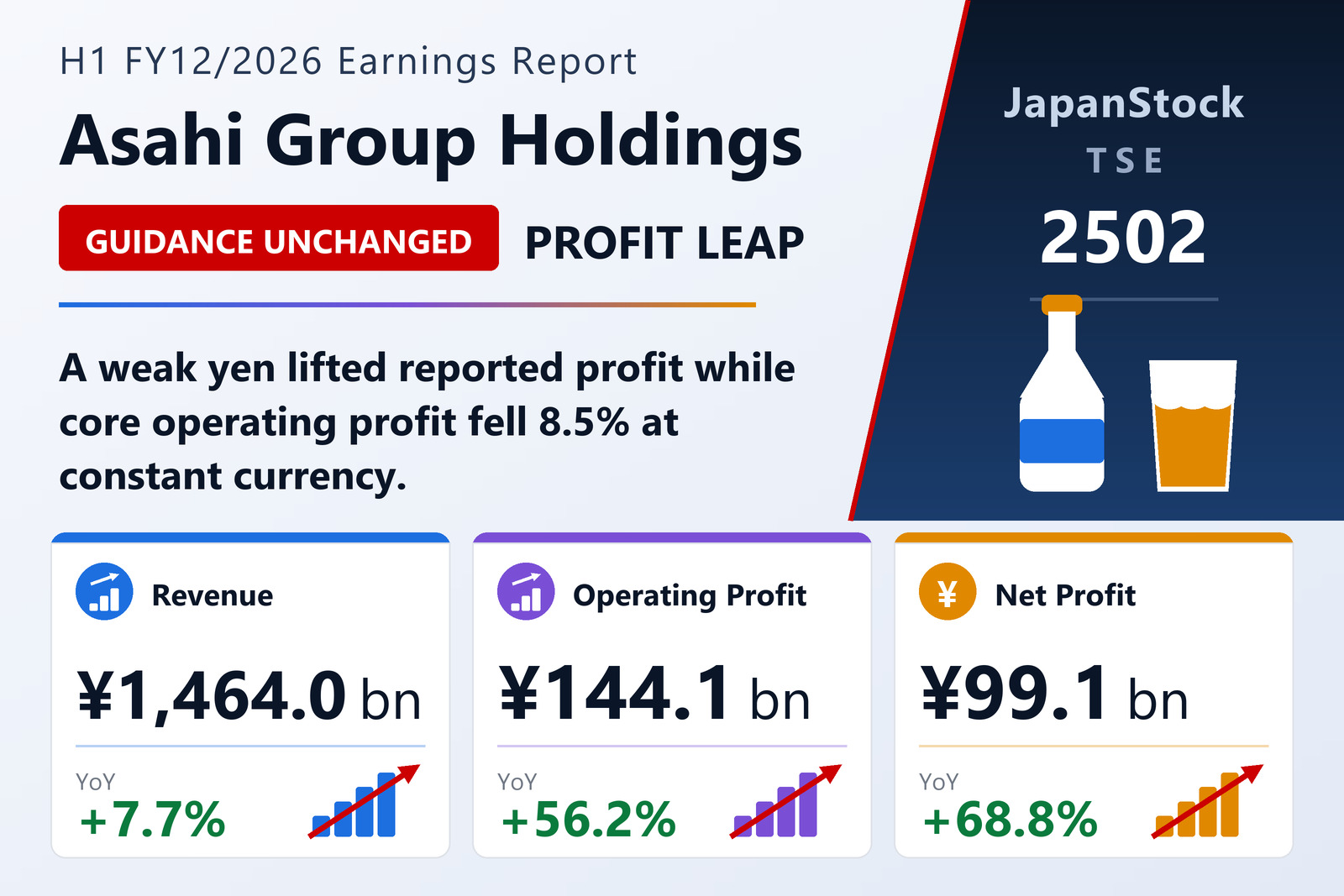
Asahi Group Holdings, Ltd. (TSE: 2502), the Tokyo-listed brewer and beverage group behind Asahi Super Dry, Peroni Nastro Azzurro, Pilsner Urquell, Schweppes in Oceania and the Wilkinson and Mintia brands in Japan, published its interim results for the year to December 2026 — the six months from January 1 to June 30 — under IFRS on August 14, 2026. Led by President and Group CEO Atsushi Katsuki, the group reported revenue of ¥1,463,963 million, up 7.7% on the ¥1,359,551 million of a year earlier, and a set of profit lines that at first glance look emphatic. Operating profit rose 56.2% to ¥144,143 million, profit before tax 58.8% to ¥138,816 million, profit for the period 68.8% to ¥100,135 million, and profit attributable to owners of the parent 68.8% to ¥99,148 million. Basic earnings per share came in at ¥67.79 against ¥39.07, up 73.5%, with diluted EPS of ¥67.67.
Two lines in the same release tell a much cooler story. Core operating profit — the company-defined measure that takes revenue less cost of sales and less selling, general and administrative expenses, and is intended to capture the performance of the ongoing business — rose just 1.5% to ¥111,354 million. And on a constant-currency basis, translating this year's foreign-currency amounts at last year's exchange rates, revenue fell 0.6% and core operating profit fell 8.5%. Between those two framings sits essentially the whole of the investment case for the half: the reported numbers are a currency-translation story layered on top of one-off items, while the underlying business went slightly backwards.
The gap between core operating profit and reported operating profit is the widest it has been in years: ¥32,789 million, against a gap of ¥17,392 million in the opposite direction a year ago, when reported operating profit of ¥92,269 million sat below core operating profit of ¥109,661 million. In other words, last year's operating line was depressed by charges and this year's is lifted by gains, which mechanically doubles the apparent swing. Management supplies its own correction for this in the shape of adjusted profit attributable to owners of the parent, which strips out non-recurring special factors such as business-portfolio restructuring and impairment losses. On that basis first-half profit was ¥73,001 million, up 8.2% — a respectable single-digit advance, and roughly one-eighth of the 68.8% the headline bottom line advertises.
Comprehensive income of ¥226,728 million, up 390.8%, is a further illustration of the same force. Almost all of it is currency: foreign-currency translation differences on overseas operations contributed ¥124,358 million of other comprehensive income this half, against a negative ¥15,521 million a year earlier. A shareholder should read that ¥226.7 billion as a mark-to-market on the yen value of Asahi's European and Australian businesses rather than as cash earned in the period.
Why the yen matters more to Asahi than to most Japanese consumer names
Asahi is unusual among Japan's food and drink companies in how much of its business sits outside Japan. Europe and Asia Pacific together generated ¥817,295 million of segment revenue in the half, 55.6% of the group total before consolidation adjustments, and both are reported in local currencies — Czech koruna, Polish zloty, euro, sterling, Australian dollar — that are then translated into yen. When the yen weakens, that translation inflates revenue and profit in reported terms without a single extra case of beer being sold.
The scale of the effect is visible in the segment disclosure. Europe's revenue rose 13.7% to ¥405,305 million in reported yen but was flat, at 0.0%, at constant currency. Its core operating profit rose 8.7% to ¥51,202 million in yen, yet fell 6.1% at constant currency. Asia Pacific tells the same story with a wider gap: revenue up 19.0% to ¥411,990 million reported but only 0.7% at constant currency, and core operating profit up 18.0% to ¥44,130 million reported but down 0.2% once currency is neutralised. Neither region grew its underlying profit. Both look like strong growth engines in the consolidated yen accounts.
Investors should also note what the FX tailwind is not doing: it is not helping the operating margin. Group core operating margin was 7.6% for the half. Europe, at 12.6%, remains the most profitable region by some distance; Asia Pacific ran at 10.7% and Japan and East Asia at just 7.9%. Below the segment lines, amortisation of intangible assets of ¥22,010 million and unallocated corporate costs of ¥15,386 million account for most of the distance between the ¥148,789 million of segment core operating profit and the ¥111,354 million reported at group level — a durable structural charge that flows from the group's long history of large overseas acquisitions.
Japan and East Asia: still working through the cyberattack
The home region was the weak point, and the reason is stated plainly. Japan and East Asia revenue fell 2.2% to ¥635,091 million and core operating profit fell 11.2% to ¥50,405 million — and because this segment is almost entirely yen-denominated, the constant-currency figures are identical, at −2.2% and −11.2%. Price revisions helped the top line; the system failures caused by the cyberattack, together with higher raw-material-related costs, more than offset them. This is the only reporting segment whose underlying profit declined by a double-digit percentage.
Set against that, the segment's reported operating profit rose 94.9% to ¥80,227 million — the single largest contributor to the group's 56.2% operating-profit jump, and a figure that sits ¥29.8 billion above its own core operating profit. That inversion is where the portfolio-restructuring gains that management excludes from adjusted profit are concentrated. Readers comparing Asahi's Japanese business with those of Kirin or Suntory should use the ¥50,405 million core figure, not the ¥80,227 million reported one.
Commercially, the group spent the half rebuilding. In Japanese alcoholic beverages it leaned harder on the karakuchi dry-finish positioning of Asahi Super Dry with advertising built around chilling the beer, released Asahi Super Dry Reiryo Karakuchi in limited volume, and launched Asahi Gold, a 100% malt standard beer that is its first new beer brand in nine years. In ready-to-drink it upgraded the quality of the growing GINON line; in alcohol-taste beverages it put out Asahi Zero Ale Taste, the first limited-edition product under the Asahi Zero brand, and a limited-run non-alcoholic lemon sour, both under the group's "Smart Drinking" push to build occasions that drinkers and non-drinkers can share. Soft drinks brought Japan's first launch of green cola, the Greek sugar-free, preservative-free, zero-calorie brand, into convenience stores in Tokyo and three neighbouring prefectures, alongside summer-demand launches including an unsweetened lemon water and a salted-grapefruit hydration drink. In food, Mintia +FOCUS Clear Ramune, formulated with 92% glucose, targeted the concentration-maintenance niche. In East Asia the focus was expanding Asahi Super Dry and other global brands, principally in China.
Europe and Asia Pacific: premium brands, global partnerships
Europe's volumes in its main markets declined, but premium beer held up and, with the currency effect, revenue and profit both rose in yen. The group extended its range in the Czech Republic with the Kozel 12 lager, strengthened Zubr in Poland, renewed the Peroni Nastro Azzurro partnership with the Italian Rugby Federation and ran a unified Peroni brand concept in the UK from advertising through to on-trade experience. The non-alcoholic push was concrete rather than rhetorical: Czech flavoured Birell products were switched entirely to 0.0% ABV, and Romania's Cooler brand entered the vitamin- and mineral-fortified sparkling water category. In neighbouring European markets and North America the group leaned on its City Football Group partnership for Asahi Super Dry and its Scuderia Ferrari tie-up for Peroni Nastro Azzurro 0.0%.
Asia Pacific — Oceania plus Southeast and South Asia — was the fastest-growing segment in reported terms. In Australian alcohol the group pushed contemporary beer, using the Great Northern partnership with the National Rugby League, while Asahi Super Dry became the official beer of the Australian Open from 2026 and was marketed alongside the Balter craft range. RTD saw a promotional push behind Hard Rated Lemon Lime 6%, the alcoholic version of the SOLO soft drink, in support of the group's multi-beverage strategy. On the soft-drink side, Schweppes ran a collaboration with a popular television series and SOLO Energy diversified its flavours, while New Zealand specialty coffee roaster Allpress opened new roasteries in Melbourne and London. In Southeast Asia, Malaysia gained a PET-bottle iced coffee under WONDA and the Philippines its first carbonated lactic-acid drink under the Goodday brand. The Other segment, which includes the Korean alcohol business and animal feed, grew revenue 38.8% to ¥17,224 million and core operating profit 34.5% to ¥3,052 million.
Balance sheet, cash flow and the dividend
Total assets rose ¥247,511 million from the December 2025 year-end to ¥6,275,926 million, driven by increases in cash and cash equivalents and in goodwill and intangible assets — the latter now standing at ¥3,756,370 million, or 59.9% of the balance sheet, a reminder of how acquisition-built this group is. Liabilities rose ¥62,398 million to ¥3,082,269 million on higher long-term borrowings, while total equity rose ¥185,113 million to ¥3,193,656 million, with retained earnings up on the half's profit despite the dividend outflow and translation differences on foreign operations adding materially. The ratio of equity attributable to owners of the parent improved a full point, to 50.8% from 49.8%.
Cash generation improved sharply. Operating cash flow was an inflow of ¥131,484 million, against an outflow of ¥2,554 million in the same period last year — a swing of ¥134.0 billion driven by the higher pre-tax profit, non-cash depreciation and amortisation add-backs, and working-capital efficiency, partly offset by income-tax payments. Investing outflows narrowed to ¥39,355 million from ¥121,253 million, a reduction of ¥81,897 million, with the prior year having included ¥45,260 million for acquisitions of subsidiaries. Financing was an outflow of ¥13,501 million against an inflow of ¥92,703 million a year earlier, as bond redemptions of ¥100,000 million and dividend payments of ¥38,029 million were only partly funded by ¥270,223 million of new long-term borrowing. Cash and cash equivalents ended the half at ¥243,075 million, ¥185,481 million above the ¥57,594 million of a year earlier.
The interim dividend is held at ¥26.00 per share, unchanged year on year, payable from September 1, 2026. The full-year forecast is ¥57.00 — the same ¥26.00 interim plus a year-end ¥31.00, against ¥52.00 paid for 2025 — and is unrevised from the previous announcement. Average shares outstanding for the half fell to 1,462,658,939 from 1,502,914,334, a 2.7% reduction from past buybacks that explains why EPS grew 73.5% while attributable profit grew 68.8%.
Guidance untouched, and the shadow of September 29
Full-year guidance for December 2026 is unchanged from the forecast published on July 8, 2026. The company targets revenue of ¥3,220,000 million, up 11.2%, core operating profit of ¥291,000 million, up 10.6%, operating profit of ¥297,000 million, up 59.8%, profit before tax of ¥274,000 million, up 52.8%, profit for the year of ¥195,600 million, up 59.3%, and profit attributable to owners of the parent of ¥194,000 million, up 59.6%, for EPS of ¥129.71. Adjusted profit attributable to owners is guided to ¥168,000 million, up 14.3%. On a constant-currency basis the same guidance implies revenue growth of 5.4% and core operating profit growth of 3.2% — again, roughly half the headline rate.
Measured against those targets the half delivered 45.5% of guided revenue, 38.3% of guided core operating profit and 51.1% of guided attributable profit. The second-half core operating profit implied by the guidance is ¥179,646 million, which would require growth well above the 1.5% managed in the first half — a demanding shape that rests on the Japanese business recovering as the cyberattack disruption recedes, and on the constant-currency declines in Europe and Asia Pacific reversing.
That cyberattack remains the defining event of Asahi's recent history. The release opens not with results but with an apology: the company deeply apologises for the considerable inconvenience caused to shareholders and other stakeholders by the postponement of its earnings announcements following the cyberattack that occurred on September 29, 2025. The consequences are visible throughout this statement — in the delayed reporting calendar, in the system failures that pushed Japanese revenue and profit lower, and in the structural review of the domestic business the company says it is now conducting alongside efforts to restore and strengthen earning power in existing areas. Elsewhere in the notes, the group adopted the IFRS 9 and IFRS 7 amendments this period with no material effect, made no significant change to the scope of consolidation, and reminds readers that interim results are not subject to audit review.
| Metric | H1 FY12/2026 | H1 FY12/2025 | Change |
|---|---|---|---|
| Revenue (¥ million) | 1,463,963 | 1,359,551 | +7.7% |
| Revenue, constant currency | — | — | −0.6% |
| Core operating profit (¥ million) | 111,354 | 109,661 | +1.5% |
| Core operating profit, constant currency | — | — | −8.5% |
| Operating profit (¥ million) | 144,143 | 92,269 | +56.2% |
| Profit before tax (¥ million) | 138,816 | 87,421 | +58.8% |
| Profit for the period (¥ million) | 100,135 | 59,310 | +68.8% |
| Profit attrib. to owners of parent (¥ million) | 99,148 | 58,725 | +68.8% |
| Adjusted profit attrib. to owners (¥ million) | 73,001 | 67,452 | +8.2% |
| Comprehensive income (¥ million) | 226,728 | 46,195 | +390.8% |
| Basic EPS (¥) | 67.79 | 39.07 | +73.5% |
| Diluted EPS (¥) | 67.67 | 39.06 | +73.2% |
| Total assets (¥ million; vs Dec 31, 2025) | 6,275,926 | 6,028,414 | +4.1% |
| Total equity (¥ million; vs Dec 31, 2025) | 3,193,656 | 3,008,543 | +6.2% |
| Owners' equity ratio (vs Dec 31, 2025) | 50.8% | 49.8% | +1.0 pt |
| Interim dividend per share (¥) | 26.00 | 26.00 | unchanged |
JapanStockPulse provides informational content only and does not constitute investment advice. Figures are taken from the company's published earnings short report and may be subject to subsequent revision.