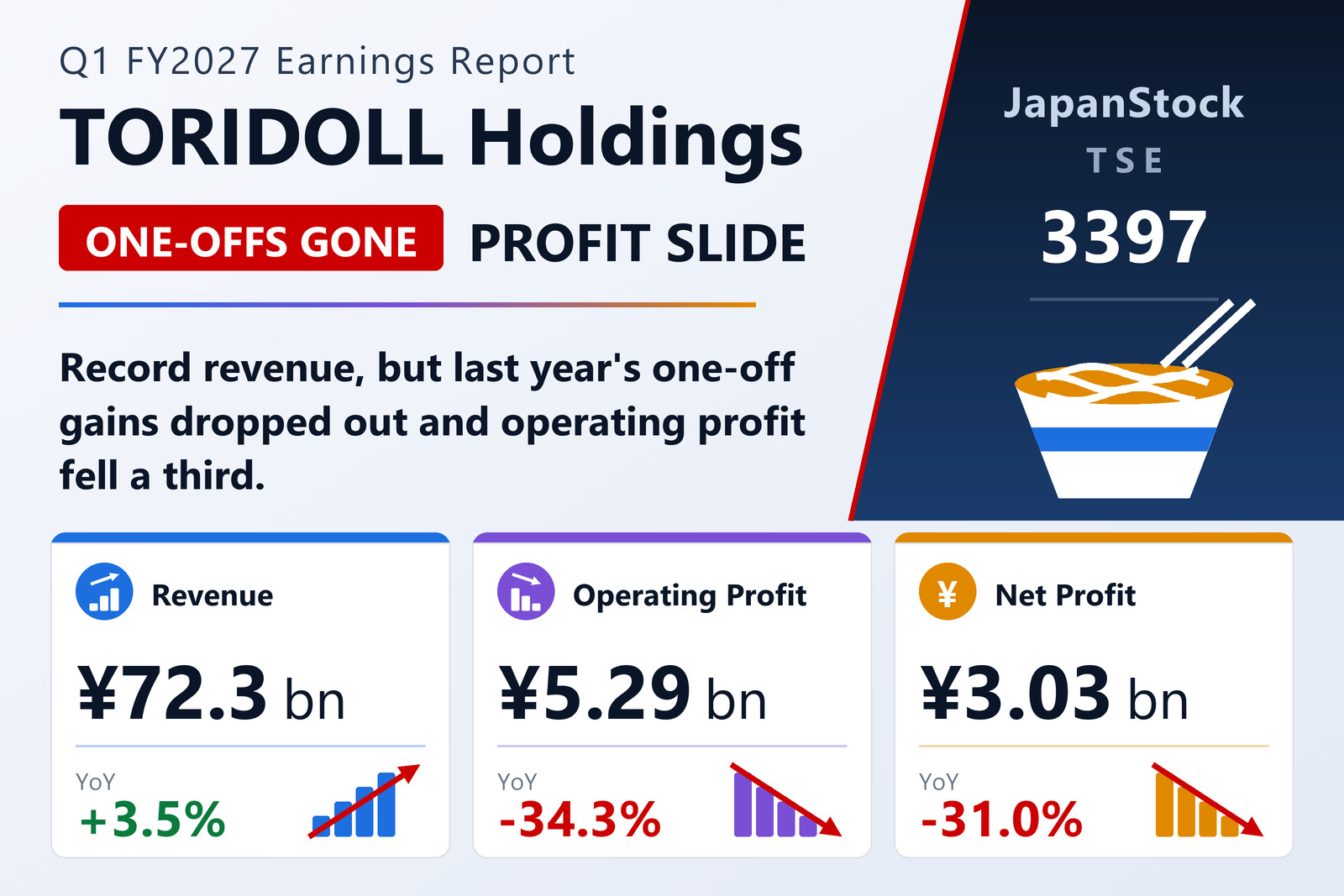
A record top line, and a profit line that moved the other way
TORIDOLL Holdings Corporation (TSE: 3397), the restaurant group founded and led by President Takaya Awata that operates the Marugame Seimen self-service Sanuki udon chain in Japan alongside a large overseas portfolio, disclosed consolidated first-quarter results for the year to March 2027 — April 1 to June 30, 2026 — under IFRS on August 14, 2026. Revenue rose 3.5% to ¥72,318 million, which the company flags as a first-quarter record. Every profit line below it moved the other way. Core operating profit, the company-defined measure equal to revenue less cost of sales and SG&A, fell 9.3% to ¥5,776 million. Operating profit fell 34.3% to ¥5,294 million, profit before tax fell 26.7% to ¥4,939 million, profit for the period fell 34.8% to ¥3,032 million and profit attributable to owners of parent fell 31.0% to ¥3,031 million. Basic earnings per share came in at ¥33.25 against ¥49.04 a year earlier, with diluted EPS of ¥33.06 against ¥48.67.
One line ran against the grain: comprehensive income rose 120.0% to ¥4,322 million, from ¥1,965 million. That has nothing to do with trading. Foreign-currency translation of overseas operations swung from a negative ¥2,492 million a year ago to a positive ¥1,186 million this time — a ¥3.68 billion reversal that, for a group with roughly a third of its revenue earned outside Japan, moves the comprehensive-income line far more violently than the operating result does.
Where the ¥2.76 billion went: core versus reported operating profit
The distance between a 9.3% decline and a 34.3% decline is the whole story of the quarter, and TORIDOLL's own definitions make it legible. Core operating profit is revenue minus cost of sales minus SG&A. Reported operating profit is then core operating profit minus impairment losses, plus other operating income, minus other operating expenses. Everything between the two lines is therefore non-core.
A year ago those non-core items were a large tailwind: other operating income and expenses were a net positive ¥1,773 million against just ¥88 million of impairment, adding roughly ¥1.69 billion to reported operating profit and lifting it to ¥8,052 million from a core figure of ¥6,367 million. This year they are a modest drag. Other operating income of ¥1,379 million — lease-cancellation gains on closed stores — was more than offset by other operating expenses of ¥1,665 million, chiefly fixed-asset retirement losses and one-off structural-reform costs, for a net negative ¥285 million; impairment losses rose to ¥197 million (¥63 million at Marugame Seimen, ¥99 million in Domestic Other, ¥36 million overseas). Add it up and non-core items swung by about ¥2.17 billion year on year, which together with the ¥591 million fall in core operating profit produces the ¥2,758 million drop in reported operating profit. Both sides of this year's entry come from the same overseas restructuring, and they largely cancel each other out.
Below the operating line the direction reverses, which is why profit before tax fell less than operating profit. Net finance costs narrowed sharply to ¥368 million from ¥1,322 million, as finance income rose to ¥349 million from ¥203 million and finance costs more than halved to ¥717 million from ¥1,525 million. Equity-method income was ¥13 million against ¥6 million, and the income tax charge eased to ¥1,907 million from ¥2,087 million. The non-controlling interest share collapsed to ¥2 million from ¥256 million, which is why profit attributable to owners of parent fell 31.0% while total profit for the period fell 34.8%.
Marugame Seimen: record revenue, and wage costs it could not absorb
The Marugame Seimen segment lifted revenue 3.2% to ¥36,509 million, another first-quarter record, but core operating profit fell 16.0% to ¥5,665 million as higher personnel and other costs outran the revenue gain. The quarter was busy on product. A new category, "Marugame Udon Meshi," launched on April 7 in four varieties, cooked to order on a sizzling grill pan and served in the pan; it passed 200,000 servings in about a week. The annual "Tomatama Curry Udon" series returned on April 21 with a new shrimp-cutlet variant stacking three prawns, and the series sold 2.34 million servings by the end of June. From June 2 the summer staple "Oni-oroshi" series arrived alongside new chilled items including a mentaiko-cream udon and a sudachi-oroshi cold udon. The chain also ran the Sanuki Udon Artisan Festival 2026 at its Kanda Ogawamachi store from May 25 to 27, bringing together six noted Sanuki udon establishments, and a free noodle-upsize campaign over three days from May 27. Marugame Seimen opened 12 stores and closed none, taking the count from 887 to 899.
The Domestic Other segment — Kona's Coffee, Ra-men Zundouya, Niku no Yamagyu, Banpaiya, Tempura Makino, Toridoll, Butaya Ton-ichi, Nagata Honjoken and Yakitate Koppe Seipan — told the same story in miniature: revenue up 5.0% to ¥10,462 million, a first-quarter record, with core operating profit down 15.0% to ¥964 million on higher personnel costs and store-opening expenses. Kona's Coffee, positioned as "the nearest Hawaii," is the growth vehicle here, adding its second Okinawa site at Naha Shintoshin Park on April 17, Natori in Miyagi on April 23 and PALM WAGON Sendai Station West Exit on April 27, and on May 28 the group opened "goodNess," a new Hawaiian café-and-bar restaurant brand, in a directly connected location at Shibuya Station. Ra-men Zundouya took its first food-court site at AEON Mall Kobe Kita on April 20 and a fourth Mie-prefecture store on April 22; Nagata Honjoken and Banpaiya added one each. The segment's store count rose from 292 to 299. Unallocated corporate costs were ¥2,706 million against ¥2,650 million a year earlier.
Overseas: the segment that grew, and the one being rebuilt
The Overseas segment was the quarter's bright spot, with revenue up 3.4% to ¥25,346 million and core operating profit up 62.6% to ¥1,853 million — a first-quarter record for the segment, and a swing of ¥713 million that more than offsets the ¥1,078 million lost at Marugame Seimen in absolute terms, though not enough to hold the consolidated line. Three brands dominate. Tam Jai, the spicy rice-noodle chain operated mainly in Hong Kong, grew both revenue and profit on new openings, strong existing stores and successful control of food and labour costs. MARUGAME UDON, which takes the domestic format into Asia and North America, also grew revenue and profit, with Taiwan and the other Asian bases plus North America all progressing steadily.
The third is the reason the reported numbers look as they do. Fulham Shore, the UK operator of the FRANCO MANCA Neapolitan pizza chain, went through a fundamental restructuring during the quarter: TORIDOLL used a legal scheme to terminate the leases of unprofitable sites and sold and exited The Real Greek business outright, with the stated aim of raising the profitability and sustainability of the operation. The store-count table makes the scale plain. The overseas network shed a net 41 stores, opening 17 (9 directly operated, 8 franchised or joint-venture) against 58 closures, of which 49 were directly operated — and the company notes that the overseas closures include the sites shut or exited under the Fulham Shore restructuring. Overseas locations fell from 923 to 882, and the group total from 2,102 to 2,080 even after the domestic additions.
EBITDA, the balance sheet and cash
Because both the gains and the costs of the restructuring sit outside the group's preferred measures, EBITDA held up far better than reported profit: ¥13,384 million, down 2.4% from ¥13,715 million, with adjusted EBITDA at ¥13,582 million, down 1.6% from ¥13,803 million. TORIDOLL defines EBITDA as operating profit plus other operating expenses, less other operating income, plus depreciation and amortisation, and adjusted EBITDA as EBITDA plus impairment losses and non-recurring expense items. Depreciation and amortisation rose to ¥7,805 million from ¥7,436 million.
The balance sheet shrank on both sides. Total assets fell 2.5% to ¥301,377 million from ¥309,072 million at March 31, 2026, as right-of-use assets fell ¥3,196 million, cash and equivalents ¥3,157 million and intangibles and goodwill ¥1,950 million, against increases of ¥578 million in property, plant and equipment and ¥458 million in other non-current assets. Liabilities fell 5.0% to ¥205,839 million, a ¥10,876 million reduction driven by ¥6,621 million less in lease liabilities and ¥1,973 million less in long-term borrowings — the mechanical consequence of closing leased restaurants. Total equity rose 3.4% to ¥95,538 million on ¥1,885 million of retained earnings and ¥1,255 million of other equity components, and equity attributable to owners of parent reached ¥95,593 million. The owners' equity ratio improved to 31.7% from 29.9% and book value per share to ¥1,087.13 from ¥1,051.11. Shrinking a lease-heavy balance sheet while adding retained earnings is precisely how a restructuring is supposed to look on this statement.
Operating cash flow was an inflow of ¥11,255 million, down 17.7%, carried by ¥7,805 million of depreciation and amortisation and ¥4,939 million of pre-tax profit. Investing used ¥5,638 million, 6.2% more than a year earlier, almost all of it ¥5,151 million of property, plant and equipment purchases. Financing used ¥9,305 million, 5.5% less, with ¥1,500 million of new long-term borrowing set against ¥5,632 million of lease-liability repayments, ¥3,528 million of loan repayments and ¥967 million of dividends. Cash and equivalents ended the quarter at ¥66,731 million, down 4.5%. No first-quarter dividend was declared; the full-year forecast is unchanged at a ¥12.00 year-end dividend with no interim payment, up from ¥11.00 for FY3/2026.
Guidance unchanged — and the arithmetic of the remaining nine months
TORIDOLL left the full-year forecast it published on May 15, 2026 entirely intact, stating that the first quarter tracked broadly in line with plan. For FY3/2027 it guides to revenue of ¥287,000 million, up 3.0%, core operating profit of ¥22,000 million, up 2.5%, operating profit of ¥17,000 million, up 60.7%, profit before tax of ¥14,000 million, up 73.1%, profit for the year of ¥7,100 million, up 158.4%, and profit attributable to owners of parent of ¥7,000 million, up 202.9%, for EPS of ¥75.10.
Set against those targets the quarter looks better than the headline decline suggests: revenue reached 25.2% of the full-year figure, core operating profit 26.3%, operating profit 31.1% and attributable profit 43.3% — all at or ahead of a straight quarterly pace. The reason the growth rates look so dramatic is what they are measured against. Guidance of ¥17,000 million at plus 60.7% implies FY3/2026 operating profit of roughly ¥10.6 billion, of which ¥8.05 billion arrived in the first quarter alone — meaning the last three quarters of last year generated only about ¥2.5 billion. The attributable line is starker still: ¥7,000 million at plus 202.9% implies a prior-year total of roughly ¥2.3 billion against a ¥4.39 billion first quarter, which is to say the final nine months of FY3/2026 produced a net loss of around ¥2.1 billion.
Read that way, the triple-digit growth rates in guidance are mostly a statement that last year's back-half charges will not repeat, rather than a promise of a step-change in trading. What the remaining nine months must actually deliver is ¥11.7 billion of operating profit and ¥3.97 billion of attributable profit — demanding against last year's comparable period, but well within reach if the Fulham Shore restructuring is genuinely finished and Tam Jai and Marugame Udon keep compounding. The pressure point is domestic: Marugame Seimen is setting revenue records and still losing 16% of its segment profit to wage inflation, and no amount of overseas recovery fixes that if it persists. TORIDOLL published supplementary explanatory materials with the release but is not holding a results briefing.
| Metric | Q1 FY3/2027 | Q1 FY3/2026 | Change |
|---|---|---|---|
| Revenue (¥ million) | 72,318 | 69,862 | +3.5% |
| Core operating profit (¥ million) | 5,776 | 6,367 | −9.3% |
| Operating profit (¥ million) | 5,294 | 8,052 | −34.3% |
| Profit before tax (¥ million) | 4,939 | 6,736 | −26.7% |
| Profit for the period (¥ million) | 3,032 | 4,649 | −34.8% |
| Profit attrib. to owners of parent (¥ million) | 3,031 | 4,393 | −31.0% |
| EBITDA (¥ million) | 13,384 | 13,715 | −2.4% |
| Adjusted EBITDA (¥ million) | 13,582 | 13,803 | −1.6% |
| Basic EPS (¥) | 33.25 | 49.04 | −32.2% |
| Marugame Seimen revenue (¥ million) | 36,509 | 35,393 | +3.2% |
| Overseas core operating profit (¥ million) | 1,853 | 1,139 | +62.6% |
| Total assets (¥ million; vs Mar 31, 2026) | 301,377 | 309,072 | −2.5% |
| Total equity (¥ million; vs Mar 31, 2026) | 95,538 | 92,356 | +3.4% |
| Owners' equity ratio (vs Mar 31, 2026) | 31.7% | 29.9% | +1.8 pt |
| Group store count (vs Mar 31, 2026) | 2,080 | 2,102 | −22 |
JapanStockPulse provides informational content only and does not constitute investment advice. Figures are taken from the company's published earnings short report and may be subject to subsequent revision.