A year that held together only at the very bottom line
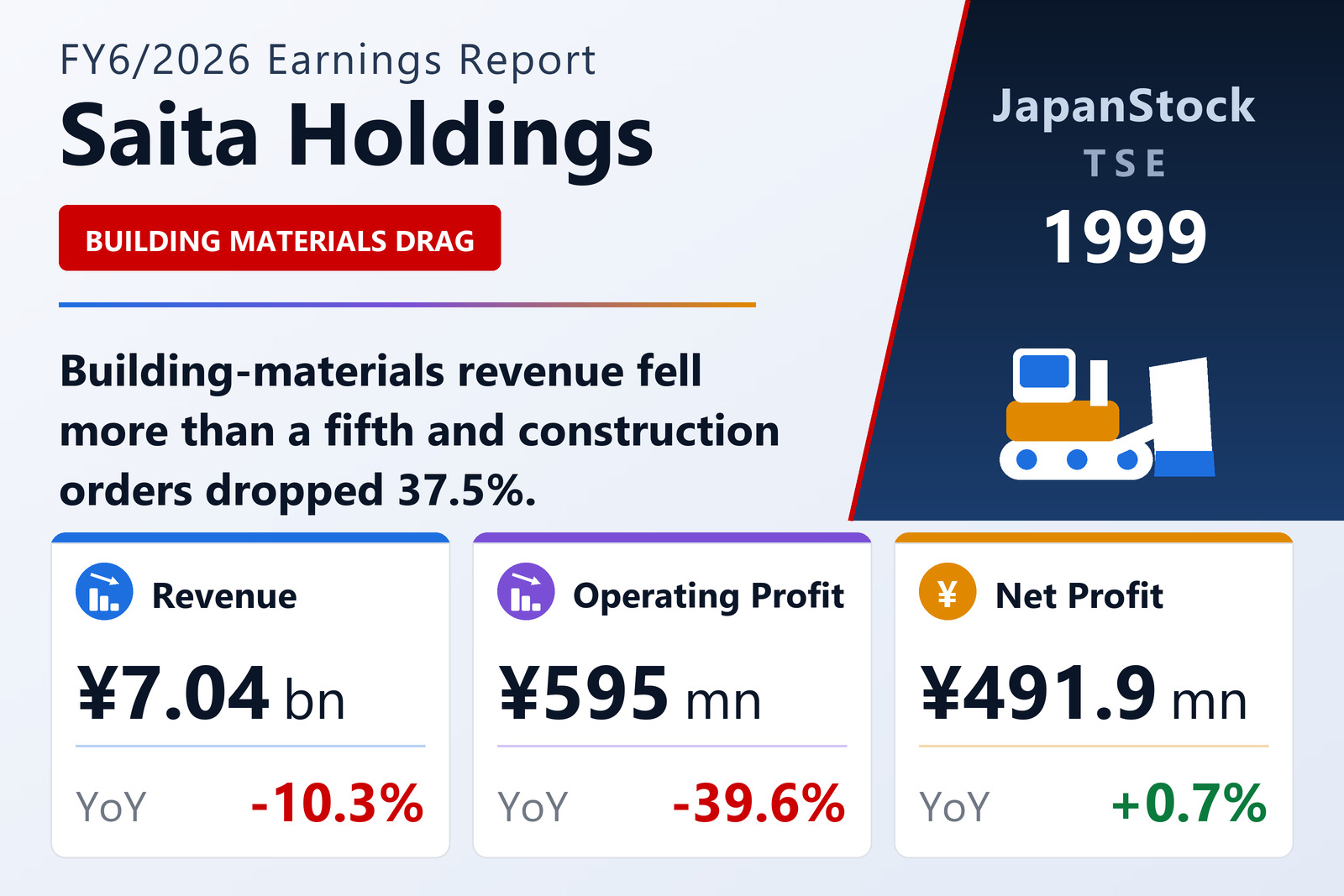
Saita Holdings Co., Ltd. (TSE: 1999), the Fukuoka-based holding company for a construction and building-materials group, disclosed consolidated results for the fiscal year ended June 30, 2026 under Japanese GAAP on August 18, 2026. Revenue fell 10.3% to ¥7,035.8 million from ¥7,841.9 million. Operating profit fell 39.6% to ¥595.2 million from ¥986.0 million, ordinary profit fell 22.7% to ¥746.6 million from ¥965.3 million — and net profit attributable to owners of parent rose 0.7% to ¥491.9 million from ¥488.2 million.
That progression, from a 40% fall at the operating line to a fractional gain at the net line, is the year's defining feature, and it is not the product of anything operational. Earnings per share came in at ¥780.20 against ¥774.40, and net assets per share at ¥9,936.46 against ¥9,201.65 — a per-share book value that is high because the share count is unusually small, at a weighted average of 630,452 shares.
The damage sits in the gross margin. Revenue fell ¥806.1 million, but gross profit fell further in proportion, down 27.9% to ¥1,767.3 million from ¥2,451.5 million, taking the gross margin to 25.1% from 31.3%. Selling, general and administrative expenses did fall, to ¥1,172.1 million from ¥1,465.5 million, absorbing about ¥293 million of the ¥684 million gross-profit decline; the remaining ¥391 million is the operating-profit shortfall almost exactly. Split by activity, gross profit on completed construction work fell to ¥370.2 million from ¥548.9 million while gross profit on the group's ancillary businesses — principally building materials — fell to ¥1,397.1 million from ¥1,902.6 million.
Building materials: the earnings engine loses a fifth of its revenue
The building-materials segment — crushed stone, crushed sand and ready-mixed concrete, manufactured, sold and hauled — is the group's profit engine, and it had the worst year. External revenue fell 21.5% to ¥3,086.8 million from ¥3,934.5 million, and segment profit fell 36.0% to ¥542.0 million from ¥846.9 million. Even after that fall the unit still supplied more operating profit than every other segment combined, so a fifth of its revenue disappearing is what moved the consolidated number.
Management's account of the year is one of price defence rather than volume. The unit "pushed appropriate selling-price negotiations" to pass through higher crude-oil and materials costs, alongside active sales activity. That the segment margin nevertheless held at 17.6% against 21.5% a year earlier suggests the pass-through worked in part — the profit decline is steeper than the revenue decline, but not dramatically so, which is the signature of a fixed-cost base meeting lost volume rather than of collapsing prices.
Construction: flat revenue, 40% less profit — and orders down 37.5%
The construction segment, covering civil engineering, building and general construction work, produced external revenue of ¥3,282.3 million, up 0.3% from ¥3,271.6 million — essentially unchanged. Segment profit fell 40.0% to ¥236.5 million from ¥394.5 million. The company is explicit about why: under severe competition for orders, and despite group-wide efforts to cut construction costs, the work being won simply carries thinner margins. The segment margin fell to 7.2% from 12.1%.
The forward-looking number is worse than the reported one. Orders received fell 37.5% to ¥2,414 million — against ¥3,282.3 million of revenue recognised in the year, an order intake roughly a quarter below the revenue it has to replace. Named awards during the year include the first zone of a prefectural Hatomune housing-complex construction project, access-road works for a construction-soil receiving site, and sewerage construction (No. 13) for the Kaizuka station-area land readjustment project. Customer concentration is worth noting alongside that: Asakura City Hall alone accounted for ¥742.2 million of construction revenue, or about 23% of the segment, down from ¥965.2 million the year before.
Away from the two main units, the picture is mixed but small. The liquor business, which manufactures and sells alcoholic beverages, lifted revenue 0.4% to ¥294.0 million and narrowed its operating loss sharply, to ¥5.5 million from ¥40.7 million — the clearest operational improvement anywhere in the group, even if the amounts are immaterial to the consolidated result. The other segment, a collection of petroleum sales, real estate, solar power generation, environmental services, security services and a lactic-acid-bacteria business, grew revenue 8.6% to ¥372.7 million while segment profit slipped 12.8% to ¥29.0 million. Unallocated corporate general and administrative expenses of ¥217.7 million, partly offset by ¥10.9 million of intersegment elimination, produced the ¥206.8 million adjustment that bridges segment profit to the consolidated operating line.
Below the operating line: a ¥171 million currency swing and a lighter tax bill
Ordinary profit of ¥746.6 million sat ¥151.4 million above operating profit — the opposite of the usual relationship for a domestic contractor, and the first half of the explanation for the flat net line. Non-operating income more than doubled to ¥171.3 million from ¥75.5 million, and non-operating expenses fell to ¥19.8 million from ¥96.2 million. Currency did most of that work on its own: the group booked a foreign-exchange gain of ¥96.1 million this year against a foreign-exchange loss of ¥74.9 million last year, a swing of roughly ¥171 million between the two years. Interest expense of ¥12.1 million and rental income from fixed assets of ¥25.0 million make up most of the rest.
Extraordinary items added the second half. Gains of ¥80.3 million — ¥44.0 million from fixed-asset sales and ¥36.3 million from the reversal of a compression special account — ran well ahead of losses of ¥22.9 million, of which ¥22.7 million was impairment (¥18.0 million at the corporate level, ¥3.0 million in liquor and ¥1.7 million in other). Pre-tax profit therefore came in at ¥804.0 million against ¥968.4 million, a 17.0% decline — already much shallower than the 39.6% at the operating line.
Tax closed the remaining gap. The total tax charge fell to ¥252.3 million from ¥385.8 million, an effective rate of 31.4% against 39.8%. Net profit including non-controlling interests still fell, to ¥551.7 million from ¥582.7 million; what turned that into a small gain at the headline was the share attributable to non-controlling interests dropping to ¥59.8 million from ¥94.4 million. Three separate items below operating profit — currency, tax rate and minority share — each moved the right way, which is why a 40% operating decline arrived at the bottom of the income statement as +0.7%.
Balance sheet: borrowings down, equity ratio up six points
The balance sheet is the year's unambiguous positive. Total assets ended at ¥9,205 million, down ¥138 million. Current assets fell ¥321 million to ¥6,446 million as trade and completed-construction receivables came down ¥487 million to ¥1,376 million, partly offset by a ¥113 million rise in cash and deposits to ¥4,798 million. Non-current assets rose ¥183 million to ¥2,758 million, driven almost entirely by investments and other assets, up ¥212 million — within which investment securities more than doubled to ¥410.6 million from ¥182.0 million, on ¥100 million of purchases plus revaluation.
Liabilities fell much faster than assets. Total liabilities came down ¥660 million to ¥2,241 million. Current liabilities fell ¥658 million to ¥1,790 million, principally on a ¥228 million reduction in income taxes payable to ¥70.5 million and a ¥208 million reduction in short-term borrowings to ¥868.7 million. Non-current liabilities were flat at ¥451 million, with long-term borrowings up ¥17 million and deferred tax liabilities up ¥15 million against a ¥36 million fall in other items.
Net assets rose ¥521 million to ¥6,963.6 million — retained earnings up ¥447 million and the valuation difference on available-for-sale securities up ¥89 million, against a ¥73 million negative move in the foreign-currency translation adjustment. The equity ratio improved to 68.1% from 62.1%, a six-point gain achieved by paying down liabilities rather than by growing the asset base. The market's view of that equity is a good deal less generous: the company's own disclosed market-value equity ratio of 28.0% of total assets implies a market capitalisation of roughly ¥2.58 billion against owners' equity of about ¥6.26 billion.
Cash flow tells the same story of a smaller, safer year. Operating cash flow halved to ¥613.9 million from ¥1,238.9 million, on pre-tax profit and the fall in trade receivables. Investing outflows were steady at ¥279.0 million against ¥294.1 million, mainly ¥195.8 million of property and equipment purchases and ¥100.1 million of investment-securities purchases against ¥46.1 million of asset-sale proceeds. Financing outflows narrowed to ¥239.9 million from ¥354.9 million, mainly the reduction in short-term borrowings, alongside ¥44.1 million of dividends paid, up from ¥37.8 million a year earlier. Cash and equivalents ended at ¥3,411 million, up ¥95 million. The company's supplementary indicators show the cost of the weaker operating cash flow: interest-bearing debt at 1.8 years of operating cash flow against 1.0, and interest coverage at 49.5× against 112.6× — both still comfortable in absolute terms, both roughly halved.
Guidance: another down year, on every single line
Management expects FY6/2027 to be worse again. Guidance calls for revenue of ¥6,800 million, down 3.4%; operating profit of ¥450 million, down 24.4%; ordinary profit of ¥450 million, down 39.7%; and net profit attributable to owners of parent of ¥250 million, down 49.2%. The shape of that forecast is as informative as its level: ordinary profit is guided level with operating profit, which means the company is assuming none of this year's ¥151 million of net non-operating income repeats — a reasonable position given that most of it was a currency gain.
The operating environment behind the guidance is unchanged from the one just reported. Japan's economy recovered moderately on improving employment and income conditions and inbound tourism, but high raw-material prices and the inflationary pressure flowing from the Middle East situation persisted. Within construction, public investment stayed firm on steady execution of the national resilience budget and private capital investment is recovering on better corporate earnings — while construction-material and raw-material costs and labour shortages keep pushing construction costs up. Favourable demand, in other words, meeting unfavourable input costs, which is precisely the squeeze visible in the construction segment's margin.
The response is incremental rather than structural. The group says it will allocate resources by market growth potential; in construction, raise site-management and technical-proposal capability and secure stable orders with an emphasis on profitability, while recruiting and developing people; in building materials, further improve production efficiency and cut manufacturing costs while continuing to negotiate appropriate selling prices in tandem with the construction business; and in liquor and environmental services, share information across group companies and expand earnings through stronger sales. Set against a 37.5% fall in construction orders, the emphasis on profitability over volume is the more consequential half of that programme — and the ¥6,800 million revenue guidance suggests management is prepared to accept the trade.
| Metric | FY6/2026 | FY6/2025 | Change |
|---|---|---|---|
| Revenue (¥ million) | 7,035.8 | 7,841.9 | −10.3% |
| Gross profit (¥ million) | 1,767.3 | 2,451.5 | −27.9% |
| Operating profit (¥ million) | 595.2 | 986.0 | −39.6% |
| Ordinary profit (¥ million) | 746.6 | 965.3 | −22.7% |
| Pre-tax profit (¥ million) | 804.0 | 968.4 | −17.0% |
| Net profit attrib. to owners of parent (¥ million) | 491.9 | 488.2 | +0.7% |
| EPS (¥) | 780.20 | 774.40 | +0.7% |
| Net assets per share (¥) | 9,936.46 | 9,201.65 | +8.0% |
| Construction revenue (¥ million) | 3,282.3 | 3,271.6 | +0.3% |
| Construction segment profit (¥ million) | 236.5 | 394.5 | −40.0% |
| Construction orders received (¥ million) | 2,414 | — | −37.5% |
| Building materials revenue (¥ million) | 3,086.8 | 3,934.5 | −21.5% |
| Building materials segment profit (¥ million) | 542.0 | 846.9 | −36.0% |
| Liquor revenue (¥ million) | 294.0 | 292.8 | +0.4% |
| Liquor segment loss (¥ million) | −5.5 | −40.7 | Loss narrowed |
| Other segment revenue (¥ million) | 372.7 | 343.0 | +8.6% |
| Other segment profit (¥ million) | 29.0 | 33.3 | −12.8% |
| Operating cash flow (¥ million) | 613.9 | 1,238.9 | −50.4% |
| Total assets (¥ million) | 9,205.4 | 9,343.7 | −1.5% |
| Net assets (¥ million) | 6,963.6 | 6,441.9 | +8.1% |
| Equity ratio | 68.1% | 62.1% | +6.0 pt |
| FY6/2027 guidance — revenue (¥ million) | 6,800 | 7,035.8 | −3.4% |
| FY6/2027 guidance — operating profit (¥ million) | 450 | 595.2 | −24.4% |
| FY6/2027 guidance — net profit (¥ million) | 250 | 491.9 | −49.2% |
JapanStockPulse provides informational content only and does not constitute investment advice. Figures are taken from the company's published earnings short report and may be subject to subsequent revision.