A record year, with each profit line growing faster than the one above it
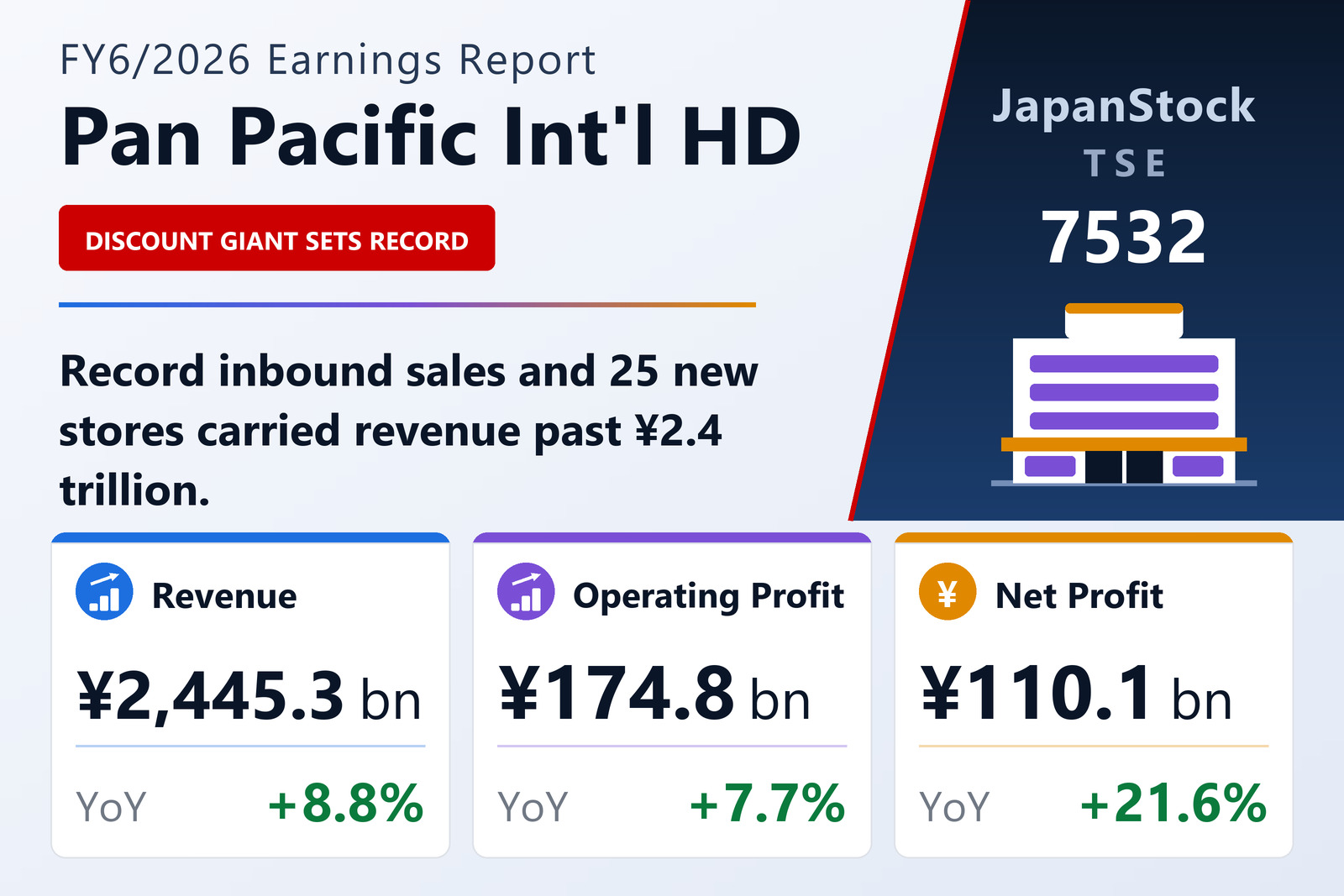
Pan Pacific International Holdings Corporation (TSE: 7532) — the operator of Don Quijote, MEGA Don Quijote, UNY and Apita — disclosed consolidated results for the fiscal year ended June 30, 2026 under Japanese GAAP on August 18, 2026. Revenue rose 8.8% to ¥2,445,260 million from ¥2,246,758 million, an increase of ¥198,502 million that takes the group past ¥2.4 trillion for the first time. Operating profit rose 7.7% to ¥174,842 million, ordinary profit 12.0% to ¥177,509 million, and net profit attributable to owners of parent 21.6% to ¥110,088 million — a record.
Earnings per share came to ¥36.84 against ¥30.32, and diluted EPS to ¥36.71 against ¥30.19; both prior-year figures are restated for the five-for-one stock split effective October 1, 2025. Return on equity improved to 16.8% from 15.8% and ordinary profit to total assets to 11.4% from 10.5%, while the operating margin held exactly flat at 7.2%. Comprehensive income rose 41.0% to ¥127,340 million, far ahead of the net line, on ¥12,915 million of positive foreign-currency translation adjustments.
The widening gap between the three profit lines is worth unpacking, because it is not operational. Between operating and ordinary profit sits the currency: the group booked a ¥4,295 million foreign-exchange gain this year where it carried a ¥4,619 million loss last year — a swing of roughly ¥8.9 billion that lifted non-operating income to ¥10,711 million while cutting non-operating expenses to ¥8,045 million from ¥12,002 million. Strip that out and ordinary profit would have grown at roughly the operating rate. Equity-method investment income, by contrast, fell to ¥347 million from ¥615 million.
Below that, the jump to a 21.6% net gain came from write-downs and tax. Impairment losses fell to ¥11,492 million from ¥18,467 million, pulling total extraordinary losses down to ¥17,716 million from ¥22,655 million, while extraordinary gains rose to ¥3,785 million from ¥1,023 million on ¥1,346 million of debt-forgiveness income and a ¥704 million release of translation adjustments. Pre-tax profit rose 19.5% to ¥163,578 million and the effective tax rate fell to 31.5% from 33.3%. Non-controlling interests absorbed ¥2,004 million against ¥840 million.
Japan: 25 new stores, record tax-free sales and a format called Robin Hood
Domestic revenue rose 9.1% to ¥2,068,195 million, an increase of ¥172,082 million, while domestic segment profit rose 4.9% to ¥165,829 million from ¥158,084 million. That split — sales up nine per cent, profit up five — is the year's central tension: the growth is being bought. Selling, general and administrative expenses rose on new-store openings and format conversions the company classes as strategic investment, on continuing pay revisions and minimum-wage increases, and on a larger number of subsidiaries falling under Japan's pro-forma standard corporate taxation. Productivity gains kept the SG&A ratio from rising further.
The top line held up because customers came in. With households more price-sensitive and defensive, PPIH says its pricing strategy and promotions lifted customer counts at existing stores, and that its strength in IP-content and trend merchandise — the goods shoppers seek out rather than substitute — sold well as consumption became more selective. Tax-free sales set an all-time record on an inbound strategy the company describes as deliberately not dependent on any single country, with growth from Southeast Asia as well as Europe and North America.
Twenty-five new domestic stores opened, all under Don Quijote Co., Ltd.: ten in Kanto, four in Chubu, three in Kinki, two each in Tohoku, Chugoku and Kyushu/Okinawa, and one each in Hokkaido and Shikoku. Four domestic stores closed. Overseas, four opened in California and one in Thailand, against one North American and five Asian closures. The group finished the year with 799 stores — 676 in Japan and 123 overseas — against 779 a year earlier.
Inside the discount-store category, food remained the largest line at ¥654,814 million, up 6.7%, followed by household goods at ¥428,832 million, up 9.0%. The fastest growth came further out on the shelf: sports and leisure goods rose 14.0% to ¥105,243 million and watches and fashion 10.2% to ¥200,876 million, while home electronics were near-static at ¥93,241 million, up 0.9%. In the UNY business — renamed this year from "domestic (general merchandise store)", with category definitions restated retroactively — food rose 7.1% to ¥336,289 million and home electronics 22.6% to ¥7,544 million, but watches and fashion fell 2.7% to ¥50,719 million. Other revenue, the smallest heading, rose 53.1% to ¥113,092 million.
The most consequential domestic development is the smallest by revenue. In April 2026 PPIH opened the first "Robin Hood" store, at Jinmeji — a food-led format that pairs UNY's fresh-food sourcing with the trend-led non-food assortment Don Quijote is built on and prices it against the group's discount DNA. The company describes it as a shop that is "like a supermarket, but not a supermarket": easier to shop than an ordinary grocer, more entertaining than one. Five were open by June 30, on plan; initial sales ran ahead of it and the launch drew wide media coverage. The target is 200 to 300 stores by 2035.
North America turns a corner, Asia nearly triples
North American revenue rose 7.1% to ¥277,936 million, an increase of ¥18,499 million, and segment profit rose 53.2% to ¥3,497 million from ¥2,283 million — lifting the segment margin to 1.3% from 0.9%. Four new California stores (TOKYO CENTRAL Irvine and Emeryville, Gelson's Toluca Lake and a sushi restaurant in El Dorado Hills), the consolidation of Mikuni Restaurant Group, Inc. and a weaker yen all added revenue; a wildfire that destroyed a store and the closure of unprofitable outlets subtracted from it.
Profit rose despite the investment cost of those openings and higher labour costs, on gross-margin improvement and productivity gains in Guam and on the reversal of prior-year inventory disposals that followed a system failure in Hawaii. The region still carries the group's heaviest write-downs — ¥6,905 million of the ¥11,492 million impairment charge — and remains the least profitable of the three segments on margin.
Asia is the standout. Revenue rose 8.7% to ¥99,129 million, an increase of ¥7,920 million, while segment profit rose 186.0% to ¥5,517 million from ¥1,929 million — a margin of 5.6% against 2.1% a year earlier, and now comfortably above North America's on barely a third of the sales. Reworking the merchandise mix area by area, rolling out new products, widening assortments and buying through local supply channels improved price competitiveness and brought in more customers, while closing unprofitable stores, cutting waste ratios through better inventory control and developing local staff took cost out of the base.
The capital numbers underline how differently the three are being run. Additions to fixed assets in Japan were ¥58,702 million against ¥43,199 million a year earlier; North America spent ¥5,540 million, down from ¥7,995 million; Asia spent ¥277 million against ¥1,517 million. Asia's profit almost tripled on essentially no new capital — a margin recovered from the estate it already had.
Equity ratio through 44%, and a dividend up more than a third
Total assets rose ¥90,941 million to ¥1,602,386 million, on ¥41,335 million more cash and deposits, ¥24,112 million more inventory, ¥14,155 million more property, plant and equipment and ¥9,232 million more intangibles, against a ¥10,036 million fall in investment securities. Liabilities fell ¥21,440 million to ¥865,961 million: trade payables rose ¥18,697 million and bonds ¥9,402 million, but borrowings came down ¥56,561 million.
Net assets rose ¥112,380 million to ¥736,425 million, on ¥85,543 million of retained-earnings growth after dividends, ¥12,777 million of currency translation adjustment and ¥13,170 million more non-controlling interests. The equity ratio reached 44.0% from 40.1% — the fifth consecutive annual improvement, from 28.3% in FY6/2022 through 30.6%, 35.8% and 40.1%. Net assets per share rose to ¥235.79 from ¥202.84, interest-bearing debt fell to 2.2 years of operating cash flow from 3.1, and interest coverage improved to 24.2 times from 19.9.
Operating cash flow rose ¥28,971 million to ¥160,939 million, built on pre-tax profit of ¥163,578 million, ¥53,599 million of depreciation, the ¥11,492 million impairment charge and a ¥13,935 million increase in trade payables, against a ¥20,915 million inventory build and ¥50,443 million of tax paid. Investing outflows of ¥62,287 million were almost entirely capital expenditure — ¥47,820 million on tangible and ¥16,028 million on intangible fixed assets. Financing used ¥81,812 million: ¥29,924 million raised in bonds against ¥56,796 million of long-term borrowing repaid, ¥24,495 million of dividends and ¥20,650 million of bond redemptions. Cash ended the year at ¥218,505 million, up ¥42,668 million.
The full-year dividend is ¥9.50 per share — ¥3.00 at the interim and ¥6.50 at the year-end — for a total payout of ¥28,406 million, a payout ratio of 25.8% and a dividend on equity of 4.3%. On a split-adjusted basis that compares with ¥7.00 for FY6/2025 (declared as ¥35.00 before the five-for-one split), where the payout ratio was 23.1% and the cash total ¥20,903 million: dividends paid rose 35.9% in a year when profit rose 21.6%. For FY6/2027 the company forecasts ¥10.00, with the interim stepping up to ¥3.50 and the year-end held at ¥6.50.
Olympic Group lands on July 1 — and guidance says margins pause
The year's largest single event falls just outside it. On April 6, 2026 PPIH and Olympic Group Co., Ltd. — a Tokyo-metropolitan retailer of specialty stores, discount stores and supermarkets — signed a share-exchange agreement, and on July 1, 2026, the first day of the new fiscal year, it took effect: Olympic Group became a wholly owned subsidiary. Shareholders received 1.18 PPIH shares for each Olympic share, and PPIH delivered 27,105,063 shares out of treasury rather than issuing new ones. Advisory fees and related acquisition costs come to approximately ¥581 million. Goodwill, and the assets and liabilities assumed, are not yet determined.
The logic is the store network. Olympic's shops cluster in the Tokyo metropolitan area and can be converted to Don Quijote or MEGA Don Quijote — and, the more interesting half, they give Robin Hood a ready-made footprint from which to expand across Kanto rather than opening one greenfield site at a time. PPIH also expects to combine its own price competitiveness in food and household goods with Olympic's specialist depth in non-food categories, and to cut costs by unifying purchasing arrangements.
The deal sits inside "Double Impact 2035", the long-term plan adopted in August 2025, which targets ¥4,200 billion of revenue and ¥330 billion of operating profit in FY6/2035. From this year's base that is roughly 72% more revenue and 89% more operating profit over nine years, or compound rates near 6% and 7% respectively — and M&A is now formally one of the plan's five growth pillars, alongside store openings, existing-store strategy, inbound and new-format development.
Against that, FY6/2027 guidance is conspicuously flat below the top line. The company expects revenue of ¥2,687,000 million, up 9.9%, but operating profit of only ¥179,000 million, up 2.4%; ordinary profit of ¥175,300 million, down 1.2%; and net profit of ¥110,500 million, up 0.4%, for EPS of ¥36.61 — slightly below this year's ¥36.84 because of the treasury shares delivered in the exchange. The implied operating margin is 6.7% against 7.2%: roughly ¥241.7 billion of extra revenue is expected to convert into about ¥4.2 billion of extra operating profit, an incremental margin near 1.7%.
Two things sit behind that. Ordinary profit is guided below operating profit — ¥175,300 million against ¥179,000 million — reversing this year's positive gap, which implies no repeat of the currency gain and heavier financing costs on an enlarged group. And the first half carries the weight: revenue of ¥1,337,500 million, up 10.5%, but operating profit of ¥94,500 million, up just 0.5%, ordinary profit down 4.5% and net profit down 7.3%, leaving an implied second half of ¥1,349,500 million in revenue and ¥84,500 million of operating profit. Management's stated FY6/2027 priorities — revitalising Olympic Group's stores, accelerating domestic openings, sharpening majica member communications, strengthening social-media promotion aimed at inbound visitors and tightening supply-chain management — are the work of a year spent absorbing rather than harvesting.
| Metric | FY6/2026 | FY6/2025 | Change |
|---|---|---|---|
| Revenue (¥ million) | 2,445,260 | 2,246,758 | +8.8% |
| Operating profit (¥ million) | 174,842 | 162,296 | +7.7% |
| Ordinary profit (¥ million) | 177,509 | 158,542 | +12.0% |
| Net profit attrib. to owners of parent (¥ million) | 110,088 | 90,512 | +21.6% |
| Comprehensive income (¥ million) | 127,340 | 90,329 | +41.0% |
| EPS (¥) | 36.84 | 30.32 | +21.5% |
| Operating margin | 7.2% | 7.2% | 0.0 pt |
| ROE | 16.8% | 15.8% | +1.0 pt |
| Domestic revenue (¥ million) | 2,068,195 | 1,896,113 | +9.1% |
| Domestic segment profit (¥ million) | 165,829 | 158,084 | +4.9% |
| North America revenue (¥ million) | 277,936 | 259,437 | +7.1% |
| North America segment profit (¥ million) | 3,497 | 2,283 | +53.2% |
| Asia revenue (¥ million) | 99,129 | 91,209 | +8.7% |
| Asia segment profit (¥ million) | 5,517 | 1,929 | +186.0% |
| Impairment loss (¥ million) | 11,492 | 18,467 | −37.8% |
| Operating cash flow (¥ million) | 160,939 | 131,968 | +22.0% |
| Total assets (¥ million) | 1,602,386 | 1,511,445 | +6.0% |
| Net assets (¥ million) | 736,425 | 624,045 | +18.0% |
| Equity ratio | 44.0% | 40.1% | +3.9 pt |
| Dividend per share (¥, split-adjusted) | 9.50 | 7.00 | +35.7% |
| FY6/2027 revenue guidance (¥ million) | 2,687,000 | 2,445,260 | +9.9% |
| FY6/2027 operating profit guidance (¥ million) | 179,000 | 174,842 | +2.4% |
| FY6/2027 ordinary profit guidance (¥ million) | 175,300 | 177,509 | −1.2% |
| FY6/2027 net profit guidance (¥ million) | 110,500 | 110,088 | +0.4% |
JapanStockPulse provides informational content only and does not constitute investment advice. Figures are taken from the company's published earnings short report and may be subject to subsequent revision.