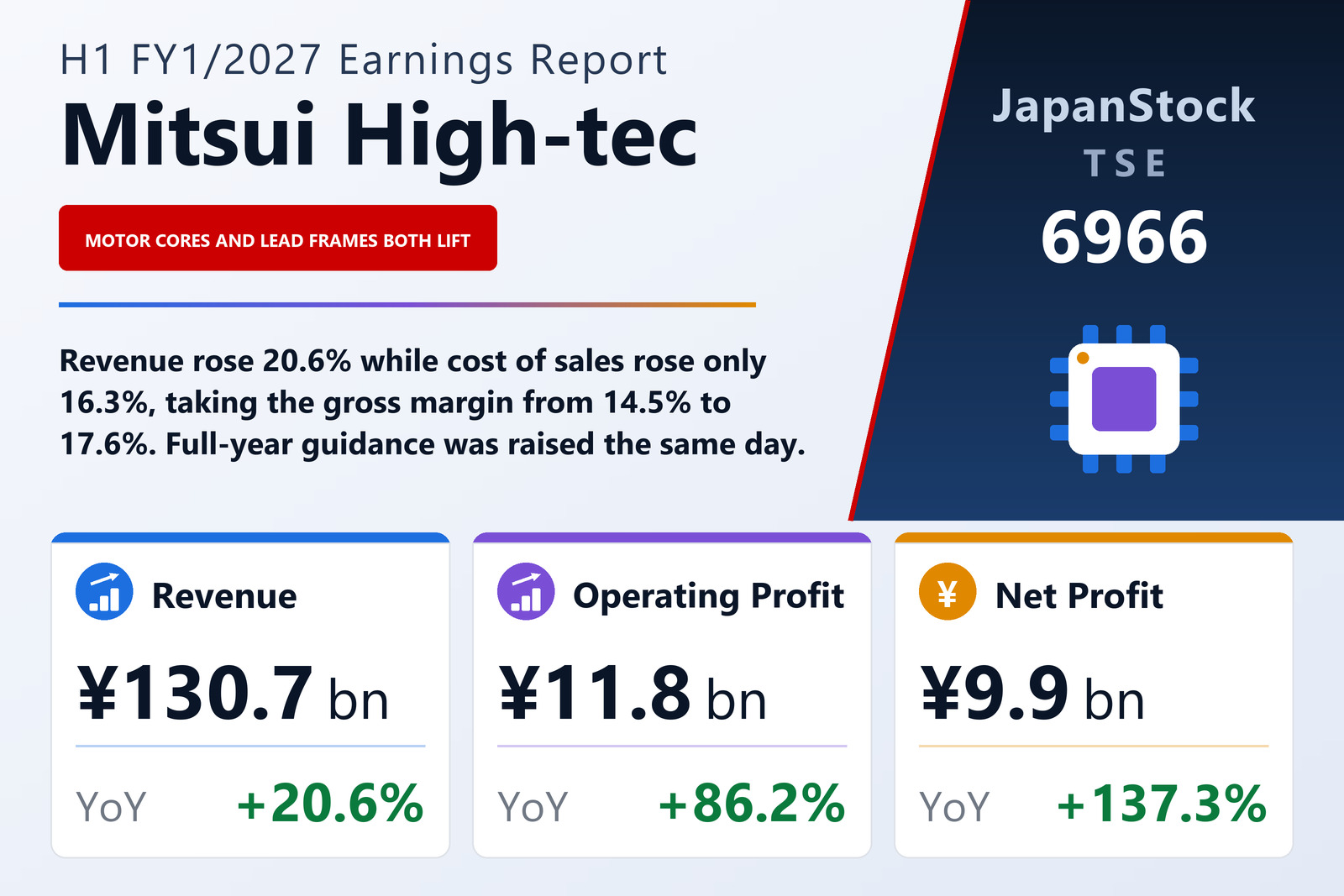
Revenue grew 20.6%, cost of sales 16.3% — and that gap is the result
Mitsui High-tec, Inc. (TSE: 6966), the Kitakyushu-based precision-machining group that stamps IC lead frames and the motor cores used in electrified-vehicle drive and generator motors, published consolidated first-half results for the six months from February 1 to July 31, 2026 on September 9, 2026 under Japanese GAAP. Revenue rose 20.6% to ¥130,672 million, operating profit 86.2% to ¥11,818 million, ordinary profit 122.8% to ¥13,319 million and profit attributable to owners of the parent 137.3% to ¥9,943 million, for earnings of ¥54.41 per share against ¥22.93. The company is listed on the Tokyo Stock Exchange Prime market and on the Fukuoka Stock Exchange.
The arithmetic between those lines is worth setting out, because it is the whole of the half. Cost of sales rose 16.3% to ¥107,648 million against revenue growth of 20.6% — a gap of a little over four percentage points, applied to a cost base above ¥100,000 million. Gross profit therefore rose 46.3% to ¥23,023 million, more than twice the rate of revenue, and the gross margin widened from 14.5% to 17.6%. Selling, general and administrative expenses grew 19.3% to ¥11,205 million, marginally slower than revenue, so almost the whole of that gross-margin gain survived to the operating line: the operating margin moved from 5.9% to 9.0%, the same 3.1-point step. A company that grew revenue by a fifth grew operating profit by 86.2% on those two spreads and on nothing else.
Below the operating line, part of the step-up is currency rather than trading
Ordinary profit rose 122.8% to ¥13,319 million, well ahead of the 86.2% recorded at the operating line, and the filing attributes that extra step mainly to foreign-exchange gains on foreign-currency financial assets. The distinction is a real one: the operating improvement was earned by the business, while a material part of the ordinary improvement was earned by the yen. Pre-tax interim profit was ¥13,426 million, up 112.5%, income taxes ¥3,508 million, up 64.7%, and interim profit ¥9,918 million, up 136.9%. Profit attributable to owners of the parent came in slightly above that total, at ¥9,943 million, because non-controlling interests bore a loss of ¥25 million against ¥2 million a year earlier. Comprehensive income was ¥13,477 million against ¥1,197 million — more than eleven times the prior-year figure, and a far larger multiple than any profit line beneath it. Subtracting interim profit from each implies other comprehensive income of roughly +¥3,559 million this year against −¥2,989 million last year, so the swing is chiefly in items outside the profit lines rather than in trading.
Motor cores carry the volume; lead frames carry the growth rate
All three reporting segments grew, and the two that matter did it differently. Electrical Components — the motor cores used in the drive and generator motors of electrified vehicles — was much the largest, at ¥89,889 million, up 16.1%, with segment operating profit of ¥8,992 million, up 68.9%. Electronic Components, the IC lead-frame business, grew far faster: revenue ¥38,749 million, up 34.8%, and segment operating profit ¥3,683 million, up 133.3%. Dies and Machine Tools, the smallest at ¥6,359 million, up 22.6%, produced the largest proportional profit move, to ¥341 million, up 562.7%, off a small base. These segment revenues include intersegment sales and transfers of ¥4,325 million, which is why the three add to ¥134,997 million against group revenue of ¥130,672 million.
The causes the filing gives run in a single line. Dies grew on increased orders for motor-core dies — the same electrification demand that drives the largest segment, one step upstream. Electronic Components grew on higher demand from automotive and consumer applications and on the weak yen, so part of that 34.8% is translation rather than volume. Electrical Components grew on firm demand for drive and generator motor cores for electrified vehicles. On profit the ranking inverts the revenue one: Electrical Components is roughly two thirds of segment revenue and lifted profit 68.9%, while Electronic Components, at under a third of revenue, more than doubled its own. The lead-frame business is where the margin moved.
Hybrids, not battery EVs, are what the filing names as firm
The market description underneath those growth rates is more specific than the numbers alone. In autos, the company says battery-EV market growth varies by region, while demand for hybrids and plug-in hybrids has been firm — and an HEV or PHEV needs motor cores as a battery EV does. In semiconductors, generative-AI-driven data-centre investment has helped and legacy semiconductors have turned to recovery; lead frames are a legacy-package product, so that turn lands on precisely the segment that more than doubled its profit. The company says it pursued orders for products and parts that save resources and energy, strengthened its global supply system, and worked group-wide on productivity and cost reduction. Its forward comment is that the electrified-vehicle market is still expanding and the semiconductor business environment is improving. Against that it sets an economy in moderate recovery but an unclear outlook, naming US economic policy, China's slowdown and Middle East tensions.
The balance sheet grew roughly in step with the business
Total assets rose 10.9% to ¥267,332 million from ¥240,994 million at January 31, 2026, and net assets 9.9% to ¥124,889 million, of which equity attributable to owners of the parent was ¥124,557 million, up 10.0%. Because assets grew marginally faster than equity, the equity ratio slipped from 47.0% to 46.6% — a 0.4-point move on a balance sheet that expanded by ¥26,338 million, which reads as growth funded partly outside equity rather than as any deterioration. Issued shares were unchanged at 197,334,325, and treasury stock rose by 70 shares to 14,585,010, including 277,500 shares held under a board-benefit trust.
Guidance raised the same day — and the 360% net-profit line needs its base stated
Mitsui High-tec revised its full-year FY1/2027 guidance in a separate release on the same day, September 9, 2026. It now expects revenue of ¥272,000 million (+24.6%), operating profit of ¥19,500 million (+54.1%), ordinary profit of ¥20,000 million (+44.8%) and profit attributable to owners of ¥14,500 million (+360.0%), for earnings per share of ¥79.34. That last figure is measured against a very depressed FY1/2026 base and should be read as such rather than as underlying growth; the operating line's +54.1%, set against a first half that already grew 86.2%, is the more informative number.
The shape of the guidance is worth reading against the half just reported. The first half delivered 48.0% of guided full-year revenue but 60.6% of guided operating profit and 68.6% of guided net profit, which leaves an implied second half of about ¥7,682 million of operating profit against the ¥11,818 million just booked, and implied earnings of roughly ¥24.93 per share against the ¥54.41 already earned. Guidance therefore assumes a second half materially less profitable than the first, and the filing does not explain why. The dividend forecast was not revised: ¥6.00 has been declared for the second quarter, with payment starting October 8, 2026, and ¥13.00 is forecast at the year-end, for an annual ¥19.00 against ¥18.00, up 5.6% — a payout of about 24% of the guided ¥79.34 of earnings per share.
| Metric | H1 FY1/2027 | H1 FY1/2026 | Change |
|---|---|---|---|
| Revenue (¥ million) | 130,672 | 108,334 | +20.6% |
| Gross profit (¥ million) | 23,023 | 15,740 | +46.3% |
| Gross margin | 17.6% | 14.5% | +3.1 pt |
| SG&A expenses (¥ million) | 11,205 | 9,393 | +19.3% |
| Operating profit (¥ million) | 11,818 | 6,347 | +86.2% |
| Ordinary profit (¥ million) | 13,319 | 5,978 | +122.8% |
| Net profit attrib. to owners of parent (¥ million) | 9,943 | 4,189 | +137.3% |
| EPS (¥) | 54.41 | 22.93 | +137.3% |
| Dies & Machine Tools — revenue (¥ million) | 6,359 | 5,186 | +22.6% |
| Dies & Machine Tools — segment profit (¥ million) | 341 | 51 | +562.7% |
| Electronic Components — revenue (¥ million) | 38,749 | 28,753 | +34.8% |
| Electronic Components — segment profit (¥ million) | 3,683 | 1,578 | +133.3% |
| Electrical Components — revenue (¥ million) | 89,889 | 77,406 | +16.1% |
| Electrical Components — segment profit (¥ million) | 8,992 | 5,325 | +68.9% |
| Total assets (¥ million) | 267,332 | 240,994 | +10.9% |
| Net assets (¥ million) | 124,889 | 113,614 | +9.9% |
| Equity ratio | 46.6% | 47.0% | −0.4 pt |
| FY1/2027 guidance — revenue (¥ million) | 272,000 | — | +24.6% |
| FY1/2027 guidance — operating profit (¥ million) | 19,500 | — | +54.1% |
| FY1/2027 guidance — ordinary profit (¥ million) | 20,000 | — | +44.8% |
| FY1/2027 guidance — net profit (¥ million) | 14,500 | — | +360.0% |
| Annual dividend per share (¥) | 19.00 | 18.00 | +5.6% |
JapanStockPulse provides informational content only and does not constitute investment advice. Figures are taken from the company's published earnings short report and may be subject to subsequent revision.