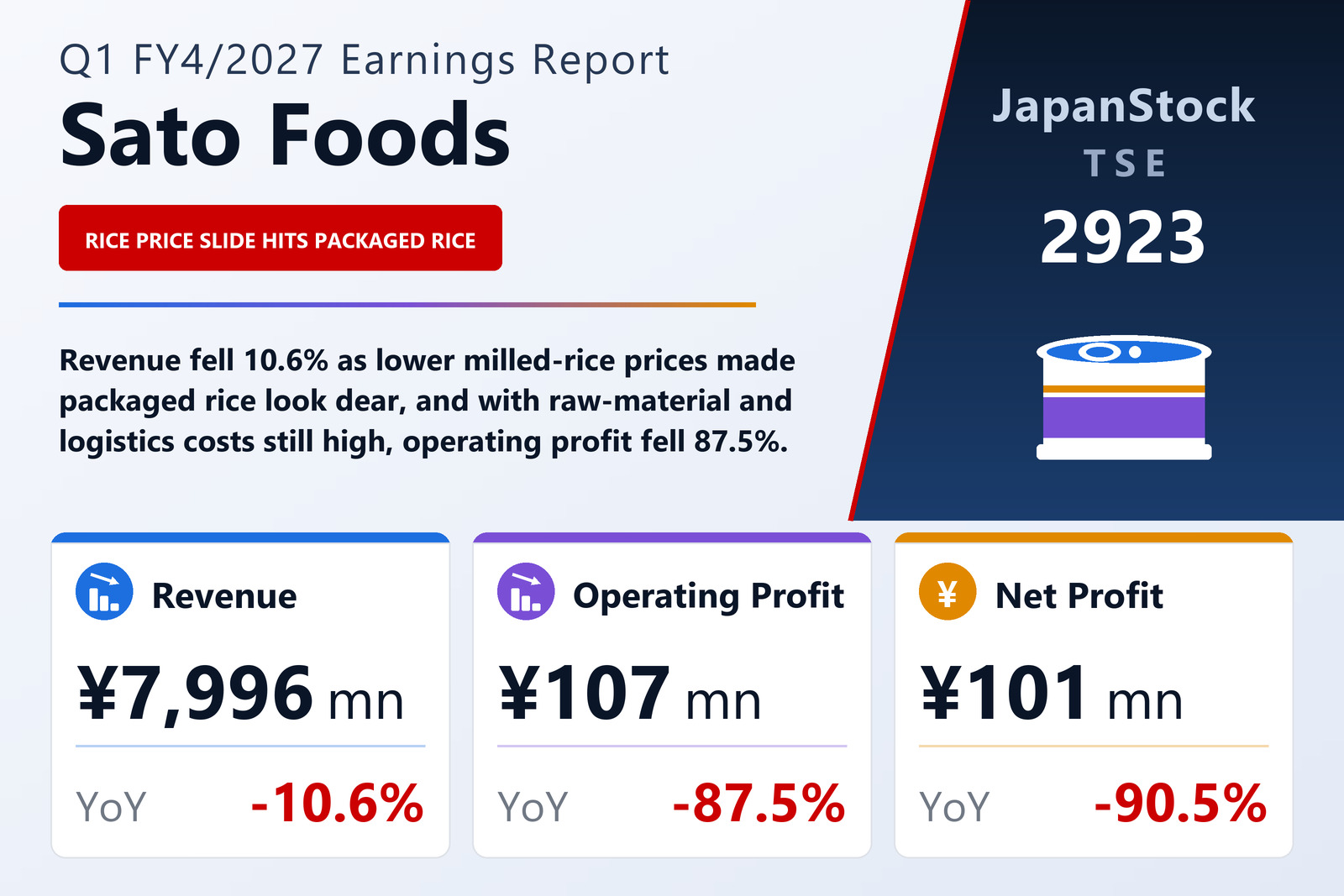
Revenue fell 10.6%, cost of sales only 3.9% — and that gap took most of the profit
Sato Foods Co., Ltd. (TSE: 2923), the maker of Sato no Gohan packaged cooked rice and of packaged mochi rice cakes, published consolidated results for the first quarter of FY4/2027 — the three months from May 1 to July 31, 2026 — on September 10, 2026 under Japanese GAAP. Revenue fell 10.6% to ¥7,996 million, operating profit 87.5% to ¥107 million, ordinary profit 84.5% to ¥150 million and profit attributable to owners of the parent 90.5% to ¥101 million, for earnings of ¥20.14 per share against ¥211.68. The quarterly statements were reviewed by the company's audit firm on a voluntary basis.
The arithmetic is short. Revenue fell by ¥945 million, but cost of sales fell only 3.9%, to ¥5,784 million from ¥6,017 million, so gross profit fell 24.3% to ¥2,212 million and the gross margin narrowed from 32.7% to 27.7%. Selling, general and administrative expenses rose 2.2% to ¥2,104 million; the filing does not break them down, but it describes nationwide television advertising and collaboration products with a well-known anime character during the period. A ¥712 million fall in gross profit and a ¥44 million rise in overheads account for virtually all of the ¥757 million fall in operating profit, and the operating margin dropped from 9.7% to 1.3%. The company attributes the decline to raw-material and logistics costs that have stayed high since the previous year, and says it revised product prices during the period to secure an appropriate profit and a stable supply.
Packaged rice lost ground as milled-rice prices fell
The group reports a single food segment and therefore publishes no segment table, but it does break sales out by product category. Packaged rice products, about 85% of revenue, fell 11.6% to ¥6,829 million. The filing says demand remains deep-rooted, but that a fall in market prices for milled rice left packaged rice looking relatively expensive, which held sales back. Packaged mochi products, including kagami mochi, fell 4.1% to ¥1,163 million, even though the filing describes sales of the main mochi products as firm. The filing states only the percentage changes for the two categories, not their prior-year amounts.
On the marketing side, Sato Foods says it ran nationwide television commercials for Sato no Gohan built around its thick-pot cooking method, and that it launched a new mainstay product, Sato no Gohan Shin-Teiban, in February 2026. In mochi it continued to promote cut mochi as an everyday ingredient rather than only a New Year food, and to sell compact kagami mochi formats suited to smaller households. The backdrop it describes cuts both ways: dual-income and single-person households are widening the use of ready-to-eat staples such as packaged rice and packaged mochi, while successive price rises keep consumers thrift- and low-price-minded.
Below the operating line, last year's securities gain is gone
Non-operating income fell to ¥142 million from ¥182 million, with by-product income down to ¥38 million from ¥57 million, while non-operating expenses rose to ¥100 million from ¥72 million, chiefly because interest expense climbed to ¥61 million from ¥37 million. Ordinary profit therefore fell 84.5% to ¥150 million. The larger swing sits one line further down: a year earlier the company booked a ¥546 million gain on the sale of investment securities, while this quarter's extraordinary gains came to just ¥250 thousand. Pre-tax profit fell 90.1% to ¥150 million from ¥1,522 million, and after ¥49 million of taxes, profit attributable to owners of the parent was ¥101 million. The filing itself names the reversal of that large prior-year extraordinary gain as one reason for the fall. Comprehensive income was ¥295 million, down 67.7%, cushioned by a ¥197 million rise in the valuation difference on securities held.
Finished-goods inventory nearly doubled while short-term borrowing appeared
Total assets fell 3.6% to ¥55,888 million from ¥57,951 million at April 30, 2026. Merchandise and finished goods rose by ¥4,311 million to ¥9,043 million, while accounts receivable fell by ¥3,018 million, cash and deposits by ¥2,588 million to ¥1,270 million, and raw materials and supplies by ¥758 million. The filing gives no reason for the inventory build; it does note that mochi, above all kagami mochi, sells mainly at the year-end, so that third-quarter sales and profit are markedly higher than in the other quarters. On the liability side, short-term borrowings of ¥4,050 million appeared where there were none at April 30, while long-term borrowings fell; total borrowings, including the current portion of long-term debt, rose to ¥22,889 million from ¥20,439 million. Other current liabilities, mainly accounts payable-other, fell by ¥4,122 million, and income taxes payable dropped to ¥16 million from ¥998 million.
Net assets eased 0.3% to ¥24,777 million: the quarter's ¥101 million profit was outweighed by ¥378 million of dividends, with a ¥193 million rise in accumulated other comprehensive income absorbing most of the difference. Because total assets shrank faster than equity, the equity ratio rose to 44.3% from 42.9%. Construction in progress stood at ¥6,585 million. The company says the second plant it is building at its Seiro Factory in Niigata Prefecture, an investment of about ¥8 billion, was completed as a building in April 2026, and that production equipment is now being brought in and installed ahead of full operation.
Full-year guidance published: revenue up 8.2%, operating profit down 11.9%
Sato Foods had left its FY4/2027 forecast undetermined, saying the effect of rice price movements could not be reasonably estimated. On September 10, 2026 it published figures in a separate release, based on the first-quarter results and the information now available. It expects revenue of ¥56,000 million (+8.2%), operating profit of ¥2,940 million (−11.9%), ordinary profit of ¥3,050 million (−15.0%) and profit attributable to owners of the parent of ¥2,060 million (−26.4%), for earnings per share of ¥408.44. As risks it names geopolitics, high energy prices, rising labour and logistics costs, changing financial conditions and raw-material inflation, with the price of rice, its main raw material, still uncertain.
Read against the quarter, the first three months delivered 14.3% of guided revenue but only 3.6% of guided operating profit, leaving ¥48,004 million of revenue and ¥2,833 million of operating profit for the remaining nine months, which include the year-end mochi season the filing identifies as the peak. After the quarter closed, the company raised the price of kagami mochi from shipments on August 3, 2026, saying it could no longer absorb the sharp rise in raw rice and higher materials, labour and logistics costs through its own efforts. The dividend forecast, which the filing also flags as revised, is ¥75.00 per share at the year-end, the same as the ¥75.00 paid for FY4/2026.
| Metric | Q1 FY4/2027 | Q1 FY4/2026 | Change |
|---|---|---|---|
| Revenue (¥ million) | 7,996 | 8,941 | −10.6% |
| Packaged rice products — sales (¥ million) | 6,829 | — | −11.6% |
| Packaged mochi products — sales (¥ million) | 1,163 | — | −4.1% |
| Cost of sales (¥ million) | 5,784 | 6,017 | −3.9% |
| Gross profit (¥ million) | 2,212 | 2,924 | −24.3% |
| Gross margin | 27.7% | 32.7% | −5.0 pt |
| SG&A expenses (¥ million) | 2,104 | 2,060 | +2.2% |
| Operating profit (¥ million) | 107 | 864 | −87.5% |
| Operating margin | 1.3% | 9.7% | −8.3 pt |
| Ordinary profit (¥ million) | 150 | 974 | −84.5% |
| Pre-tax profit (¥ million) | 150 | 1,522 | −90.1% |
| Net profit attrib. to owners of parent (¥ million) | 101 | 1,067 | −90.5% |
| Comprehensive income (¥ million) | 295 | 913 | −67.7% |
| EPS (¥) | 20.14 | 211.68 | −90.5% |
| Total assets (¥ million) | 55,888 | 57,951 | −3.6% |
| Net assets (¥ million) | 24,777 | 24,860 | −0.3% |
| Equity ratio | 44.3% | 42.9% | +1.4 pt |
| Merchandise and finished goods (¥ million) | 9,043 | 4,731 | +91.1% |
| Total borrowings (¥ million) | 22,889 | 20,439 | +12.0% |
| FY4/2027 guidance — revenue (¥ million) | 56,000 | — | +8.2% |
| FY4/2027 guidance — operating profit (¥ million) | 2,940 | — | −11.9% |
| FY4/2027 guidance — ordinary profit (¥ million) | 3,050 | — | −15.0% |
| FY4/2027 guidance — net profit (¥ million) | 2,060 | — | −26.4% |
| FY4/2027 guidance — EPS (¥) | 408.44 | — | — |
| Annual dividend per share (¥) | 75.00 | 75.00 | unchanged |
JapanStockPulse provides informational content only and does not constitute investment advice. Figures are taken from the company's published earnings short report and may be subject to subsequent revision.