Revenue grew 4.3%, cost of sales 0.8% — and that gap is the quarter
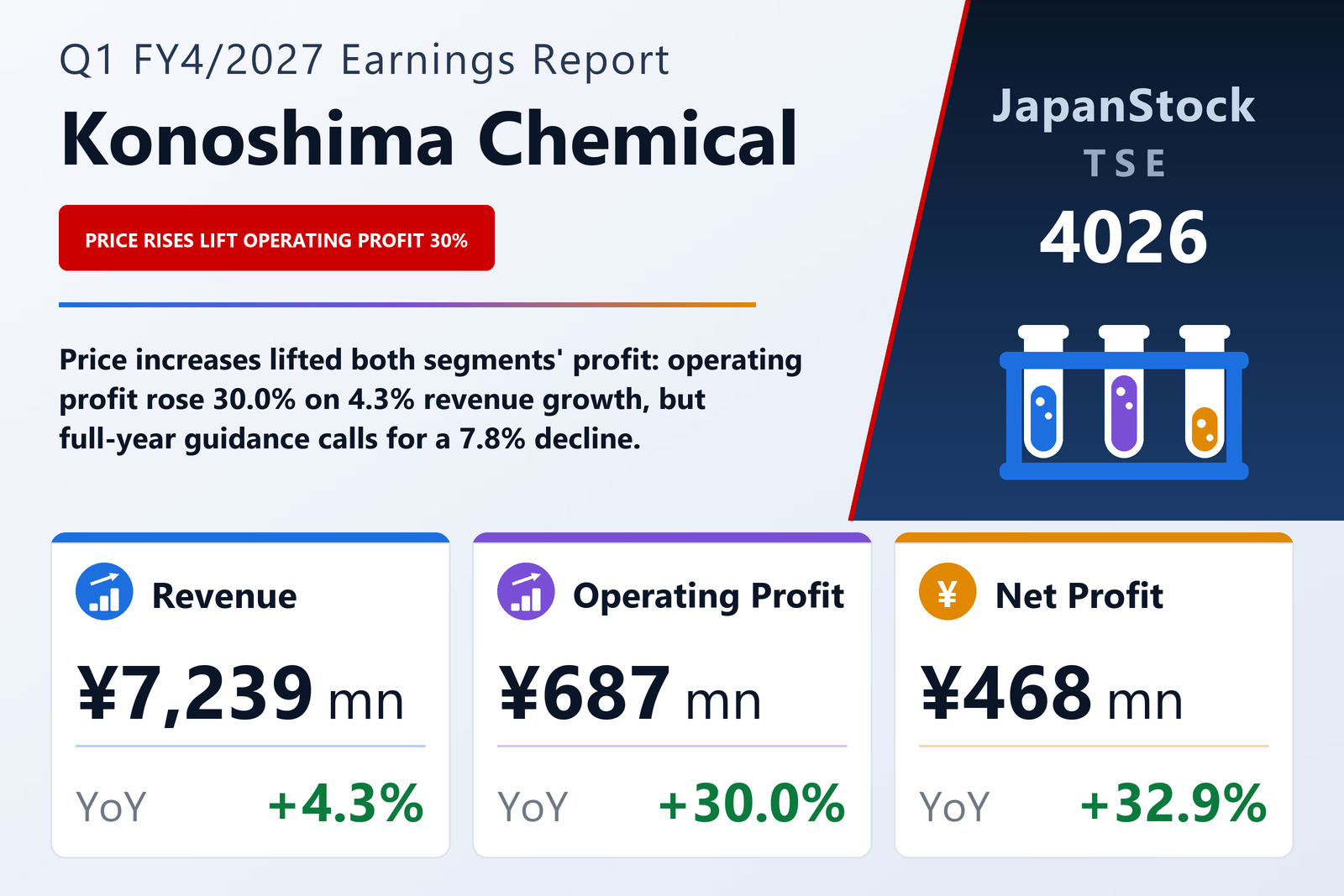
Konoshima Chemical Co., Ltd. (TSE: 4026), which makes building materials such as soffit boards, siding and fire-resistant panels alongside magnesium compounds and ceramics, published non-consolidated results for the first quarter of the fiscal year ending April 2027 — the three months from May 1 to July 31, 2026 — on September 10, 2026, under Japanese GAAP. Revenue rose 4.3% to ¥7,239 million, operating profit 30.0% to ¥687 million, ordinary profit 33.0% to ¥669 million and net profit 32.9% to ¥468 million, for earnings of ¥51.58 per share against ¥38.90 (¥51.32 against ¥38.69 diluted). The shares are listed on the Tokyo Stock Exchange, and the quarterly statements were not reviewed by an auditor.
The arithmetic is short. Revenue added ¥296 million, while cost of sales rose just 0.8% to ¥5,108 million from ¥5,069 million, so nearly all of the extra revenue reached gross profit: gross profit rose 13.7% to ¥2,130 million and the gross margin widened from 27.0% to 29.4%. Selling, general and administrative expenses grew 7.4% to ¥1,443 million — faster than revenue, and absorbing ¥99 million of the ¥257 million gain in gross profit. What remained lifted operating profit by ¥158 million, and the operating margin moved from 7.6% to 9.5%. A company whose revenue grew by little more than 4% grew operating profit by 30.0% almost entirely because its cost of sales barely moved.
Both segments grew revenue about 4%, and both lifted profit much faster
Building Materials, the larger segment by revenue, sold ¥3,936 million, up 4.4%, and earned segment profit of ¥385 million, up 35.6% from ¥284 million. In housing, the company sold more of its higher-value premium soffit boards and of siding; outside housing, it sold more fire-resistant panels for urban high-rise buildings. It attributes the profit gain to price increases it has been implementing since earlier periods and to the wider sales of premium soffit boards.
Chemical Products sold ¥3,302 million, up 4.1%, with segment profit of ¥557 million, up 19.1% from ¥468 million. Magnesium revenue grew on wider sales of higher-value magnesium oxide for supplements, sold overseas, and of flame-retardant magnesium hydroxide for domestic customers, while ceramics revenue fell on lower orders for phosphors. The profit gain is credited to price increases, cost improvements and the supplement-grade magnesium oxide. Chemical Products remains the more profitable of the two, with a segment margin of about 16.9% against 9.8% for Building Materials (14.8% and 7.5% a year earlier). Together the segments earned ¥943 million against ¥752 million; unallocated corporate expenses, mainly for administrative departments such as general affairs, rose to ¥256 million from ¥224 million and took part of that gain before operating profit.
Below the operating line, little changed the picture
Non-operating income doubled to ¥34 million from ¥17 million, chiefly on dividends received of ¥22 million against ¥10 million, while non-operating expenses rose to ¥51 million from ¥42 million, including interest of ¥40 million against ¥35 million. Ordinary profit therefore rose 33.0% to ¥669 million, slightly faster than operating profit. The only extraordinary item was a ¥2 million loss on disposal of fixed assets. Pre-tax profit was ¥667 million against ¥501 million, and income taxes of ¥198 million — ¥54 million current and ¥144 million deferred — put the effective rate at about 29.7%, close to last year's 29.5%. Net profit of ¥468 million reflects the operating improvement rather than any one-off.
Housing starts recovered from a regulation-depressed base
The company describes a Japanese economy in moderate recovery on improving employment and income, with an outlook it calls opaque because of the escalating Middle East situation and moves in exchange and interest rates. In housing, the main market for Building Materials, cumulative new housing starts for April to June 2026 were above the prior year, with owner-occupied, rental and for-sale housing all rising — but the filing notes that the prior-year period had been depressed by the enforcement of the revised Building Standards Act and the revised Building Energy Conservation Act, so the comparison is against a weak base. Management says it is working under its medium-term plan's two basic policies: building a sustainable growth model by addressing social issues such as environmental measures, balancing social contribution with profit growth, and managing with an awareness of the cost of capital and the share price.
Capital spending shows up in the balance sheet
Total assets rose ¥1,224 million to ¥32,018 million from April 30, 2026, mainly because property, plant and equipment grew by ¥867 million; construction in progress rose to ¥2,974 million from ¥2,165 million. Inventories also built up, with finished products at ¥2,719 million against ¥2,556 million and work in progress at ¥1,199 million against ¥997 million. Liabilities rose ¥967 million to ¥17,049 million, mainly because electronically recorded obligations for equipment rose by ¥895 million, to ¥1,159 million — the unpaid side of that investment. Short-term borrowings increased to ¥6,500 million from ¥5,900 million while long-term borrowings fell to ¥1,646 million from ¥2,036 million, leaving total borrowings, including the current portion of long-term debt, at ¥9,240 million against ¥9,122 million. Net assets rose ¥257 million to ¥14,968 million, mainly on a ¥232 million increase in retained earnings, and the equity ratio slipped from 47.6% to 46.6%. No quarterly cash-flow statement was prepared; depreciation was ¥514 million against ¥493 million.
Guidance: a strong first quarter, then a softer rest of the year
Konoshima Chemical published its forecasts for the fiscal year ending April 2027 in a separate notice on the same day, September 10, 2026, and the tanshin marks both the earnings and the dividend forecasts as changed from the most recently announced ones. For the first half, May to October, it expects revenue of ¥14,570 million (+5.4%), operating profit of ¥1,170 million (−3.3%), ordinary profit of ¥1,100 million (−4.8%) and net profit of ¥770 million (−4.1%), for earnings of ¥84.74 per share. For the full year it expects revenue of ¥30,530 million (+9.0%), operating profit of ¥2,470 million (−7.8%), ordinary profit of ¥2,300 million (−10.3%) and net profit of ¥1,610 million (−13.0%), for earnings of ¥177.18 per share.
Set against the quarter just reported, the guidance has a clear shape. The first quarter delivered 23.7% of guided revenue but 27.8% of guided operating profit and 29.1% of guided net profit. The first-half forecast implies second-quarter revenue of about ¥7,331 million — slightly more than the first quarter's — but operating profit of only about ¥483 million against the ¥687 million just booked. For the full year, revenue is guided up 9.0% while operating profit is guided down 7.8%, an implied operating margin of about 8.1% against 9.5% in the first quarter. The tanshin itself does not explain what the forecasts assume and refers readers to the separate notice. The dividend forecast is ¥26.00 at the interim and ¥26.00 at the year-end, ¥52.00 in total against ¥49.00 (¥23.00 plus ¥26.00) for the year ended April 2026, up 6.1% — about 29% of the guided earnings per share.
| Metric | Q1 FY4/2027 | Q1 FY4/2026 | Change |
|---|---|---|---|
| Revenue (¥ million) | 7,239 | 6,943 | +4.3% |
| Gross profit (¥ million) | 2,130 | 1,873 | +13.7% |
| Gross margin | 29.4% | 27.0% | +2.4 pt |
| SG&A expenses (¥ million) | 1,443 | 1,344 | +7.4% |
| Operating profit (¥ million) | 687 | 528 | +30.0% |
| Operating margin | 9.5% | 7.6% | +1.9 pt |
| Ordinary profit (¥ million) | 669 | 503 | +33.0% |
| Net profit (¥ million) | 468 | 352 | +32.9% |
| EPS (¥) | 51.58 | 38.90 | +32.6% |
| Building Materials — revenue (¥ million) | 3,936 | 3,771 | +4.4% |
| Building Materials — segment profit (¥ million) | 385 | 284 | +35.6% |
| Chemical Products — revenue (¥ million) | 3,302 | 3,171 | +4.1% |
| Chemical Products — segment profit (¥ million) | 557 | 468 | +19.1% |
| Unallocated corporate expense (¥ million) | −256 | −224 | +14.3% |
| Total assets (¥ million) | 32,018 | 30,793 | +4.0% |
| Total liabilities (¥ million) | 17,049 | 16,082 | +6.0% |
| Net assets (¥ million) | 14,968 | 14,710 | +1.8% |
| Equity ratio | 46.6% | 47.6% | −1.0 pt |
| H1 FY4/2027 guidance — operating profit (¥ million) | 1,170 | — | −3.3% |
| FY4/2027 guidance — revenue (¥ million) | 30,530 | — | +9.0% |
| FY4/2027 guidance — operating profit (¥ million) | 2,470 | — | −7.8% |
| FY4/2027 guidance — ordinary profit (¥ million) | 2,300 | — | −10.3% |
| FY4/2027 guidance — net profit (¥ million) | 1,610 | — | −13.0% |
| FY4/2027 guidance — EPS (¥) | 177.18 | — | — |
| Annual dividend per share (¥) | 52.00 | 49.00 | +6.1% |
JapanStockPulse provides informational content only and does not constitute investment advice. Figures are taken from the company's published earnings short report and may be subject to subsequent revision.