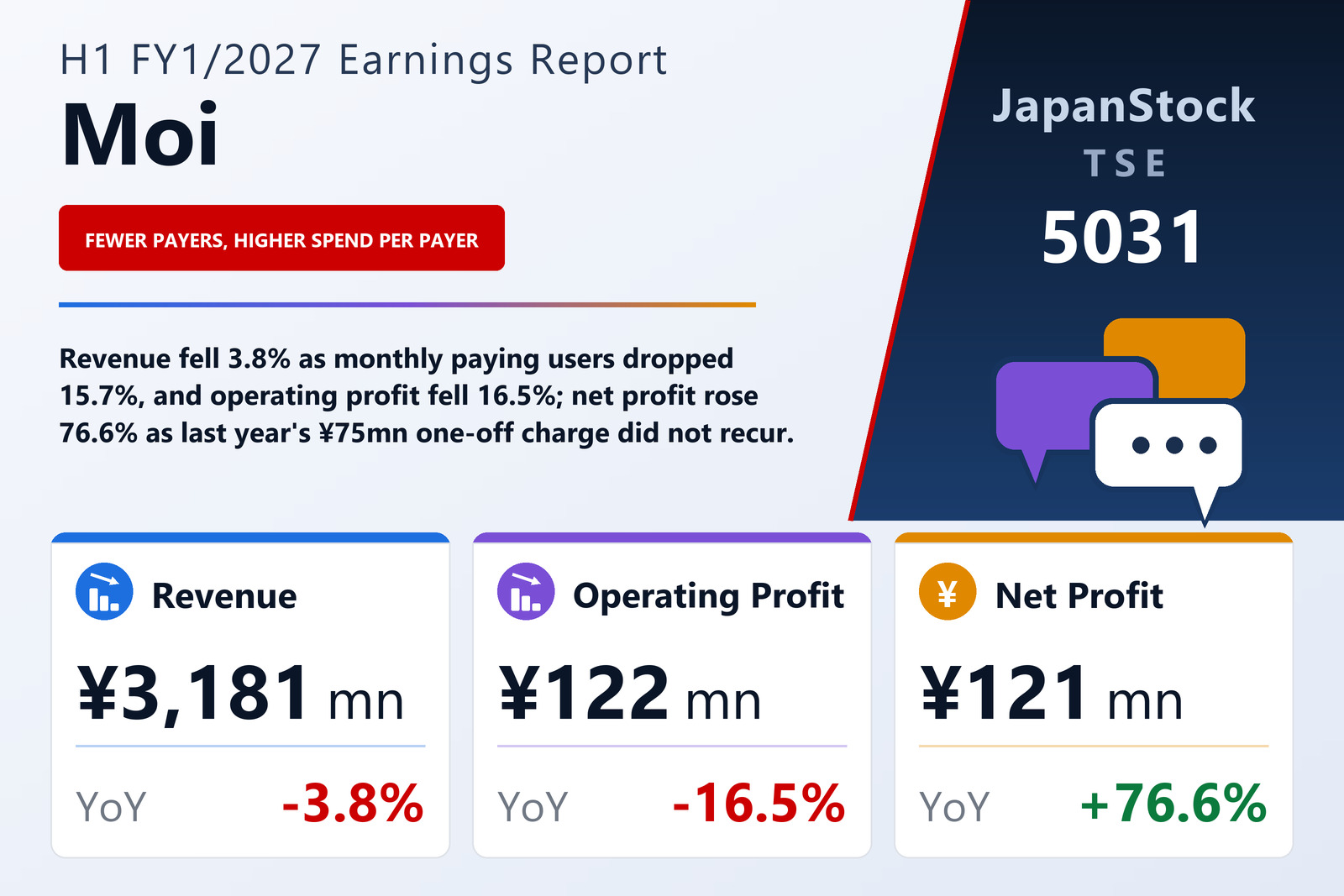
Fewer paying users, each paying more — and revenue fell 3.8%
Moi Corporation (TSE: 5031), which operates the live-streaming communication platform TwitCasting, published non-consolidated results for the first half of the fiscal year ending January 31, 2027 — the six months from February 1 to July 31, 2026 — on September 10, 2026, under Japanese GAAP. Revenue fell 3.8% to ¥3,181 million and operating profit 16.5% to ¥122 million, while ordinary profit was essentially unchanged at ¥181 million, up 0.1%. Net profit rose 76.6% to ¥121 million, for earnings of ¥8.06 per share against ¥4.93. The company is listed on the Tokyo Stock Exchange and reports a single segment, its live-streaming communication platform business, so the filing carries no segment breakdown.
Beneath the revenue line the filing gives the two figures that drive it, and they moved in opposite directions. The monthly average number of paying users of points fell 15.7% to 57 thousand, which the company attributes to the strong impact of changes in the competitive environment of Japan's live-streaming service market. Monthly average point ARPPU — average revenue per paying user, which the company names as one of its key indicators — rose 12.2% to ¥8,052. The net result was point-sales revenue of ¥2,762 million, down 5.5%, or 86.8% of the half's revenue; the filing does not break down the remaining ¥419 million.
The company's own gross-profit measure rose 8.3% while the accounting one fell 8.6%
The filing's other key indicator is real gross profit, which the company defines as total revenue less the rewards paid to monetised streamers and the fees paid to payment processors such as Apple Inc. and Google Inc. It rose 8.3% to ¥988 million, and the company gives two reasons: a further shift in its revenue structure as a smaller share of point sales was settled through in-app payment, and continued growth in its paid Membership service. The accounting measure moved the other way. Cost of sales rose 1.3% to ¥1,637 million against revenue down 3.8%, so gross profit fell 8.6% to ¥1,543 million and the gross margin narrowed from 51.1% to 48.5%. The filing does not say why cost of sales rose while revenue fell.
Lower SG&A absorbed most of the gross-profit fall, but not all of it
Selling, general and administrative expenses fell 7.9% to ¥1,421 million, a reduction of about ¥121 million set against a gross-profit fall of about ¥145 million. The ¥24 million difference is the fall in operating profit, which came to 16.5%, leaving ¥122 million, and the operating margin slipped from 4.4% to 3.8%. The largest expense line, fees paid, fell 22.6% to ¥695 million from ¥898 million, and communication costs fell 13.6% to ¥196 million from ¥227 million. The filing does not itemise the fees, but their fall sits alongside its own statement that a smaller share of point sales went through in-app payment. Two lines rose: salaries by 5.7% to ¥174 million, and advertising by 102.0% to ¥91 million from ¥45 million — roughly doubling, for reasons the filing does not give.
Below the operating line, commission income filled the gap and a one-off charge dropped out
Non-operating income rose to ¥59 million from ¥35 million, mostly commission income of ¥53 million against ¥31 million, which the filing does not describe further, while non-operating expenses shrank to almost nothing from the ¥370 thousand of foreign-exchange losses a year earlier. That improvement of roughly ¥24 million below the operating line offset the ¥24 million lost above it, leaving ordinary profit at ¥181 million, up 0.1%.
The rise in net profit comes from the comparison rather than from trading. In the first half of FY1/2026 the company booked an extraordinary loss of ¥75 million as transaction-negotiation costs: a provision for costs that might additionally arise in resolving its continuing talks with a music-copyright management organisation over the revenue reports tied to music used on TwitCasting. The filing does not say whether those talks have concluded. This half carried no extraordinary items, so pre-tax profit equalled ordinary profit, at ¥181 million against ¥106 million, up 71.1%. Income taxes were ¥59 million against ¥37 million, and net profit rose 76.6% to ¥121 million. Earnings per share rose by less, 63.5% to ¥8.06, because the average number of shares rose to 15,083,000 from 13,966,000 after the share issue described below.
A share issue to SBI Holdings lifted net assets by more than half, and ¥1.5 billion went into time deposits
On June 30, 2026, the company received payment for a third-party allotment of new shares to SBI Holdings, which added ¥460 million each to share capital and to capital surplus; the cash-flow statement records ¥921 million of proceeds. Shares in issue rose to 17,317,000 from 13,966,000 at January 31, 2026, and the company holds no treasury stock. With the half's profit also turning retained earnings positive, at ¥100 million against a deficit of ¥21 million, net assets rose 52.9% to ¥3,016 million and the equity ratio climbed from 46.4% to 59.7%.
Total assets rose 18.8% to ¥5,050 million. Cash and deposits grew by ¥841 million to ¥3,824 million, but ¥1,500 million now sits in time deposits of more than three months, so cash and cash equivalents fell by ¥658 million to ¥2,325 million. Liabilities, all of them current, fell by ¥242 million to ¥2,033 million, chiefly because amounts payable to business partners and others fell by ¥259 million and trade payables — the rewards owed to users — by ¥93 million, while deposits received, which hold ticket and content sale proceeds and Membership fees, rose by ¥27 million. Operating cash flow was an outflow of ¥39 million against an inflow of ¥2 million a year earlier, as those payments outweighed pre-tax profit; investing activities used ¥1,540 million, almost all of it the time deposit, and the share issue brought in ¥921 million. The head-office relocation added ¥24 million of building fixtures.
What the company worked on, and a full-year plan that leans on the second half
The company describes its target market, video posting and live streaming, as set to keep expanding steadily on user growth at the major global social networks. In the half it released a beauty filter that naturally retouches skin, eyes and nose, ran campaigns in which both streamers and viewers take part, and held joint online viewing events for a varied range of films. Aiming to grow the platform in both cultural and economic terms, it held an exhibition of square artworks made by TwitCasting creators, announced an initiative with UUUM Co., Ltd. to widen exchange between creators, added PayPay payment and an X follow-management feature to Membership, and opened the top two plans of Membership U, its offer for student streamers, to users aged 18 and over. On the wider economy it describes a gradual recovery with an unclear outlook, citing rising prices, concern about higher interest rates, overseas economies and geopolitical risk.
Full-year FY1/2027 guidance is unchanged from the figures published with the FY1/2026 results on March 11, 2026: revenue of ¥6,829 million (+2.1%), operating profit of ¥409 million (+20.5%) and ordinary profit of ¥461 million (+18.5%). The company publishes no net-profit or per-share forecast. The first half delivered 46.6% of guided revenue but only 29.9% of guided operating profit and 39.3% of guided ordinary profit, which implies a second half of about ¥3,648 million of revenue and ¥287 million of operating profit — revenue about 15% above the first half's, and operating profit more than double the ¥122 million just reported. The filing gives no half-by-half plan and no reason for expecting that shape. No dividend was paid for FY1/2026 and none is forecast for FY1/2027.
| Metric | H1 FY1/2027 | H1 FY1/2026 | Change |
|---|---|---|---|
| Revenue (¥ million) | 3,181 | 3,305 | −3.8% |
| Gross profit (¥ million) | 1,543 | 1,688 | −8.6% |
| Gross margin | 48.5% | 51.1% | −2.6 pt |
| SG&A expenses (¥ million) | 1,421 | 1,542 | −7.9% |
| Operating profit (¥ million) | 122 | 146 | −16.5% |
| Operating margin | 3.8% | 4.4% | −0.6 pt |
| Ordinary profit (¥ million) | 181 | 181 | +0.1% |
| Extraordinary losses (¥ million) | 0 | 75 | −100.0% |
| Pre-tax profit (¥ million) | 181 | 106 | +71.1% |
| Net profit (¥ million) | 121 | 68 | +76.6% |
| EPS (¥) | 8.06 | 4.93 | +63.5% |
| Point sales revenue (¥ million) | 2,762 | — | −5.5% |
| Real gross profit, company-defined (¥ million) | 988 | — | +8.3% |
| Monthly average paying users, points (thousand) | 57 | — | −15.7% |
| Monthly average point ARPPU (¥) | 8,052 | — | +12.2% |
| Total assets (¥ million) | 5,050 | 4,249 | +18.8% |
| Cash and deposits (¥ million) | 3,824 | 2,983 | +28.2% |
| Net assets (¥ million) | 3,016 | 1,973 | +52.9% |
| Equity ratio | 59.7% | 46.4% | +13.3 pt |
| FY1/2027 guidance — revenue (¥ million) | 6,829 | — | +2.1% |
| FY1/2027 guidance — operating profit (¥ million) | 409 | — | +20.5% |
| FY1/2027 guidance — ordinary profit (¥ million) | 461 | — | +18.5% |
| FY1/2027 guidance — net profit (¥ million) | — | — | — |
| Annual dividend per share (¥) | 0.00 | 0.00 | unchanged |
JapanStockPulse provides informational content only and does not constitute investment advice. Figures are taken from the company's published earnings short report and may be subject to subsequent revision.