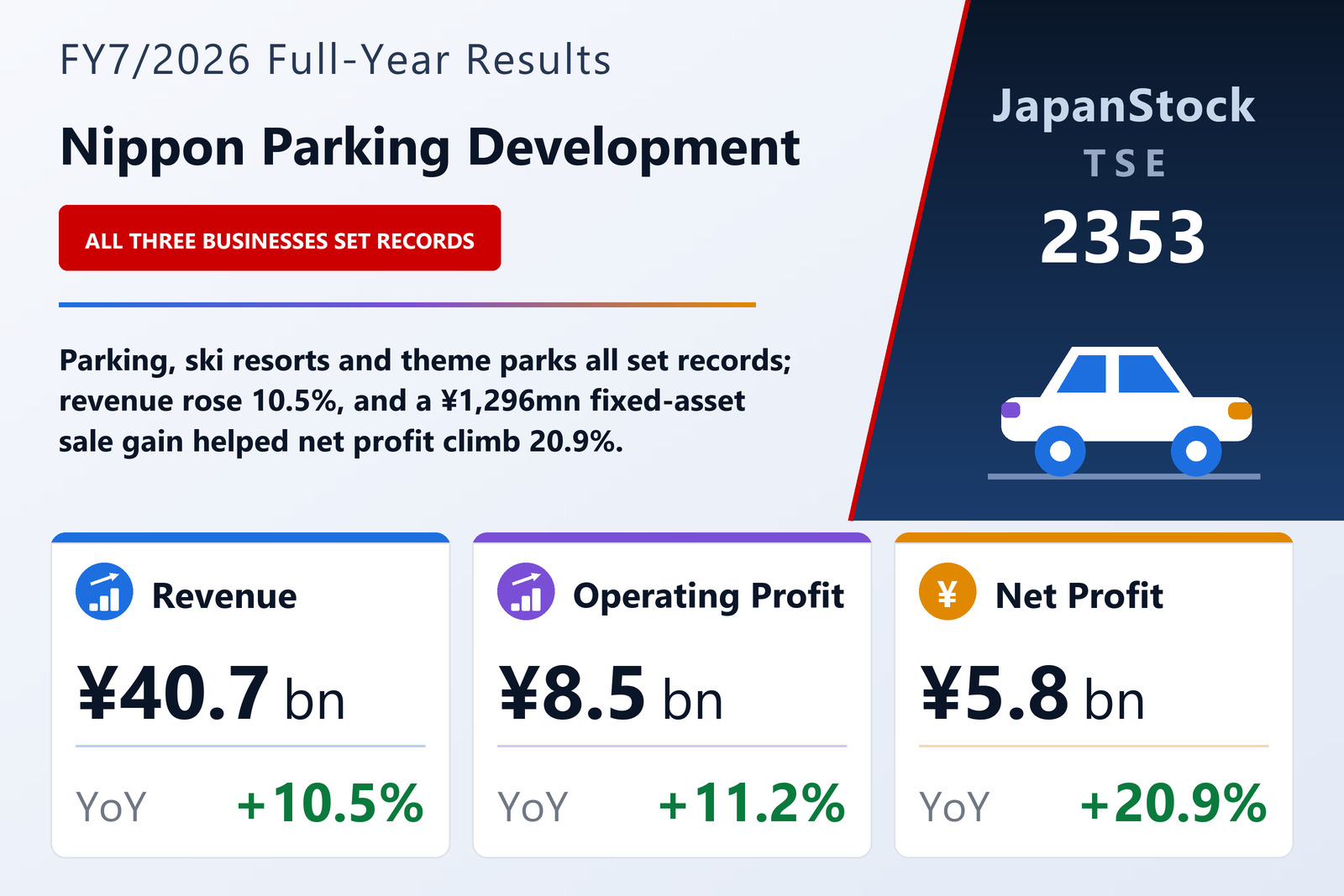
Revenue and every profit line grew by double digits, to records
Nippon Parking Development Co., Ltd. (TSE: 2353), which operates parking facilities attached to office buildings, commercial facilities and residences alongside ski resorts, theme parks, lodging and villa businesses, published consolidated results for the full year from August 1, 2025 to July 31, 2026 on September 11, 2026 under Japanese GAAP. Revenue rose 10.5% to ¥40,707 million, operating profit 11.2% to ¥8,515 million, ordinary profit 13.7% to ¥8,906 million and profit attributable to owners of the parent 20.9% to ¥5,801 million, for earnings of ¥18.35 per share against ¥15.05. The company says revenue and every profit line grew by double digits and set records. Return on equity was 29.5%, against 27.7% a year earlier.
The operating result was growth at a constant margin, not margin expansion. Cost of sales rose 10.5% to ¥24,431 million, in step with revenue, so gross profit also rose 10.5%, to ¥16,275 million, and the gross margin held at 40.0%. Selling, general and administrative expenses grew 9.8% to ¥7,759 million, slightly slower than revenue, which nudged the operating margin from 20.8% to 20.9%. Almost all of the 11.2% rise in operating profit is therefore the business getting bigger on unchanged economics.
Below operating profit, investment gains and a fixed-asset sale widened the growth
Ordinary profit grew faster than operating profit, 13.7% against 11.2%. Non-operating income more than doubled to ¥783 million from ¥371 million, chiefly because gains on sales of investment securities rose to ¥338 million from ¥48 million; interest income was ¥81 million and foreign-exchange gains ¥134 million. Against that, interest expense nearly doubled to ¥269 million from ¥141 million as borrowings increased. Extraordinary items then added more. Extraordinary income was ¥1,302 million against ¥143 million, almost all of it a ¥1,296 million gain on sales of fixed assets, while extraordinary losses rose to ¥504 million, including impairment losses of ¥308 million and losses on retirement of fixed assets of ¥195 million. The filing does not identify the assets sold or impaired.
Net of both, extraordinary items added roughly ¥798 million to pre-tax profit, against a net charge of roughly ¥114 million a year earlier, and pre-tax profit rose 25.7% to ¥9,703 million. Income taxes rose 34.5% to ¥2,916 million, lifting the effective rate from about 28.1% to 30.1%, and profit attributable to non-controlling interests rose 31.4% to ¥986 million, which the filing links mainly to the ski business. Profit attributable to owners of the parent therefore grew 20.9%. Earnings per share grew a little faster, 21.9%, because share buybacks cut the average share count to 316,085,360 from 319,032,365.
Parking is still the largest profit pool; theme parks grew fastest
Segment figures include intersegment sales. Parking, the largest, grew revenue 7.8% to ¥19,238 million and segment profit 9.9% to ¥4,934 million, more than half of the ¥9,014 million earned by the three reportable segments. Ski Resorts grew revenue 9.9% to ¥11,498 million but profit only 5.7%, to ¥2,373 million, so its margin slipped from 21.5% to 20.6%. Theme Parks, which also carry the lodging and villa businesses, grew fastest: revenue 16.9% to ¥8,993 million and profit 27.2% to ¥1,707 million, lifting the margin from 17.5% to 19.0%. The Other segment, covering education, healthcare, renewable energy and similar businesses, had revenue of ¥1,108 million, up 16.0%, and profit of ¥196 million, down 7.2%. After unallocated corporate costs of ¥695 million against ¥631 million, the segments reconcile to operating profit of ¥8,515 million.
In parking, the domestic portfolio grew by a net 154 sites, with 226 new contracts and 72 cancellations, against a net gain of 113 the year before, to 1,666 sites and 49,304 spaces; the company says it pushed sublease proposals for parking attached to condominiums. Domestic parking revenue rose 9.0% to ¥17,818 million, and the contract rate at directly operated monthly-only sites improved from 92.2% to 93.9%. Overseas revenue fell to ¥1,420 million from ¥1,503 million: Thailand grew 16.1% to ¥1,420 million, but there was no revenue from South Korea, against ¥280 million a year earlier. The company says it concentrated overseas resources on Thailand, where sites fell by three to 49 as low-margin contracts ended.
Ski resorts: record inbound skiers in a warm winter, fewer summer visitors
The winter was warm with little snow, after heavy snowfall the season before, and the company credits its continued investment in snowmaking machines with opening its main resorts on a normal schedule and operating stably to the end of the season. Winter visitors were 1,883 thousand against 1,893 thousand, essentially flat, but inbound visitors rose 23.2% to a record 544 thousand from 441 thousand, and members of its children's season-pass program rose to 48 thousand from 44 thousand. Green-season visitors at lift-operated resorts fell to 499 thousand from 520 thousand, which the filing attributes to poor weather on holidays and weekends, rainy-season rain and record heat in July.
Revenue still grew 9.9% because lift-ticket prices were revised across the group's resorts and food, beverage and premium lounge services were expanded, taking revenue per visitor to a record. The filing does not explain why segment profit grew more slowly than revenue. It does describe rising labor and energy costs as an industry-wide issue, and the segment's depreciation rose to ¥1,231 million from ¥1,023 million while its additions to fixed assets increased to ¥4,796 million from ¥2,776 million.
Theme parks: more visitors, record lodging, and a second base in Izu
Theme-park visitors rose 4.6% to 958 thousand, the highest since the parks joined the group, on influencer and IP collaborations and new attractions at its parks in the Nasu area of Tochigi Prefecture. Lodging guests rose 6.8% to a record 226 thousand, helped by free stays for children of elementary-school age and younger and by distinctive rental villas, and villa sales set a record, including the company's first sale of a newly built property priced above ¥100 million. In March 2026 the group acquired all shares of Izu Kanko Kaihatsu Co., Ltd., which operates Amagi Tokyu Resort, and began running hotel, golf and villa operations on the Izu Peninsula; it is a newly consolidated subsidiary this year. The filing does not state how much revenue or profit it contributed.
Borrowing, a buyback and time deposits reshaped the balance sheet
Total assets rose 22.1%, or ¥11,030 million, to ¥61,014 million at July 31, 2026. Cash and deposits rose ¥5,854 million to ¥27,518 million, mainly on new borrowing, and property, plant and equipment rose ¥3,834 million to ¥20,309 million, mainly on ski-resort investment. Liabilities rose ¥8,946 million to ¥36,055 million: borrowings increased by ¥5,103 million, and consolidating Izu Kanko Kaihatsu added a ¥3,348 million non-current reserve related to business combinations. Net assets rose only 9.1%, to ¥24,959 million, because share buybacks reduced them by ¥2,286 million and ¥2,556 million was paid in dividends, so the equity ratio fell from 38.3% to 33.2%. Treasury shares rose to 36,725,677 from 28,834,384.
Operating cash flow was ¥8,207 million, level with ¥8,180 million, as pre-tax profit of ¥9,703 million and depreciation of ¥2,270 million were offset by ¥2,259 million of income taxes paid. The investing outflow nearly doubled to ¥9,269 million: ¥7,261 million went on property, plant and equipment and ¥7,136 million into time deposits, partly offset by a ¥3,921 million inflow from acquiring the shares of the newly consolidated subsidiary. Financing used ¥359 million, with ¥7,300 million of new long-term borrowing more than absorbed by ¥2,556 million of dividends, ¥2,505 million of share buybacks, ¥2,196 million of loan repayments and a ¥500 million bond redemption. Because time deposits sit outside cash equivalents, cash and cash equivalents fell ¥1,245 million to ¥19,672 million even though cash and deposits on the balance sheet rose.
Guidance: operating profit to ¥10,000 million, net profit up only 3.4%, dividend to ¥10.00
For FY7/2027 the company forecasts revenue of ¥45,700 million (+12.3%), operating profit of ¥10,000 million (+17.4%), ordinary profit of ¥10,000 million (+12.3%) and profit attributable to owners of the parent of ¥6,000 million (+3.4%), or ¥19.25 per share. By segment it expects parking revenue of ¥20,800 million (+8.1%) and operating profit, including company-wide SG&A, of ¥4,725 million (+11.5%); ski revenue of ¥13,320 million (+15.8%) and operating profit of ¥3,000 million (+26.4%); and theme-park revenue of ¥10,700 million (+19.0%) and operating profit of ¥2,050 million (+20.1%). The company also plans to acquire all shares of the operator of Izu Fujimi New Town in November 2026.
The shape of that guidance is worth reading. Ordinary profit is guided level with operating profit, implying no net non-operating income against roughly ¥390 million this year, and net profit growth of 3.4% sits far below operating growth of 17.4%. The FY7/2026 base included the net extraordinary gain of roughly ¥798 million; the filing does not say what it assumes for extraordinary items next year. The annual dividend for FY7/2026 rises to ¥9.00 from ¥8.00, the 16th consecutive annual increase and a 49.0% payout ratio, with payment starting October 30, 2026. For FY7/2027 the company forecasts ¥10.00 (+11.1%), under a medium-term shareholder-return policy adopted by the board on August 7, 2026 that sets minimum annual dividends of ¥10.00, ¥11.00 and ¥12.00 for FY7/2027 through FY7/2029.
| Metric | FY7/2026 | FY7/2025 | Change |
|---|---|---|---|
| Revenue (¥ million) | 40,707 | 36,832 | +10.5% |
| Gross profit (¥ million) | 16,275 | 14,726 | +10.5% |
| Gross margin | 40.0% | 40.0% | unchanged |
| SG&A expenses (¥ million) | 7,759 | 7,066 | +9.8% |
| Operating profit (¥ million) | 8,515 | 7,659 | +11.2% |
| Operating margin | 20.9% | 20.8% | +0.1 pt |
| Ordinary profit (¥ million) | 8,906 | 7,832 | +13.7% |
| Extraordinary income (¥ million) | 1,302 | 143 | +808.4% |
| Extraordinary losses (¥ million) | 504 | 257 | +95.8% |
| Pre-tax profit (¥ million) | 9,703 | 7,718 | +25.7% |
| Net profit attrib. to owners of parent (¥ million) | 5,801 | 4,799 | +20.9% |
| EPS (¥) | 18.35 | 15.05 | +21.9% |
| Comprehensive income (¥ million) | 6,943 | 5,741 | +20.9% |
| Parking — revenue (¥ million) | 19,238 | 17,847 | +7.8% |
| Parking — segment profit (¥ million) | 4,934 | 4,490 | +9.9% |
| Ski Resorts — revenue (¥ million) | 11,498 | 10,461 | +9.9% |
| Ski Resorts — segment profit (¥ million) | 2,373 | 2,246 | +5.7% |
| Theme Parks — revenue (¥ million) | 8,993 | 7,690 | +16.9% |
| Theme Parks — segment profit (¥ million) | 1,707 | 1,342 | +27.2% |
| Other — revenue (¥ million) | 1,108 | 955 | +16.0% |
| Other — segment profit (¥ million) | 196 | 211 | −7.2% |
| Total assets (¥ million) | 61,014 | 49,984 | +22.1% |
| Net assets (¥ million) | 24,959 | 22,875 | +9.1% |
| Equity ratio | 33.2% | 38.3% | −5.1 pt |
| Operating cash flow (¥ million) | 8,207 | 8,180 | +0.3% |
| Investing cash flow (¥ million) | −9,269 | −4,888 | n.m. |
| Financing cash flow (¥ million) | −359 | 1,203 | n.m. |
| FY7/2027 guidance — revenue (¥ million) | 45,700 | — | +12.3% |
| FY7/2027 guidance — operating profit (¥ million) | 10,000 | — | +17.4% |
| FY7/2027 guidance — ordinary profit (¥ million) | 10,000 | — | +12.3% |
| FY7/2027 guidance — net profit (¥ million) | 6,000 | — | +3.4% |
| Annual dividend per share (¥) | 10.00 | 9.00 | +11.1% |
| Annual dividend per share, FY7/2026 vs FY7/2025 (¥) | 9.00 | 8.00 | +12.5% |
JapanStockPulse provides informational content only and does not constitute investment advice. Figures are taken from the company's published earnings short report and may be subject to subsequent revision.