Sales dipped 2.3%, but three quarters of operating profit disappeared
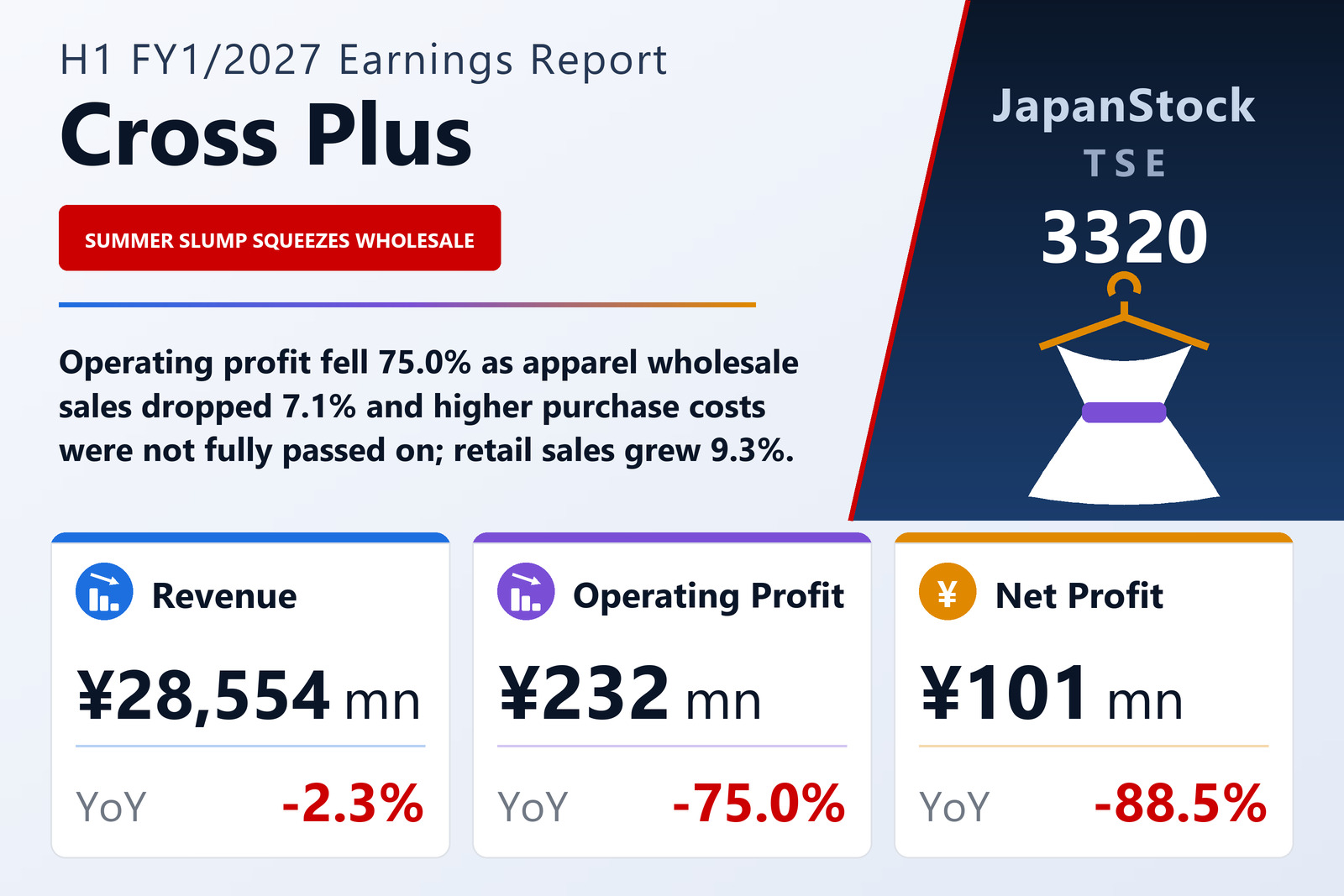
Cross Plus Inc. (TSE: 3320), an apparel wholesaler and retailer, published consolidated first-half results for the six months from February 1 to July 31, 2026 on September 11, 2026 under Japanese GAAP. Revenue fell 2.3% to ¥28,554 million, operating profit 75.0% to ¥232 million, ordinary profit 66.7% to ¥357 million and profit attributable to owners of the parent 88.5% to ¥101 million, for earnings of ¥13.67 per share against ¥119.68. The shares are listed on the Tokyo and Nagoya stock exchanges. The period includes a change in the scope of consolidation: on June 2, 2026 the company acquired all shares of a company whose main business is planning, manufacturing and selling a licensed apparel brand, bringing it and one subsidiary into the group. Both have a March 31 year-end and were consolidated using provisional accounts as of June 30. The interim report was not reviewed by an auditor.
The arithmetic of the operating line is short. Cost of sales fell only 1.6% to ¥20,659 million against the 2.3% drop in revenue, so gross profit fell 4.0% to ¥7,894 million and the gross margin narrowed from 28.2% to 27.6%. At the same time selling, general and administrative expenses rose 5.0% to ¥7,662 million. Gross profit was ¥332 million lower and SG&A ¥367 million higher: together ¥699 million, within ¥1 million of the ¥698 million by which operating profit fell. The operating margin dropped from 3.2% to 0.8%.
Weather and costs: the company's own explanation
The company attributes the weaker gross margin to apparel wholesale, where purchase costs rose on higher raw-material prices and the weak yen and price increases did not pass those costs on in full. SG&A expenses rose on higher personnel costs and on variable costs, such as sales commissions, that grew with retail sales. On demand, it describes an apparel market in which unseasonable weather across Japan from late May held back sales of summer goods, and in which inflation driven by raw-material prices made consumers more cautious with money. The wider economy, it says, recovered moderately, while geopolitical risks including the Middle East and U.S. trade policy left the outlook uncertain.
Apparel wholesale shrank 7.1%; retail and lifestyle goods grew
Cross Plus does not report segment information, on the grounds that clothing makes up most of the business, but it discloses revenue by division, giving current amounts and year-on-year rates without the prior-year amounts. Apparel wholesale, at ¥19,941 million, down 7.1%, is roughly 70% of revenue; it fell because summer goods sold slowly in stores after temperatures rose late from May, and because sales to suburban specialty stores remained difficult. Lifestyle wholesale rose 21.8% to ¥1,745 million, helped by UV-protection products under the seasonal goods brand Yoki, leaving wholesale as a whole at ¥21,687 million, down 5.3%. Retail grew 9.3% to ¥6,669 million: clothing and a wider range of DECOY general goods lifted store sales, and maternity products sold well online. Other revenue was ¥197 million, down 13.4%.
The sales-channel breakdown tells the same story. Specialty stores, the largest channel at ¥12,650 million, fell 7.4%, and department stores and other fell 4.0% to ¥991 million. Mass retailers were flat at ¥9,880 million (+0.3%), while non-store sales rose 7.7% to ¥2,900 million and e-commerce 9.9% to ¥1,760 million; the remaining ¥370 million slipped 0.7%. The company says it is widening its specialty-store channel to improve profitability, building up its functional fashion brand and its men's business, adding beauty products such as a Korean nail brand to lifestyle wholesale, and using social media and video to market online.
Below the operating line, last year's securities gain is gone and tax took most of the rest
Non-operating income edged up to ¥181 million from ¥172 million, but non-operating expenses doubled to ¥56 million from ¥28 million: interest expense rose to ¥22 million from ¥8 million, and a foreign-exchange loss of ¥12 million replaced last year's ¥10 million gain. A year earlier the company also booked a ¥200 million gain on the sale of investment securities; this half had no such gain and recorded a ¥22 million valuation loss on investment securities instead, so pre-tax profit fell 73.5% to ¥335 million. Income taxes were ¥233 million, of which ¥213 million was deferred tax. That is about 70% of pre-tax profit, against about 30% a year earlier, and the filing does not explain the higher burden. What remained was net profit of ¥101 million.
Comprehensive income fell 97.7% to ¥31 million from ¥1,402 million. Other comprehensive income was negative ¥69 million, against positive ¥515 million a year earlier, mainly because the valuation difference on available-for-sale securities swung to −¥232 million from +¥576 million; deferred hedge gains of ¥174 million partly offset it.
A slightly smaller balance sheet, a higher equity ratio and cash spent on the acquisition
Total assets fell 2.0% to ¥29,095 million from ¥29,678 million at January 31, 2026. Current assets dropped ¥1,118 million, chiefly because notes and accounts receivable fell ¥552 million, electronically recorded receivables ¥342 million and cash and deposits ¥185 million. Non-current assets rose ¥535 million: property, plant and equipment grew ¥593 million and goodwill rose to ¥415 million from ¥180 million, while investment securities fell ¥350 million. Liabilities fell ¥454 million to ¥9,749 million, with electronically recorded obligations down ¥569 million and long-term borrowings down ¥386 million, partly offset by accounts payable up ¥550 million. Net assets slipped 0.7% to ¥19,345 million, and because assets shrank faster, the equity ratio rose from 65.5% to 66.4%.
Operating cash flow was ¥808 million, about half the ¥1,603 million of a year earlier, supported by a ¥1,042 million fall in receivables against pre-tax profit of only ¥335 million. Investing activities used ¥455 million, against an inflow of ¥51 million, as ¥723 million went on acquiring subsidiary shares that changed the scope of consolidation, partly offset by ¥387 million from selling investment securities; purchases of property, plant and equipment were ¥112 million. Financing used ¥543 million, including ¥506 million of long-term debt repayment and dividends of ¥200 million against ¥110 million. Cash and cash equivalents ended the half at ¥4,788 million, down ¥185 million.
Guidance was revised a week earlier, and the dividend still rises
The full-year FY1/2027 forecast was revised in a separate release on September 4, 2026, replacing the forecast published on March 13, 2026; this filing does not restate the earlier figures. The company now expects revenue of ¥61,000 million (+1.9%), operating profit of ¥700 million (−50.0%), ordinary profit of ¥900 million (−45.0%) and profit attributable to owners of the parent of ¥900 million (−48.8%), for earnings per share of ¥120.57. The first half delivered 46.8% of guided revenue but only 33.1% of guided operating profit and 11.2% of guided net profit, so the forecast implies a second half with about ¥32,446 million of revenue, ¥468 million of operating profit and ¥799 million of net profit, which is more profit than the first half produced. The filing says only that the forecast reflects the first-half results, and gives no reason for the implied second-half improvement.
The dividend forecast was not revised. The interim dividend is ¥30.00, up from ¥23.00, payable from October 26, 2026, which is more than twice first-half earnings per share of ¥13.67. A year-end dividend of ¥30.00 is forecast against ¥27.00, for an annual ¥60.00 against ¥50.00, up 20.0% and about half of the guided ¥120.57 of earnings per share. As a subsequent event, the board resolved on September 4, 2026 to buy back up to 250,000 shares or ¥350 million between September 7 and November 30, 2026, through market purchases including the ToSTNeT-3 off-auction system, citing a flexible capital policy and stronger shareholder returns; the shares may be used as part of the consideration in M&A or cancelled. The 250,000 shares equal about 3.3% of the 7,464,279 shares outstanding excluding treasury stock at July 31, 2026.
| Metric | H1 FY1/2027 | H1 FY1/2026 | Change |
|---|---|---|---|
| Revenue (¥ million) | 28,554 | 29,217 | −2.3% |
| Gross profit (¥ million) | 7,894 | 8,226 | −4.0% |
| Gross margin | 27.6% | 28.2% | −0.5 pt |
| SG&A expenses (¥ million) | 7,662 | 7,295 | +5.0% |
| Operating profit (¥ million) | 232 | 930 | −75.0% |
| Operating margin | 0.8% | 3.2% | −2.4 pt |
| Ordinary profit (¥ million) | 357 | 1,074 | −66.7% |
| Pre-tax profit (¥ million) | 335 | 1,264 | −73.5% |
| Net profit attrib. to owners of parent (¥ million) | 101 | 886 | −88.5% |
| EPS (¥) | 13.67 | 119.68 | −88.6% |
| Comprehensive income (¥ million) | 31 | 1,402 | −97.7% |
| Apparel Wholesale — revenue (¥ million) | 19,941 | — | −7.1% |
| Lifestyle Wholesale — revenue (¥ million) | 1,745 | — | +21.8% |
| Retail — revenue (¥ million) | 6,669 | — | +9.3% |
| Other — revenue (¥ million) | 197 | — | −13.4% |
| Total assets (¥ million) | 29,095 | 29,678 | −2.0% |
| Net assets (¥ million) | 19,345 | 19,474 | −0.7% |
| Equity ratio | 66.4% | 65.5% | +0.9 pt |
| FY1/2027 guidance — revenue (¥ million) | 61,000 | — | +1.9% |
| FY1/2027 guidance — operating profit (¥ million) | 700 | — | −50.0% |
| FY1/2027 guidance — ordinary profit (¥ million) | 900 | — | −45.0% |
| FY1/2027 guidance — net profit (¥ million) | 900 | — | −48.8% |
| FY1/2027 guidance — EPS (¥) | 120.57 | — | — |
| Annual dividend per share (¥) | 60.00 | 50.00 | +20.0% |
JapanStockPulse provides informational content only and does not constitute investment advice. Figures are taken from the company's published earnings short report and may be subject to subsequent revision.