Revenue grew 40.1%, cost of sales 44.9% — and the operating line went the other way
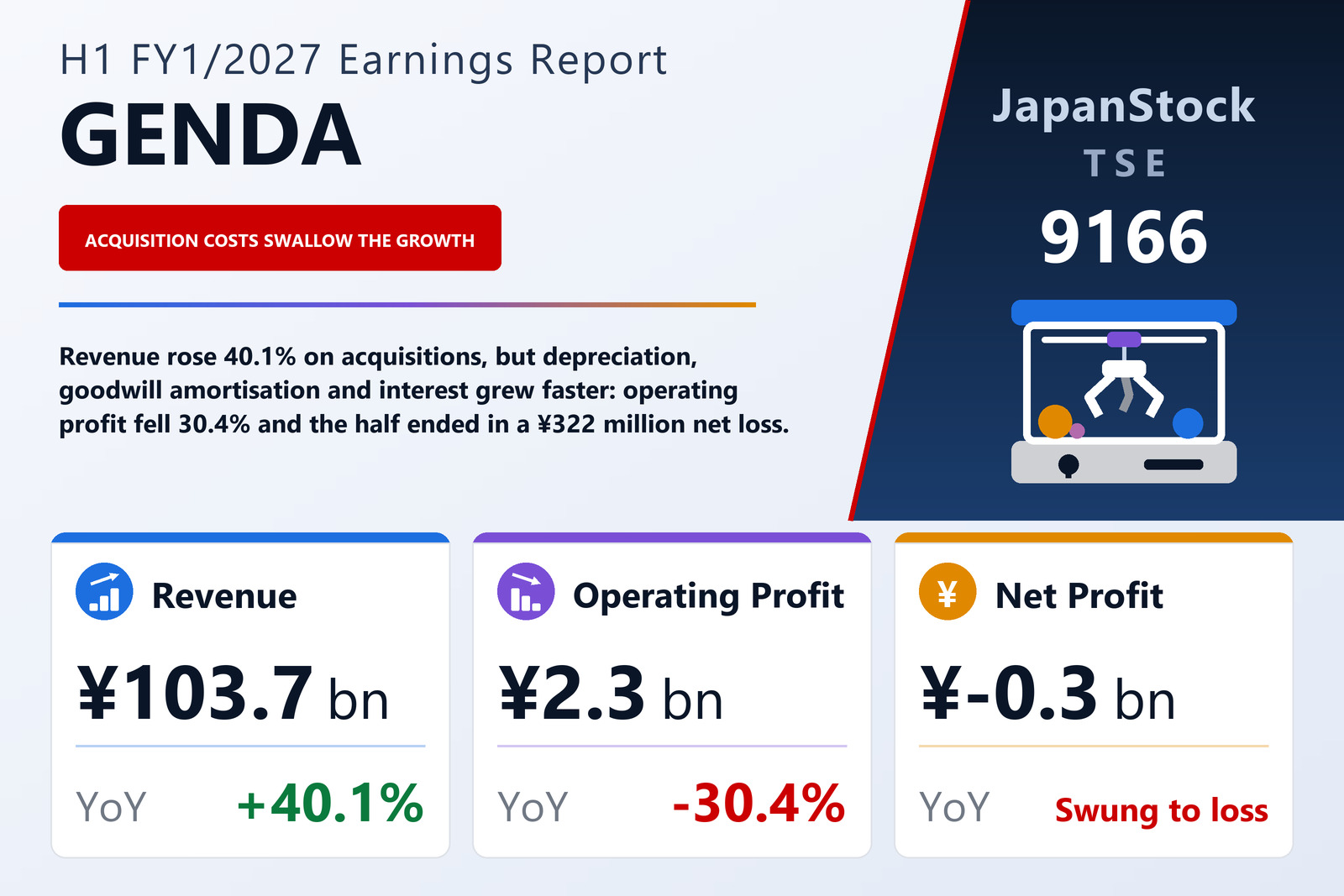
GENDA Inc. (TSE: 9166), the entertainment group that runs GiGO amusement arcades in Japan, North America, the United Kingdom and China alongside karaoke, food and beverage, foreign-exchange machines, photo studios, character merchandise and film distribution, published consolidated results for the first half of FY1/2027 — the six months from February 1 to July 31, 2026 — on September 11, 2026 under Japanese GAAP. Revenue rose 40.1% to ¥103,664 million, but operating profit fell 30.4% to ¥2,252 million, ordinary profit 53.8% to ¥1,110 million, and the bottom line swung to a net loss attributable to owners of the parent of ¥322 million from a profit of ¥335 million, for a loss of ¥1.76 per share against earnings of ¥1.98. The company is listed on the Tokyo Stock Exchange.
The shape of the half is set by two spreads, both running against the company. Cost of sales rose 44.9% to ¥82,110 million against revenue growth of 40.1%, so gross profit grew only 24.7% to ¥21,554 million and the gross margin narrowed from 23.4% to 20.8%. Selling, general and administrative expenses then rose 37.4% to ¥19,301 million — slower than revenue, but on a gross-profit line that had grown by only a quarter — and the operating margin halved, from 4.4% to 2.2%. The cash-flow statement shows where the cost growth sits: depreciation rose 63.4% to ¥6,179 million and goodwill amortisation 52.0% to ¥2,376 million, together ¥3,211 million more than a year earlier — more than three times the ¥987 million by which operating profit fell. The segment note tells the same story from the other side: profit before those two charges rose in both segments, and it was the charges that turned the operating line down.
Interest and a tax charge larger than pre-tax profit turn a thin operating profit into a net loss
Below the operating line the pressure continued. Non-operating income rose to ¥621 million from ¥249 million, helped by a foreign-exchange gain of ¥106 million, an ¥85 million gain on the sale of investment securities and ¥65 million of compensation received, but non-operating expenses rose to ¥1,763 million from ¥1,082 million. Interest paid was the largest item, up 75.4% to ¥1,133 million, and loan-related fees — which the filing defines as fees on borrowing taken for acquisitions — rose to ¥224 million from ¥95 million. Ordinary profit therefore fell 53.8% to ¥1,110 million. There were no extraordinary items, so pre-tax profit was the same ¥1,110 million; income taxes of ¥1,407 million, down from ¥2,025 million but still larger than pre-tax profit, produced an interim loss of ¥296 million, and after ¥25 million attributable to non-controlling interests the loss attributable to owners of the parent was ¥322 million against a profit of ¥335 million. The filing does not explain why the tax charge exceeded pre-tax profit. Comprehensive income nevertheless rose 115.7% to ¥1,644 million, because foreign-currency translation adjustments contributed ¥1,941 million against ¥377 million a year earlier.
Two accounting notes frame the comparison. The prior-year figures have been restated for the finalisation of the provisional purchase-price accounting for the July 2, 2025 combination with Pixel Intermediate Holding Corporation; the filing says the finalisation had no effect on the current interim statements. And all per-share figures reflect the two-for-one stock split of April 1, 2025, so the ¥1.98 of prior-year earnings per share is on the same share basis as this half's ¥1.76 loss. The average number of shares in issue rose 7.8% to 182,474,907 from 169,207,987, reflecting the ¥18,452 million equity issue booked in the prior-year half.
On the company's own measures the half grew — but at half the rate of revenue
GENDA reports two non-GAAP figures alongside the statutory ones, and both grew. Adjusted EBITDA — operating profit plus depreciation, goodwill amortisation and M&A-related costs — rose 21.1% to ¥11,206 million from ¥9,252 million. Adjusted interim net profit — profit attributable to owners plus M&A-related goodwill and intangible amortisation and impairment, less gains on negative goodwill, plus M&A-related costs — was ¥2,728 million, up 0.1% from ¥2,724 million, for adjusted earnings of ¥14.95 per share against ¥16.09: a flat profit spread over 7.8% more shares. The M&A-related costs the company adds back cover brokerage, advisory, due-diligence and valuation fees, loan-arrangement fees on acquisition borrowing and the costs of the public offering. Even on the adjusted basis, though, growth was half the rate of revenue: the adjusted EBITDA margin slipped from 12.5% to 10.8%. Setting the depreciation and goodwill figures from the cash-flow statement against the company's definition implies M&A-related costs of roughly ¥399 million in the half, down from about ¥669 million.
Amusement is seven tenths of revenue, and the Platform segment earns almost all of the profit
The group reports two segments. Entertainment Platform — amusement, karaoke, food and beverage, tourism and lifestyle — had revenue of ¥95,690 million, up 41.5%, including ¥49 million of intersegment sales, and segment profit of ¥10,381 million, up 33.5% from ¥7,778 million. Entertainment Contents — character merchandising and content and promotion — had revenue of ¥12,455 million, up 42.1%, of which ¥4,453 million was sold within the group, chiefly prizes supplied to the arcades, and segment profit of ¥263 million, up 16.9% from ¥225 million. Segment profit is stated before depreciation and goodwill amortisation; the reconciliation to operating profit deducts ¥6,163 million of segment depreciation and ¥2,376 million of goodwill amortisation and ¥386 million of intersegment eliminations, and adds ¥534 million of net corporate income. The management discussion also gives an adjusted segment profit before M&A-related costs: ¥10,703 million, up 27.5%, for Platform and ¥335 million, up 19.6%, for Contents.
The revenue note breaks the Platform segment down by service. Amusement was ¥72,981 million, up 42.2%, and on its own is 70% of group revenue; karaoke ¥14,206 million, up 23.8%; lifestyle — the photo-studio business consolidated last year — ¥2,584 million from ¥787 million; tourism, the foreign-exchange machines, ¥1,722 million, up 44.2%; and food and beverage ¥2,170 million, up 1.8%. On the Contents side, character merchandise grew 54.6% to ¥5,304 million while content and promotion fell 20.5% to ¥2,081 million. Some subsidiaries were reclassified from karaoke to lifestyle this half, with the prior year restated to match, and a further ¥2,590 million of lease revenue, against ¥1,006 million a year earlier, sits outside these lines.
The filing's account of the half is one of integration as much as growth. In Japan, GENDA GiGO Entertainment converted five arcades to its crane-game “oasis” format — the converted store in Hokuto, Hokkaido took 673% of its prior-year revenue — opened four more, and drew crowds with limited IP collaborations and a June event, GiGO EXPO 2026, so that existing-store sales rose strongly. In North America, Kiddleton was renamed GENDA Americas in March and its subsidiaries were folded into one company each in the United States and Canada; the company says the mini-location route business recorded its highest monthly visit count since November 2025 in July and its first monthly profit at every level of the income statement. GENDA Playnation Entertainment, the UK holiday-park operator consolidated in the fourth quarter of last year, contributed to revenue over Easter and the summer but, the filing stresses, earns most of its profit in the second half — the main reason it gives for the group's results becoming more second-half-weighted. Two GiGO stores opened in Shanghai. In karaoke, three equipment dealers were merged into ENNE between February and March, Shin Corporation absorbed Mero Works in April, the Karaoke BanBan app passed three million members, and the July acquisition of Ottotree Entertainment took karaoke into Malaysia. Toshin Pack, a character-goods maker, was consolidated in May. On the Contents side, Ares Company set a monthly sales record in April supplying prizes, and Gaga distributed 13 films, including “Sentimental Value”, winner of the Academy Award for international feature film, and took the Umamusume: Pretty Derby feature to more than 600 cinemas in the United States and Canada.
Short-term debt was termed out; buy-backs and the loss trimmed net assets
Total assets rose ¥6,010 million to ¥228,581 million from January 31, 2026. Inventories grew ¥2,623 million to ¥14,478 million, amusement-facility machines ¥986 million to ¥33,800 million and goodwill ¥691 million to ¥51,003 million; goodwill and customer-related assets of ¥14,809 million together make up almost 29% of the balance sheet. Liabilities rose ¥6,367 million to ¥163,653 million, but their composition changed sharply: short-term borrowings fell ¥27,720 million to ¥11,905 million while long-term borrowings rose ¥23,973 million to ¥61,729 million. Borrowings and bonds together stood at about ¥99,647 million, down from ¥102,951 million, against cash and deposits of ¥31,461 million. Net assets slipped ¥357 million to ¥64,928 million: the interim loss reduced retained earnings by ¥353 million, and the purchase of 3,396,900 treasury shares for ¥1,966 million under board resolutions of December 12, 2025 and May 1, 2026 was largely offset by a ¥1,937 million rise in the foreign-currency translation adjustment. The equity ratio fell from 29.2% to 28.3%.
Operating cash flow rose to ¥6,556 million from ¥4,924 million, and investing outflows fell to ¥12,234 million from ¥49,179 million as spending on subsidiary acquisitions dropped to ¥2,953 million from ¥30,417 million; purchases of property and equipment were ¥10,144 million, so operating cash flow did not cover capital expenditure. Financing brought in a net ¥4,867 million, against ¥45,584 million a year earlier when the company raised ¥18,452 million of equity: this half it drew ¥36,400 million of long-term loans and issued ¥7,000 million of bonds while repaying ¥27,867 million of short-term borrowings on a net basis. Cash and equivalents ended the half at ¥31,277 million. The consolidation scope grew by 18 companies — GENDA Americas Holdings, Toshin Pack and Ottotree Entertainment with its 15 subsidiaries — and shrank by 12, among them Mero Works and Premier Amusements, largely through the mergers described above.
Guidance unchanged — and the first half delivered a quarter of the guided adjusted net profit
GENDA left the full-year FY1/2027 guidance it published on March 12, 2026 unchanged: revenue of ¥215,000 million (+25.8%), adjusted EBITDA of ¥30,000 million (+31.3%) and adjusted net profit of ¥10,600 million (+15.7%). The company guides only on these three measures; it publishes no forecast for operating profit, ordinary profit or statutory net profit. The first half delivered 48.2% of guided revenue, 37.4% of guided adjusted EBITDA and 25.7% of guided adjusted net profit, which leaves an implied second half of about ¥18,794 million of adjusted EBITDA against the ¥11,206 million just booked, and ¥7,872 million of adjusted net profit against ¥2,728 million. The filing's own explanation is the seasonality it describes at Playnation and the second-half weighting of the group as a whole; the numbers still require a second half far stronger than the first.
The dividend is new. GENDA paid nothing for FY1/2026. For FY1/2027 it will pay an interim dividend of ¥4.00 per share on a July 31 record date, to be resolved by the board on September 30, 2026 with payment starting October 23, and forecasts a further ¥4.00 at the year-end, for an annual ¥8.00; the forecast is unchanged from the most recent one. Issued shares stood at 188,378,582 at July 31, up 622,000 on the year-end, with the exercise of stock acquisition rights adding ¥21 million of proceeds, and treasury shares at 6,277,976.
| Metric | H1 FY1/2027 | H1 FY1/2026 | Change |
|---|---|---|---|
| Revenue (¥ million) | 103,664 | 73,973 | +40.1% |
| Gross profit (¥ million) | 21,554 | 17,289 | +24.7% |
| Gross margin | 20.8% | 23.4% | −2.6 pt |
| SG&A expenses (¥ million) | 19,301 | 14,050 | +37.4% |
| Operating profit (¥ million) | 2,252 | 3,239 | −30.4% |
| Operating margin | 2.2% | 4.4% | −2.2 pt |
| Ordinary profit (¥ million) | 1,110 | 2,406 | −53.8% |
| Net profit attrib. to owners of parent (¥ million) | −322 | 335 | profit to loss |
| EPS (¥) | −1.76 | 1.98 | profit to loss |
| Comprehensive income (¥ million) | 1,644 | 762 | +115.7% |
| Adjusted EBITDA (¥ million) | 11,206 | 9,252 | +21.1% |
| Adjusted net profit (¥ million) | 2,728 | 2,724 | +0.1% |
| Adjusted EPS (¥) | 14.95 | 16.09 | −7.1% |
| Entertainment Platform — revenue (¥ million) | 95,690 | 67,621 | +41.5% |
| Entertainment Platform — segment profit (¥ million) | 10,381 | 7,778 | +33.5% |
| Entertainment Contents — revenue (¥ million) | 12,455 | 8,763 | +42.1% |
| Entertainment Contents — segment profit (¥ million) | 263 | 225 | +16.9% |
| Total assets (¥ million) | 228,581 | 222,571 | +2.7% |
| Net assets (¥ million) | 64,928 | 65,285 | −0.5% |
| Equity ratio | 28.3% | 29.2% | −0.9 pt |
| FY1/2027 guidance — revenue (¥ million) | 215,000 | — | +25.8% |
| FY1/2027 guidance — adjusted EBITDA (¥ million) | 30,000 | — | +31.3% |
| FY1/2027 guidance — adjusted net profit (¥ million) | 10,600 | — | +15.7% |
| Annual dividend per share (¥) | 8.00 | 0.00 | new |
JapanStockPulse provides informational content only and does not constitute investment advice. Figures are taken from the company's published earnings short report and may be subject to subsequent revision.