Revenue up by a third, cost of sales down by a tenth
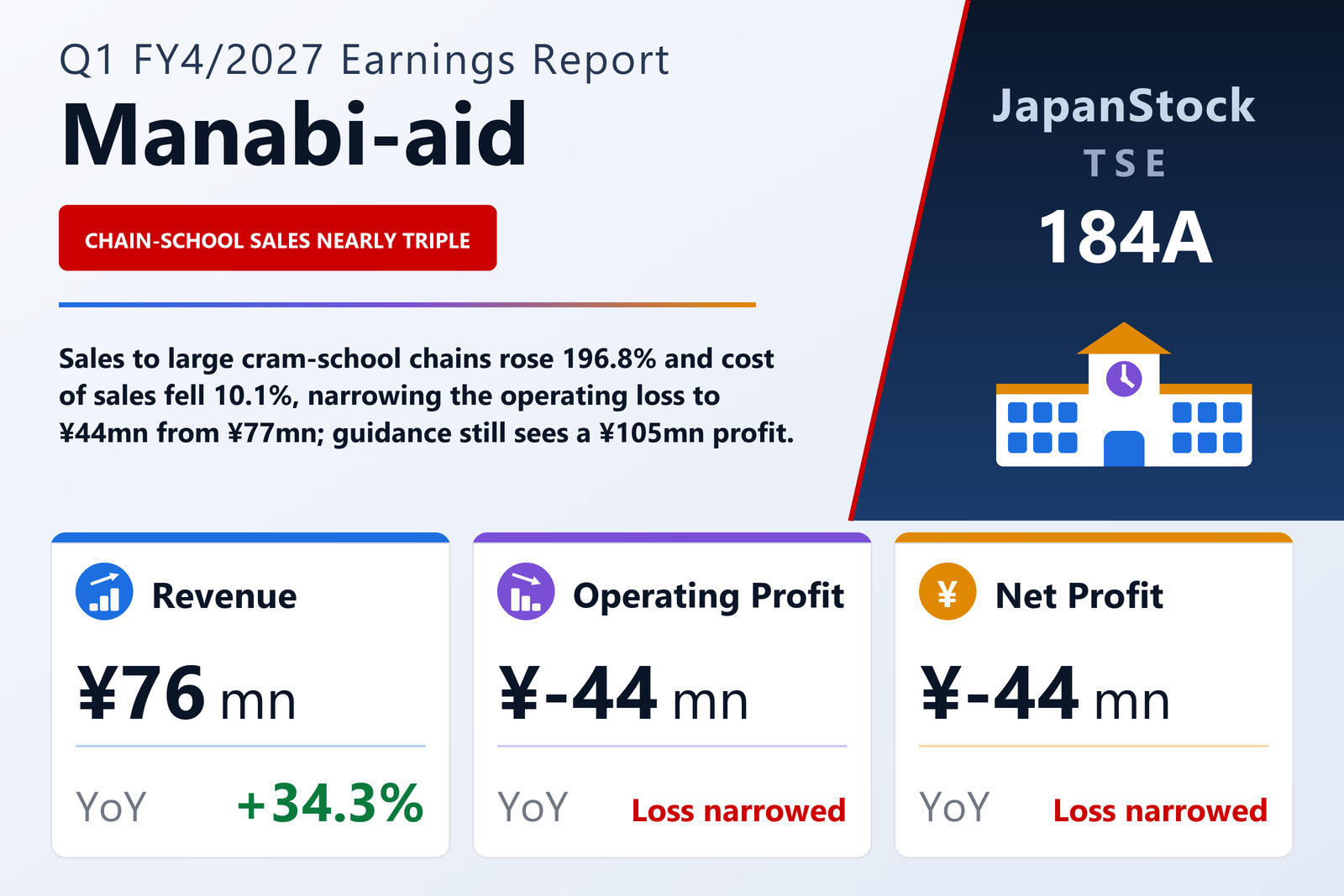
Manabi-aid Co., Ltd. (TSE: 184A), the Tokyo-based provider of video lessons and management tools to cram schools, published non-consolidated results for the first quarter of its fiscal year ending April 2027 — the three months from May 1 to July 31, 2026 — on September 14, 2026 under Japanese GAAP. Revenue rose 34.3% to ¥76 million. The operating loss narrowed to ¥44 million from ¥77 million, the ordinary loss to ¥44 million from ¥85 million and the net loss to ¥44 million from ¥85 million, a loss of ¥12.99 per share against ¥30.04. The shares are listed on the Tokyo Stock Exchange.
The improvement is made almost entirely between the revenue line and the gross-profit line. Stated in the thousands the income statement uses, revenue grew to ¥76,928 thousand from ¥57,276 thousand while cost of sales fell 10.1% to ¥46,145 thousand, so gross profit rose to ¥30,783 thousand from ¥5,925 thousand and the gross margin widened from 10.3% to 40.0%. Selling, general and administrative expenses also fell, by 10.2% to ¥75,055 thousand, but they still absorbed 97.6% of revenue, against 146.0% a year earlier, which is why the quarter remained loss-making. The operating loss of ¥44,272 thousand compares with ¥77,682 thousand, an improvement of ¥33,410 thousand. The filing does not explain the fall in cost of sales or in SG&A.
The ordinary loss improved by more than the operating loss — by ¥41,069 thousand — because the prior-year quarter carried ¥7,598 thousand of share issuance costs that did not recur; this quarter's non-operating expenses were ¥61 thousand of interest. Income taxes were a charge of ¥19 thousand against a credit of ¥107 thousand, leaving a net loss of ¥44,348 thousand. The per-share loss narrowed faster than the net loss because the average share count rose 20.2%, to 3,413,500 from 2,838,892, after last year's share issue. Diluted earnings per share are not disclosed because the company made a loss.
Large chains carry the growth; independent schools and publishers shrink
Manabi-aid reports a single segment, its education digital business, but breaks revenue down by service, and the lines moved in opposite directions. Manabi-aid Master for School — the version sold to large cram-school operators — rose 196.8% to ¥49,684 thousand, 64.6% of revenue, which the company credits to active selling to large chains. The standard Manabi-aid Master fell 16.9% to ¥16,070 thousand, with the filing pointing to a business environment for independent cram schools that is still contracting. Manabi-aid for Enterprise, its video and content work for publishers and textbook companies, fell 59.3% to ¥7,832 thousand on fewer projects, and other revenue rose 71.8% to ¥3,342 thousand. The filing does not give the prior-year amounts for each service, only the percentages.
The company says it pushed Manabi-aid Master, which combines video lessons with management functions, into large cram schools and used those introductions to sell system development and optional services. It also sells services aimed at the recommendation-based university admissions that the entrance-exam reform has expanded, including an essay-correction service, and released a new question-answering service. Under the capital and business alliance agreed in May 2025, it introduced Manabi-aid Master across the ITTO individual-tutoring chain operated by NOVA Holdings, developed a success model with that partner and began rolling it out to other cram schools, while continuing joint development of systems to make cram-school operations more efficient.
A going-concern event disclosure, and why management sees no material uncertainty
The filing states that events or conditions exist that could cast significant doubt on the company's ability to continue as a going concern. It cites the prior fiscal year's operating loss of ¥171,739 thousand and negative operating cash flow of ¥108,105 thousand, and a first quarter that was again loss-making at the operating level. Its response began with a board resolution on May 30, 2025 to issue new shares by third-party allotment to Inayoshi Capital Partners (ICP) and to form a capital and business alliance, with payment completed on June 16, 2025. NOVA Holdings, a subsidiary of ICP, then acquired all of ICP's shares in the company, among other steps including a tender offer, and now holds 51.63% of the voting rights as parent. Cash and cash equivalents stood at ¥449,672 thousand at the quarter-end, and management judges that there is no significant funding concern.
Management lists three measures. First, from the second quarter it has taken on operational work for the parent group's cram-school business, which it expects to lift revenue and operating profit substantially from the second quarter onward. Second, it is developing new learning services that combine its video-lesson and teaching-material know-how with the NOVA group's language-education and multilingual content. Third, it is strengthening its management through staff and operating know-how from the parent group. On that basis it concludes that there is no material uncertainty about the going-concern assumption, and the quarterly statements carry no going-concern note.
The August 1 contract with NOVA Holdings
As a subsequent event, Manabi-aid signed a group operations basic agreement for the cram-school business with NOVA Holdings on August 1, 2026 and took over headquarters operations for that business. The scope runs from curriculum planning and the design and development of teaching materials, services and products to sales and customer service, school operation, franchise headquarters functions and school development. Its fee is calculated on the royalty income from the NOVA group's schools covered by the agreement, and Manabi-aid in turn pays usage fees for support it receives, such as the student and classroom management system. The contract runs from August 1, 2026 to July 31, 2027 and renews automatically for a year unless either side declines at least six months before expiry. The company says the resulting revenue is already reflected in its full-year forecast; the filing does not state an amount.
Balance sheet: receivables collected, cash little changed
Total assets fell 8.4% to ¥567 million from ¥619 million at April 30, 2026. Accounts receivable and contract assets fell by ¥32,993 thousand to ¥37,589 thousand and cash and deposits by ¥10,200 thousand to ¥449,672 thousand. Total liabilities fell ¥7,430 thousand to ¥75,113 thousand, with other payables down ¥5,910 thousand and long-term borrowings reduced to zero outside the current portion of ¥13,850 thousand, while contract liabilities rose to ¥18,694 thousand from ¥4,117 thousand. Net assets fell by exactly the quarter's net loss, ¥44,348 thousand, to ¥492 million, and the equity ratio was 86.8% against 86.7%. No quarterly cash flow statement was prepared; depreciation was ¥2,147 thousand against ¥1,813 thousand.
Guidance: a return to profit, left unchanged
Full-year FY4/2027 guidance is unchanged from the forecast published on June 15, 2026: revenue of ¥708 million, up 93.5%, operating profit of ¥105 million, ordinary profit of ¥106 million and net profit of ¥83 million, or ¥24.51 per share. The filing prints no percentage change for the profit lines. The first quarter delivered 10.9% of guided revenue, which leaves about ¥631 million of revenue and about ¥149 million of operating profit for the remaining nine months to reach the forecast — a turn the company ties to the parent-group contract that starts contributing in the second quarter. No dividend was paid for FY4/2026 and none is forecast for FY4/2027.
| Metric | Q1 FY4/2027 | Q1 FY4/2026 | Change |
|---|---|---|---|
| Revenue (¥ million) | 76 | 57 | +34.3% |
| Cost of sales (¥ million) | 46 | 51 | −10.1% |
| Gross profit (¥ million) | 30 | 5 | +419.5% |
| Gross margin | 40.0% | 10.3% | +29.7 pt |
| SG&A expenses (¥ million) | 75 | 83 | −10.2% |
| Operating profit (¥ million) | −44 | −77 | loss narrowed |
| Ordinary profit (¥ million) | −44 | −85 | loss narrowed |
| Net profit (¥ million) | −44 | −85 | loss narrowed |
| EPS (¥) | −12.99 | −30.04 | loss narrowed |
| Manabi-aid Master for School revenue (¥ thousand) | 49,684 | — | +196.8% |
| Manabi-aid Master revenue (¥ thousand) | 16,070 | — | −16.9% |
| Manabi-aid for Enterprise revenue (¥ thousand) | 7,832 | — | −59.3% |
| Other revenue (¥ thousand) | 3,342 | — | +71.8% |
| Total assets (¥ million) | 567 | 619 | −8.4% |
| Cash and deposits (¥ million) | 449 | 459 | −2.2% |
| Net assets (¥ million) | 492 | 536 | −8.3% |
| Equity ratio | 86.8% | 86.7% | +0.1 pt |
| FY4/2027 guidance — revenue (¥ million) | 708 | — | +93.5% |
| FY4/2027 guidance — operating profit (¥ million) | 105 | — | loss to profit |
| FY4/2027 guidance — ordinary profit (¥ million) | 106 | — | n.m. |
| FY4/2027 guidance — net profit (¥ million) | 83 | — | n.m. |
| FY4/2027 guidance — EPS (¥) | 24.51 | — | n.m. |
| Annual dividend per share (¥) | 0.00 | 0.00 | unchanged |
JapanStockPulse provides informational content only and does not constitute investment advice. Figures are taken from the company's published earnings short report and may be subject to subsequent revision.