Revenue grew 15.1%, but overheads grew faster
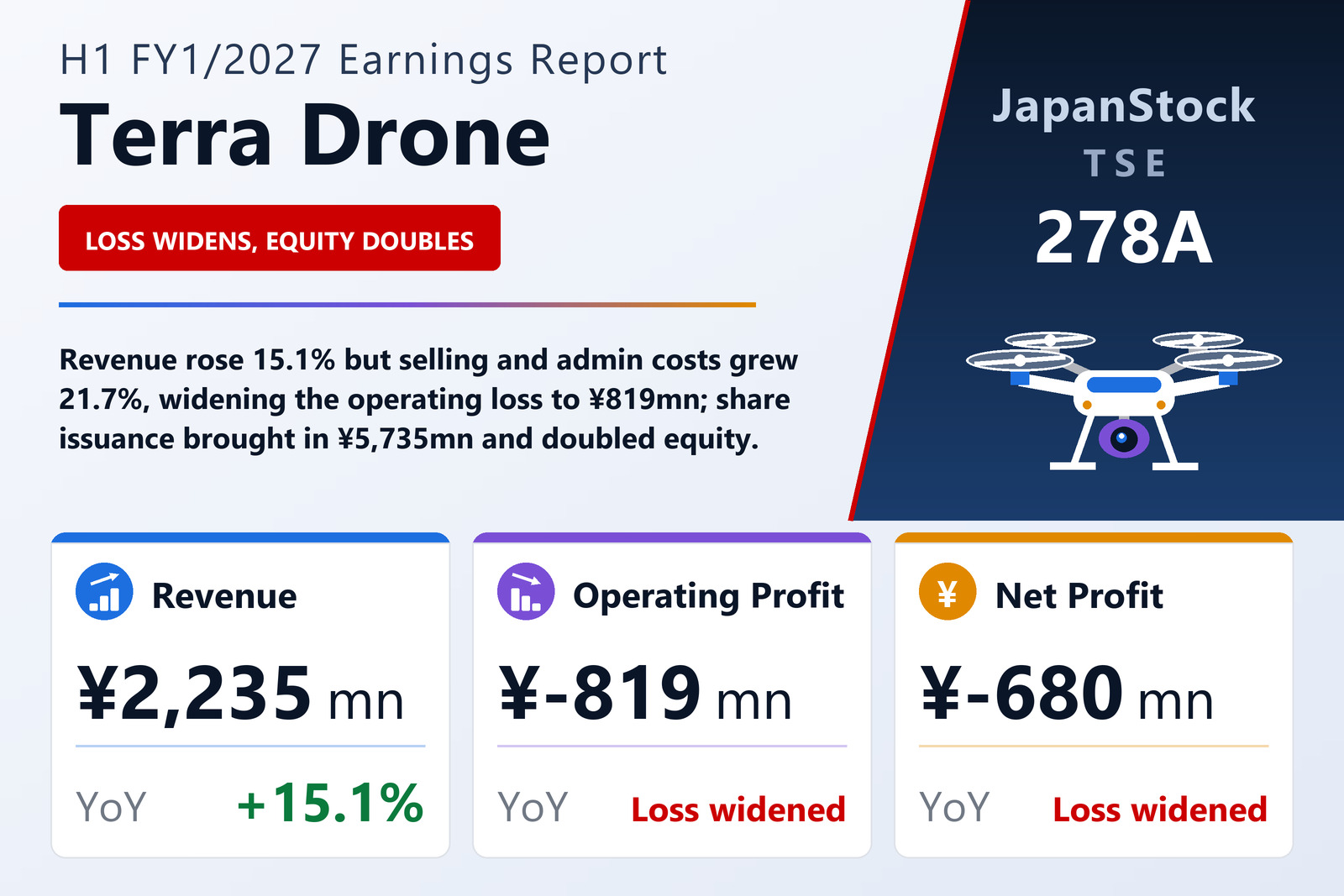
Terra Drone Corporation (TSE: 278A), which provides industrial drone solutions and a platform for managing drone air traffic, published consolidated first-half results for the six months from February 1 to July 31, 2026 on September 14, 2026 under Japanese GAAP. Revenue rose 15.1% to ¥2,235 million, while the operating loss widened to ¥819 million from ¥666 million, the ordinary loss to ¥695 million from ¥541 million and the loss attributable to owners of the parent to ¥680 million from ¥394 million, or ¥69.26 per share against ¥41.61. The company is listed on the Tokyo Stock Exchange, and the interim financial statements were not reviewed by an auditor.
The gross line improved. Cost of sales rose only 10.8% to ¥1,225 million, so gross profit grew 20.7% to ¥1,009 million and the gross margin widened from 43.1% to 45.2%. The improvement stopped there: selling, general and administrative expenses rose 21.7% to ¥1,829 million, an increase of ¥326 million against a ¥173 million gain in gross profit, and the difference of ¥152 million is how much further the operating loss widened. The filing neither breaks SG&A down nor explains the increase. One inconsistency in the filing should be noted: its summary page prints the prior-year operating loss as ¥681 million, while the income statement and the segment note both give ¥666 million, the figure used in this article and its table.
Subsidies fell and extraordinary losses rose
Net non-operating income was little changed, at about ¥123 million against ¥125 million, but its make-up shifted. Subsidy income fell to ¥64 million from ¥193 million, offset by a foreign-exchange gain of ¥64 million in place of a ¥20 million loss and by equity-method investment income of ¥15 million in place of a ¥74 million loss, while non-operating expenses included a ¥39 million settlement payment. The ordinary loss therefore widened by ¥154 million, close to the operating line's ¥152 million. Extraordinary losses rose to ¥103 million from ¥14 million, mostly a ¥94 million loss on contract cancellation that the filing does not explain further. The pre-tax loss was ¥799 million against ¥553 million and, after income taxes of ¥10 million, the interim net loss was ¥809 million against ¥565 million.
The loss attributable to owners of the parent widened by more than the group's, by ¥285 million, because non-controlling shareholders absorbed less of it: ¥129 million against ¥171 million. Non-controlling interests on the balance sheet fell from ¥135 million at January 31, 2026 to zero at July 31, and the filing does not explain the change. The comprehensive loss was ¥885 million against ¥736 million, including other comprehensive income of −¥75 million, mostly the share of equity-method affiliates (−¥50 million) and currency translation (−¥25 million).
Drone Solutions carried the wider loss; traffic-management revenue more than doubled
Terra Drone reports two segments, and they moved very differently. Drone Solutions, which applies industrial drones to survey, inspection and agriculture work and is also where the company is building its defence business, grew revenue 6.4% to ¥1,906 million, but its segment loss widened to ¥444 million from ¥294 million, a deterioration of ¥149 million. Traffic Management, built around a UTM (unmanned aircraft system traffic management) platform, more than doubled revenue to ¥328 million from ¥151 million, up 116.5%, while its segment loss was almost unchanged at ¥374 million against ¥371 million. Nearly all of the group's wider operating loss therefore sits in Drone Solutions. There were no intersegment sales in either half, so the two segments add up to group revenue and their losses to the operating loss.
The filing describes the drivers by business line, without figures. In Drone Solutions, survey and disaster recovery, inspection and agriculture all grew steadily: survey and disaster recovery was led by domestic projects, both indoor inspection services and sales of indoor-inspection drone hardware exceeded the prior year, and agriculture was led by projects in Indonesia. The filing gives no reason for the wider segment loss. In Traffic Management, the company says it won more projects, mainly overseas, as demand for drone-operation safety management and regulatory compliance rose in Europe and the Middle East, and that it is continuing consultations and demonstration trials with government bodies and related operators, centred on Unifly NV.
Defence is named as a growth area, without separate figures
According to the filing, Terra Drone announced its full-scale entry into the defence business in March 2026, is preparing to establish a U.S. company named Terra Defense, and is developing and deploying interceptor drones in collaboration with a Ukrainian company, which it does not name. It describes defence as a medium- to long-term growth area and says demand for unmanned systems is rising as countries review security policy and expand defence investment. Three companies were newly consolidated during the half: Sora Consulting GmbH, Euro USC Netherlands and Terra Defense Europe OU. The filing gives no revenue or profit figures for the defence activities or for the new subsidiaries.
Share issuance doubled equity and more than tripled cash
The balance sheet changed far more than the income statement. New shares issued on the exercise of stock acquisition rights increased capital by ¥2,880 million and capital surplus by ¥2,780 million, and the cash-flow statement records ¥5,735 million of proceeds from issuing shares, plus ¥30 million from issuing new stock acquisition rights. Issued shares rose to 10,397,100 from 9,718,000. Separately, the company transferred ¥2,900 million from its capital reserve to retained earnings to offset accumulated losses, a move that did not change total equity; after that transfer and the half's loss, the retained-earnings deficit stood at ¥2,080 million against ¥4,310 million at January 31.
Total assets rose 69.4% to ¥11,746 million from ¥6,934 million, mainly because cash and deposits increased by ¥5,266 million to ¥7,285 million. Net assets rose to ¥9,889 million from ¥5,008 million, equity to ¥9,840 million from ¥4,835 million and the equity ratio to 83.8% from 69.7%. Liabilities edged down to ¥1,857 million, with contract liabilities up ¥216 million to ¥582 million, and investment securities fell by ¥479 million to ¥327 million. Operating activities used ¥458 million of cash against ¥31 million a year earlier, including ¥130 million paid in connection with fire-related losses, which the filing does not describe. Investing activities brought in ¥164 million, helped by ¥350 million from selling shares in affiliates and ¥230 million transferred back from an escrow account, and financing activities brought in ¥5,791 million.
Full-year guidance still calls for a ¥1,658 million operating loss
Guidance for FY1/2027, published on March 16, 2026, was not changed. The company expects revenue of ¥5,073 million, up 6.1%, an operating loss of ¥1,658 million, an ordinary loss of ¥1,419 million and a loss attributable to owners of the parent of ¥1,266 million, or ¥131.88 per share; the filing does not print the prior year's full-year losses for comparison. The first half delivered 44.1% of guided revenue but 49.4% of the guided operating loss and 53.7% of the guided net loss, which implies a second half with revenue of about ¥2,838 million, an operating loss of about ¥839 million, slightly larger than the first half's, and a net loss of about ¥586 million. No dividend was paid for FY1/2026 and none is forecast for FY1/2027.
| Metric | H1 FY1/2027 | H1 FY1/2026 | Change |
|---|---|---|---|
| Revenue (¥ million) | 2,235 | 1,943 | +15.1% |
| Gross profit (¥ million) | 1,009 | 836 | +20.7% |
| Gross margin | 45.2% | 43.1% | +2.1 pt |
| SG&A expenses (¥ million) | 1,829 | 1,503 | +21.7% |
| Operating profit (¥ million) | −819 | −666 | loss widened |
| Ordinary profit (¥ million) | −695 | −541 | loss widened |
| Pre-tax profit (¥ million) | −799 | −553 | loss widened |
| Net profit attrib. to owners of parent (¥ million) | −680 | −394 | loss widened |
| EPS (¥) | −69.26 | −41.61 | loss widened |
| Drone Solutions — revenue (¥ million) | 1,906 | 1,791 | +6.4% |
| Drone Solutions — segment profit (¥ million) | −444 | −294 | loss widened |
| Traffic Management (UTM) — revenue (¥ million) | 328 | 151 | +116.5% |
| Traffic Management (UTM) — segment profit (¥ million) | −374 | −371 | loss widened |
| Cash and deposits (¥ million) | 7,285 | 2,019 | +260.8% |
| Total assets (¥ million) | 11,746 | 6,934 | +69.4% |
| Net assets (¥ million) | 9,889 | 5,008 | +97.4% |
| Equity attrib. to owners of parent (¥ million) | 9,840 | 4,835 | +103.5% |
| Equity ratio | 83.8% | 69.7% | +14.1 pt |
| Operating cash flow (¥ million) | −458 | −31 | n.m. |
| Investing cash flow (¥ million) | 164 | −1,242 | n.m. |
| Financing cash flow (¥ million) | 5,791 | 36 | n.m. |
| FY1/2027 guidance — revenue (¥ million) | 5,073 | — | +6.1% |
| FY1/2027 guidance — operating profit (¥ million) | −1,658 | — | — |
| FY1/2027 guidance — ordinary profit (¥ million) | −1,419 | — | — |
| FY1/2027 guidance — net profit (¥ million) | −1,266 | — | — |
| Annual dividend per share (¥) | 0.00 | 0.00 | unchanged |
JapanStockPulse provides informational content only and does not constitute investment advice. Figures are taken from the company's published earnings short report and may be subject to subsequent revision.