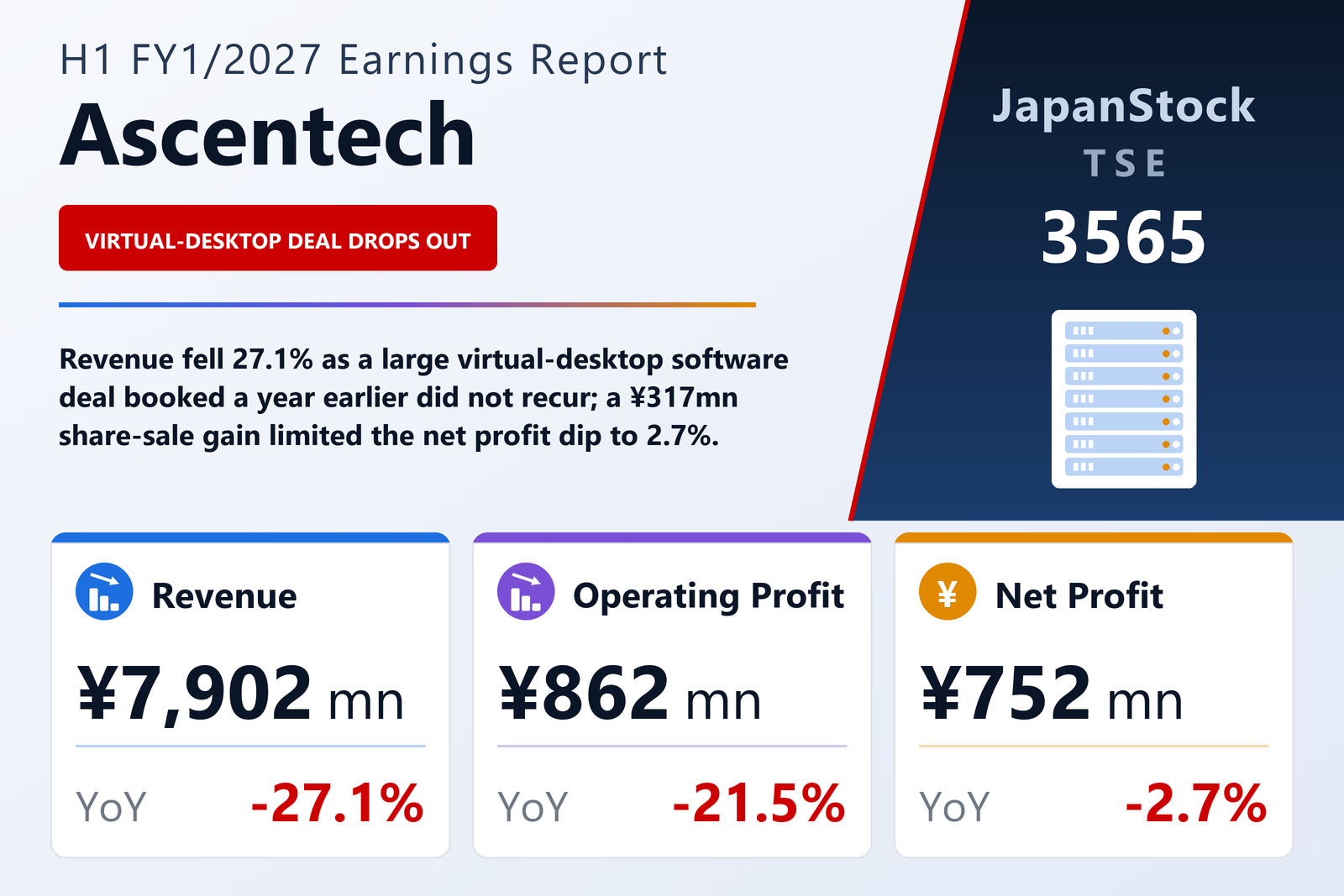
Revenue fell mainly because a large prior-year deal did not recur
Ascentech K.K. (TSE: 3565), which sells IT infrastructure across virtual desktops, cloud infrastructure and zero-trust security and has entered the AI business, published consolidated first-half results for the six months from February 1 to July 31, 2026 on September 14, 2026 under Japanese GAAP. Revenue fell 27.1% to ¥7,902 million, operating profit 21.5% to ¥862 million, ordinary profit 30.8% to ¥773 million and profit attributable to owners of the parent 2.7% to ¥752 million, or ¥17.51 per share against ¥18.07. Both per-share figures are restated for a three-for-one stock split effective May 1, 2026, as though it had taken place at the start of the previous fiscal year. The company is listed on the Tokyo Stock Exchange and reports a single segment, IT infrastructure, so the filing gives no segment breakdown. The interim statements were not reviewed by an auditor.
The filing names one main cause for the revenue decline. Cloud infrastructure and zero-trust security both performed well, it says, but revenue fell in the virtual-desktop area against a large virtual-desktop software deal booked in the same half a year earlier, which did not recur. The comparison base was an unusually high one: in the first half of FY1/2026, revenue had grown 88.4% and operating profit 355.8%. The filing does not say how large the prior-year deal was.
The company also reports on what it calls its stock business: sales of its own products, including self-provided maintenance services such as Remote PC Array, targeted at specific industries including financial institutions, healthcare and local governments. That business produced revenue of ¥1,180 million in the half, about 15% of the total, and new orders of ¥1,199 million, which the company says will contribute to future sales and profit. The filing gives no prior-year comparison for either figure.
A wider gross margin could not make up for the lost gross profit
Cost of sales fell faster than revenue, by 29.3% to ¥6,474 million, so gross profit fell only 15.0% to ¥1,427 million and the gross margin widened from 15.5% to 18.1%. The filing credits two areas. Remote PC Array, the company's own cloud-infrastructure product, continued to be adopted by local governments in line with new guidelines from the Ministry of Internal Affairs and Communications, and higher-margin zero-trust security products were adopted by large enterprises. Against that, gross profit in the virtual-desktop area fell, and in total the decline outweighed the gains. The company adds that its costs were pushed up by the weak yen, even though it takes out foreign-exchange forward contracts when orders are received.
Selling, general and administrative expenses fell 2.6% to ¥565 million. The fall in operating profit, ¥236 million, is therefore ¥251 million of lost gross profit less about ¥15 million of lower overheads. Because profit fell less steeply than revenue, the operating margin actually rose, from 10.1% to 10.9%.
Currency cut ordinary profit; a share sale restored most of it
Below the operating line, the company recorded a foreign-exchange loss of ¥158 million against ¥15 million a year earlier. It attributes the loss mainly to marking to market a foreign-currency liability recorded under its strategic business alliance with Cloud Software Group, Inc., based in Fort Lauderdale, Florida. Interest income rose to ¥38 million from ¥6 million, lifting non-operating income to ¥69 million from ¥34 million, but ordinary profit still fell 30.8% to ¥773 million, a steeper fall than at the operating line.
This is where net profit parts company with the rest of the income statement. Citrix Systems, Inc., a Cloud Software Group company with which Ascentech has a strategic capital and business alliance, acquired Numecent Holdings Ltd, and Ascentech sold the Numecent shares it held, booking an extraordinary gain of ¥317 million on the sale of investment securities, against extraordinary gains of ¥1 million a year earlier. Pre-tax profit was therefore ¥1,091 million, down only 2.4%. Income taxes were ¥338 million, down 1.9%, an effective rate of about 31% in both halves, and profit attributable to owners of the parent came to ¥752 million, down 2.7%. The one-off gain accounts for nearly all of the gap between a 30.8% fall in ordinary profit and a 2.7% fall in net profit. Comprehensive income was ¥778 million, down 2.2%.
A smaller balance sheet and a cash outflow from operations
Total assets fell 9.4% to ¥31,938 million from ¥35,266 million at January 31, 2026, chiefly because cash and deposits fell by ¥2,549 million, to ¥10,027 million, and long-term prepaid expenses by ¥1,985 million. Liabilities fell further, by ¥3,703 million to ¥25,355 million, led by a ¥2,432 million drop in accounts payable and a ¥1,255 million fall in long-term accounts payable. Net assets rose 6.1% to ¥6,583 million, as the half's profit more than covered ¥429 million of dividends, and the equity ratio rose from 17.6% to 20.6%.
Operating cash flow was an outflow of ¥2,216 million, against an inflow of ¥3,388 million a year earlier. The filing points to the ¥2,432 million fall in accounts payable and a ¥2,065 million increase in prepaid expenses, partly offset by the decline in long-term prepaid expenses and ¥1,213 million of prepaid-expense amortization; income taxes paid also rose, to ¥733 million from ¥269 million. Investing activities brought in ¥482 million, mainly ¥500 million from withdrawn time deposits, and financing used ¥429 million, all of it dividends. Cash and cash equivalents ended the half at ¥2,527 million, down ¥2,049 million since January 31 and well below the ¥10,027 million of cash and deposits on the balance sheet; the filing does not reconcile the two.
New AI products and a Korean distribution agreement
The company announced two new products of its own in the half: Edge AI Array, an AI platform optimized for virtual humans, and SapiaBox, an on-premises AI solution for the AI business it has entered. Under its growth strategy of expanding through M&A and strategic alliances, it also signed a business alliance and a distributor agreement with PIOLINK, which the filing describes as a major South Korean network-security company. The filing puts no figures on either development. Its market commentary is that hybrid work continues to take hold, that the need for stronger security, centred on ransomware, should keep demand for virtual desktops and zero-trust security firm, and that corporate use of AI will raise demand for IT infrastructure that supports AI securely.
Guidance and the dividend forecast both unchanged
Ascentech left unchanged the FY1/2027 guidance it published on March 17, 2026: revenue of ¥17,500 million (+1.4%), operating profit of ¥2,000 million (−29.6%), ordinary profit of ¥2,100 million (−27.4%) and profit attributable to owners of ¥1,430 million (−30.6%), or ¥33.25 per share after the split (¥99.77 without it). The first half delivered 45.2% of guided revenue, 43.1% of guided operating profit and 36.8% of guided ordinary profit, but already 52.6% of guided net profit, because the share-sale gain sits below the ordinary line. Meeting the revenue guidance implies second-half revenue of about ¥9,598 million, above the ¥7,902 million just reported; the filing does not break its guidance into halves.
The dividend forecast was also left unchanged. An interim dividend of ¥7.00 has been declared, with payment starting October 14, 2026, and ¥8.00 is forecast at the year-end, for ¥15.00 for the year on a post-split basis; without the split, the annual forecast would be ¥45.00. The filing prints FY1/2026's dividend unadjusted, at ¥30.00, all of it paid at the year-end. Divided by three for the split, that is ¥10.00, so the forecast is 50% higher. At the guided ¥33.25 of earnings per share, ¥15.00 is a payout of about 45%.
| Metric | H1 FY1/2027 | H1 FY1/2026 | Change |
|---|---|---|---|
| Revenue (¥ million) | 7,902 | 10,833 | −27.1% |
| Cost of sales (¥ million) | 6,474 | 9,154 | −29.3% |
| Gross profit (¥ million) | 1,427 | 1,679 | −15.0% |
| Gross margin | 18.1% | 15.5% | +2.6 pt |
| SG&A expenses (¥ million) | 565 | 580 | −2.6% |
| Operating profit (¥ million) | 862 | 1,098 | −21.5% |
| Operating margin | 10.9% | 10.1% | +0.8 pt |
| Foreign-exchange loss, non-operating (¥ million) | 158 | 15 | +918.5% |
| Ordinary profit (¥ million) | 773 | 1,116 | −30.8% |
| Extraordinary gains (¥ million) | 317 | 1 | n.m. |
| Pre-tax profit (¥ million) | 1,091 | 1,118 | −2.4% |
| Income taxes (¥ million) | 338 | 344 | −1.9% |
| Net profit attrib. to owners of parent (¥ million) | 752 | 773 | −2.7% |
| EPS (¥) | 17.51 | 18.07 | −3.1% |
| Total assets (¥ million) | 31,938 | 35,266 | −9.4% |
| Net assets (¥ million) | 6,583 | 6,206 | +6.1% |
| Equity ratio | 20.6% | 17.6% | +3.0 pt |
| Cash and deposits (¥ million) | 10,027 | 12,576 | −20.3% |
| Operating cash flow (¥ million) | −2,216 | 3,388 | n.m. |
| FY1/2027 guidance — revenue (¥ million) | 17,500 | — | +1.4% |
| FY1/2027 guidance — operating profit (¥ million) | 2,000 | — | −29.6% |
| FY1/2027 guidance — ordinary profit (¥ million) | 2,100 | — | −27.4% |
| FY1/2027 guidance — net profit (¥ million) | 1,430 | — | −30.6% |
| FY1/2027 guidance — EPS (¥) | 33.25 | — | — |
| Annual dividend per share (¥) | 15.00 | 10.00 | +50.0% |
JapanStockPulse provides informational content only and does not constitute investment advice. Figures are taken from the company's published earnings short report and may be subject to subsequent revision.