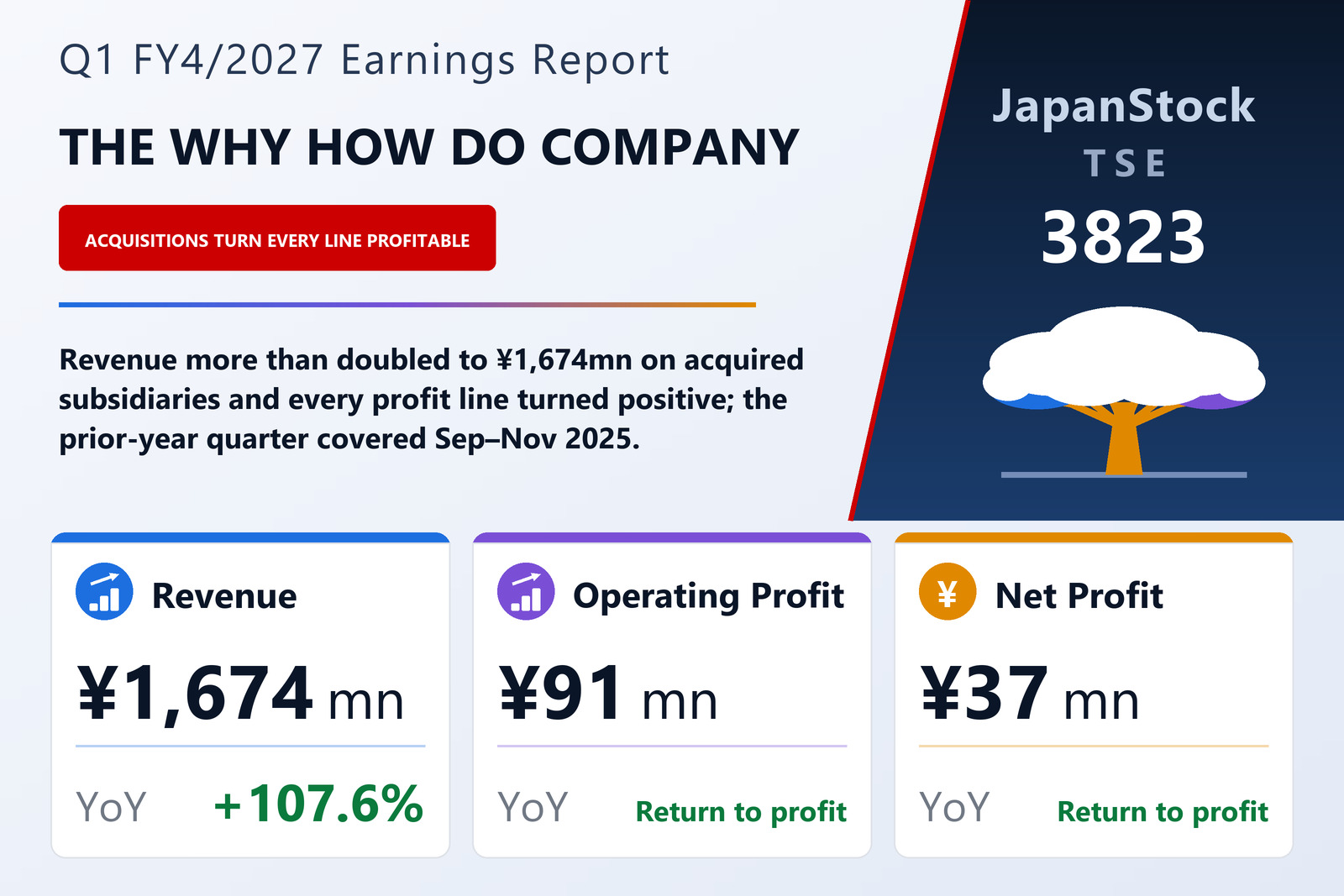
Profitable at every level — against a comparison quarter that is not like-for-like
THE WHY HOW DO COMPANY, Inc. (TSE: 3823), a Tokyo-based group that names M&A as the main axis of its growth and now holds businesses in solutions, restaurant-related services, education, entertainment and lifestyle, published consolidated first-quarter results for the three months from May 1 to July 31, 2026 on September 14, 2026, under Japanese GAAP. The filing lists the Tokyo Stock Exchange as its listing venue. Revenue rose 107.6% to ¥1,674 million, operating profit was ¥91 million against a loss of ¥125 million, ordinary profit ¥77 million against a loss of ¥134 million, and profit attributable to owners of the parent ¥37 million against a loss of ¥156 million, or ¥0.25 per share against a loss of ¥1.23. In the company's own words, the group moved into the black at every stage of the income statement.
The comparison needs its context stated up front. An extraordinary general meeting on March 24, 2026 moved the fiscal year-end from August to April. The prior-year first quarter therefore runs from September 1 to November 30, 2025, a different set of calendar months, and the fiscal year just ended was an eight-month transitional period from September 1, 2025 to April 30, 2026. For that reason the company does not analyse its segments against the prior-year quarter, and its full-year guidance carries no year-on-year percentages. The +107.6% revenue figure is the company's own, but it compares a summer quarter with an autumn one; in the data table the segment change column is marked as not meaningful for the same reason.
Acquisitions doubled revenue; cost of sales grew faster still
The filing attributes the revenue growth to four companies acquired during the previous fiscal year: Stillan, a bridal business in the Lifestyle segment; Goodman, which sells and makes measuring and leak-detection instruments for infrastructure maintenance, in Solutions; Iiyama Doken, a civil-engineering and paving contractor; and Kowell, which plans, sells, rents and maintains LED lighting. Iiyama Doken and Kowell were acquired close to the end of the previous fiscal year, so this is the first quarter in which they contribute in full. Cost of sales rose faster than revenue, by 136.4% to ¥797 million, so gross profit grew 86.9% to ¥877 million and the gross margin fell from 58.2% to 52.4%. The filing does not comment on the gross margin.
The turnaround was made below gross profit. Selling, general and administrative expenses rose 32.2% to ¥786 million, far more slowly than revenue, which cut their weight from 73.7% of revenue to 46.9%. That swing is what moved the operating line from a loss of ¥125 million to a profit of ¥91 million, an operating margin of 5.5%. Acquisition accounting is visible in the costs: depreciation was ¥26.4 million against ¥15.4 million, and goodwill amortisation ¥37.9 million against ¥9.2 million.
Below the operating line: financing costs, a crypto write-down and a heavy tax charge
Non-operating income was ¥22.6 million, most of it an ¥18.5 million reversal of the allowance for doubtful accounts. Non-operating expenses were larger, at ¥36.4 million: interest of ¥10.0 million against ¥5.3 million, share issuance costs of ¥9.1 million, a foreign-exchange loss of ¥7.7 million, a ¥5.4 million valuation loss on crypto assets and a ¥1.9 million loss on bond redemption. Ordinary profit was therefore ¥77 million. Extraordinary items were small this time, gains of ¥5.4 million and losses of ¥0.4 million, whereas the prior-year quarter had carried ¥61.2 million of gains, chiefly a ¥42.2 million gain on sale of fixed assets, and ¥57.5 million of losses, chiefly ¥53.5 million of civil-rehabilitation-related expenses. Pre-tax profit was ¥82.7 million and income taxes ¥41.8 million, roughly half of it; after ¥3.9 million attributable to non-controlling interests, the parent kept ¥37 million. Other comprehensive income was a loss of ¥10.9 million, leaving comprehensive income of ¥30 million.
The company's adjusted metrics
The filing also discloses three company-defined, non-GAAP measures, with no prior-year figures. Adjusted EBITDA was ¥165 million, defined as operating profit plus depreciation, provisions, transfers from other accounts, amortisation of goodwill and intangible assets, and M&A-related costs. Adjusted operating profit was ¥139 million, operating profit plus amortisation of goodwill and intangibles and M&A-related costs, and adjusted net profit ¥93 million, or ¥0.63 per share, on the same basis applied to profit attributable to owners. M&A-related costs include brokerage, legal, due-diligence, financial-advisory, valuation and post-merger integration fees, financing fees and share-related fees; for adjusted net profit they also include costs booked below the operating line. The company describes adjusted EBITDA of ¥1 billion as its medium-term target.
Solutions and Lifestyle carry the group; a loss now sits in Other
Solutions was the largest segment, with revenue of ¥785 million against ¥86 million in the prior-year quarter and segment profit of ¥145 million against ¥15 million. It still houses the original software businesses, a demo-handset management system for mobile-phone shops, social games and apps, and IoT products, but the revenue breakdown shows how small they now are: content services brought in ¥31 million and platforms ¥12 million, while the line covering Goodman, Kowell and contract development brought in ¥734 million. Lifestyle reported revenue of ¥565 million against ¥479 million and segment profit of ¥37 million against ¥77 million. It combines tanning-machine sales and rental and cosmetics at Sunrise Japan, the Stillan bridal business in western Shizuoka, and Iiyama Doken's civil engineering, paving and snow-clearing work in Iiyama, Nagano. The company says bridal was firm and Iiyama Doken contributed in full; it gives no reason for the lower segment profit, and the two quarters cover different months.
Entertainment reported revenue of ¥275 million against ¥195 million and segment profit of ¥45 million against ¥4 million. It combines music production and concerts centred on the musician Tetsuya Komuro, including fan-club and copyright income, with a capsule-toy business at Dream Planet, where the company says it is steadily adding vending machines. Education, which runs IT training courses of about six months for job-seekers in Shinjuku and Yokohama, reported revenue of ¥41 million against ¥33 million and profit of ¥8 million against ¥6 million; the company notes that an improving job market has reduced the number of places available. Food & Beverage-Related, now a trademark-management and single-site subleasing business, reported revenue of ¥2 million against ¥9 million. These segment figures include intersegment sales.
The segment totals do not reconcile to operating profit the way they did a year earlier. Reportable segments earned ¥238 million against ¥106 million. The Other category, outside the reportable segments, recorded a loss of ¥105 million on revenue of ¥3 million, against a profit of ¥1 million, while reconciling adjustments shrank to −¥41 million from −¥233 million. Within those adjustments, unallocated corporate expenses fell to ¥4.2 million from ¥226.1 million, and goodwill amortisation rose to ¥37.9 million from ¥9.2 million. The filing states that there was no change to the reportable segments and does not explain the shift between Other and corporate expenses, so segment profit should not be read as like-for-like across the two quarters.
Going-concern note withdrawn; goodwill is over a quarter of assets
The filing withdraws the going-concern risk disclosure the company had been carrying. The group had recorded an operating loss in every fiscal year since the year to August 2009 except the year to August 2018, and in the eight-month period to April 30, 2026 it posted an operating loss of ¥502 million and a net loss of ¥929 million. Citing profit at every level in this quarter, an equity ratio of 32.4% and cash and deposits of ¥1,435 million, the company judged that the conditions no longer exist and removed the note, in a separate release issued the same day. The quarterly statements were not reviewed by an auditor, and no quarterly cash-flow statement was prepared.
Total assets were ¥5,206 million at July 31, 2026, ¥124 million lower than at April 30, mainly because cash and deposits fell ¥112 million. Liabilities fell ¥272 million to ¥3,473 million, with borrowings down ¥146 million and trade payables and other payables each down ¥50 million. Net assets rose ¥147 million to ¥1,732 million: the exercise of stock acquisition rights added ¥59 million each to share capital and capital surplus, a share exchange for additional shares in Kowell added a further ¥41.5 million to capital surplus, and the quarter's profit did the rest. The equity ratio rose from 28.9% to 32.4% and shares issued from 145,416,193 to 150,169,693. Goodwill stood at ¥1,429 million, 27.5% of total assets. Long-term loans receivable of ¥1,224 million and long-term receivables of ¥252 million sit against an allowance for doubtful accounts of ¥1,259 million, and the balance sheet still carries ¥144 million of rehabilitation obligations.
Guidance unchanged, with no year-on-year comparison and no dividend
Full-year guidance for FY4/2027, the twelve months from May 1, 2026 to April 30, 2027, is unchanged from the figures published on June 15, 2026: revenue of ¥6,259 million, operating profit of ¥165 million, adjusted operating profit of ¥349 million and adjusted EBITDA of ¥464 million. No ordinary-profit or net-profit guidance is given, and no year-on-year change is stated because the prior period ran for eight months. The first quarter delivered 26.7% of guided revenue but 55.2% of guided operating profit, 39.8% of adjusted operating profit and 35.6% of adjusted EBITDA. Guidance therefore implies only about ¥74 million of operating profit over the remaining nine months, and the filing does not explain why the forecast was left unchanged. No dividend was paid for FY4/2026 and none is forecast for FY4/2027; the company says it will give priority to funding investment under its M&A-led strategy.
| Metric | Q1 FY4/2027 | Q1 FY4/2026 | Change |
|---|---|---|---|
| Revenue (¥ million) | 1,674 | 806 | +107.6% |
| Gross profit (¥ million) | 877 | 469 | +86.9% |
| Gross margin | 52.4% | 58.2% | −5.8 pt |
| SG&A expenses (¥ million) | 786 | 594 | +32.2% |
| Operating profit (¥ million) | 91 | −125 | loss to profit |
| Ordinary profit (¥ million) | 77 | −134 | loss to profit |
| Net profit attrib. to owners of parent (¥ million) | 37 | −156 | loss to profit |
| EPS (¥) | 0.25 | −1.23 | loss to profit |
| Adjusted EBITDA (¥ million) | 165 | — | — |
| Adjusted operating profit (¥ million) | 139 | — | — |
| Adjusted net profit (¥ million) | 93 | — | — |
| Solutions — revenue (¥ million) | 785 | 86 | n.m. |
| Solutions — segment profit (¥ million) | 145 | 15 | n.m. |
| Food & Beverage-Related — revenue (¥ million) | 2 | 9 | n.m. |
| Food & Beverage-Related — segment profit (¥ million) | 1 | 2 | n.m. |
| Education — revenue (¥ million) | 41 | 33 | n.m. |
| Education — segment profit (¥ million) | 8 | 6 | n.m. |
| Entertainment — revenue (¥ million) | 275 | 195 | n.m. |
| Entertainment — segment profit (¥ million) | 45 | 4 | n.m. |
| Lifestyle — revenue (¥ million) | 565 | 479 | n.m. |
| Lifestyle — segment profit (¥ million) | 37 | 77 | n.m. |
| Total assets (¥ million) | 5,206 | 5,331 | −2.3% |
| Net assets (¥ million) | 1,732 | 1,585 | +9.3% |
| Equity ratio | 32.4% | 28.9% | +3.5 pt |
| FY4/2027 guidance — revenue (¥ million) | 6,259 | — | — |
| FY4/2027 guidance — operating profit (¥ million) | 165 | — | — |
| FY4/2027 guidance — adjusted operating profit (¥ million) | 349 | — | — |
| FY4/2027 guidance — adjusted EBITDA (¥ million) | 464 | — | — |
| Annual dividend per share (¥) | 0.00 | 0.00 | unchanged |
JapanStockPulse provides informational content only and does not constitute investment advice. Figures are taken from the company's published earnings short report and may be subject to subsequent revision.