A first quarter that beat its own plan
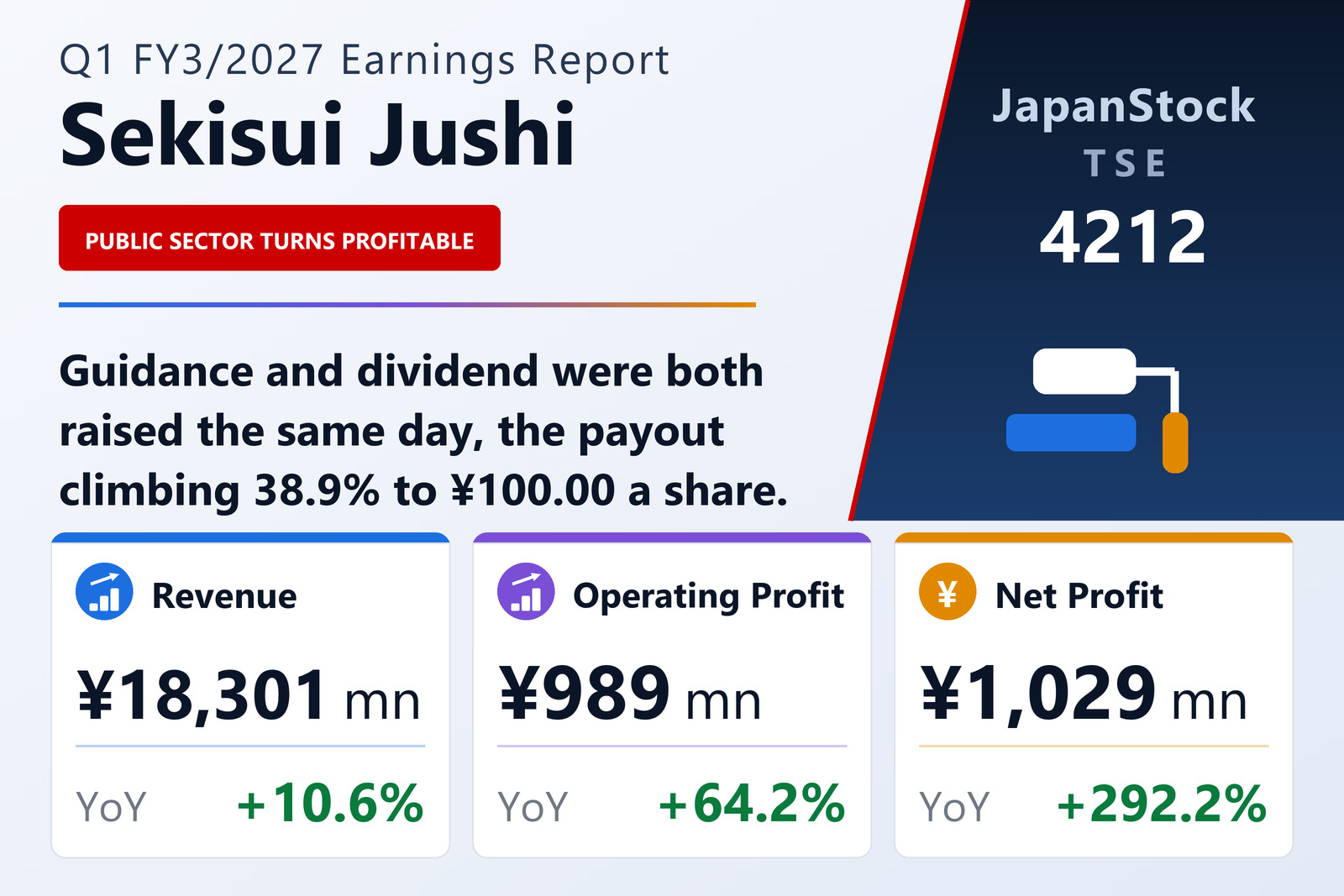
Sekisui Jushi Corporation (TSE: 4212) — maker of road-safety and traffic-sign products, noise barriers, fences, artificial turf and logistics materials — published consolidated first-quarter results for FY3/2027 on July 30, 2026, covering April 1 to June 30, 2026 under Japanese GAAP. Revenue rose 10.6% to ¥18,301 million, operating profit 64.2% to ¥989 million, ordinary profit 61.5% to ¥1,229 million, and net profit attributable to owners of parent 292.2% to ¥1,029 million. Earnings per share reached ¥34.37 against ¥8.49. EBITDA rose 38.2% to ¥2,107 million and net profit before goodwill amortisation 131.3% to ¥1,429 million.
One qualification belongs at the front. The company completed the finalisation of provisional accounting for a business combination during FY3/2026, and the year-earlier comparatives shown here reflect that finalisation — so the percentage changes are measured against restated figures, not the numbers originally published.
The other qualification is about the quality of the revenue growth. Alongside solid underlying demand, management attributes part of the increase to customers pulling forward orders in some businesses, because of uncertainty about the outlook for raw-material procurement — crude-oil-derived inputs in particular. That is revenue borrowed from later quarters rather than created, and it argues for reading the 10.6% growth rate as flattered.
Two segments, and where each one moved
The public-sector segment grew revenue 6.0% to ¥8,580 million and swung from a ¥5 million operating loss to a ¥43 million profit — a small number in absolute terms, but the difference between a division that loses money in its seasonally weakest quarter and one that does not. Within it the picture was mixed. Noise barriers fell sharply on both revenue and profit as expressway maintenance budgets shrank, construction periods lengthened and some deliveries slipped, though preparation continues for full-scale deliveries on Shinkansen-related projects. Traffic-safety products held up: the flagship Delineator guide markers and Pole Cone lane separators tracked the prior year while self-illuminating electronic display products grew, and sign and marking materials did well on improved workability from product upgrades plus the pull-forward effect.
Landscape-related products grew on protective fences and trial installations of head-on collision prevention products for expressways, a new field. Sports facilities went the other way: artificial turf built a solid order book on replacement demand, but completion of some large projects slipped into the second quarter, so both revenue and profit fell. Among affiliated group companies, domestic road-marking and structural maintenance work was weak on shrinking expressway budgets, and snow and wind fencing fell against a prior year that had concentrated deliveries; in Europe, severe winter snow temporarily stalled road works in the January–March local quarter, but margin improvement and currency effects still lifted revenue and profit.
The private-sector segment did the heavy lifting: revenue up 15.2% to ¥9,744 million and profit up 41.6% to ¥1,150 million. Integrated logistics products rose strongly on stable supply and flexible pricing amid a disordered market, helped again by pull-forward demand; agriculture-related products grew on wider sales of farming stakes and strength in wildlife-damage countermeasures. Among group companies, aluminium-plastic laminate composite panels rose sharply on higher orders and new applications for home centres and convenience stores, digital picking systems grew, and detached-house exterior products beat the prior year in a fiercely competitive market. The housing-related business went the other way, with mesh fences and screening fences weak on soft housing starts and construction delays from a shortage of skilled labour, even as soundproof screening fences, vertical-lattice fences and mechanical-parking fences held up; assembled pipe systems fell on more cautious customer capital spending and fewer large projects.
Cash, balance sheet and the revisions
Total assets fell 0.8% to ¥141,359 million, with current assets down ¥2,843 million and fixed assets up ¥1,634 million. Liabilities fell 4.8% to ¥39,471 million and net assets rose 0.8% to ¥101,888 million, lifting the equity ratio 1.2 points to 70.8% — among the strongest balance sheets in its sector.
Cash generation moved the other way from profit. Operating cash flow fell 31.9% to ¥1,747 million despite pre-tax profit of ¥1,775 million, as inventory build and tax payments offset the profit improvement and a reduction in trade receivables. Investing activities produced an inflow of ¥312 million on sales of investment securities, against an outflow of ¥1,815 million a year earlier, while financing used ¥2,576 million on short-term debt repayment and dividends, against ¥1,106 million. Cash and equivalents ended ¥536 million lower at ¥14,765 million.
Both forecasts were revised upward the same day, in a separate release. Full-year guidance now stands at revenue of ¥84,000 million (+7.5%), operating profit of ¥6,300 million (+10.8%), ordinary profit of ¥6,500 million (+3.8%) and net profit of ¥5,400 million (+35.8%), for earnings per share of ¥180.08. The half-year figures are the more revealing: operating profit of just ¥1,740 million, up 1.0%, of which the first quarter has already delivered ¥989 million, implying ¥751 million in the second quarter — well below the quarter just reported, and consistent with treating some of the pull-forward demand as unrepeatable.
The dividend revision is the larger gesture. The annual payout is now planned at ¥100.00 — ¥56.00 interim and ¥44.00 final — against ¥72.00 for FY3/2026, a 38.9% increase, and a faster rise than the 35.8% net-profit growth now guided for the year.
| Metric | Q1 FY3/2027 | Q1 FY3/2026 | Change |
|---|---|---|---|
| Revenue (¥ million) | 18,301 | 16,545 | +10.6% |
| Operating profit (¥ million) | 989 | 602 | +64.2% |
| Operating margin | 5.40% | 3.64% | +1.76 pt |
| Ordinary profit (¥ million) | 1,229 | 761 | +61.5% |
| Net profit attrib. to owners of parent (¥ million) | 1,029 | 262 | +292.2% |
| Comprehensive income (¥ million) | 1,896 | 73 | n.m. |
| EPS (¥) | 34.37 | 8.49 | +304.8% |
| EBITDA (¥ million) | 2,107 | 1,524 | +38.2% |
| Net profit before goodwill amortisation (¥ million) | 1,429 | 617 | +131.3% |
| Public sector — revenue (¥ million) | 8,580 | 8,096 | +6.0% |
| Public sector — segment profit (¥ million) | 43 | −5 | loss to profit |
| Private sector — revenue (¥ million) | 9,744 | 8,461 | +15.2% |
| Private sector — segment profit (¥ million) | 1,150 | 812 | +41.6% |
| Operating cash flow (¥ million) | 1,747 | 2,567 | −31.9% |
| Total assets (¥ million) | 141,359 | 142,568 | −0.8% |
| Total liabilities (¥ million) | 39,471 | 41,464 | −4.8% |
| Net assets (¥ million) | 101,888 | 101,103 | +0.8% |
| Shareholders' equity (¥ million) | 100,059 | 99,247 | +0.8% |
| Equity ratio | 70.8% | 69.6% | +1.2 pt |
| FY3/2027 guidance — revenue (¥ million) | 84,000 | — | +7.5% |
| FY3/2027 guidance — operating profit (¥ million) | 6,300 | — | +10.8% |
| FY3/2027 guidance — ordinary profit (¥ million) | 6,500 | — | +3.8% |
| FY3/2027 guidance — net profit (¥ million) | 5,400 | — | +35.8% |
| FY3/2027 guidance — EPS (¥) | 180.08 | — | — |
| Annual dividend per share (¥) | 100.00 | 72.00 | +38.9% |
JapanStockPulse provides informational content only and does not constitute investment advice. Figures are taken from the company's published earnings short report and may be subject to subsequent revision.