Double-digit growth on every line below revenue
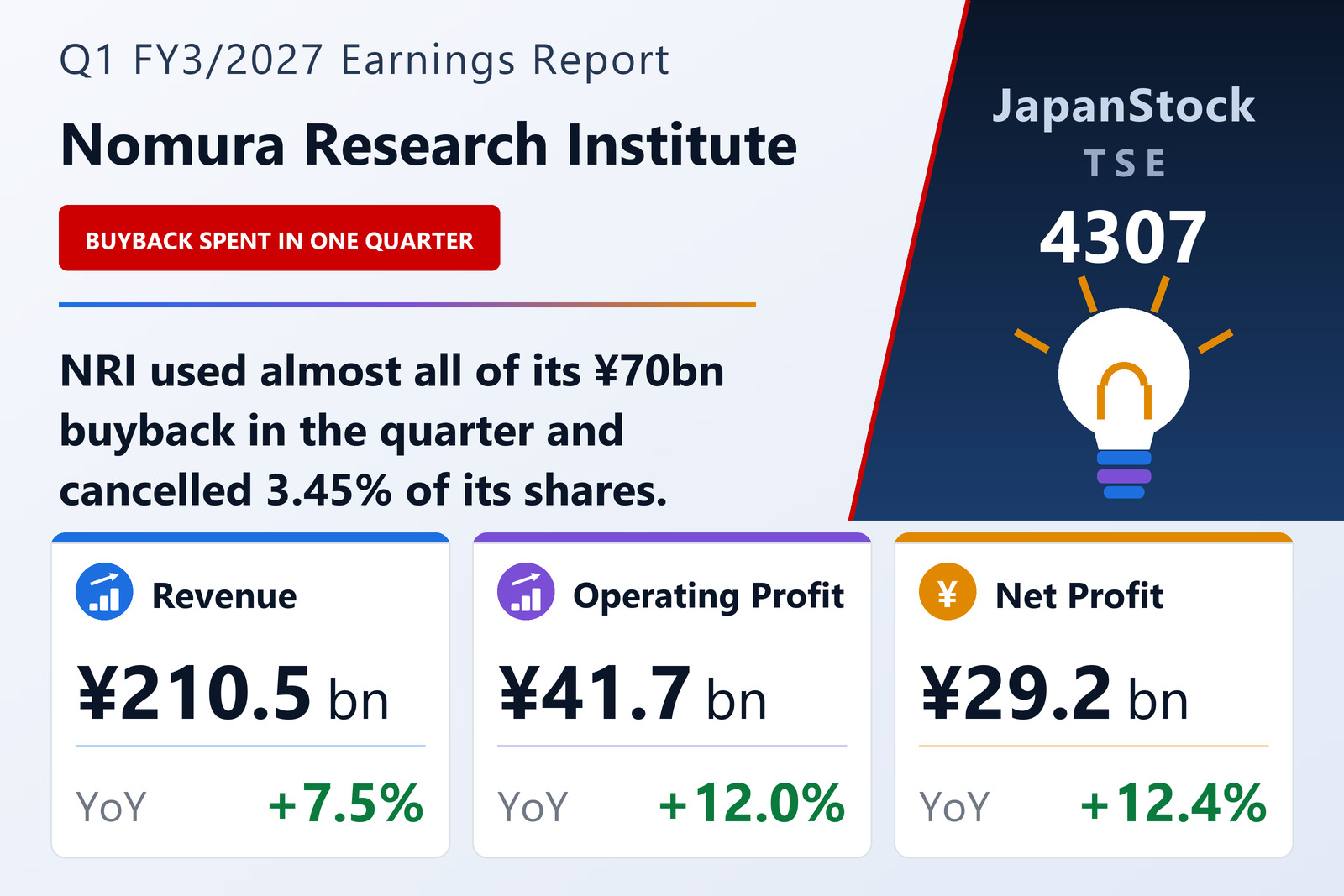
Nomura Research Institute, Ltd. (TSE: 4307), the Tokyo-based IT consulting and systems integration group, disclosed consolidated first-quarter results for the fiscal year ending March 2027 — April 1 to June 30, 2026 — under IFRS on July 30, 2026. Revenue rose 7.5% to ¥210,455 million from ¥195,770 million. Operating profit rose 12.0% to ¥41,711 million, profit before tax 13.0% to ¥42,914 million, and profit attributable to owners of parent 12.4% to ¥29,214 million from ¥26,000 million. Basic earnings per share came to ¥51.42 against ¥45.43, a 13.2% gain — running ahead of net profit growth because the share count is shrinking. The quarterly statements were not reviewed by an accounting auditor, and there were no changes to the scope of consolidation or to accounting policies.
Margins moved the right way at every stage. Cost of sales rose 6.1% to ¥131,742 million, slower than the 7.5% revenue gain, so gross profit rose 10.0% to ¥78,713 million; selling, general and administrative expenses rose 8.1% to ¥37,676 million. The operating margin reached 19.8%, up 0.8 percentage point, and the EBITDA margin 26.0%, up 0.6 point. NRI attributes the improvement to a larger volume of domestic system-development projects and operations services.
NRI also reports a proprietary measure it calls business profit — operating profit excluding one-off items such as goodwill and fixed-asset impairment, which it presents as the gauge of recurring performance. That came in at ¥41,719 million, up 11.9%, essentially identical to the IFRS operating figure because no material one-offs arose in the quarter. The distinction matters far more for the full-year comparison discussed below than it does here.
Below the operating line, finance income rose to ¥2,223 million from ¥2,008 million while finance costs fell to ¥1,020 million from ¥1,275 million, which is why pre-tax profit grew a full percentage point faster than operating profit. Income tax expense was ¥13,597 million against ¥11,858 million, an effective rate of 31.7%. Profit for the period was ¥29,317 million, up 12.2%, of which ¥102 million went to non-controlling interests. Comprehensive income jumped 31.7% to ¥34,257 million, helped by a soft ¥26,012 million prior-year base that had itself fallen 18.9%; ¥3,577 million of remeasurements on defined benefit plans and ¥1,526 million of gains on debt instruments measured at fair value through other comprehensive income did most of the work.
The weak spot was abroad. Overseas revenue was ¥28,151 million, up only 2.3%, so the overseas share of the total slipped to 13.4% from 14.1%. Effectively all of this quarter's growth was made in Japan.
Financial IT and IT platform carry the quarter; consulting and industrial IT go backwards
NRI runs four reporting segments, and this quarter they split cleanly two against two. One caveat on the comparisons: from this quarter NRI Australia Limited and its subsidiaries moved from Industrial IT Solutions into Financial IT Solutions, and prior-year segment figures have been restated on the new basis. Segment revenue below includes intersegment sales.
Financial IT Solutions, the largest segment, produced revenue of ¥120,517 million, up 8.9%, and operating profit of ¥20,742 million, up 18.9% — profit growth at more than twice the revenue rate, lifting the segment margin to 17.2% from 15.8%. The business sells system consulting, development and operations services and shared-utility platforms to securities firms, insurers and banks, and NRI credits a favourable order environment and a larger operations-services base for the profitability gain.
IT Platform Services grew fastest on both lines: revenue up 10.3% to ¥57,680 million and operating profit up 24.8% to ¥11,096 million, taking the margin to 19.2% from 17.0% — the highest of the four segments. The segment runs data centres and IT infrastructure and sells information-security services, and the growth came specifically from the digital security and digital workplace businesses.
Consulting is the first of the two that went backwards on profit. Revenue rose 4.4% to ¥15,052 million on increased AI consulting orders in the domestic business, but operating profit fell 8.7% to ¥2,901 million and the margin dropped to 19.3% from 22.0%. The reason NRI gives is specific and operational: delays in winning public-sector work left utilisation below plan. Demand was not the problem; the pipeline's timing was.
Industrial IT Solutions — system consulting, development and operations for distribution, manufacturing, services and the public sector — grew revenue 3.8% to ¥58,780 million on domestic distribution-sector demand, but operating profit fell 10.9% to ¥6,711 million, with the margin down to 11.4% from 13.3%, the lowest of the four. NRI says new projects were still in their ramp-up phase and contributed little profit — a timing effect rather than a pricing one, on the company's own account.
The arithmetic of the split is worth holding onto. The two segments that shrank produced ¥9,612 million of combined operating profit against ¥10,707 million a year earlier, a decline of ¥1,095 million. The two that grew added ¥5,499 million between them, from ¥26,339 million to ¥31,838 million. The strong half of the business absorbed the weak half five times over.
The whole ¥70 billion buyback, spent inside one quarter
On April 24, 2026 NRI's board authorised a share repurchase of up to 21,000,000 shares — 3.66% of shares outstanding excluding treasury stock as at March 31, 2026 — for up to ¥70,000 million, running from May 15 to August 31, 2026 through on-market purchases under a discretionary dealing contract, with buying paused for ten business days after each quarterly results date.
In the quarter to June 30 NRI bought 14,707,100 shares for ¥69,999 million — one million yen short of the entire budget, at an average of roughly ¥4,760 a share. That is 70.0% of the share ceiling but 99.999% of the value ceiling, so the value cap bound first and the programme is effectively complete more than two months before its stated end date.
Alongside it came a cancellation. The board resolved on June 11, 2026 to cancel 20,044,102 shares, or 3.45% of shares outstanding before cancellation, and the procedure completed on June 30. Shares issued fell to 561,197,409 from 581,241,511 — exactly the cancelled amount — and treasury shares to 1,500,020 from 6,837,002. The weighted average share count for the quarter was 568,130,812 against 572,306,610 a year earlier, which is what turns 12.4% net profit growth into 13.2% EPS growth.
The balance sheet records the cost. Total assets fell 5.6% to ¥906,390 million from ¥959,794 million at the March year-end: current assets fell 11.2% to ¥444,936 million while non-current assets edged up 0.6% to ¥461,453 million. Total equity fell 13.9% to ¥377,200 million and equity attributable to owners of parent likewise 13.9% to ¥373,424 million, taking the equity ratio to 41.2% from 45.2% — a four-point drop entirely explained by the buyback and dividend. Retained earnings fell ¥88,248 million to ¥265,808 million, reflecting dividends and the transfer to capital surplus on cancellation. Interest-bearing debt was essentially unchanged at ¥204,402 million, so when the gross debt-to-equity ratio moved to 0.55 from 0.47 and the net ratio to 0.19 from 0.05, it was the denominator that moved, not the borrowing.
Cash generation, meanwhile, was strong. Operating cash flow rose 25.6% to ¥61,698 million on the higher operating profit. Investing activities produced an inflow of ¥36,088 million against an outflow of ¥18,096 million a year earlier, mainly from redemptions of time deposits, so free cash flow came to ¥97,787 million against ¥31,041 million. Financing consumed ¥99,372 million — ¥71,056 million of treasury share purchases and ¥24,090 million of dividends — leaving cash and equivalents at ¥131,784 million, only ¥836 million below the year-end figure. NRI also notes a seasonal shape to its receivables: because relatively many projects complete at the fiscal year-end, trade receivables run small at a quarter-end (down ¥57,309 million to ¥88,879 million) and contract assets run large (up ¥8,647 million to ¥74,075 million).
Guidance untouched — but read its growth rates as a rebound
NRI left its FY3/2027 forecasts unrevised: revenue of ¥850,000 million, up 4.3%; operating profit of ¥175,000 million, up 200.3%; profit before tax of ¥177,000 million, up 200.8%; and profit attributable to owners of parent of ¥119,000 million, up 679.9%, for basic EPS of ¥209.46.
Those percentages need reading carefully. They are arithmetic against a depressed base, not a forecast of underlying acceleration. The prior year, FY3/2026, was weighed down by one-off impairment charges — precisely the items NRI's business-profit measure exists to strip out. Working backwards from the guidance, prior-year operating profit was about ¥58.3 billion and prior-year profit attributable to owners about ¥15.3 billion. Set against that, this single quarter's ¥41,711 million of operating profit is by itself around 72% of the entire prior full year. The guided "growth" is mostly the absence of last year's write-downs.
Measured against the targets rather than against last year, the quarter is close to a straight-line pace. Revenue of ¥210,455 million is 24.8% of the ¥850,000 million target, operating profit 23.8% of ¥175,000 million, and profit attributable to owners 24.5% of ¥119,000 million. Nothing in the quarter argues for a revision in either direction, which is presumably why none was made.
On shareholder returns, the FY3/2027 dividend forecast is ¥84.00 per share — ¥42.00 at the interim and ¥42.00 at the year-end — against ¥77.00 for FY3/2026, which paid ¥35.00 and ¥42.00. The 9.1% increase sits entirely in the interim payment, which rises 20.0% to match the year-end. Against forecast EPS of ¥209.46 that is a payout ratio of roughly 40%, before the buyback is counted.
MTP2028, AX demand and a new employee-shareholding trust
In April 2026 NRI adopted the NRI Group Medium-Term Management Plan (2026–2028), the back half of its longer-range "NRI Group Vision 2030". It names three growth areas. First, AI-driven business transformation: consulting that supports customers' AI transformation end to end, plus high-value solution services that embed AI into NRI's financial business platforms in the complex, mission-critical areas it considers its strength — accelerated by co-creation with AI technology companies in Japan and abroad. Second, expansion of digital security services: stronger security consulting, an AI-embedded digital trust platform, and a wider global security support structure. Third, expansion of social co-creation services: widening its financial business platforms to lower investment costs across the industry, and extending social DX into areas such as social security.
The market NRI describes is supportive. IT investment demand is firm in modernisation of legacy systems and in digital security, and demand tied to "AX" — AI transformation — is rising rapidly as companies move on from AI-assisted process improvement to reworking business models and supply chains themselves. NRI does flag the other side: continued inflation, rising domestic interest rates and heightened geopolitical risk could yet cause corporate investment to be held back. The segment results map onto that description fairly directly — digital security and digital workplace lifted IT Platform Services 10.3%, and AI consulting orders lifted Consulting's top line even as public-sector timing cut its margin.
One material subsequent event closes the filing. On June 19, 2026 the board resolved to reintroduce its trust-type employee stock ownership incentive plan, E-Ship®. The vehicle, the "NRI Group Employee Shareholding Association Dedicated Trust V2030" with Nomura Trust and Banking as trustee, was contracted on July 30, 2026 and runs to March 13, 2029. It will buy up to ¥24,000 million of NRI shares on the Tokyo Stock Exchange between August 4 and September 4, 2026 — funded by borrowing that NRI guarantees — and then sell them on to the employee shareholding association over the trust's life, with any residual borrowing at termination falling to NRI to repay. It is an employee-benefit mechanism rather than a capital return, but the practical effect is a further block of on-market buying arriving within days of the ¥70 billion programme finishing.
| Metric | Q1 FY3/2027 | Q1 FY3/2026 | Change |
|---|---|---|---|
| Revenue (¥ million) | 210,455 | 195,770 | +7.5% |
| Overseas revenue (¥ million) | 28,151 | 27,520 | +2.3% |
| Gross profit (¥ million) | 78,713 | 71,571 | +10.0% |
| Business profit (¥ million) | 41,719 | 37,290 | +11.9% |
| Operating profit (¥ million) | 41,711 | 37,246 | +12.0% |
| Operating margin | 19.8% | 19.0% | +0.8 pt |
| EBITDA margin | 26.0% | 25.3% | +0.6 pt |
| Profit before tax (¥ million) | 42,914 | 37,978 | +13.0% |
| Profit attrib. to owners of parent (¥ million) | 29,214 | 26,000 | +12.4% |
| Comprehensive income (¥ million) | 34,257 | 26,012 | +31.7% |
| Basic EPS (¥) | 51.42 | 45.43 | +13.2% |
| Consulting revenue (¥ million) | 15,052 | 14,420 | +4.4% |
| Consulting operating profit (¥ million) | 2,901 | 3,176 | −8.7% |
| Financial IT Solutions revenue (¥ million) | 120,517 | 110,678 | +8.9% |
| Financial IT Solutions operating profit (¥ million) | 20,742 | 17,445 | +18.9% |
| Industrial IT Solutions revenue (¥ million) | 58,780 | 56,655 | +3.8% |
| Industrial IT Solutions operating profit (¥ million) | 6,711 | 7,531 | −10.9% |
| IT Platform Services revenue (¥ million) | 57,680 | 52,288 | +10.3% |
| IT Platform Services operating profit (¥ million) | 11,096 | 8,894 | +24.8% |
| Operating cash flow (¥ million) | 61,698 | 49,138 | +25.6% |
| Total assets (¥ million; vs Mar 31, 2026) | 906,390 | 959,794 | −5.6% |
| Equity attrib. to owners (¥ million; vs Mar 31, 2026) | 373,424 | 433,905 | −13.9% |
| Equity ratio (vs Mar 31, 2026) | 41.2% | 45.2% | −4.0 pt |
JapanStockPulse provides informational content only and does not constitute investment advice. Figures are taken from the company's published earnings short report and may be subject to subsequent revision.