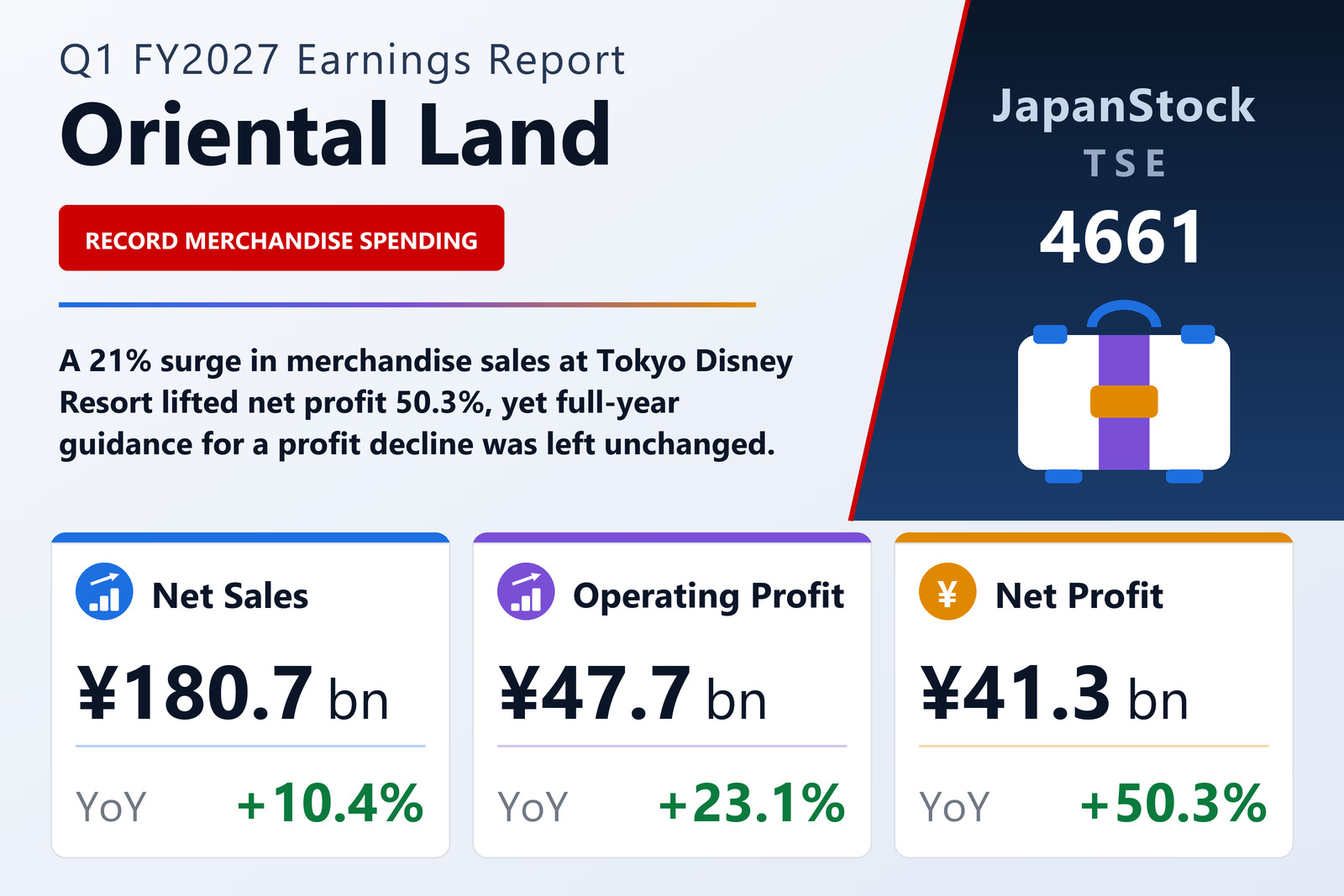
Oriental Land Co., Ltd. (TSE: 4661), which runs Tokyo Disneyland, Tokyo DisneySea and the Tokyo Disney Resort hotels under licence from The Walt Disney Company, reported consolidated first-quarter results for the year ending March 2027 under Japanese GAAP. Net sales rose 10.4% to ¥180,734 million, operating profit climbed 23.1% to ¥47,716 million, ordinary profit surged 48.6% to ¥58,309 million, and profit attributable to owners of the parent jumped 50.3% to ¥41,297 million. Basic earnings per share were ¥25.18, up from ¥16.77 a year earlier.
Merchandise does the heavy lifting
Every theme-park revenue line grew, but merchandise was the standout. Guest spending on goods rose 21.0% to ¥47,219 million from ¥39,031 million, comfortably the fastest-growing line in the group and the single biggest contributor to the quarter's revenue gain. Attractions and shows — still the largest line — added 7.5% to ¥70,300 million, food and beverage rose 11.3% to ¥26,338 million, and other theme-park income gained 12.5% to ¥3,576 million. Together, theme-park revenue advanced 12.3% to ¥147,433 million.
The hotel business grew more modestly, up 2.7% to ¥29,292 million, while other businesses edged 1.8% higher to ¥4,006 million. The mix matters: merchandise and food carry different margins from admissions, and a quarter in which per-guest spending on goods rises a fifth is a materially more profitable quarter than one driven by ticket volume alone.
Theme Park segment drives profit; hotels flat
Theme Park segment profit rose 29.3% to ¥37,865 million from ¥29,275 million, capturing almost all of the group's profit growth. Hotel segment profit was essentially flat at ¥9,254 million against ¥9,168 million, a gain of 0.9% despite the 2.7% revenue increase. The Other segment — which covers the Ikspiari retail complex, the Disney Resort Line monorail and the group's employee-canteen operations — nearly tripled to ¥563 million from ¥192 million. After a ¥33 million consolidation adjustment, group operating profit came to ¥47,716 million.
A ¥10.6 billion non-operating swing
Ordinary profit grew far faster than operating profit, up 48.6% against 23.1%. The gap reflects net non-operating income of roughly ¥10,593 million in the quarter, against just ¥484 million a year earlier — a swing of about ¥10.1 billion below the operating line that accounts for the bulk of the outsized bottom-line gain. Comprehensive income rose a more restrained 23.0% to ¥40,938 million, growing well behind net profit.
Balance sheet, capital spending and a cruise venture
Total assets stood at ¥1,622,391 million at June 30, 2026, marginally below the ¥1,629,076 million reported at March 31. Net assets rose to ¥1,128,138 million from ¥1,100,021 million, lifting the equity ratio to 69.5% from 67.5% and net assets per share to ¥687.96 from ¥670.86. Construction in progress climbed to ¥134,012 million from ¥103,200 million at the March year-end, a ¥30.8 billion increase that points to heavy ongoing capital spending. The company also added one consolidated subsidiary during the quarter, Oriental Land Cruise Co., Ltd., the vehicle for its cruise-ship venture.
Guidance unchanged — implying a sharp slowdown
Despite the strong start, management under president and representative director Wataru Takahashi left full-year guidance untouched. For the first half it still forecasts net sales of ¥324,046 million (+2.5%), operating profit of ¥58,932 million (down 13.6%), ordinary profit of ¥67,185 million (down 3.1%) and net profit of ¥45,520 million (down 5.8%), with EPS of ¥27.76. For the full year it guides net sales of ¥724,312 million (+2.8%), operating profit of ¥160,776 million (down 4.5%), ordinary profit of ¥168,057 million (down 0.9%) and net profit of ¥113,797 million (down 6.6%), with EPS of ¥69.39.
The arithmetic is striking. The first quarter alone delivered 36% of the full-year net-profit target and 30% of the full-year operating-profit target, yet the company continues to guide for a full-year decline. Held to the interim forecast, second-quarter operating profit would be just ¥11,216 million. Either the guidance embeds a genuinely severe second-half cost step-up — plausible given the capex build — or it is conservative and due for revision.
The dividend forecast for the year to March 2027 is unchanged at ¥8 interim plus ¥8 year-end, for ¥16 in total, up from the ¥15 (¥7 plus ¥8) paid for the year to March 2026. Oriental Land had 1,800,450,800 shares issued and 160,627,806 in treasury — including shares held by the employee-shareholding and share-benefit trusts — for a weighted average of 1,639,768,744 shares.
| Metric | Q1 FY2027/3 | Q1 FY2026/3 | Change |
|---|---|---|---|
| Net sales (¥ billion) | 180.73 | 163.75 | +10.4% |
| Operating profit (¥ billion) | 47.72 | 38.77 | +23.1% |
| Ordinary profit (¥ billion) | 58.31 | 39.25 | +48.6% |
| Profit attributable to owners (¥ billion) | 41.30 | 27.48 | +50.3% |
| Basic EPS (¥) | 25.18 | 16.77 | +50.1% |
| Theme Park segment profit (¥ billion) | 37.87 | 29.28 | +29.3% |
| Hotel segment profit (¥ billion) | 9.25 | 9.17 | +0.9% |
| Equity ratio (%, vs prior FY-end) | 69.5 | 67.5 | +2.0pt |
JapanStockPulse provides informational content only and does not constitute investment advice. Figures are taken from the company's published earnings short report and may be subject to subsequent revision.