An order book growing faster than the revenue line
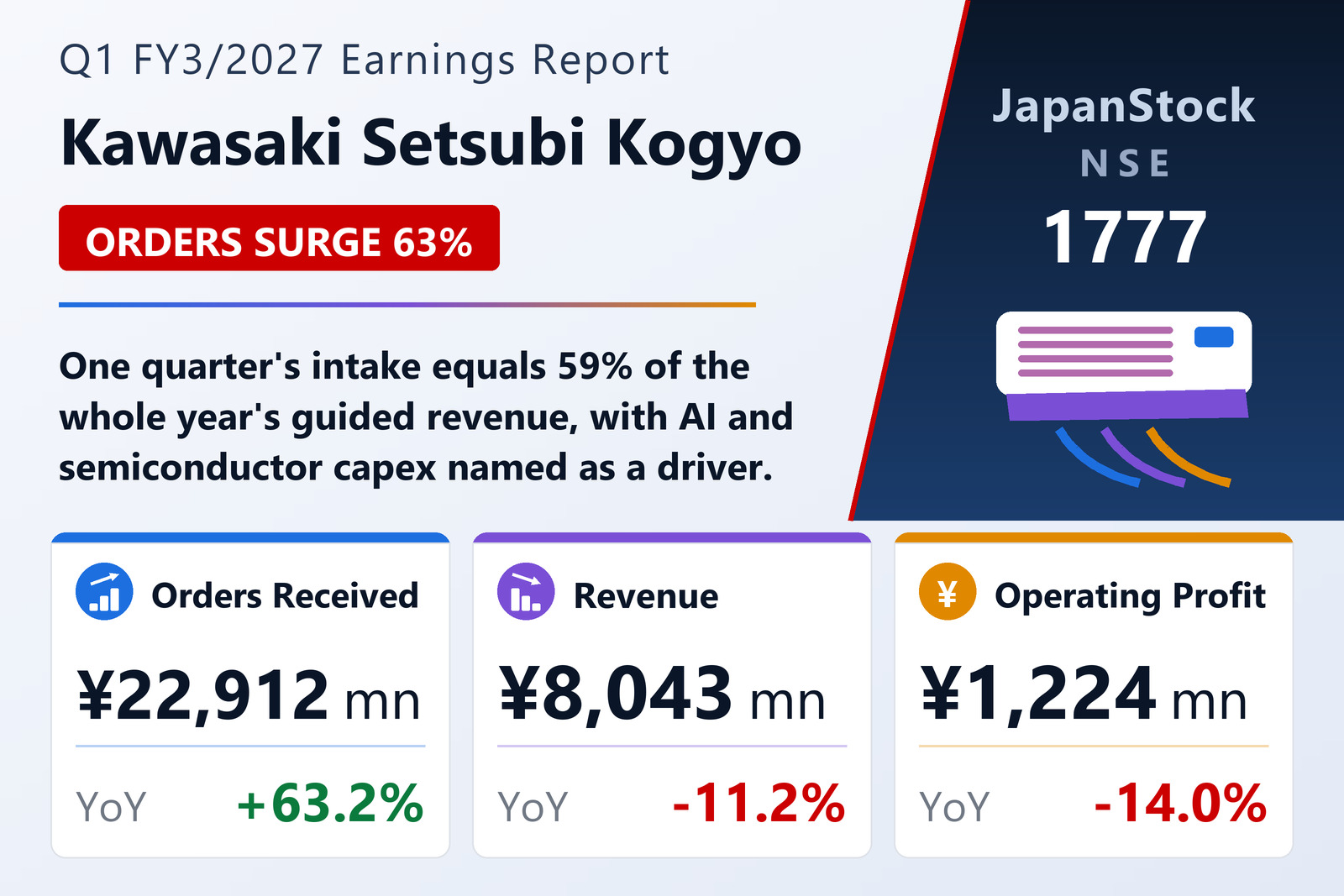
Kawasaki Setsubi Kogyo Co., Ltd. (NSE: 1777), the Nagoya-headquartered mechanical contractor that designs and installs plumbing, air-conditioning and sanitation systems, published non-consolidated first-quarter results for FY3/2027 — the three months from April 1 to June 30, 2026 — under Japanese GAAP on July 31, 2026. The two headline numbers point in opposite directions. Orders received rose 63.2% to ¥22,912 million, while completed-construction revenue fell 11.2% to ¥8,043 million.
That gap is the whole story of the quarter. At ¥22,912 million the intake is 2.8 times the revenue recognised in the same three months, and it lands against a full-year revenue plan of ¥39,000 million — meaning a single quarter's orders equal roughly 59% of the entire year's guided billings. For a contractor that recognises revenue as work progresses, a book filling that much faster than it empties is a forward indicator, not a current one: none of it reaches the profit-and-loss account until the jobs are executed.
Management attributes the demand to a construction market in which public facility investment stayed firm, private capital spending held up on solid corporate earnings, and replacement demand for the equipment in ageing buildings remained steady. It singles out one growth driver by name — capital-expenditure plans tied to AI and semiconductors are expanding, a segment of the market that is capital-intensive in exactly the mechanical systems this company installs. Against that it flags chronic labour shortages, higher construction-material prices and delays to work in progress caused by shortages of crude-oil-derived materials.
A wider margin undone by heavier overhead
The margin arithmetic is unusual and worth separating out. Cost of completed construction fell faster than revenue — down 13.4% to ¥6,086 million from ¥7,030 million — so gross profit fell only 3.5% to ¥1,956 million on revenue that fell 11.2%. The gross margin therefore widened to 24.32% from 22.38%, a gain of 1.94 percentage points. On execution quality alone, this was a better quarter than the one before it.
The gain did not survive the line below. Selling, general and administrative expenses rose 21.2% to ¥732 million from ¥604 million — an increase of ¥128 million against a gross-profit decline of ¥71 million. Together the two took operating profit down 14.0% to ¥1,224 million, and the operating margin slipped to 15.22% from 15.71%, a far smaller erosion than the revenue decline implies. Non-operating items were negligible on both sides, so ordinary profit fell an identical 14.0% to ¥1,238 million. After tax of ¥398 million against ¥445 million, net profit was ¥840 million, down 15.4%, and earnings per share ¥70.23 against ¥83.03.
One technical note affects how the tax line should be read: the company applies the accounting treatment specific to quarterly financial statements, estimating a full-year effective tax rate and applying it to quarterly pre-tax profit rather than computing tax on the quarter itself. The resulting 32.1% effective rate is therefore an annual estimate, not a quarterly outcome.
Central Japan held; the west lost a third of its revenue
The company reports through three geographic segments, and they moved very differently. Central Japan, the home region and the largest of the three, produced revenue of ¥3,855 million, down 7.1%, with segment profit of ¥784 million, down 11.7%. Eastern Japan was the only segment to grow on both lines: revenue of ¥2,706 million, up 0.5%, and segment profit of ¥490 million, up 3.4% — a segment margin of 18.11%, the best of the three.
Western Japan is where the group's revenue decline sits almost in its entirety. Revenue fell 33.1% to ¥1,481 million from ¥2,215 million, a drop of ¥734 million that accounts for roughly seven-tenths of the ¥1,015 million fall at company level. Segment profit held up far better, down 13.2% to ¥290 million, which lifted the western margin to 19.58% from 15.08% — the same execution-quality effect visible in the group gross margin, concentrated in the region that shrank most. Unallocated corporate expense rose 24.5% to ¥341 million from ¥274 million, which is where the SG&A increase discussed above reappears.
A lighter balance sheet, a stronger equity ratio
Total assets fell 5.7% to ¥24,924 million over the three months, a decline of ¥1,499 million driven almost entirely by collections: accounts receivable from completed construction fell ¥2,992 million to ¥11,778 million as the group was paid for work handed over at the March year-end, while cash and deposits rose ¥1,975 million to ¥4,929 million. Total liabilities fell ¥1,532 million to ¥8,488 million, chiefly on lower payables for construction work.
Net assets were essentially flat, up ¥32 million to ¥16,436 million, as the ¥840 million earned in the quarter was almost entirely offset by the dividend paid. The equity ratio rose to 65.9% from 62.1% — but the mechanism matters: equity barely moved, so the 3.8-point improvement is an arithmetic consequence of an asset base that contracted 5.7% on a working-capital swing. When receivables rebuild as the year's work is delivered, the ratio will mechanically give the gain back.
Guidance and the ¥95 dividend both held
Kawasaki Setsubi Kogyo left the forecast published with its April 28, 2026 full-year results unchanged. For FY3/2027 it guides revenue of ¥39,000 million, up 3.6%, operating profit of ¥5,000 million, up 1.9%, ordinary profit of ¥5,060 million, up 1.5%, and net profit of ¥3,447 million, down 6.5%, for EPS of ¥288.11. The interim plan is revenue of ¥20,500 million, up 13.6%, with operating profit of ¥2,700 million, up 10.2%.
Measured against those targets the first quarter delivered 20.6% of guided revenue and 24.5% of guided operating profit — the profit share running well ahead of a straight-line quarter, which leaves room for the second-half margin compression the guidance implies. The full-year plan embeds an operating margin of 12.82% against the 15.22% just posted, so management is explicitly not extrapolating current profitability. The annual dividend is held at ¥95.00 per share, matching FY3/2026, though the composition changes: the prior year's ¥95.00 was ¥50.00 ordinary plus a ¥45.00 special dividend, while FY3/2027 is guided as ¥45.00 at the interim and ¥50.00 at the year-end with no special element. On guided EPS that is a payout ratio of roughly 33%.
| Metric | Q1 FY3/2027 | Q1 FY3/2026 | Change |
|---|---|---|---|
| Orders received (¥ million) | 22,912 | — | +63.2% |
| Revenue (¥ million) | 8,043 | 9,058 | −11.2% |
| Gross profit (¥ million) | 1,956 | 2,027 | −3.5% |
| Gross margin | 24.32% | 22.38% | +1.94 pt |
| SG&A expenses (¥ million) | 732 | 604 | +21.2% |
| Operating profit (¥ million) | 1,224 | 1,423 | −14.0% |
| Operating margin | 15.22% | 15.71% | −0.49 pt |
| Ordinary profit (¥ million) | 1,238 | 1,439 | −14.0% |
| Net profit (¥ million) | 840 | 993 | −15.4% |
| EPS (¥) | 70.23 | 83.03 | −15.4% |
| Eastern Japan — revenue (¥ million) | 2,706 | 2,692 | +0.5% |
| Eastern Japan — segment profit (¥ million) | 490 | 474 | +3.4% |
| Central Japan — revenue (¥ million) | 3,855 | 4,150 | −7.1% |
| Central Japan — segment profit (¥ million) | 784 | 888 | −11.7% |
| Western Japan — revenue (¥ million) | 1,481 | 2,215 | −33.1% |
| Western Japan — segment profit (¥ million) | 290 | 334 | −13.2% |
| Unallocated corporate expense (¥ million) | −341 | −274 | +24.5% |
| Total assets (¥ million) | 24,924 | 26,424 | −5.7% |
| Net assets (¥ million) | 16,436 | 16,403 | +0.2% |
| Equity ratio | 65.9% | 62.1% | +3.8 pt |
| FY3/2027 guidance — revenue (¥ million) | 39,000 | — | +3.6% |
| FY3/2027 guidance — operating profit (¥ million) | 5,000 | — | +1.9% |
| FY3/2027 guidance — ordinary profit (¥ million) | 5,060 | — | +1.5% |
| FY3/2027 guidance — net profit (¥ million) | 3,447 | — | −6.5% |
| FY3/2027 guidance — EPS (¥) | 288.11 | — | — |
| Annual dividend per share (¥) | 95.00 | 95.00 | unchanged |
JapanStockPulse provides informational content only and does not constitute investment advice. Figures are taken from the company's published earnings short report and may be subject to subsequent revision.