A small operator with two very different businesses
Buffalo Co., Ltd. (TSE: 3352) published consolidated first-quarter results for FY3/2027 on July 31, 2026, covering April 1 to June 30, 2026 under Japanese GAAP. Two segments carry the group: 15 Autobacs car-accessory stores operated under franchise, and a ten-restaurant chain run by subsidiary Buffalo Food Service under franchise agreements with PISOLA (Italian) and Yakiniku Like (grilled meat). No store was opened or closed in either format during the quarter, so everything below is like-for-like.
One disambiguation is worth making up front for international readers: this company is not Buffalo Inc., the Nagoya-based maker of PC peripherals and network storage. They share a name and nothing else.
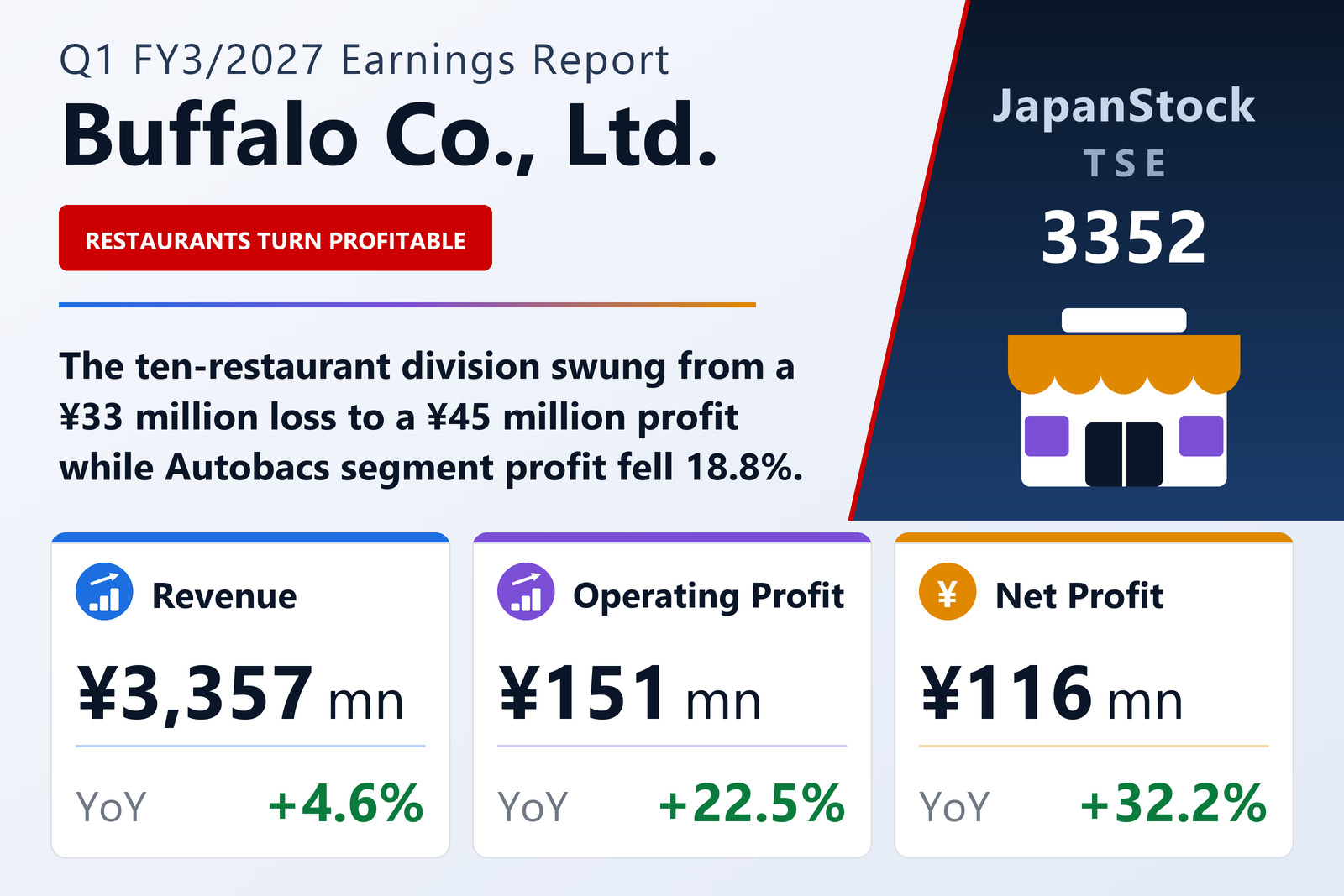
Group revenue rose 4.6% to ¥3,357 million and operating profit 22.5% to ¥151 million, lifting the operating margin to 4.49% from 3.83%. Ordinary profit rose 15.4% to ¥163 million — growing more slowly than operating profit, so the non-operating contribution shrank slightly — and net profit attributable to owners of parent rose 32.2% to ¥116 million, faster than either, with earnings per share at ¥49.67 against ¥37.56. Comprehensive income tracked net profit almost exactly at ¥116 million, so nothing material moved through other comprehensive income.
The restaurants did the work
The segment split reverses the intuitive reading. The Autobacs business is 85% of revenue and grew it 3.5% to ¥2,845 million — but segment profit fell 18.8% to ¥202 million from ¥248 million, taking its margin down to 7.09% from 9.03%. The restaurant business, 15% of revenue, grew 11.5% to ¥512 million and swung from a ¥33 million segment loss to a ¥45 million profit, an ¥78 million improvement that is nearly three times the ¥28 million rise in group operating profit.
Put plainly: without the restaurants, this would have been a down quarter. Management describes the turnaround as the product of a deliberate push begun when it took on the PISOLA format in April 2024 — strengthening operational quality in that format specifically, improving service standards, tightening cost control, and optimising staffing including through the recruitment of specified-skilled foreign workers. Industry conditions helped: customer counts have been recovering gradually and per-customer spend is rising as operators pass through higher ingredient and labour costs, though the company notes that persistent inflation keeps consumers value-conscious, so generating a sense of good value remains the sector's shared problem.
On the Autobacs side the revenue drivers were solid and the profit outcome was not. New-vehicle sales ran above the prior year and a long Golden Week boosted outings, lifting demand for maintenance and consumables. Within the store business, the company has been concentrating on the pit and service-labour category built around vehicle inspection, adding smartphone-app booking and more pit equipment; oil and battery both beat the prior year on the back of a web-booking system that made same-day oil changes easier. The car sales department is where the pressure shows: a shortage of used vehicles in circulation intensified competition for stock, and although reinforcing the appraisal team lifted auction-market volumes and unit prices enough to grow revenue, retail sales to individuals were weak. A revenue mix tilting toward lower-margin auction disposals and higher-cost stock acquisition is a plausible reading of a segment margin that fell nearly two points on rising sales, though the company does not break the margin out by department.
Unallocated corporate expense rose 3.8% to ¥96 million from ¥92 million, a modest increase that leaves the whole of the group's profit story inside the two segments.
A balance sheet that essentially stood still
Total assets were flat at ¥9,827 million, down ¥5 million over the three months. Current assets edged up ¥9 million to ¥6,134 million, with inventory ¥41 million higher against a ¥36 million reduction in accounts receivable inside other current assets; non-current assets fell ¥14 million to ¥3,692 million on small declines in property and lease deposits.
Total liabilities fell 1.2% to ¥3,293 million. Current liabilities rose ¥26 million to ¥1,844 million as ¥99 million more in accounts payable and ¥32 million more in deposits received outweighed a ¥97 million reduction in accrued income taxes; non-current liabilities fell ¥65 million to ¥1,449 million, chiefly a ¥46 million repayment of long-term borrowings. Net assets rose 0.5% to ¥6,533 million, retained earnings gaining ¥34 million as the quarter's profit exceeded the dividend paid. The equity ratio ended at 66.5% against 66.1%.
Guidance held; the dividend rises for the second year
Buffalo states that first-quarter performance is broadly in line with plan and left the FY3/2027 forecast published on May 14, 2026 unchanged: revenue of ¥14,050 million, up 2.5%, operating profit of ¥713 million, up 17.9%, ordinary profit of ¥720 million, up 10.6%, and net profit of ¥485 million, up 9.7%, for EPS of ¥206.96.
Against those targets the quarter delivered 23.9% of guided revenue, 21.1% of guided operating profit and 24.0% of guided net profit — close enough to a straight-line quarter that the plan looks neither stretched nor conservative. The guided full-year operating margin of 5.07% sits above the 4.49% just posted, so management is assuming further improvement rather than a repeat of this quarter, which for a business with fixed store counts means the restaurant recovery has to keep going.
The dividend rises. FY3/2026 paid ¥65.00 per share — ¥30.00 interim and ¥35.00 at the year-end — and FY3/2027 is guided at ¥70.00, with the interim raised to ¥35.00 and the year-end held at ¥35.00, unchanged from the previously published forecast. On guided EPS of ¥206.96 that is a payout ratio of roughly 34%. The share count is small — 2,345,874 shares issued, 2,464 held in treasury — which is worth keeping in mind when comparing per-share figures with larger listed peers.
| Metric | Q1 FY3/2027 | Q1 FY3/2026 | Change |
|---|---|---|---|
| Revenue (¥ million) | 3,357 | 3,208 | +4.6% |
| Operating profit (¥ million) | 151 | 123 | +22.5% |
| Operating margin | 4.49% | 3.83% | +0.66 pt |
| Ordinary profit (¥ million) | 163 | 142 | +15.4% |
| Net profit attrib. to owners of parent (¥ million) | 116 | 88 | +32.2% |
| Comprehensive income (¥ million) | 116 | 87 | +32.2% |
| EPS (¥) | 49.67 | 37.56 | +32.2% |
| Autobacs business — revenue (¥ million) | 2,845 | 2,749 | +3.5% |
| Autobacs business — segment profit (¥ million) | 202 | 248 | −18.8% |
| Restaurant business — revenue (¥ million) | 512 | 459 | +11.5% |
| Restaurant business — segment profit (¥ million) | 45 | −33 | loss to profit |
| Unallocated corporate expense (¥ million) | −96 | −92 | +3.8% |
| Autobacs stores at period end | 15 | 15 | unchanged |
| Restaurants at period end | 10 | — | — |
| Total assets (¥ million) | 9,827 | 9,831 | −0.1% |
| Total liabilities (¥ million) | 3,293 | 3,333 | −1.2% |
| Net assets (¥ million) | 6,533 | 6,498 | +0.5% |
| Equity ratio | 66.5% | 66.1% | +0.4 pt |
| FY3/2027 guidance — revenue (¥ million) | 14,050 | — | +2.5% |
| FY3/2027 guidance — operating profit (¥ million) | 713 | — | +17.9% |
| FY3/2027 guidance — ordinary profit (¥ million) | 720 | — | +10.6% |
| FY3/2027 guidance — net profit (¥ million) | 485 | — | +9.7% |
| FY3/2027 guidance — EPS (¥) | 206.96 | — | — |
| Annual dividend per share (¥) | 70.00 | 65.00 | +7.7% |
JapanStockPulse provides informational content only and does not constitute investment advice. Figures are taken from the company's published earnings short report and may be subject to subsequent revision.