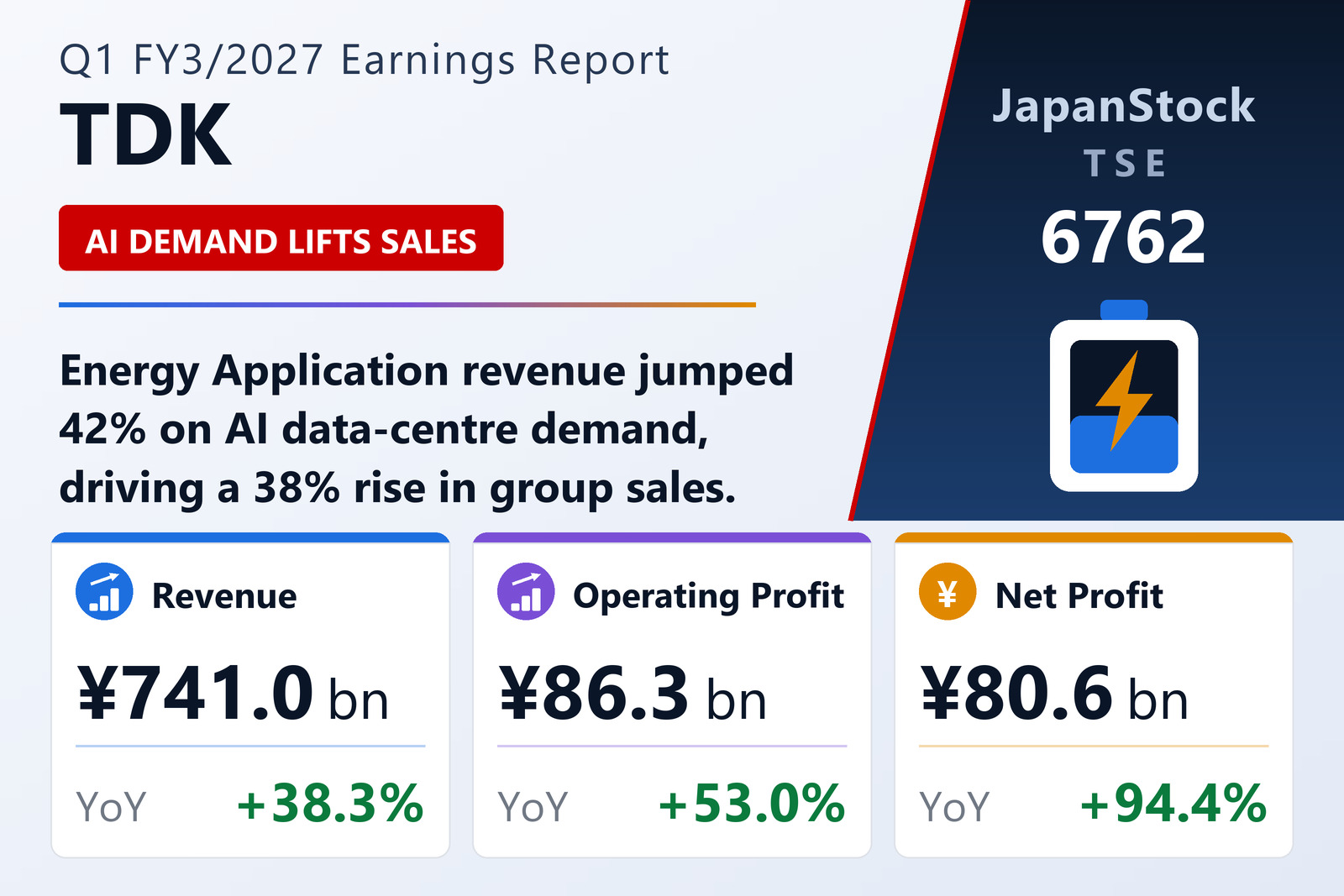
TDK Corporation (TSE: 6762), the Tokyo-based maker of passive components, sensors, magnetic heads and rechargeable batteries, reported consolidated results for the three months ended June 30, 2026 under IFRS. Net sales rose 38.3% to ¥741,005 million from ¥535,753 million a year earlier, operating profit climbed 53.0% to ¥86,310 million, profit before tax advanced 64.0% to ¥94,500 million, and profit attributable to owners of the parent nearly doubled, up 94.4% to ¥80,581 million. Basic earnings per share were ¥42.45 against ¥21.85, and diluted EPS ¥42.40 against ¥21.82. Total comprehensive income, swollen by a large positive translation adjustment on a weaker yen, reached ¥151,284 million versus just ¥8,097 million a year ago.
Where the growth came from
Every reporting segment grew. The swing factor was Energy Application Products — rechargeable batteries and power supplies — whose external sales rose 42.1% to ¥405,795 million from ¥285,519 million, contributing ¥120,276 million of the group's ¥205,252 million revenue increase, or roughly 59% of the total gain. That segment alone now accounts for 54.8% of consolidated sales, up from 53.3%. Energy devices sold mainly into the ICT market, where new smartphone launches offset an overall decline in ICT-related production. Magnetic Application Products — HDD heads, HDD suspensions and magnets — grew fastest in percentage terms, up 49.6% to ¥81,608 million from ¥54,554 million, as demand for nearline HDDs used in AI data centres stayed firm and magnet sales into the automotive market increased.
Passive Components revenue rose 28.0% to ¥176,803 million from ¥138,140 million, with capacitors up 35.1% to ¥80,752 million, inductive devices up 26.2% to ¥61,980 million and other passive components — high-frequency parts, piezoelectric materials and circuit-protection devices — up 16.4% to ¥34,071 million; capital-investment demand in the industrial-equipment market was the main driver, with inductive devices lifted by automotive. Sensor Application Products gained 33.3% to ¥61,856 million on ICT-market sales, and the Other category, largely mechatronics production equipment, rose 34.3% to ¥14,943 million. Overseas sales climbed 39.2% to ¥686,935 million and now represent 92.7% of the consolidated total, 0.6 points more than a year ago.
Segment profits: passives and sensors triple, energy margin narrows
The profit mix shifted more sharply than the revenue mix. Segment profit at Passive Components jumped 172.2% to ¥17,385 million, lifting that segment's margin from 4.6% to 9.8%, while Sensor Application Products profit rose 191.6% to ¥7,845 million and its margin more than doubled from 5.8% to 12.7% — the clearest evidence that last year's restructuring and rationalisation programmes are now feeding through. Magnetic Application Products profit rose 51.8% to ¥9,550 million on a broadly flat 11.7% margin. Energy Application Products remains by far the largest profit pool at ¥69,389 million, up 25.3%, but its margin fell from 19.4% to 17.1%, so the segment supplied 59% of the revenue growth and only 41% of the segment-profit growth. The Other category narrowed its loss to ¥1,832 million from ¥2,476 million. Segment profit before corporate items totalled ¥102,338 million, up 49.9%, against an unallocated corporate charge of ¥16,028 million, up from ¥11,843 million — leaving the reported operating margin at 11.6% versus 10.5%.
One quarter, 29% of the full-year profit target — and guidance untouched
TDK explicitly stated there was no revision to its previously announced forecast. Full-year FY3/2027 guidance still calls for net sales of ¥2,580,000 million (+3.0%), operating profit of ¥295,000 million (+8.3%), profit before tax of ¥300,000 million (+8.4%) and profit attributable to owners of the parent of ¥225,000 million (+15.0%), with basic EPS of ¥118.54. That leaves an unusual gap between the run rate and the target. The first quarter alone banked 29.3% of the full-year operating-profit target, 28.7% of the sales target and 35.8% of the net-profit target — and it did so in what is normally TDK's seasonally lightest quarter, ahead of the autumn smartphone build. Holding a +3.0% full-year sales forecast after a +38.3% quarter implies management is assuming a materially weaker remainder of the year, a stronger yen, or simply declining to move a forecast set only three months earlier. Investors will read the unchanged number as conservatism rather than as a statement about demand.
Dividend held, balance sheet expands, operating cash flow turns negative
The dividend forecast was likewise unrevised. TDK pays no first- or third-quarter dividend; for FY3/2027 it still guides an annual ¥40.00 per share (¥20.00 interim plus ¥20.00 year-end), up from the ¥36.00 paid for FY3/2026 (¥16.00 plus ¥20.00). Total assets grew 7.6% from the March year-end to ¥4,751,331 million, an increase of ¥336,156 million driven by property, plant and equipment up ¥124,380 million, trade receivables up ¥119,479 million and inventories up ¥52,830 million. Liabilities rose ¥222,628 million, most of it current bonds and borrowings up ¥142,350 million. Equity attributable to owners of the parent rose 5.1% to ¥2,298,943 million, but because assets grew faster the equity ratio slipped 1.1 points to 48.4%. The more striking line is cash flow: operating cash flow swung to an outflow of ¥19,154 million from an inflow of ¥59,043 million, a ¥78,197 million deterioration, as the ¥108,748 million build in trade receivables, a ¥26,579 million inventory build and ¥43,725 million of income tax payments overwhelmed ¥81,985 million of quarterly profit and ¥57,321 million of depreciation. Investing outflows were ¥60,220 million, including ¥84,875 million of fixed-asset purchases, and financing raised ¥85,389 million. With a ¥21,407 million currency benefit, period-end cash still rose to ¥870,197 million.
Linergy Power in, Actutek out
TDK reported a material change to its consolidation scope during the quarter. It acquired shares in Linergy Power Sdn Bhd, a specified subsidiary, bringing it into consolidation, and sold its stake in Actutek Corporation, removing it from the group. There were no changes to accounting policies. Issued shares stood at 1,943,859,885 with 45,705,825 held in treasury, and the weighted-average share count for the quarter was 1,898,154,117.
| Metric | Q1 FY3/2027 | Q1 FY3/2026 | YoY |
|---|---|---|---|
| Net sales (¥ billion) | 741.01 | 535.75 | +38.3% |
| Operating profit (¥ billion) | 86.31 | 56.42 | +53.0% |
| Operating margin (%) | 11.6 | 10.5 | +1.1 pt |
| Profit before tax (¥ billion) | 94.50 | 57.63 | +64.0% |
| Profit for the period (¥ billion) | 81.99 | 42.38 | +93.4% |
| Profit attrib. to owners (¥ billion) | 80.58 | 41.46 | +94.4% |
| Basic EPS (¥) | 42.45 | 21.85 | +94.3% |
| Diluted EPS (¥) | 42.40 | 21.82 | +94.3% |
| Total comprehensive income (¥ billion) | 151.28 | 8.10 | +1,768.4% |
| Energy Application Products sales (¥ billion) | 405.80 | 285.52 | +42.1% |
| Overseas sales (¥ billion) | 686.94 | 493.52 | +39.2% |
| Operating cash flow (¥ billion) | -19.15 | 59.04 | -¥78.20bn |
JapanStockPulse provides informational content only and does not constitute investment advice. Figures are taken from the company's published earnings short report and may be subject to subsequent revision.