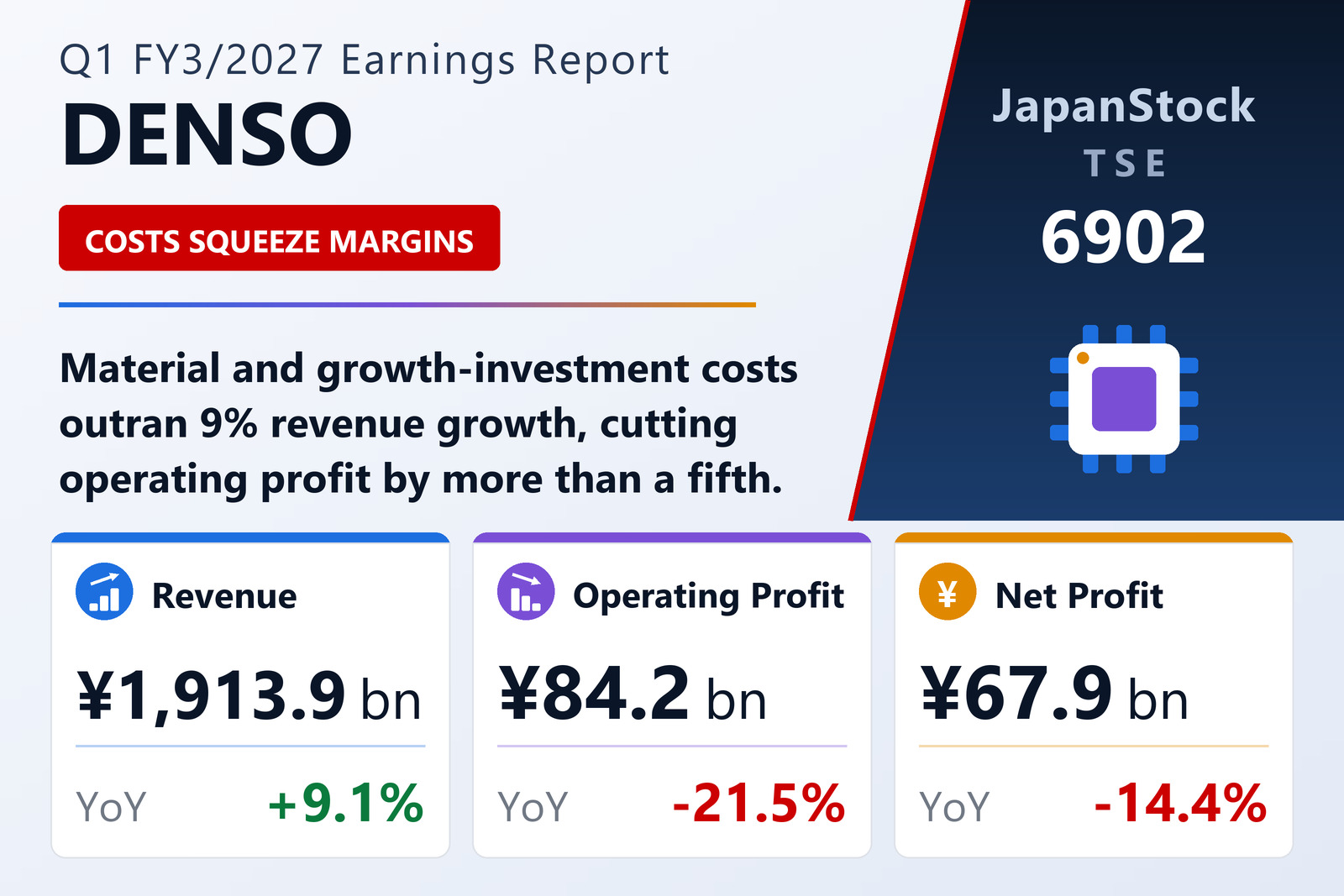
DENSO Corporation (TSE / Nagoya: 6902), the Toyota-affiliated supplier that ranks among the world's largest makers of automotive components, reported consolidated results under IFRS for the first quarter of the fiscal year ending March 2027 — the three months from April 1 to June 30, 2026. Revenue rose 9.1% to ¥1,913,868 million, an increase of ¥159.7 billion, on higher vehicle output at its customers and expanded sales of electrification and vehicle-intelligence products. Profitability moved the other way: operating profit fell 21.5% to ¥84,178 million, profit before tax fell 19.7% to ¥112,634 million, profit for the period fell 14.7% to ¥75,845 million, and profit attributable to owners of the parent fell 14.4% to ¥67,875 million. Basic earnings per share were ¥25.51, against ¥28.50 a year earlier.
Revenue growth that never reached the profit line
The gap between the top and bottom lines is unusually stark. Cost of sales climbed 10.5% to ¥1,667,486 million, faster than the 9.1% revenue gain, so gross profit was essentially flat at ¥246,382 million — up just 0.3% on ¥245,691 million a year earlier. That alone compressed the gross margin from 14.0% to 12.9%. Selling, general and administrative expenses then rose 18.1% to ¥163,954 million as the group stepped up investment for future growth under its new 2030 medium-term plan, "CORE 2030." The combined effect took the operating margin down from 6.1% to 4.4%. Management attributes the squeeze to surging prices for materials such as copper and aluminium and to the growth spending, partly offset by a favourable currency translation effect from the weaker yen.
Below the operating line the picture was mixed. Financial income slipped to ¥31,733 million from ¥34,226 million and finance costs rose to ¥8,280 million from ¥4,996 million, while a ¥3,928 million foreign-exchange gain a year ago turned into a ¥358 million loss. Equity-method investments swung to a ¥5,361 million gain from a ¥136 million loss. A lighter tax charge of ¥36,789 million — an effective rate of 32.7% against 36.6% — is why net profit fell less steeply than operating profit. Total comprehensive income dropped 33.4% to ¥36,258 million, hit by an ¥82,147 million negative remeasurement of defined-benefit pension plans that outweighed a ¥43,694 million positive translation adjustment on foreign operations.
Europe swings to a loss; Japan profit nearly halves
DENSO reports by region, and every region grew revenue while three of the five saw profit fall. Japan, the largest at ¥1,110,033 million including inter-segment sales (+9.5%), saw segment profit collapse 43.3% to ¥7,566 million from ¥13,343 million, as material-cost inflation and growth investment overwhelmed the benefit of a weak yen and higher operating rates. North America was the bright spot: revenue up 13.7% to ¥538,071 million on stronger vehicle sales, with profit up 12.1% to ¥25,301 million on rationalisation gains despite higher input costs. Europe grew revenue 6.3% to ¥198,757 million on currency alone but swung to an operating loss of ¥8,617 million from a ¥5,215 million profit, the result of quality-related costs. Asia lifted revenue 6.6% to ¥489,217 million — again on the weaker yen, as vehicle sales in the region were soft — while profit fell 12.2% to ¥41,826 million on unfavourable operating-rate variances and material costs. The residual "Other" region, mainly South American subsidiaries, grew revenue 23.0% to ¥37,045 million and profit 31.6% to ¥7,252 million. The four reportable regions together produced ¥66,076 million of profit, down from ¥88,799 million; adding the ¥7,252 million from "Other" and ¥10,850 million of corporate items and eliminations gives the consolidated ¥84,178 million.
Revenue guidance raised, profit guidance held
DENSO revised its full-year FY3/2027 forecast on the same day, in a separate notice published July 31, 2026. Revenue guidance was raised to ¥7,750,000 million, up 2.8% year on year, to absorb the first quarter's stronger vehicle sales and the translation benefit of a weaker yen. Operating profit, however, was left at the previously published ¥500,000 million — down 9.5% on the prior year — because the copper and aluminium price surge that hit the first quarter offsets the operating-rate and currency gains. The rest of the revised forecast comprises profit before tax of ¥553,000 million (−10.4%), profit of ¥422,000 million (−13.4%), profit attributable to owners of the parent of ¥382,000 million (−13.9%) and basic EPS of ¥150.08. From the second quarter onward the company assumes exchange rates of ¥153 to the U.S. dollar and ¥180 to the euro.
A ¥313.6 billion buyback and a higher dividend
The quarter's most striking balance-sheet item is the scale of the share repurchase. Treasury shares jumped from 219,039,381 to 403,942,048 — an increase of roughly 184.9 million shares — and the cash-flow statement shows ¥313,586 million spent acquiring own shares, against ¥118,593 million a year earlier. On the balance sheet the treasury-stock deduction widened from ¥437,244 million to ¥750,264 million. The average share count for the quarter fell to 2,661,121,906 from 2,781,428,110, a 4.3% reduction that cushioned the per-share decline: EPS fell 10.5% while attributable profit fell 14.4%. Issued shares were unchanged at 2,910,979,691. On dividends, DENSO paid ¥67.00 per share for FY3/2026 (¥32.00 interim plus ¥35.00 year-end) and forecasts ¥74.00 for FY3/2027 — ¥37.00 at the half and ¥37.00 at year-end — unchanged from its previous dividend forecast and a 10.4% increase.
Cash flow strengthens as the balance sheet gears up
Operating cash flow rose sharply to ¥238,958 million from ¥164,377 million, helped by a ¥174,806 million release from trade receivables and a lower tax payment of ¥70,750 million, and despite ¥47,187 million tied up in inventories. Investing activities consumed ¥106,768 million — including ¥88,746 million of capital expenditure on property, plant and equipment against ¥95,925 million of depreciation — reversing a ¥60,592 million inflow a year earlier. Financing activities turned to a ¥92,673 million inflow from a ¥56,655 million outflow, as ¥447,568 million of borrowings and ¥80,725 million of bond issuance funded the buyback and ¥94,222 million of dividends. Cash and equivalents ended the quarter at ¥1,429,125 million, up ¥239,999 million from March. Total assets edged up ¥65.2 billion to ¥8,796,049 million, but liabilities rose ¥467.8 billion to ¥3,482,763 million while equity fell ¥402.6 billion to ¥5,313,286 million on the repurchase — pushing the ratio of equity attributable to owners of the parent down from 62.9% to 58.1%.
| Metric | Q1 FY3/2027 | Q1 FY3/2026 | YoY |
|---|---|---|---|
| Revenue (¥ billion) | 1,913.87 | 1,754.14 | +9.1% |
| Gross profit (¥ billion) | 246.38 | 245.69 | +0.3% |
| Operating profit (¥ billion) | 84.18 | 107.21 | −21.5% |
| Operating margin (%) | 4.4 | 6.1 | −1.7 pp |
| Profit before tax (¥ billion) | 112.63 | 140.23 | −19.7% |
| Profit for the period (¥ billion) | 75.85 | 88.87 | −14.7% |
| Profit attrib. to owners (¥ billion) | 67.88 | 79.27 | −14.4% |
| Total comprehensive income (¥ billion) | 36.26 | 54.41 | −33.4% |
| Basic EPS (¥) | 25.51 | 28.50 | −10.5% |
| Operating cash flow (¥ billion) | 238.96 | 164.38 | +45.4% |
| Annual dividend (¥, FY3/27 forecast vs FY3/26) | 74.00 | 67.00 | +10.4% |
JapanStockPulse provides informational content only and does not constitute investment advice. Figures are taken from the company's published earnings short report and may be subject to subsequent revision.