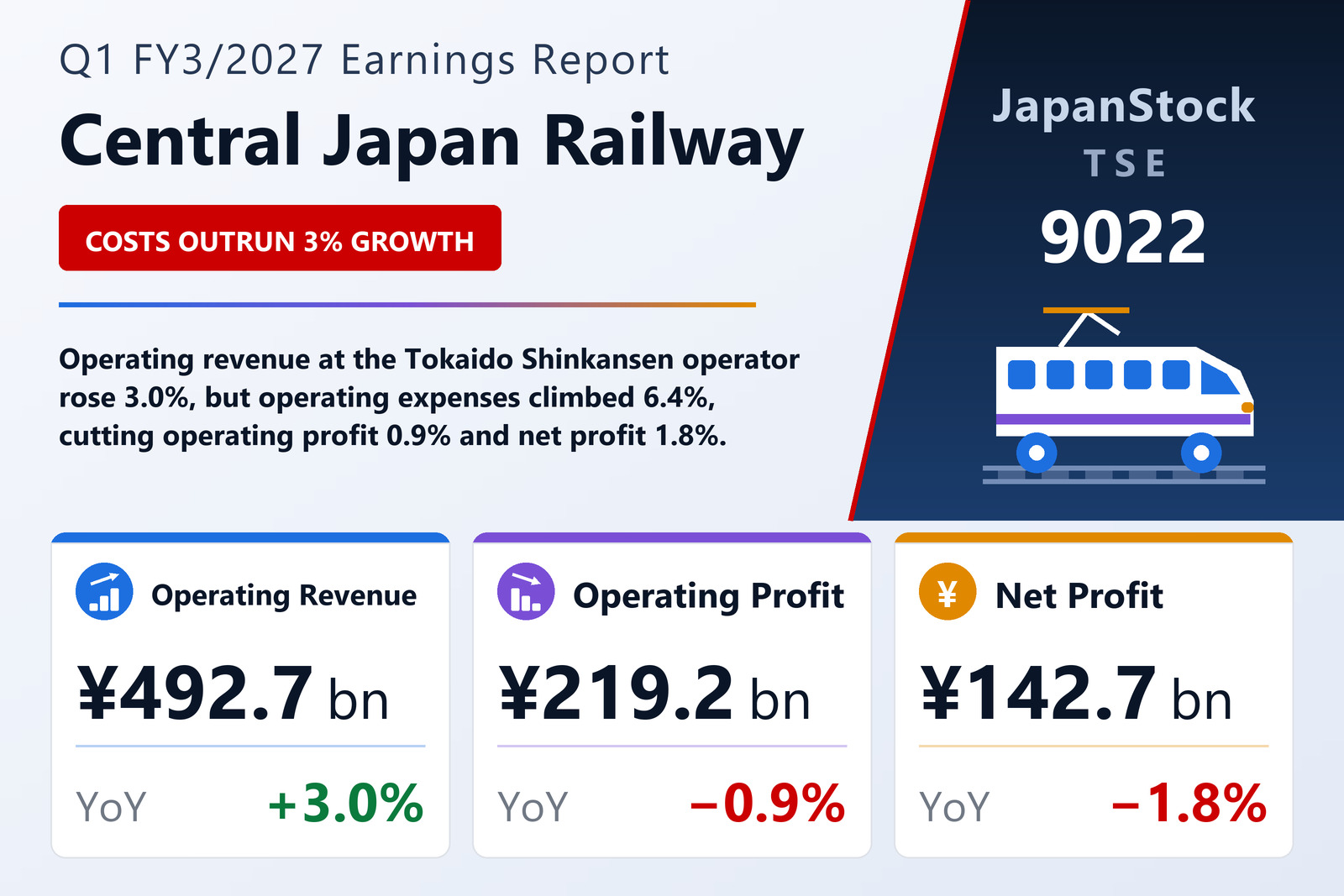
Central Japan Railway Company (TSE: 9022), the operator of the Tokaido Shinkansen and a company listed on both the Tokyo and Nagoya exchanges, reported consolidated results for the first quarter of the fiscal year ending March 2027 — the three months from April 1 to June 30, 2026 — under Japanese GAAP. Operating revenue rose 3.0% to ¥492,716 million, but operating profit fell 0.9% to ¥219,165 million. Ordinary profit edged up 0.5% to ¥208,548 million, profit attributable to owners of the parent fell 1.8% to ¥142,658 million and comprehensive income dropped 6.1% to ¥150,243 million. Basic earnings per share came to ¥149.59 against ¥147.88 a year earlier, with no diluted figure reported. Group-wide transport volume rose 0.4% to 16,993 million passenger-kilometres. The comparison is against an unusually strong base: in the year-earlier quarter revenue had grown 9.9% and operating profit 20.0%.
Operating costs grew twice as fast as revenue
The gap between a 3.0% revenue gain and a 0.9% profit decline sits entirely in the cost line. Total operating expenses rose 6.4% to ¥273,551 million from ¥257,057 million — more than double the pace of the top line. Transportation and other operating expenses and cost of sales accounted for most of it at ¥219,319 million, up 6.3%, while selling, general and administrative expenses rose 6.8% to ¥54,231 million. Depreciation was not the driver: it edged down to ¥48,892 million from ¥49,454 million. The result was an operating margin of 44.5%, against 46.3% a year earlier — a level that remains among the highest of any large Japanese listed company, but 1.8 percentage points thinner. Management described an operating environment of continued price inflation, a shrinking working-age population and changing lifestyles and work patterns, and said it is pursuing two pillars — expanding revenue through new ideas, and a "business reform" programme that uses AI and the latest ICT to build a more efficient operating structure.
Interest income lifted ordinary profit even as operating profit fell
Below the operating line the direction reversed. Non-operating income jumped 41.2% to ¥9,986 million from ¥7,072 million, led by interest received of ¥6,074 million against ¥3,804 million — a 59.7% increase that reflects higher yen interest rates on the group's large cash and trust balances — plus dividends received of ¥2,987 million against ¥2,640 million. Non-operating expenses were slightly lower at ¥20,602 million versus ¥20,765 million, comprising interest paid of ¥11,745 million (¥11,406 million), interest on long-term payables for railway facility purchases of ¥8,114 million (¥8,236 million) and other items. That swing was enough to turn a 0.9% operating decline into a 0.5% rise in ordinary profit. Pre-tax quarterly profit was essentially flat at ¥207,836 million against ¥207,324 million, but income taxes rose to ¥63,475 million from ¥61,064 million, an effective rate of 30.5% against 29.5%, and the share attributable to non-controlling interests rose to ¥1,701 million from ¥1,047 million — which is how a flat pre-tax result became a 1.8% decline at the bottom line.
Earnings per share rose while profit fell — buybacks explain the gap
Despite the 1.8% fall in profit attributable to owners, basic earnings per share rose 1.2% to ¥149.59 from ¥147.88. The reconciling item is the share count. The weighted-average number of shares for the quarter was 953,670,288, down 2.9% from 981,928,310 in the year-earlier quarter. Shares issued including treasury stock were unchanged at 1,001,177,100, but treasury shares climbed to 51,116,891 at June 30 from 46,005,091 at the March year-end — an increase of 5,111,800 shares — and treasury stock on the balance sheet grew to ¥147,887 million from ¥130,305 million, a ¥17.6 billion addition during the quarter alone. Retained earnings rose ¥127,360 million to ¥4,994,362 million as the quarter's profit was booked net of the year-end dividend payment.
Transportation carried the revenue; the growth came from everything else
The transportation segment, which produced 81.4% of external sales, delivered revenue including intersegment transactions of ¥404,361 million, up 1.3%, but segment profit of ¥204,381 million, down 2.4%. Tokaido Shinkansen volume rose 0.4% to 14,756 million passenger-kilometres and conventional-line volume 0.1% to 2,236 million, helped by timetables running up to 13 Nozomi services an hour in peak bands, flexible lengthening of limited express services such as the Shinano and Hida, continued N700S deliveries, and preparations for the new "Supreme Class" premium seating. Every other segment grew faster: the merchandise business lifted revenue 8.6% to ¥47,029 million and profit 33.8% to ¥4,293 million on a renewed food hall at JR Nagoya Takashimaya and expanded station stores; real estate revenue fell 5.9% to ¥22,462 million but profit rose 3.4% to ¥7,139 million as the group opened "Piyorin village" at Nagoya Station, a retail facility at the east exit of Okazaki Station and the NAKAGAWA CANAL DOORS mixed-use complex; and the "other" segment — hotels, travel, advertising, rolling-stock manufacturing and construction — grew revenue 5.1% to ¥60,641 million and profit 57.1% to ¥3,669 million, with the Courtyard by Marriott Kyoto Station opened and rebranding under way at the Hilton Takayama Resort and Courtyard by Marriott Shin-Yokohama. Segment profit before eliminations totalled ¥219,484 million, with intersegment eliminations of −¥319 million against −¥545 million a year earlier.
Maglev construction drew ¥193.7 billion from the dedicated trust
Total assets fell ¥71.9 billion to ¥10,804,237 million from ¥10,876,154 million at the March year-end, liabilities fell ¥189.0 billion to ¥5,550,499 million and net assets rose ¥117.1 billion to ¥5,253,737 million, lifting the equity ratio to 48.0% from 46.6% on shareholders' equity of ¥5,183,898 million against ¥5,068,159 million. The internal shift is the story: current assets fell ¥204.5 billion to ¥1,470,362 million while fixed assets rose ¥132.5 billion to ¥9,333,874 million, of which tangible fixed assets were ¥6,397,985 million against ¥6,371,268 million. The single biggest movement was the trust that ring-fences the Chuo Shinkansen construction funds borrowed from the Japan Railway Construction, Transport and Technology Agency, which fell to ¥655,912 million from ¥849,581 million — a ¥193.7 billion drawdown in three months. The ¥3,000,000 million long-term borrowing behind that trust was unchanged, and total long-term debt was flat at ¥4,768.4 billion. On the Shinagawa–Nagoya section the company continued land acquisition and construction, with the Shinagawa-side bore of the main tunnel broken through in the Yamanashi work section of the South Alps Tunnel and, in the Kajigaya work section of the First Metropolitan Area Tunnel, shafts serving as emergency exits connected for the first time in an urban tunnel. In the Shizuoka work section it held an exchange of views with the mayors of the eight cities and two towns of the Oi River basin in May and briefings on water resources and environmental conservation in May and June. Running tests continued on the Yamanashi test line on the premise of fitting high-temperature superconducting magnets to commercial vehicles, with the improved L0 series test car (M10) used to advance commercial-vehicle specification and design. No quarterly consolidated cash flow statement was prepared for the period.
Full-year guidance and the ¥32.00 dividend left unchanged
The company made no change to the full-year forecast issued with its March-year results: operating revenue of ¥1,993,000 million, down 0.7%, operating profit of ¥702,000 million, down 15.4%, ordinary profit of ¥653,000 million, down 16.4%, profit attributable to owners of ¥447,000 million, down 19.1%, and earnings per share of ¥470.05. Against that plan the first quarter delivered 24.7% of forecast revenue, 31.2% of forecast operating profit and 31.9% of forecast net profit — comfortably ahead of a pro-rata pace, which is the arithmetic consequence of guiding a steep profit decline for the year as a whole while the opening quarter came in broadly flat. The dividend forecast was likewise unrevised at ¥16.00 interim and ¥16.00 year-end for an annual ¥32.00, matching the year ended March 2026. There was no material change to the scope of consolidation and no changes to accounting policies or estimates, though the company applies the quarter-specific tax method of multiplying pre-tax profit by an estimated annual effective rate. The quarterly consolidated financial statements were not subject to review by a certified public accountant or an audit firm; supplementary materials were disclosed the same day and a briefing for institutional investors and analysts was held.
| Metric | Q1 FY3/2027 | Q1 FY3/2026 | YoY |
|---|---|---|---|
| Operating revenue (¥ million) | 492,716 | 478,283 | +3.0% |
| Operating expenses (¥ million) | 273,551 | 257,057 | +6.4% |
| Operating profit (¥ million) | 219,165 | 221,225 | −0.9% |
| Operating margin (%) | 44.5 | 46.3 | −1.8 pt |
| Ordinary profit (¥ million) | 208,548 | 207,532 | +0.5% |
| Profit attributable to owners of parent (¥ million) | 142,658 | 145,211 | −1.8% |
| Comprehensive income (¥ million) | 150,243 | 159,950 | −6.1% |
| Basic EPS (¥) | 149.59 | 147.88 | +1.2% |
| Weighted-average shares (thousand) | 953,670 | 981,928 | −2.9% |
| Transportation segment revenue (¥ million) | 404,361 | 399,274 | +1.3% |
| Transportation segment profit (¥ million) | 204,381 | 209,323 | −2.4% |
| Transport volume (million passenger-km) | 16,993 | — | +0.4% |
| Total assets (¥ million, vs FY3/26 year-end) | 10,804,237 | 10,876,154 | −0.7% |
| Net assets (¥ million, vs FY3/26 year-end) | 5,253,737 | 5,136,631 | +2.3% |
| Shareholders' equity (¥ million, vs FY3/26 year-end) | 5,183,898 | 5,068,159 | +2.3% |
| Equity ratio (%, vs FY3/26 year-end) | 48.0 | 46.6 | +1.4 pt |
| FY3/27 revenue guidance (¥ million, unchanged) | 1,993,000 | — | −0.7% |
| FY3/27 operating profit guidance (¥ million, unchanged) | 702,000 | — | −15.4% |
| FY3/27 ordinary profit guidance (¥ million, unchanged) | 653,000 | — | −16.4% |
| FY3/27 profit attributable to owners guidance (¥ million, unchanged) | 447,000 | — | −19.1% |
| FY3/27 EPS guidance (¥) | 470.05 | — | — |
| Annual dividend (¥, FY3/27 forecast vs FY3/26 actual) | 32.00 | 32.00 | Unchanged |
JapanStockPulse provides informational content only and does not constitute investment advice. Figures are taken from the company's published earnings short report and may be subject to subsequent revision.