Two-wheeler volumes and a weaker yen do the work
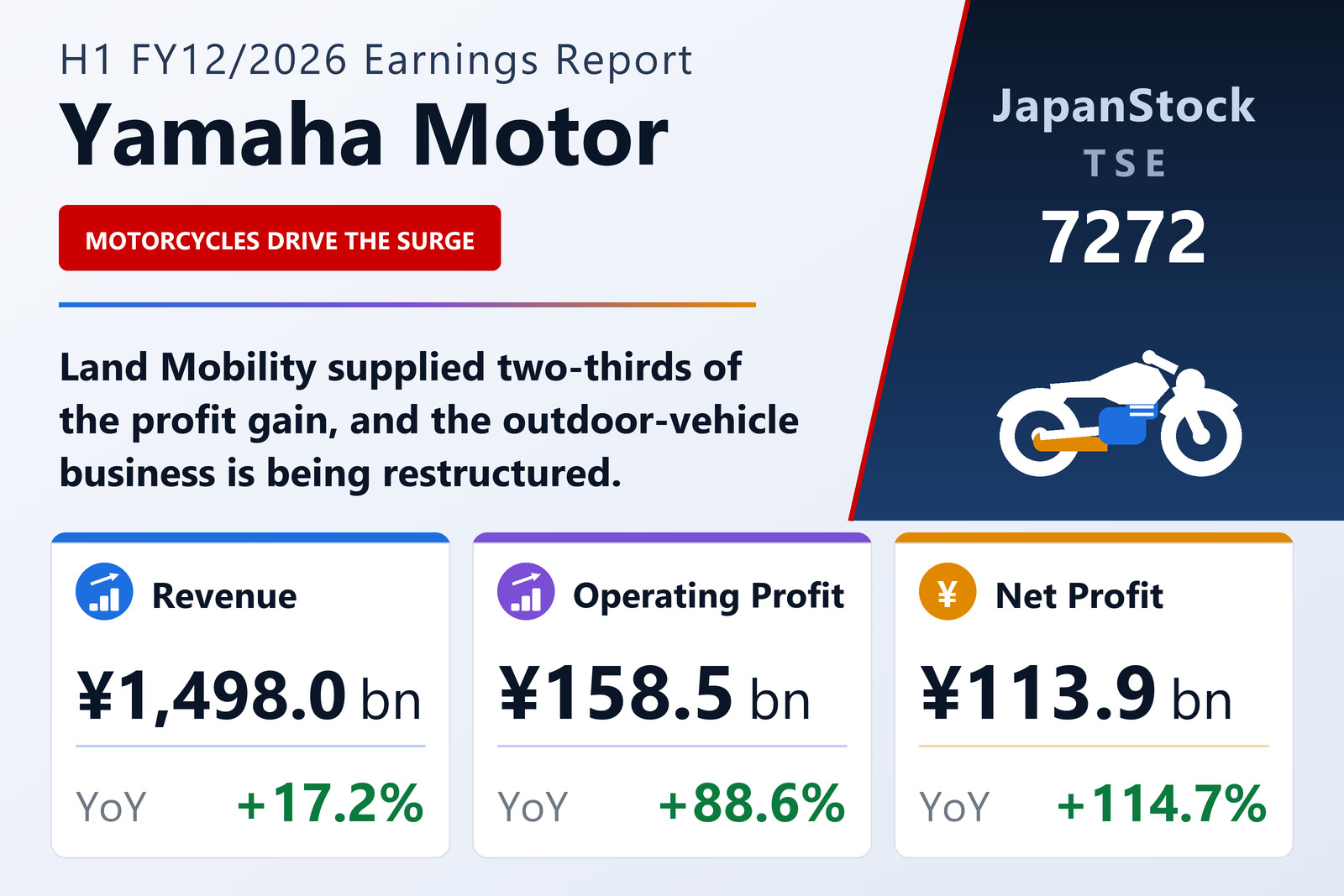
Yamaha Motor Co., Ltd. (TSE: 7272) published consolidated results for the six months to June 30, 2026 on August 4, 2026 under IFRS. Revenue rose 17.2% to ¥1,497,989 million, an increase of ¥220,200 million, while operating profit climbed 88.6% to ¥158,476 million — a gain of ¥74,400 million. Pre-tax profit rose 92.5% to ¥159,487 million and net profit attributable to owners of the parent 114.7% to ¥113,900 million. Earnings per share were ¥117.37 against ¥54.56.
Management attributes the revenue gain principally to higher motorcycle sales. On the profit line, rising unit volumes, currency translation and a reduction in selling, general and administrative expenses more than offset the cost of United States tariffs and higher procurement prices. The half was translated at ¥158 to the U.S. dollar and ¥185 to the euro, respectively ¥10 and ¥23 weaker than a year earlier. Comprehensive income multiplied more than eight times to ¥152,791 million from ¥18,358 million, reflecting currency movements as well as the profit itself.
Land Mobility carries the half; Robotics returns to profit
Land Mobility, which houses motorcycles, e-bike drive units and automotive components, lifted external revenue 21.8% to ¥984,558 million and segment profit 89.8% to ¥112,731 million. Unit sales grew in Europe and the United States and rose sharply in India and ASEAN, offsetting a decline in Japan; price increases and currency added to the volume effect. Within the segment, the smart power vehicle business — electric-assist bicycles, e-Kit drive units and wheelchair electrification units — grew revenue on e-Kit volumes but widened its loss on procurement costs and research spending.
Marine revenue rose 7.4% to ¥300,669 million and segment profit 18.3% to ¥46,042 million. Outboard demand was slightly lower in the United States and flat in Europe, but grew in Asia and Latin America; watercraft unit sales fell. Robotics returned to profit, posting ¥3,665 million against a ¥1,541 million loss on revenue up 24.5% to ¥60,120 million, as surface mounters sold well in China and industrial robots recovered; back-end semiconductor equipment continued to see demand from generative-AI and advanced-packaging customers, though the group's own shipments in the period fell short of a year earlier on timing. Financial Services revenue rose 18.1% to ¥63,638 million and profit 50.6% to ¥12,127 million on a larger sales-finance receivable book, a better interest margin and the absence of the prior year's interest-rate-swap valuation loss.
Outdoor Land Vehicles to stop building ROVs in Georgia
Outdoor Land Vehicles remained the group's problem business, narrowing its loss only to ¥11,981 million from ¥13,670 million on revenue up 3.3% to ¥80,289 million. All-terrain vehicles held up while recreational off-highway vehicles continued to struggle, and the golf-car business lost sales in the United States. As a subsequent event, Yamaha disclosed a restructuring of the segment: it will end in-house production of recreational off-highway vehicles at Yamaha Motor Manufacturing Corporation of America in Georgia and move to an OEM supply arrangement with a partner, redirecting the freed capacity toward all-terrain vehicles and golf cars.
The plan cuts about 200 permanent positions and, with adjustments to contract staffing, roughly 300 people in total, and reorganises the plant's layout around golf-car assembly and logistics. Yamaha expects to book about ¥12,000 million of one-off costs in 2026 covering severance, additional promotional spending tied to the end of in-house production, inventory write-offs, supplier settlements and impairment. It is targeting a substantial earnings improvement in 2027 and a standalone profit for the Outdoor Land Vehicle business in 2028.
Balance sheet, guidance and dividend
Total assets rose ¥118,600 million from the December year-end to ¥3,021,226 million, with current assets up ¥57,300 million on trade and sales-finance receivables despite lower inventories, and non-current assets up ¥61,300 million. Liabilities rose ¥24,100 million to ¥1,728,300 million. Total equity rose ¥94,590 million to ¥1,292,919 million as ¥120,500 million of half-year profit and ¥32,300 million of other comprehensive income outweighed ¥20,200 million of dividends and a ¥38,900 million change in ownership interests in a continuing subsidiary — the buy-in of the remaining 49% of Taiwan Yamaha Motor for NT$7,840 million (¥38,868 million) in January. The equity-attributable ratio improved to 41.4% from 39.0% and net debt to equity to 0.50 times from 0.58.
Yamaha revised its full-year forecast and now guides to revenue of ¥2,900,000 million (+14.4%), operating profit of ¥260,000 million (+105.7%) and net profit attributable to owners of ¥170,000 million (+955.3%), for earnings per share of ¥175.16. The half has therefore already delivered 61.0% of the full-year operating-profit target. The annual dividend forecast is ¥50.00 against ¥35.00 last year, with the ¥25.00 interim payable from September 4, 2026.
| Metric | H1 FY12/2026 | H1 FY12/2025 | Change |
|---|---|---|---|
| Revenue (¥ million) | 1,497,989 | 1,277,820 | +17.2% |
| Operating profit (¥ million) | 158,476 | 84,032 | +88.6% |
| Pre-tax profit (¥ million) | 159,487 | 82,857 | +92.5% |
| Net profit attrib. to owners of parent (¥ million) | 113,900 | 53,061 | +114.7% |
| Comprehensive income (¥ million) | 152,791 | 18,358 | +732.3% |
| EPS (¥) | 117.37 | 54.56 | +115.1% |
| Land Mobility — revenue (¥ million) | 984,558 | 808,150 | +21.8% |
| Land Mobility — segment profit (¥ million) | 112,731 | 59,397 | +89.8% |
| Marine — revenue (¥ million) | 300,669 | 279,975 | +7.4% |
| Marine — segment profit (¥ million) | 46,042 | 38,917 | +18.3% |
| Outdoor Land Vehicles — revenue (¥ million) | 80,289 | 77,688 | +3.3% |
| Outdoor Land Vehicles — segment profit (¥ million) | -11,981 | -13,670 | loss narrowed |
| Robotics — revenue (¥ million) | 60,120 | 48,270 | +24.5% |
| Robotics — segment profit (¥ million) | 3,665 | -1,541 | loss to profit |
| Financial Services — revenue (¥ million) | 63,638 | 53,882 | +18.1% |
| Financial Services — segment profit (¥ million) | 12,127 | 8,051 | +50.6% |
| Total assets (¥ million) | 3,021,226 | 2,902,584 | +4.1% |
| Shareholders' equity (¥ million) | 1,292,919 | 1,198,329 | +7.9% |
| Equity attrib. to owners of parent (¥ million) | 1,251,305 | 1,132,238 | +10.5% |
| Equity ratio | 41.4% | 39.0% | +2.4 pt |
| FY12/2026 guidance — revenue (¥ million) | 2,900,000 | — | +14.4% |
| FY12/2026 guidance — operating profit (¥ million) | 260,000 | — | +105.7% |
| FY12/2026 guidance — net profit (¥ million) | 170,000 | — | +955.3% |
| FY12/2026 guidance — EPS (¥) | 175.16 | — | — |
| Annual dividend per share (¥) | 50.00 | 35.00 | +42.9% |
JapanStockPulse provides informational content only and does not constitute investment advice. Figures are taken from the company's published earnings short report and may be subject to subsequent revision.