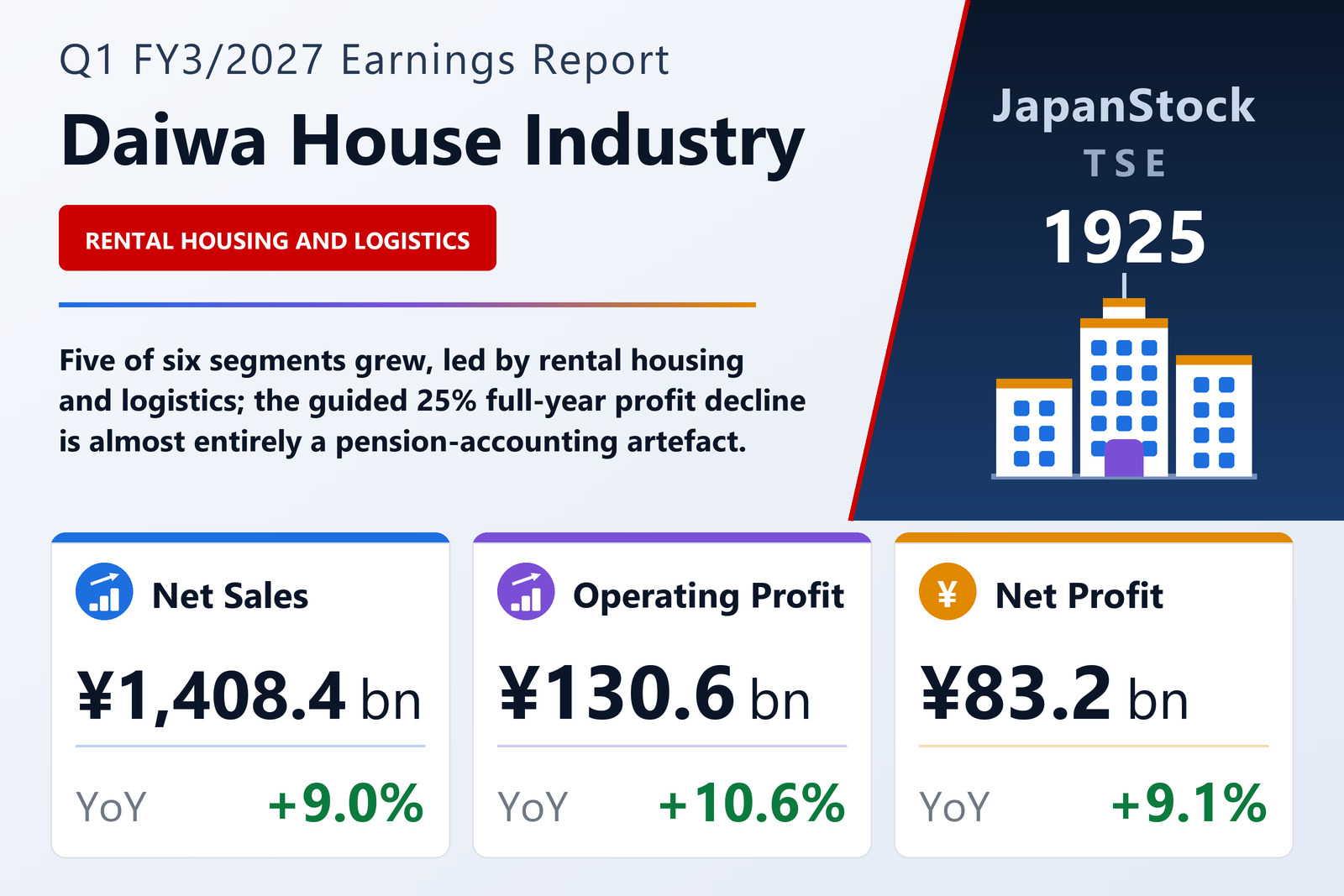
Daiwa House Industry Co., Ltd. (TSE: 1925), Japan's largest housebuilder and one of the country's most broadly diversified developers, reported consolidated first-quarter results for the year to March 2027 under Japanese GAAP. Net sales rose 9.0% to ¥1,408,385 million, operating profit gained 10.6% to ¥130,644 million, ordinary profit rose 9.9% to ¥123,000 million and net profit attributable to owners of the parent climbed 9.1% to ¥83,194 million. Basic earnings per share came in at ¥134.33 against ¥123.25 a year earlier. Comprehensive income nearly tripled, up 188.1% to ¥105,833 million, as valuation and translation items swung back in the group's favour.
A broad acceleration after a flat year-ago quarter
The comparison is unusually flattering because the same quarter a year earlier was close to stalled. In Q1 of the March 2026 year, net sales grew just 0.4%, operating profit fell 3.1%, ordinary profit fell 6.2%, net profit fell 16.6% and comprehensive income collapsed 68.9%. Against that base, the group has now returned to a growth rate roughly in line with its medium-term ambitions, and it did so with volume rather than one-off gains: five of six reporting segments grew both sales and profit, and only the small condominium business went backwards. The domestic backdrop helped. Japanese housing starts for the April–June quarter rose year on year across all three of the categories that matter most to Daiwa House — owner-occupied houses, rental housing and built-for-sale homes. Non-residential construction was more mixed: total general construction floor area declined, with offices expanding but shops, factories and warehouses all contracting, which makes the group's growth in commercial and business facilities a share-gain story rather than a market-tide story.
Rental housing and corporate facilities do the heavy lifting
Rental Housing remains the profit engine, with sales up 10.7% to ¥386,648 million and operating profit up 12.6% to ¥42,868 million. Occupancy of the D-ROOM portfolio and the number of units under management both stayed high, two domestic development properties were sold, and in May 2026 the company launched MOKURIE, a multi-family product built from locally sourced timber. Business & Corporate Facilities was the largest single profit contributor at ¥54,402 million, up 13.5% on sales of ¥368,867 million (+6.9%). Single-Family Houses delivered the fastest profit growth of any segment — operating profit up 29.2% to ¥9,255 million on sales up 14.3% to ¥269,258 million — helped by the "Smart Made Housing." push and supporting campaigns, and in the United States by Trumark Companies LLC's March 2026 acquisition of the single-family business of JK Monarch Enterprises LLC in Washington State.
Commercial Facilities grew sales 9.1% to ¥315,416 million but operating profit was essentially flat at ¥35,656 million (+0.5%). The segment opened COTOE Hashimoto in Kanagawa in May 2026 — a 20-year-old shopping centre taken through a full regeneration — and Mito Kobun Terrace in Ibaraki under the Park-PFI scheme, while Royal Home Center added two stores to reach 67 nationwide. The drag came from urban hotels, where occupancy slipped on slower inbound demand even as average daily rate and RevPAR rose. Environment & Energy, the smallest segment, grew sales 14.6% to ¥32,044 million and profit 12.9% to ¥4,943 million across its EPC, retail power and independent-power operations; a grid-scale battery storage demonstration at the group's Kyushu plant is now complete and begins operating in September 2026. The sole laggard was Condominiums, where sales fell 13.6% to ¥56,068 million and operating profit dropped 46.5% to ¥1,878 million purely on the timing of unit handovers.
Data centres become a formal growth pillar
The most strategically significant move of the quarter was organisational. In April 2026 Daiwa House created a dedicated Data Center Business Division inside its Business Solutions headquarters, giving what had been an opportunistic development line its own command structure. In the same month the group completed and began operating Module DPDC Fukushima I in Okuma, Fukushima — a modular data-centre facility that serves as the template for the division's build-out. The pull-through is already visible in the group's construction subsidiaries: both Fujita and Sumitomo Densetsu reported strong order intake for data centres and power-transmission work during the quarter. Logistics, the other capital-intensive engine, kept expanding in parallel: four projects broke ground — DPL Miyagi Taiwa, DPL Sendai Nagamachi II, DPL Samukawa I and DPL Morioka Minami — while DPL Kuki Miyashiro II reached completion. The group finished June managing 271 properties, and Daiwa Logistics opened the Nagoya Minami Logistics Center to bring its network to 110 centres covering roughly 429,000 tsubo.
Land buying inflates the balance sheet
Total assets grew ¥203,946 million over the three months to ¥8,616,366 million at June 30, 2026, from ¥8,412,419 million at the March year-end, driven mainly by higher inventories as the group bought land for the commercial-facilities and single-family businesses. Total liabilities rose ¥223,597 million to ¥5,613,742 million, funded through borrowings and commercial paper. Net assets edged down ¥19,650 million to ¥3,002,624 million, because ¥61,934 million of prior-year dividends were paid out and non-controlling interests fell — shareholders' equity itself actually rose slightly, to ¥2,909,582 million from ¥2,896,744 million. The equity ratio consequently slipped to 33.8% from 34.4%. Interest-bearing debt excluding lease obligations stood at ¥3,463,955 million, for a debt-to-equity ratio of 1.19 times, or 1.10 times once rating-agency equity credit on ¥250.0 billion of hybrid bonds and loans is taken into account. For a developer funding a simultaneous logistics, data-centre and commercial pipeline, that is a deliberate rather than a stressed balance sheet — but it is the line to watch if land acquisition keeps running at this pace.
Guidance's 25% profit drop is mostly an accounting artefact
Daiwa House revised both its earnings and dividend forecasts alongside these results. For the full year to March 2027 it guides to net sales of ¥5,900,000 million (+5.8%) but operating profit of ¥460,000 million (−25.2%), ordinary profit of ¥402,000 million (−29.7%) and net profit attributable to owners of ¥266,000 million (−24.1%), with EPS of ¥214.74 on a split-adjusted basis — ¥429.48 without the split. Those declines look alarming and are almost entirely artificial. The prior year's operating expenses were reduced by ¥115,675 million of amortisation of retirement-benefit actuarial differences, a non-recurring credit that inflated the FY3/2026 base. Excluding it, the guidance implies operating profit down only 7.9%, ordinary profit down 11.9% and net profit down just 2.0% — a plateau rather than a slump, and one the first quarter's 10.6% operating-profit gain gives the company room to beat.
The dividend is similarly distorted by mechanics. For the year just ended, FY3/2026 paid an interim dividend of ¥75.00 and a year-end of ¥100.00 for an annual total of ¥175.00, of which ¥165.00 was ordinary and ¥10.00 a commemorative payment marking the company's 70th anniversary. For FY3/2027 the company forecasts an interim of ¥86.00 and a year-end of ¥46.00 — figures that cannot simply be added, because the year-end sits on a post-split share count while the interim does not. Investors comparing headline dividend totals across the two years will need to adjust for the split before drawing any conclusion about the payout trajectory.
| Metric | Q1 FY3/2027 | Q1 FY3/2026 | YoY |
|---|---|---|---|
| Net sales (¥ billion) | 1,408.39 | 1,292.14 | +9.0% |
| Operating profit (¥ billion) | 130.64 | 118.12 | +10.6% |
| Ordinary profit (¥ billion) | 123.00 | 111.94 | +9.9% |
| Net profit attrib. to owners (¥ billion) | 83.19 | 76.24 | +9.1% |
| Comprehensive income (¥ billion) | 105.83 | 36.74 | +188.1% |
| Basic EPS (¥) | 134.33 | 123.25 | +9.0% |
| Total assets (¥ billion, vs Mar 31, 2026) | 8,616.37 | 8,412.42 | +2.4% |
| Equity ratio (%, vs Mar 31, 2026) | 33.8 | 34.4 | −0.6pt |
| FY3/2027 net sales guidance (¥ billion) | 5,900.00 | — | +5.8% |
| FY3/2027 operating profit guidance (¥ billion) | 460.00 | — | −25.2% |
| FY3/2027 ordinary profit guidance (¥ billion) | 402.00 | — | −29.7% |
| FY3/2027 net profit guidance (¥ billion) | 266.00 | — | −24.1% |
JapanStockPulse provides informational content only and does not constitute investment advice. Figures are taken from the company's published earnings short report and may be subject to subsequent revision.