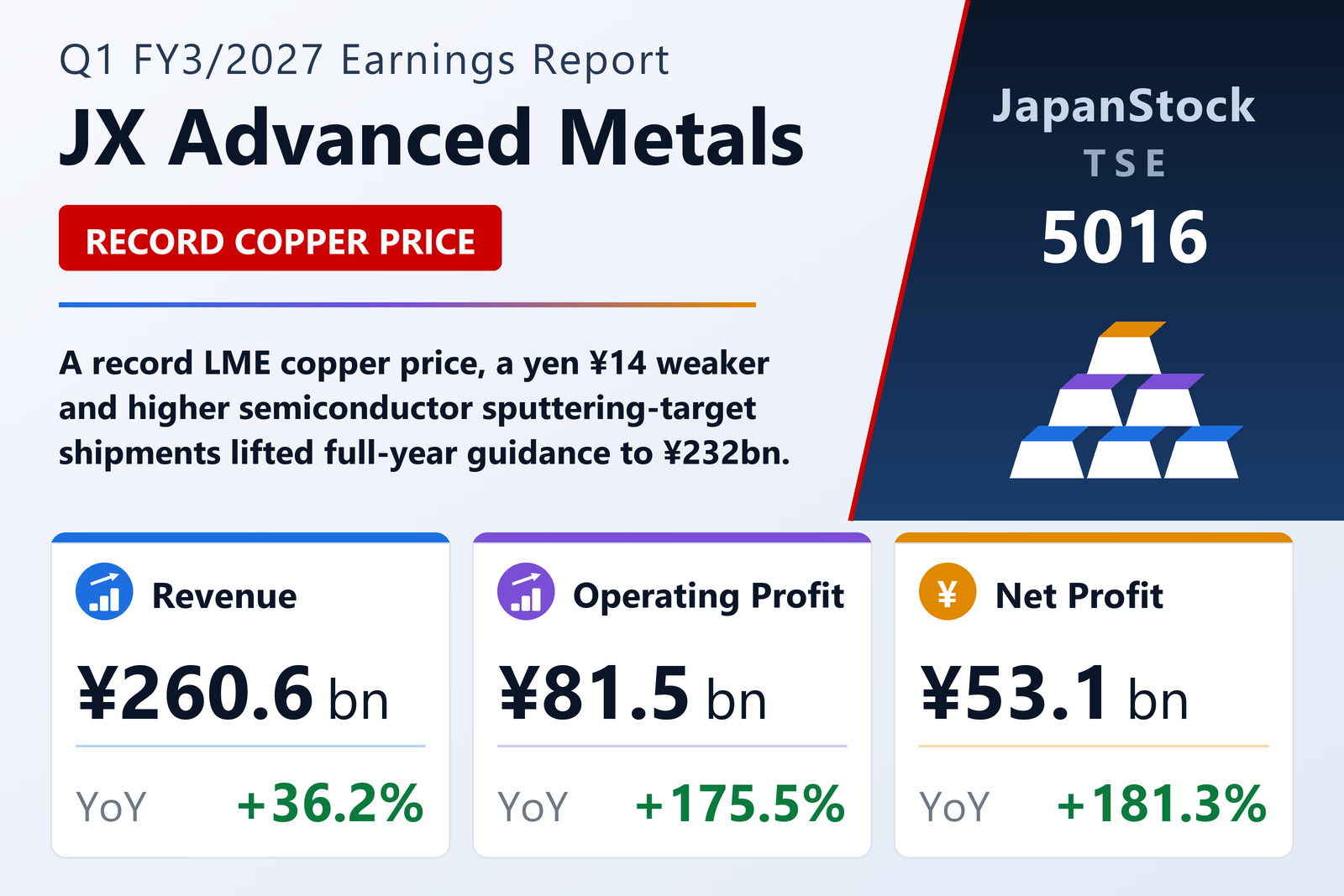
JX Advanced Metals Corporation (TSE: 5016) reported consolidated first-quarter results for the year to March 2027 (April 1 to June 30, 2026) under IFRS on August 6. Revenue rose 36.2% to ¥260,604 million, operating profit surged 175.5% to ¥81,446 million, profit before tax climbed 179.9% to ¥79,644 million and profit attributable to owners of the parent jumped 181.3% to ¥53,070 million. Basic earnings per share came to ¥56.80 against ¥20.35 a year earlier, with diluted EPS of ¥56.06, and total comprehensive income more than sextupled to ¥76,356 million (+506.7%). Operating margin widened to 31.3% from 15.5%. The income statement shows where the leverage came from: gross profit rose 39.9% to ¥58,748 million against an 11.7% rise in selling, general and administrative expenses, while share of profit of equity-method investees more than doubled to ¥32,854 million from ¥13,643 million and other income multiplied to ¥20,719 million from ¥1,386 million. Below the operating line sat ¥543 million of finance income against ¥2,345 million of finance costs, ¥19,226 million of income tax expense and ¥7,348 million of profit attributable to non-controlling interests.
A record copper price and a ¥159 yen do much of the heavy lifting
The quarter's two biggest swing factors were both external. The yen opened at ¥159 to the dollar, firmed briefly after yen-buying intervention by the government and the Bank of Japan, then resumed weakening as the Japan–US rate gap stayed wide even after the BOJ's additional hike; it ended the quarter at ¥162 and averaged ¥159, a full ¥14 weaker than the same three months a year earlier. Copper on the London Metal Exchange opened at 557 cents a pound, rose on tight concentrate supply and expectations for AI data-centre and power-infrastructure demand, and set an all-time high of 639 cents on May 13, 2026. US rate-hike speculation and a firmer dollar knocked it back from there, but it closed the quarter at 605 cents and averaged 604 cents, 172 cents above the prior-year average. Management characterised the operating backdrop as broadly firm despite continued uncertainty from US trade and tariff policy and from geopolitical risk, with the strong expansion in AI-related investment doing the work.
Semiconductor Materials: sputtering targets ride advanced logic and memory
Segment revenue rose 34.2% to ¥52,114 million from ¥38,831 million, and segment operating profit rose 68.9% to ¥14,412 million from ¥8,535 million. The unit manufactures and sells sputtering targets for semiconductors, compound-semiconductor and crystal materials, and chlorides. AI-related demand kept expanding, with growing data volumes driving needs for high-capacity storage and faster data transmission, so demand for advanced logic chips and memory stayed at a high level and the company sold more of its core products, led by sputtering targets. This is the strategic centre of the business — the Hitachinaka semiconductor plant that opened in March 2026 was built for exactly this demand — yet on the quarter's numbers it remained the smallest of the three reportable segments by revenue.
ICT Materials: rolled copper foil and titanium copper offset weaker device shipments
Segment revenue rose 19.1% to ¥93,134 million from ¥78,169 million, with segment operating profit up 70.7% to ¥13,064 million from ¥7,654 million. The unit's range runs from rolled copper foil and titanium copper to ultrafine nickel powder, electromagnetic-shielding film and electric wire. Two products did the work this quarter: rolled copper foil, on resilient smartphone demand, and titanium copper, a high-performance copper alloy whose volumes rose sharply with the rapid build-out of AI servers. The end market itself was less friendly. Memory shortages and rising memory prices constrained component procurement and cost lines across the industry, and smartphone, PC and tablet shipments all fell year on year; brands with stronger procurement power and higher-priced models held up better than the market as a whole.
Base Materials: a Chilean disposal gain and a doubling of equity-method income
The smelting-and-resources business, not the semiconductor franchise, produced most of the quarter's profit. Segment revenue jumped 65.1% to ¥123,739 million from ¥74,967 million and segment operating profit almost quadrupled, up 288.4% to ¥56,786 million from ¥14,622 million — two-thirds of the ¥84,262 million reportable-segment total. The unit collects and sells recycled feedstock, performs contract smelting of electrolytic copper and makes and sells precious metals. Reduced mine output in the resources business was a drag, but higher copper and other metal prices and, decisively, the gain on the partial transfer of shares in SCM Minera Lumina Copper Chile completed in April 2026 more than covered it. The two income lines that carried the increase both sit above the operating-profit line under IFRS and therefore flow straight into the ¥81.4 billion headline: equity-method income rose ¥19,211 million and other income rose ¥19,333 million, together accounting for almost three-quarters of the ¥51,888 million increase in group operating profit. The carrying value of equity-method investments closed the quarter at ¥375,446 million against ¥372,153 million at March 31. Strip the one-off away and the underlying step-up is considerably more modest — which is also why the raised full-year guidance is not simply the first quarter annualised.
A ¥194.9 billion tender offer, not a trading loss, explains the equity drop
Total equity fell to ¥725,433 million from ¥838,258 million even as total assets grew to ¥1,670,135 million from ¥1,505,337 million, and the filing identifies the cause precisely. JX Advanced Metals launched a tender offer to buy back its own shares that had not settled by June 30, so the obligation to purchase was recognised as a ¥194,877 million liability within "other financial liabilities" and the offsetting entry was booked inside "other components of equity." That single item swung other components of equity from +¥88,800 million to −¥89,787 million and dominates the ¥189,181 million of transactions with owners recorded in the quarter; the remainder is ¥23,212 million of dividends paid, a +¥35,376 million equity component from the issue of convertible bonds with share acquisition rights, ¥7,487 million of dividends to non-controlling interests, and a ¥30,504 million transfer from non-controlling interests to capital surplus on capital transactions with non-controlling shareholders. The tender offer settled on July 9, 2026, with 57,300,112 common shares acquired for ¥194,877 million — about 6% of shares outstanding — making it both the largest event on the quarter's balance sheet and a subsequent event for the accounts.
The funding shows up on the other side of the ledger. Current other financial liabilities ballooned to ¥198,237 million from ¥7,123 million, non-current bonds and borrowings rose to ¥404,067 million from ¥178,274 million on the convertible issue, and cash and cash equivalents more than tripled to ¥218,978 million from ¥66,306 million, pre-funding the July settlement. Gross interest-bearing debt rose ¥112.3 billion to ¥436.6 billion, but because of the cash build net interest-bearing debt actually fell ¥40.3 billion to ¥217.6 billion and the net debt-to-equity ratio improved to 0.34 times from 0.36. The headline solvency optics still deteriorated: the parent equity ratio dropped 9.8 points to 38.5% and equity attributable to owners per share fell ¥108.91 to ¥675.53. Investors should read the equity-ratio fall as the accounting shadow of a buyback that returns capital to shareholders, not as a loss of earning power.
Guidance raised across the board on weaker-yen, higher-copper assumptions
The company revised its full-year FY3/2027 forecast upward alongside the results, publishing a separate notice on the change. Against the guidance issued on May 11, revenue goes to ¥1,025,000 million from ¥930,000 million (+10.2%), operating profit to ¥232,000 million from ¥190,000 million (+22.1%), profit before tax to ¥221,000 million from ¥178,000 million (+24.2%), profit attributable to owners to ¥141,000 million from ¥114,000 million (+23.7%) and basic EPS to ¥155.80 from ¥125.97. Measured against FY3/2026 actuals — revenue ¥884,638 million, operating profit ¥174,967 million, profit attributable ¥104,645 million and EPS ¥112.94 — that is growth of 15.9%, 32.6% and 34.7% respectively. Management attributes the upgrade to higher volumes and improved unit selling prices in the Focus businesses on expanding AI-server-related demand, plus a weaker yen and higher copper prices than previously assumed, partly offset by expected mine production cuts from bad weather in the resources business. The new plan assumes LME copper at 586 cents a pound (580 cents from July) and the yen at ¥157 to the dollar (¥160 from July, ¥155 from October). Both copper assumptions sit well below the 604-cent first-quarter average and the 605-cent quarter-end print, which leaves headroom if spot holds. The first quarter alone already covers about 35% of the full-year operating-profit target.
Dividend reset to ¥20, and no cash-flow statement in this filing
On the dividend, the board resolved a change to the shareholder-return policy on May 11, 2026, applied from this year's forecast: FY3/2027 is guided at ¥10.00 at the interim and ¥10.00 at the year-end, ¥20.00 in total, against ¥31.00 paid for FY3/2026 (¥6.00 interim plus a ¥25.00 year-end). That dividend forecast is unchanged from the previous announcement, and the ¥23,212 million charged to retained earnings during the quarter is the FY3/2026 year-end payment. Shares issued rose to 953,183,210 from 928,463,102 and treasury shares stood at 2,288,019 at June 30 — before the 57.3 million shares bought in July — with a weighted-average count of 934,301,891. Three housekeeping points close the filing out. The company did not prepare a condensed quarterly consolidated statement of cash flows for the period, disclosing only depreciation and amortisation of ¥12,629 million against ¥10,742 million a year earlier. There was no change in the scope of consolidation, no change in accounting policies and no going-concern issues, and the attached quarterly financial statements were not reviewed by an accounting auditor. The statements are prepared under the Tokyo Stock Exchange's quarterly reporting rules, with some IAS 34 disclosures omitted.
| Metric | Q1 FY3/2027 | Q1 FY3/2026 | YoY |
|---|---|---|---|
| Revenue (¥ billion) | 260.60 | 191.28 | +36.2% |
| Gross profit (¥ billion) | 58.75 | 41.99 | +39.9% |
| SG&A expenses (¥ billion) | 28.94 | 25.92 | +11.7% |
| Share of profit of equity-method investees (¥ billion) | 32.85 | 13.64 | +140.8% |
| Other income (¥ billion) | 20.72 | 1.39 | +1,394.9% |
| Operating profit (¥ billion) | 81.45 | 29.56 | +175.5% |
| Profit before tax (¥ billion) | 79.64 | 28.46 | +179.9% |
| Quarterly profit (¥ billion) | 60.42 | 23.24 | +160.0% |
| Profit attrib. to owners (¥ billion) | 53.07 | 18.87 | +181.3% |
| Total comprehensive income (¥ billion) | 76.36 | 12.59 | +506.7% |
| Basic EPS (¥) | 56.80 | 20.35 | +179.1% |
| Operating margin | 31.3% | 15.5% | +15.8 pt |
| Segment revenue: Semiconductor Materials (¥ billion) | 52.11 | 38.83 | +34.2% |
| Segment OP: Semiconductor Materials (¥ billion) | 14.41 | 8.54 | +68.9% |
| Segment revenue: ICT Materials (¥ billion) | 93.13 | 78.17 | +19.1% |
| Segment OP: ICT Materials (¥ billion) | 13.06 | 7.65 | +70.7% |
| Segment revenue: Base Materials (¥ billion) | 123.74 | 74.97 | +65.1% |
| Segment OP: Base Materials (¥ billion) | 56.79 | 14.62 | +288.4% |
JapanStockPulse provides informational content only and does not constitute investment advice. Figures are taken from the company's published earnings short report and may be subject to subsequent revision.