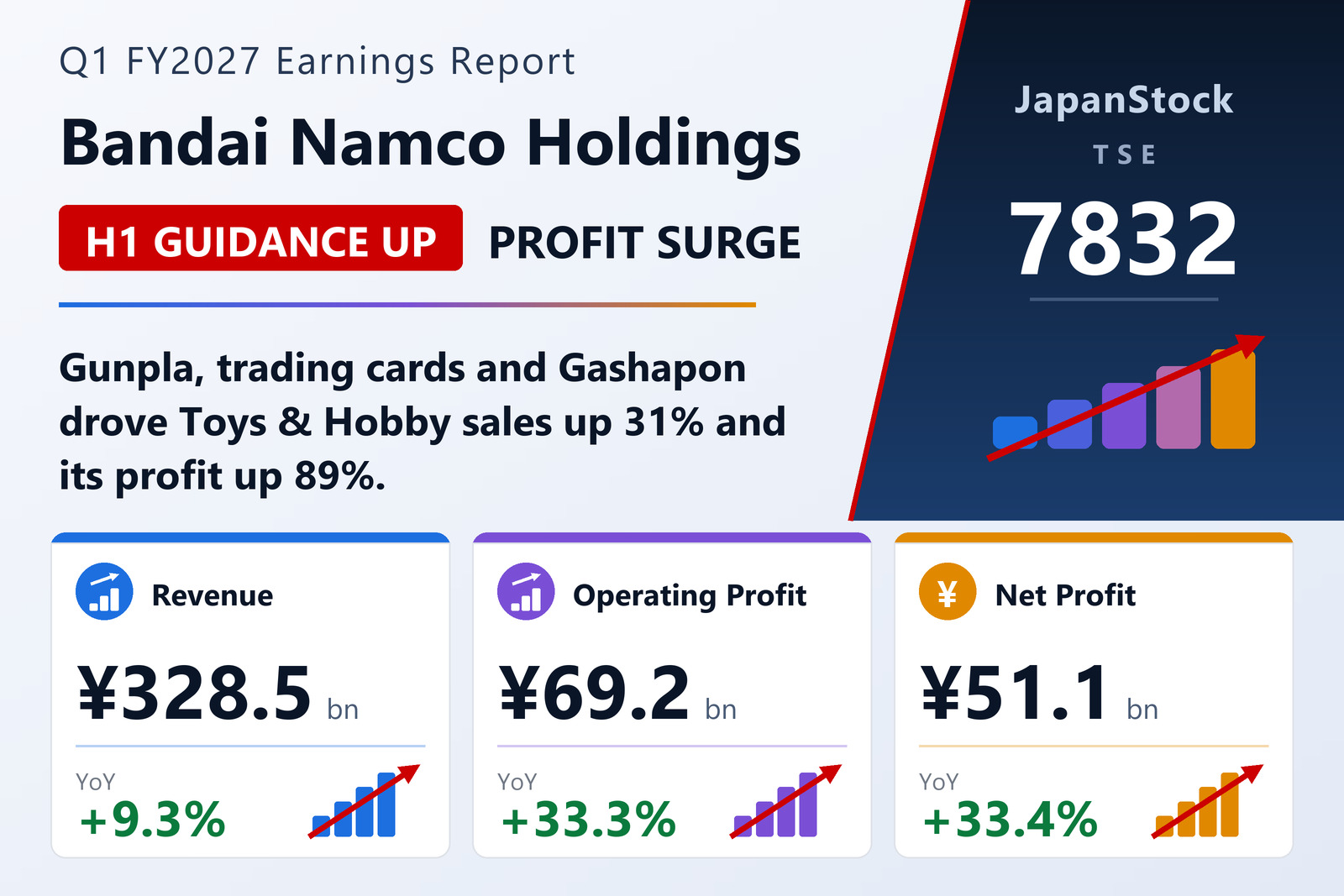
Bandai Namco Holdings Inc. (TSE: 7832), the Tokyo-listed owner of the Gundam, DRAGON BALL, ONE PIECE and Tamagotchi franchises, reported consolidated results for the first quarter of the fiscal year ending March 2027 — the three months from April 1 to June 30, 2026 — under Japanese accounting standards. Net sales rose 9.3% to ¥328,494 million, operating profit climbed 33.3% to ¥69,204 million, ordinary profit advanced 36.3% to ¥74,493 million and net profit attributable to owners of the parent increased 33.4% to ¥51,135 million. Basic earnings per share came to ¥79.73 against ¥59.22 a year earlier, and comprehensive income rose 36.6% to ¥57,525 million. The quarterly figures were voluntarily reviewed by an accounting auditor. The company is led by President and Representative Director Arihisa Asako, with Takashi Tsuji as chief financial officer.
Profit growth ran at more than three times the pace of sales
The most striking feature of the quarter is the gap between the top and bottom lines. Sales grew 9.3%; operating profit grew 33.3%. That gearing lifted the operating margin to 21.1% from 17.3% a year earlier — a 3.8-point expansion in a single year, and a level Bandai Namco has rarely sustained across a full fiscal year. Ordinary profit outpaced operating profit again, rising 36.3% to ¥74,493 million, leaving ¥5,289 million of net non-operating income above the ordinary line. The comparison base was itself respectable: the prior-year first quarter had grown sales 7.1% and operating profit 17.9%, so this is acceleration on top of growth rather than a rebound from a weak quarter.
The wider backdrop was mixed but broadly supportive. Japan's economy recovered moderately while raw-material and general price increases persisted. In the entertainment market specifically, the continued spread of video streaming kept widening the global audience for Japanese intellectual property — the characters and franchises that sit at the centre of Bandai Namco's business — even as ongoing political instability across the world left the outlook uncertain at home and abroad. Against that, the group continued to execute the three-year medium-term plan it launched in April 2025 under the purpose "Fun for All into the Future" and the medium-to-long-term vision "Connect with Fans," built on three common themes: further expansion of business scale, acquisition of new business pillars, and construction of a structure that generates long-term profit. During the quarter management pressed its "IP axis strategy" — maximising the value of each intellectual property by delivering the optimal products and services to the optimal regions at the optimal timing.
Toys & Hobby: Gunpla, Ichiban Kuji and trading cards do the heavy lifting
Essentially all of the quarter's growth came from one segment. Toys & Hobby sales rose 31.2% to ¥192,760 million and segment profit jumped 88.8% to ¥53,944 million — close to a doubling of profit on a roughly one-third increase in revenue. Toys & Hobby now supplies 58.7% of group sales and 71.7% of the sum of reported segment profits, making Bandai Namco's quarter almost entirely a story about physical product.
Management attributes the expansion to a widening of categories, product line-ups and target demographics both in Japan and overseas, more real-event and store touchpoints for fans, and a strengthening of production and distribution capability behind them. The strongest categories were Gunpla — the Gundam-series plastic model kits — along with Ichiban Kuji character lottery products and other high-target merchandise aimed at adult collectors, trading card games, Gashapon capsule toys, confectionery and food, and stationery. The IP doing the pulling was the familiar core: the Gundam series, DRAGON BALL, ONE PIECE and Tamagotchi. The segment result also includes a one-off benefit — a refund of additional United States tariffs booked at a North American subsidiary — which flatters the profit line and is not a recurring item.
Digital, Visual & Music and Amusement gave some of it back
Three of the four remaining segments went the other way. Digital sales fell 15.7% to ¥90,901 million and segment profit dropped 30.8% to ¥15,011 million. Network content itself held up well — flagship app titles drawn from DRAGON BALL, ONE PIECE, THE IDOLM@STER and the Gundam series performed strongly on continued user-facing initiatives — but home video games ran into a difference in title line-up against a prior-year quarter that had carried a major worldwide new release. That is a scheduling comparison rather than a demand signal, but it is a large one in a segment that was a quarter of group revenue.
Visual & Music sales fell 9.3% to ¥19,279 million and segment profit fell 68.8% to ¥1,320 million, the steepest proportional profit decline in the group. Licensing of Gundam- and Love Live!-series products and services, the global rollout of titles such as One-Punch Man, and video distribution were all stable; the problem was the base. The prior-year quarter had been carried by theatrical box office and video distribution of "Mobile Suit Gundam GQuuuuuuX," and nothing in this quarter's slate was built to match it.
Amusement sales rose 12.6% to ¥38,092 million but segment profit slipped 4.0% to ¥1,991 million — traffic growth without profit growth. "Bandai Namco Cross Store," "Gashapon no Depaato" and the group's IP-experience official shops drew crowds, and existing-store sales at domestic amusement facilities ran at 107.6% of the prior year, but the incremental revenue did not reach the bottom line. The residual Other segment, covering group logistics and administrative support companies, grew sales 14.4% to ¥10,366 million and profit 34.5% to ¥662 million.
Balance sheet: a share cancellation that ran through capital surplus
Total assets stood at ¥1,179,437 million at June 30, 2026, down ¥11,056 million from March 31. Notes and accounts receivable plus contract assets added ¥5,140 million, merchandise and finished goods ¥8,740 million, work in process ¥10,469 million and investment securities ¥4,628 million — but all of that was outweighed by a ¥42,328 million fall in cash and deposits, largely on dividend payments. Total liabilities fell ¥36,527 million to ¥292,542 million, mainly a ¥10,814 million reduction in income taxes payable and a ¥28,382 million reduction in other current liabilities on lower accounts payable. Net assets rose ¥25,470 million to ¥886,894 million, and the equity ratio strengthened to 75.1% from 72.3%, with shareholders' equity of ¥885,795 million against ¥860,781 million three months earlier.
Two items drove the net-asset increase: retained earnings up ¥7,330 million, and a ¥19,737 million reduction in treasury stock following a share cancellation — because treasury stock is a deduction from net assets, retiring it increases the total. Shares issued fell to 645,000,000 from 650,000,000 and treasury shares to 3,634,147 from 8,634,037. The accounting is worth noting: the cancellation pushed capital surplus into negative territory, so capital surplus was set to zero and the negative balance deducted from retained earnings instead. The average share count for the quarter was 641,365,936, down from 647,217,510 in the prior-year quarter — a reduction that supports EPS independently of the profit growth.
First-half guidance raised, full-year left untouched — and the dividend
Alongside the results, Bandai Namco issued a separate "Notice of Revision to the Consolidated Earnings Forecast for the Six Months Ending September 30, 2026," raising its first-half plan from the version published on May 13, 2026. The revised half-year forecast is net sales of ¥690,000 million (+7.2%), operating profit of ¥124,000 million (+17.6%), ordinary profit of ¥130,000 million (+18.0%) and net profit attributable to owners of ¥90,000 million (+14.1%), for EPS of ¥140.33.
The full-year FY3/2027 forecast was left completely unchanged: net sales of ¥1,350,000 million (+0.1%), operating profit of ¥185,000 million (−2.4%), ordinary profit of ¥190,000 million (−5.9%) and net profit attributable to owners of ¥130,000 million (−7.6%), for EPS of ¥202.69. The contrast is the most consequential number in the release. The first quarter alone delivered 37.4% of the unchanged full-year operating-profit target, and the raised first-half target of ¥124,000 million is 67.0% of it — leaving only ¥61,000 million of operating profit implied for the second half against ¥124,000 million in the first. Management left the annual numbers alone citing continued uncertainty across world regions and increasingly rapid change in markets and in customer lifestyles and preferences. Whether that is genuine caution about a heavy comparison base and a tariff benefit that does not repeat, or conservatism that will be revised away in November, is the question the second-quarter release will answer.
On distributions, the FY3/2026 annual dividend was ¥73.00 — ¥23.00 at the interim and ¥50.00 at the year-end. For FY3/2027 the company forecasts an interim dividend of ¥25.00, described as the base dividend under its profit-distribution policy, and unchanged from the previously announced forecast. The year-end dividend is undecided and will be considered separately under the same policy, so no full-year total is currently forecast.
| Metric | Q1 FY3/2027 | Q1 FY3/2026 | YoY |
|---|---|---|---|
| Net sales (¥ million) | 328,494 | 300,430 | +9.3% |
| Operating profit (¥ million) | 69,204 | 51,921 | +33.3% |
| Ordinary profit (¥ million) | 74,493 | 54,658 | +36.3% |
| Net profit attrib. to owners (¥ million) | 51,135 | 38,329 | +33.4% |
| Basic EPS (¥) | 79.73 | 59.22 | +34.6% |
| Comprehensive income (¥ million) | 57,525 | 42,115 | +36.6% |
| Operating margin (%) | 21.1 | 17.3 | +3.8pt |
| Equity ratio (%, vs Mar 31, 2026) | 75.1 | 72.3 | +2.8pt |
| Toys & Hobby sales (¥ million) | 192,760 | — | +31.2% |
| Digital sales (¥ million) | 90,901 | — | −15.7% |
| Visual & Music sales (¥ million) | 19,279 | — | −9.3% |
| Amusement sales (¥ million) | 38,092 | — | +12.6% |
| Other sales (¥ million) | 10,366 | — | +14.4% |
| Toys & Hobby segment profit (¥ million) | 53,944 | — | +88.8% |
| Digital segment profit (¥ million) | 15,011 | — | −30.8% |
| H1 FY3/2027 net sales guidance (¥ million) | 690,000 | — | +7.2% |
| H1 FY3/2027 operating profit guidance (¥ million) | 124,000 | — | +17.6% |
| H1 FY3/2027 net profit guidance (¥ million) | 90,000 | — | +14.1% |
| FY3/2027 net sales guidance (¥ million) | 1,350,000 | — | +0.1% |
| FY3/2027 operating profit guidance (¥ million) | 185,000 | — | −2.4% |
| FY3/2027 net profit guidance (¥ million) | 130,000 | — | −7.6% |
| FY3/2027 interim dividend forecast (¥) | 25.00 | 23.00 | +8.7% |
JapanStockPulse provides informational content only and does not constitute investment advice. Figures are taken from the company's published earnings short report and may be subject to subsequent revision.