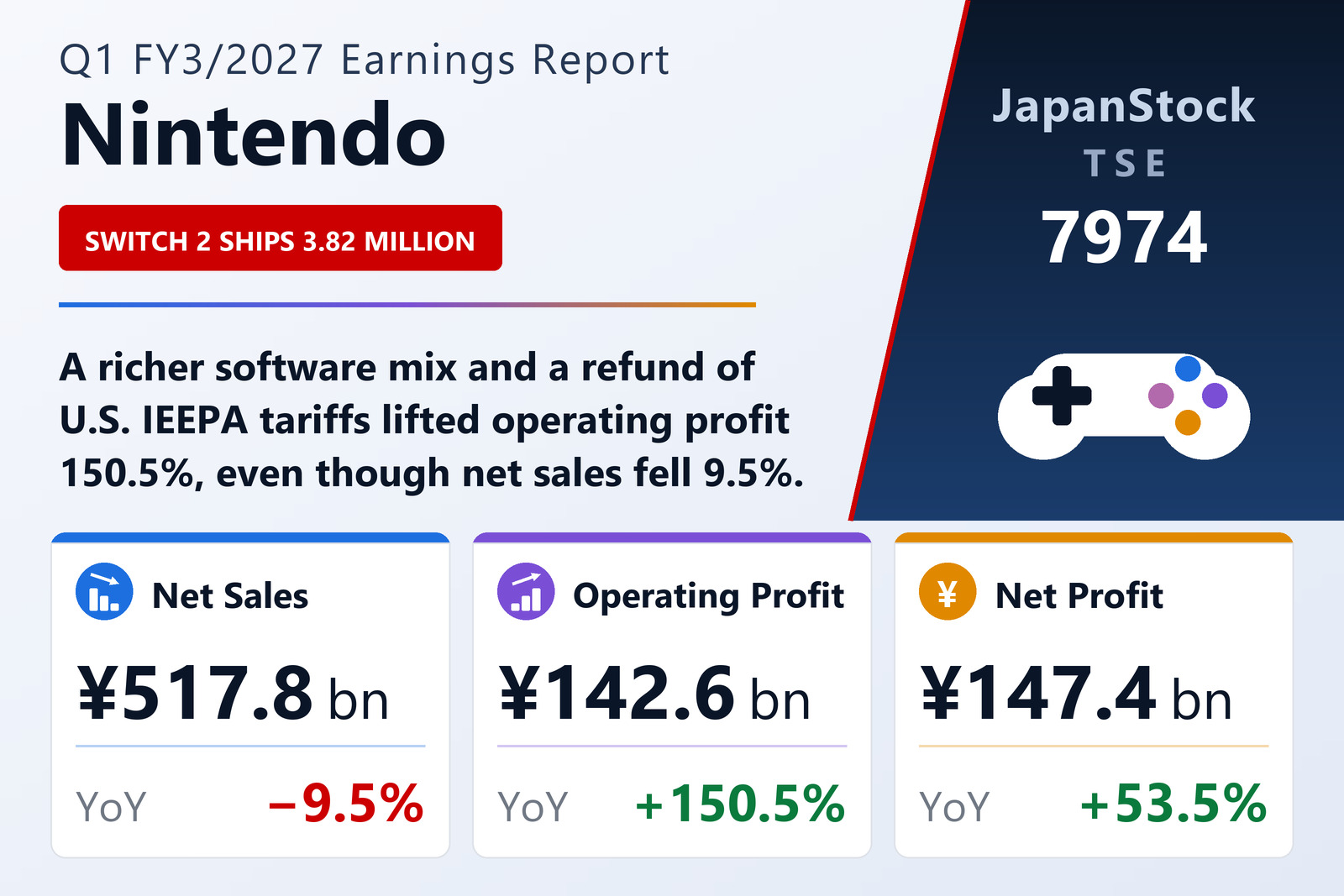
Nintendo Co., Ltd. (TSE: 7974) reported consolidated first-quarter results for the year to March 2027 under Japanese GAAP on August 6. Net sales fell 9.5% to ¥517,813 million against a formidable comparison — the June 2025 quarter contained the worldwide launch of Nintendo Switch 2 and had itself grown sales 132.1% — but every line beneath the top line moved emphatically the other way. Operating profit surged 150.5% to ¥142,596 million, ordinary profit rose 115.1% to ¥206,150 million, and profit attributable to owners of the parent climbed 53.5% to ¥147,423 million. Basic earnings per share came in at ¥127.88 against ¥82.48, and comprehensive income more than doubled, up 120.7% to ¥167,757 million. The operating margin widened from 9.9% to 27.5% in a single year — the clearest evidence yet that the Switch 2 cycle has moved out of its low-margin hardware-launch phase and into the software-driven phase where Nintendo actually earns its returns.
Switch 2 ships 3.82 million units as it enters year two
The dedicated video game platform business is where the quarter was decided, and Nintendo's unit disclosure is unusually informative. Nintendo Switch 2 hardware sold 3.82 million units in the three months, with the console reaching the second anniversary of its June launch during the period and management describing sales as continuing to run smoothly. Switch 2 software sold 9.46 million units, carried by Yoshi and the Mysterious Encyclopedia, released in May, and Star Fox, released in June, alongside continued momentum for Pokopia, the Pokémon title launched in the prior fiscal year. The original Nintendo Switch, now nine years into its life, still moved 0.66 million units of hardware — a remarkable figure for a platform whose successor is already on shelves, and a reminder that the two systems are being sold into different price tiers rather than one simply replacing the other.
Tomodachi Life alone sells 7.94 million copies
The single biggest seller of the quarter did not run on the new console at all. Tomodachi Life: Living the Dream, released in April for the original Switch, sold 7.94 million units — more than four-fifths of the entire Switch 2 software slate on its own, and one of the strongest quarterly debuts Nintendo has recorded for a non-flagship franchise. Total Nintendo Switch software reached 33.81 million units, a number that owes a great deal to a design decision rather than a marketing one: because Switch 2 plays Switch software, titles released for the original console in prior years continued to sell at a steady clip to an installed base that keeps expanding through the new hardware. The 33.81 million legacy figure against 9.46 million on the new platform shows how much economic life Nintendo has managed to extract from a catalogue that a hard generational break would have stranded.
Digital sales jump 90% and a Mario movie doubles IP income
Two high-margin revenue streams expanded sharply. Digital sales in the dedicated platform business rose 90.0% to ¥132.7 billion, driven principally by higher sales of download versions of titles also sold at retail — revenue that carries no manufacturing, distribution or retail-margin cost and therefore flows almost directly to the operating line. Separately, IP-related income rose 107.4% to ¥34.8 billion, lifted above all by cinema audiences for The Super Mario Galaxy Movie. Nintendo remains overwhelmingly an export business: overseas sales of ¥403.2 billion accounted for 77.9% of the consolidated total, which leaves the reported yen figures materially exposed to currency moves in both directions.
A tariff refund and a favourable mix rebuild the margin
Management attributed the operating-profit surge to two things. The first was mix: software sales held up well and rose as a share of total revenue, and software carries a far higher gross margin than consoles, which are sold at or near cost early in a cycle. The second was a one-off in the opposite direction from last year's headwind — Nintendo received a refund of tariffs levied under the U.S. IEEPA that it had previously booked within cost of sales, releasing a charge that had depressed the prior-year margin. Below the operating line the picture improved again: equity-method investment income of ¥30.3 billion, foreign-exchange gains of ¥16.8 billion and interest income of ¥13.1 billion lifted ordinary profit to ¥206,150 million, or 39.8% of sales. Net profit grew more slowly than ordinary profit — 53.5% against 115.1% — because the prior-year quarter had carried a lighter effective tax burden. Per-share growth ran slightly ahead of net profit at 55.0%, as the average share count fell to 1,152,828,655 from 1,164,248,184 and treasury holdings stood at 134,431,384 shares against 1,287,260,000 issued.
Balance sheet, dividend and unchanged full-year guidance
Total assets edged up ¥10.5 billion to ¥3,815,896 million from the March year-end, as lower cash and deposits were more than offset by higher inventories and other current assets. Liabilities rose ¥46.8 billion to ¥896.9 billion, mainly on notes and accounts payable, while net assets fell ¥36.2 billion to ¥2,918,951 million on a decline in retained earnings following the year-end dividend payment. The equity ratio slipped to 76.5% from 77.6%, with shareholders' equity of ¥2,917,741 million — a balance sheet with essentially no leverage in it. On distributions, Nintendo reiterated an annual dividend forecast of ¥162.00 for FY3/2027, down from the ¥219.00 paid for FY3/2026; because the company guides on a full-year basis only, it publishes an annual total rather than an interim and year-end split. Full-year guidance was also left unchanged from the May 8 announcement: net sales of ¥2,050,000 million (−11.4%), operating profit of ¥370,000 million (+2.7%), ordinary profit of ¥430,000 million (−20.7%) and net profit of ¥310,000 million (−26.9%), for EPS of ¥268.90. The first quarter alone has already delivered 38.5% of the full-year operating-profit target and 47.6% of the net-profit target, which — absent a currency reversal — leaves the guidance looking conservative. The release schedule behind it is dense: Splatoon Raiders arrived in July, with Fire Emblem: Fortune's Weave due in September, Nintendo Switch Sports Resort in October and The Legend of Zelda: Ocarina of Time within 2026, plus Rhythm Heaven Miracle Stars launched in July for the original Switch. There were no changes to the scope of consolidation, no accounting-policy changes, and the attached quarterly statements were not subject to audit review.
| Metric | Q1 FY3/2027 | Year earlier | Change |
|---|---|---|---|
| Net sales (¥ billion) | 517.81 | 572.36 | −9.5% |
| Operating profit (¥ billion) | 142.60 | 56.93 | +150.5% |
| Operating margin (%) | 27.5 | 9.9 | +17.6 pt |
| Ordinary profit (¥ billion) | 206.15 | 95.82 | +115.1% |
| Profit attrib. to owners of parent (¥ billion) | 147.42 | 96.03 | +53.5% |
| Basic EPS (¥) | 127.88 | 82.48 | +55.0% |
| Comprehensive income (¥ billion) | 167.76 | 76.02 | +120.7% |
| Digital sales (¥ billion) | 132.70 | — | +90.0% |
| IP-related income (¥ billion) | 34.80 | — | +107.4% |
| Overseas sales (¥ billion) | 403.20 | — | 77.9% of sales |
| Total assets (¥ billion, vs Mar 31, 2026) | 3,815.90 | 3,805.31 | +0.3% |
| Net assets (¥ billion, vs Mar 31, 2026) | 2,918.95 | 2,955.18 | −1.2% |
| Equity ratio (%) | 76.5 | 77.6 | −1.1 pt |
| Platform / title | Units sold |
|---|---|
| Nintendo Switch 2 — hardware | 3.82 |
| Nintendo Switch 2 — software | 9.46 |
| Nintendo Switch — hardware | 0.66 |
| Nintendo Switch — software | 33.81 |
| of which Tomodachi Life: Living the Dream | 7.94 |
JapanStockPulse provides informational content only and does not constitute investment advice. Figures are taken from the company's published earnings short report and may be subject to subsequent revision.