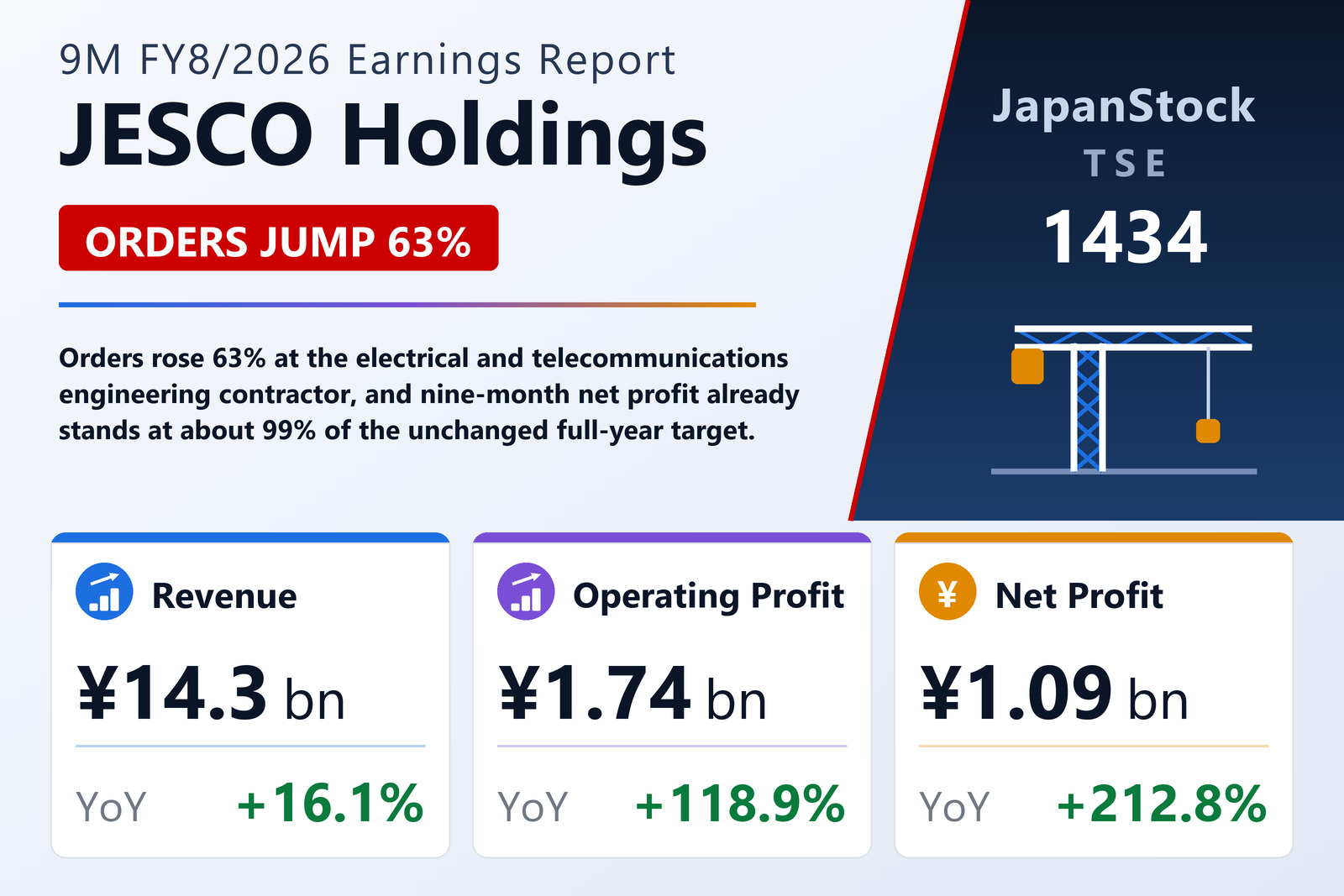
JESCO Holdings Inc. (TSE: 1434), an electrical and telecommunications engineering contractor founded in 1970 and operating in Japan and Vietnam under the slogan "FOR SAFETY FOR SOCIETY", reported consolidated nine-month results for the period from September 1, 2025 to May 31, 2026 under Japanese GAAP. Revenue rose 16.1% to ¥14,311 million, operating profit more than doubled, up 118.9% to ¥1,736 million, ordinary profit climbed 122.5% to ¥1,754 million and net profit attributable to owners of the parent surged 212.8% to ¥1,093 million. Basic earnings per share were ¥157.35, against ¥50.44 a year earlier, and comprehensive income rose 235.4% to ¥1,187 million.
Orders surge on storage and security work
Orders received across the group jumped 62.8% to ¥17,243 million, comfortably outpacing revenue and lifting the order backlog. The gains came from grid-scale battery storage — large batteries connected to the power network or to renewable plants to charge and discharge electricity — and from telecommunications systems, as demand for renewables and for stronger security infrastructure picked up. Several large, long-duration project wins were booked in the period.
Japan's operating backdrop was mixed. Overseas instability, rising geopolitical risk and prolonged inflation weighed on domestic demand, but wage rises, inflation-relief and growth-investment support, and better employment and income conditions kept the economy firm overall. In telecom and electrical work, security-strengthening demand rose across both public and private sectors, alongside national-resilience disaster-mitigation projects and defence-related facility work.
Domestic EPC drives the margin
The domestic EPC (engineering, procurement, construction) segment took orders of ¥12,546 million (+63.5%) on revenue of ¥9,170 million (+1.1%), and segment profit rose 70.5% to ¥1,278 million. Solar-power and grid-storage revenue slipped between periods because of grid-connection timing, but telecom-infrastructure work — surveillance cameras and road equipment installed for security purposes — plus electrical work from new-build and renewal demand progressed steadily. Profit rose sharply on higher utilisation rates and on progress at well-priced projects. The company says it manages raw-material price spikes and inventory shortages by writing terms into its contracts and securing materials early.
The group-wide operating margin widened to about 12.1% from 6.4% a year earlier.
ASEAN losses narrow
The ASEAN EPC segment took orders of ¥535 million (−33.4%) on revenue of ¥979 million (−14.3%), and posted a segment loss of ¥30 million, sharply narrower than the ¥188 million loss a year earlier. The design division performed well as technical-capability upgrades and added engineers won new customers, and design and estimating orders from Japanese companies stayed firm on Japan's labour shortage. The construction division deliberately held back from taking orders from local firms, which cut revenue. Work on electrical equipment and ICT (information and communications technology) construction supervision for the terminal building at Long Thanh International Airport, under construction in eastern Ho Chi Minh City, progressed on schedule. The group is also focused on collecting outstanding receivables and targets a return to profit for the segment during the medium-term plan period.
Real estate nearly doubles
The real-estate business, launched in 2022, recorded orders and revenue of ¥4,161 million, both up 97.1%, and segment profit of ¥797 million (+148.4%). With property prices high, the business is shifting from its old resale model to a "real-estate regeneration" model aimed at defending profit levels. Rent renewals on owned buildings and full occupancy lifted rental-management income, and two properties held for sale were sold during the period. The company says it is watching interest rates but that the impact on results is currently minimal.
On the balance sheet, total assets rose to ¥19,467 million from ¥17,647 million at the August 2025 year-end, while net assets increased to ¥8,496 million from ¥7,561 million. Equity was ¥8,397 million against ¥7,475 million, lifting the equity ratio to 43.1% from 42.4%.
Guidance already all but met
JESCO left its full-year FY8/2026 guidance unchanged at revenue of ¥20,000 million (+4.9%), operating profit of ¥1,800 million (+4.5%), ordinary profit of ¥1,750 million (+3.4%) and net profit of ¥1,100 million (+2.2%), with EPS of ¥158.57. That leaves the plan looking conservative on the face of the nine-month numbers: net profit of ¥1,093 million is already about 99% of the full-year target, and nine-month operating profit of ¥1,736 million is about 96% of the ¥1,800 million goal, with one quarter still to run.
Dividend raised
The company kept its FY8/2026 dividend forecast at an interim of ¥0.00 and a year-end of ¥48.00, for an annual ¥48.00 — a 20% increase on the ¥40.00 paid for FY8/2025, which was likewise all paid at the year-end. Shares issued total 6,975,400, with 16,880 held in treasury and an average of 6,946,613 shares outstanding during the period.
Medium-term plan: "JESCO VISION 2035"
The current three-year plan, published in August 2025 and covering FY8/2026 to FY8/2028, is framed as "JESCO VISION 2035" — a ten-year aspiration to be "a good company creating the future together with stakeholders". Under the slogan "Challenge & Innovation" it targets a sharp rise in revenue and operating profit and a sustained high ROE, via four aims: growth built around the domestic EPC business; a stronger management base through people and DX strategy to raise on-site capability; sustained high ROE by running the business with capital cost and share price in mind; and ESG progress so the company grows sustainably alongside society.
Structurally, the renewables market is shifting. An obligation from fiscal 2026 for operators with fossil-fuel-intensive plants to set rooftop-solar adoption targets for fiscal 2030, together with greater environmental awareness, is moving demand from mega-solar toward self-consumption rooftop systems, while grid-scale battery-storage investment expands as output curtailment grows with renewables. Amid an engineer shortage, contractors able to handle design through construction in one package are increasingly favoured. JESCO points to a prime-contractor structure covering planning, design, construction and maintenance, client trust built on a deep project record, and an offshore design structure at its Vietnamese group companies for speed and cost competitiveness. It is also raising on-site capability through in-house qualification training and using generative AI for construction front-loading — moving work earlier in the project cycle — and back-office process reform.
| Metric | 9M FY8/26 | 9M FY8/25 | YoY |
|---|---|---|---|
| Orders received (¥ million) | 17,243 | 10,590 | +62.8% |
| Revenue (¥ million) | 14,311 | 12,324 | +16.1% |
| Operating profit (¥ million) | 1,736 | 793 | +118.9% |
| Ordinary profit (¥ million) | 1,754 | 788 | +122.5% |
| Net profit attrib. to owners (¥ million) | 1,093 | 349 | +212.8% |
| Basic EPS (¥) | 157.35 | 50.44 | +212.0% |
| Comprehensive income (¥ million) | 1,187 | 354 | +235.4% |
| Equity ratio (%) | 43.1 | 42.4 | +0.7pt |
| Annual dividend forecast (¥) | 48.00 | 40.00 | +20.0% |
JapanStockPulse provides informational content only and does not constitute investment advice. Figures are taken from the company's published earnings short report and may be subject to subsequent revision.