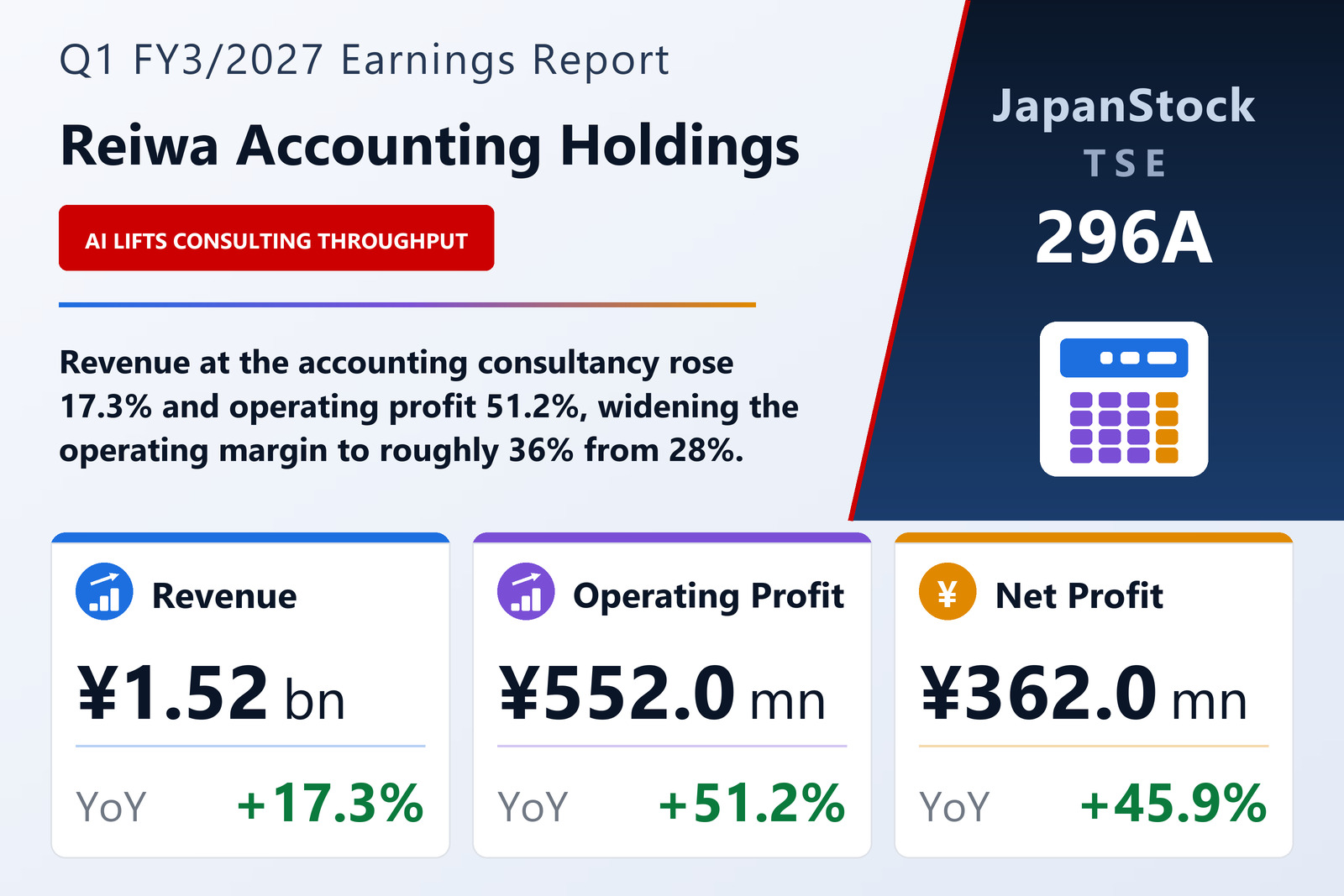
Reiwa Accounting Holdings Inc. (TSE: 296A), a Tokyo-listed group of accounting and corporate-reorganisation consultancies, reported consolidated results for the first quarter of the fiscal year ending March 2027 — the three months to June 30, 2026 — under Japanese GAAP. Revenue rose 17.3% to ¥1,523 million, operating profit surged 51.2% to ¥552 million, ordinary profit climbed 49.6% to ¥547 million, and net profit attributable to owners of the parent advanced 45.9% to ¥362 million. Basic earnings per share came to ¥9.68, up from ¥6.53; comprehensive income rose 47.9% to ¥375 million.
Consulting demand and AI-driven throughput
The standout figure is the margin. Operating profit grew three times faster than revenue, lifting the operating margin to about 36.2% from 28.1% a year earlier — the clearest sign yet that the group's productivity programme is landing. Management set an explicit target of raising latent work-processing capacity above the prior year, and says case-throughput speed has improved as a result.
The backdrop is favourable. Japanese companies facing chronic staff shortages are outsourcing more accounting work to outside specialists just as that work grows more sophisticated and complex. Demand for high-expertise advice on corporate reorganisations is also firm, with managements under pressure to run their businesses with an eye on cost of capital and share price. Japan's economy is recovering gradually on inbound demand, though the outlook remains clouded by an energy-price spike following US and Israeli strikes on Iran, a weak and volatile yen, geopolitical risk in the Middle East and Ukraine, and persistent inflation.
At system-development subsidiary Miracle Keiri Inc., the AI asset-classification solution "Miracle X" is scaling up steadily, mainly among large-enterprise clients, with further systems in development. Pairing the group's hands-on accounting expertise with AI is now working in earnest on both sides of the business — internally as a productivity lever, and externally as a product the group sells. The company reports a single "Consulting" segment; education and staffing plus system development remain quantitatively immaterial, so segment disclosure is omitted.
Balance sheet reflects the dividend payout
Total assets fell ¥508 million over the quarter to ¥3,527 million, and net assets declined ¥382 million to ¥2,302 million. Current assets dropped ¥527 million to ¥2,890 million, driven mainly by a ¥420 million fall in cash and deposits on the dividend payment. Non-current assets edged up ¥18 million to ¥636 million, chiefly a ¥26 million rise in intangibles from software development. Total liabilities fell ¥125 million to ¥1,224 million, largely on a ¥202 million reduction in income taxes payable. Equity ended at ¥2,254 million for an equity ratio of 63.9%, down from 65.4% at the March year-end — retained earnings gained ¥362 million from net profit but gave back ¥748 million in dividends paid.
Dividend nudged higher
Reiwa Accounting paid an annual dividend of ¥32.50 for FY3/2026 (¥12.50 interim, ¥20.00 year-end). For FY3/2027 it maintains its forecast of ¥33.00 — ¥13.00 at the interim and ¥20.00 at year-end — a modest increase left unchanged from the prior forecast.
Guidance left unchanged despite the fast start
The company kept both its half-year and full-year forecasts intact. For the first half it guides revenue of ¥2,920 million (+10.0%), operating profit of ¥878 million (+7.0%), ordinary profit of ¥875 million (+6.3%) and net profit of ¥575 million (+1.9%), with EPS of ¥15.37. For the full year it guides revenue of ¥6,300 million (+10.4%), operating profit of ¥2,160 million (+8.7%), ordinary profit of ¥2,160 million (+8.3%) and net profit of ¥1,440 million (+1.3%), with EPS of ¥38.50.
That leaves an unusually wide gap between run-rate and forecast: Q1 revenue is about 24% of the full-year target, but Q1 operating profit is already roughly 26% of the annual figure. Management describes the productivity gains now showing through as structural and expects them to ripple through the year, but has held guidance steady pending clearer evidence. With 37,500,000 shares issued and 97,000 in treasury, the weighted average share count for the quarter was 37,403,000; there were no potentially dilutive shares, so no diluted EPS is reported. The scope of consolidation was unchanged, and the group applies accounting treatments specific to quarterly consolidated financial statements. Because no quarterly consolidated statements were prepared for Q1 FY3/2025, the year-earlier quarter carried no comparatives of its own.
| Metric | Q1 FY3/2027 | Q1 FY3/2026 | YoY |
|---|---|---|---|
| Revenue (¥ million) | 1,523 | 1,298 | +17.3% |
| Operating profit (¥ million) | 552 | 364 | +51.2% |
| Ordinary profit (¥ million) | 547 | 365 | +49.6% |
| Net profit attrib. to owners (¥ million) | 362 | 248 | +45.9% |
| Basic EPS (¥) | 9.68 | 6.53 | +48.2% |
| Annual dividend (¥) | 33.00 | 32.50 | +1.5% |
| FY3/2027 revenue guidance (¥ million) | 6,300 | — | +10.4% |
| FY3/2027 operating profit guidance (¥ million) | 2,160 | — | +8.7% |
JapanStockPulse provides informational content only and does not constitute investment advice. Figures are taken from the company's published earnings short report and may be subject to subsequent revision.