Loan interest carries the quarter
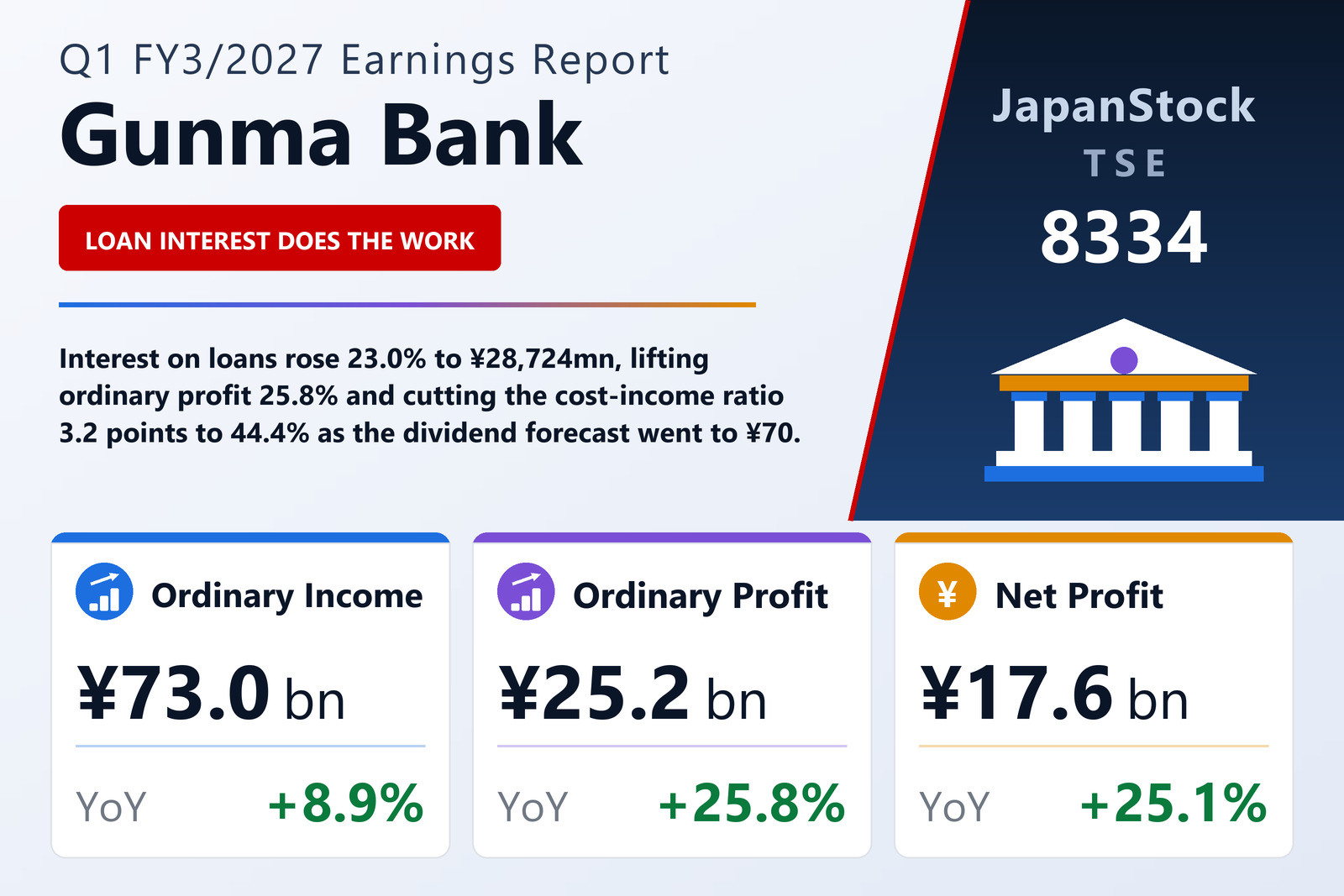
The Gunma Bank, Ltd. (TSE: 8334), the regional lender headquartered in Maebashi and the principal bank of Gunma Prefecture, published consolidated first-quarter results for FY3/2027 on August 3, 2026, covering April 1 to June 30, 2026 under Japanese GAAP. Ordinary income rose 8.9% to ¥72,962 million, ordinary profit 25.8% to ¥25,175 million and net profit attributable to owners of the parent 25.1% to ¥17,584 million, for earnings per share of ¥46.46 against ¥36.77. The base is not a soft one: the same quarter a year earlier had itself grown ordinary profit 24.8% and net profit 26.0%.
Interest income did the work, rising 19.2% to ¥46,951 million. Within it, interest on loans climbed 23.0% to ¥28,724 million and interest and dividends on securities 8.7% to ¥15,570 million, while fees and commissions income added 7.9% to ¥9,214 million. In the bank's own supplementary disclosure, net interest income rose ¥4,758 million to ¥30,592 million and core business net profit excluding gains and losses on cancellation of investment trusts rose 21.2% to ¥19,646 million. On that same basis the overhead ratio improved 3.2 points to 44.4% and annualised return on equity rose 1.4 points to 11.3%.
Deposit costs up, bond losses down
Ordinary expenses grew only 1.8% to ¥47,786 million, and the two halves of that number pull in opposite directions. Funding costs rose 20.8% to ¥16,360 million, with interest on deposits up 35.3% to ¥7,810 million as higher domestic rates reach savers. Against that, other business expenses — the line that carries losses on sales of government and other bonds — fell 18.2% to ¥12,186 million, and general and administrative expenses were held to a 0.7% increase at ¥14,110 million. Credit costs fell to ¥273 million from ¥781 million.
Securities results were the one weak spot. Total securities-related gains fell ¥944 million to ¥952 million: losses on government and other bonds narrowed to ¥3,448 million from ¥6,913 million, but gains on equities and related instruments dropped to ¥4,401 million from ¥8,810 million. Across the three segments, banking supplied nearly all of the profit — ordinary income including inter-segment transactions rose 7.6% to ¥61,952 million and segment profit 25.8% to ¥23,656 million, or 93.7% of the ¥25,236 million segment total. Leasing grew revenue 15.1% to ¥9,691 million but its profit slipped 6.8% to ¥414 million, while the businesses grouped as “other” lifted revenue 30.6% to ¥2,696 million and profit 42.2% to ¥1,165 million.
A 5.8% equity ratio is not a capital ratio
Total assets edged up 0.3% to ¥10,883,706 million over the three months. Deposits grew 1.3% to ¥8,668,161 million and securities 2.1% to ¥2,043,294 million, while loans and bills discounted were essentially flat, down 0.1% to ¥7,120,838 million. Net assets rose 2.1% to ¥632,403 million and the equity ratio to 5.8% from 5.7%. That last figure needs reading carefully, and the bank says so itself: it is period-end net assets divided by period-end total assets, and is not the capital adequacy ratio defined under Japan's capital adequacy notification. The regulatory number is disclosed separately in the supplementary material and is far higher — a consolidated total capital ratio of 15.73% at June 30, 2026 against 15.13% at March 31, 2026, with common equity Tier 1 at 14.19%.
Comprehensive income moved the other way from profit, falling 3.5% to ¥25,194 million while net profit rose 25.1%. The cause sits entirely in other comprehensive income, which fell to ¥7,610 million from ¥12,058 million: the valuation difference on available-for-sale securities contributed ¥8,370 million against ¥12,429 million a year earlier, and the retirement benefit adjustment was negative ¥1,147 million against negative ¥512 million. On a parent-only basis loans were 5.6% higher than a year earlier, growth the bank attributes to head-office lending in cross-border loans and structured finance and to its overseas branches, alongside steady increases in mid-sized, small-business and retail lending; deposits and negotiable certificates of deposit were 1.1% higher, mainly on corporate balances.
Guidance untouched, dividend raised 12.9%
The forecasts published on May 11, 2026 were left unchanged. For the first half the bank expects ordinary profit of ¥46,500 million (+14.6%) and net profit of ¥32,000 million (+14.9%), for earnings per share of ¥84.54; for the full year, ordinary profit of ¥95,000 million (+11.9%) and net profit of ¥65,000 million (+10.4%), for earnings per share of ¥171.73. First-quarter ordinary profit is 26.5% of the full-year target and net profit 27.1%, slightly ahead of a straight-line pace; against the first-half target the bank puts progress at 55.0%. The annual dividend forecast rises to ¥70.00 per share from ¥62.00, split ¥35.00 interim and ¥35.00 final against ¥30.00 and ¥32.00 a year earlier — a 12.9% increase.
Two notes accompany the figures. The bank adopted the revised Practical Guidelines on Accounting for Financial Instruments (revised Implementation Guidance No. 9, issued March 11, 2025) from the start of this fiscal year, measuring at fair value the unlisted shares held among the assets of qualifying investment partnerships as the basis for accounting for those interests; it states the effect on the quarterly consolidated financial statements is immaterial. And the average share count for the quarter fell 1.0% to 378,499,827 from 382,388,573, which is why earnings per share grew 26.4% while net profit grew 25.1%.
| Metric | Q1 FY3/2027 | Q1 FY3/2026 | Change |
|---|---|---|---|
| Ordinary income (¥ million) | 72,962 | 66,968 | +8.9% |
| — interest income (¥ million) | 46,951 | 39,372 | +19.2% |
| —— interest on loans (¥ million) | 28,724 | 23,355 | +23.0% |
| —— interest and dividends on securities (¥ million) | 15,570 | 14,322 | +8.7% |
| — fees and commissions income (¥ million) | 9,214 | 8,536 | +7.9% |
| Ordinary expenses (¥ million) | 47,786 | 46,958 | +1.8% |
| — funding costs (¥ million) | 16,360 | 13,539 | +20.8% |
| —— interest on deposits (¥ million) | 7,810 | 5,772 | +35.3% |
| — other business expenses (¥ million) | 12,186 | 14,904 | −18.2% |
| — general and administrative expenses (¥ million) | 14,110 | 14,016 | +0.7% |
| Ordinary profit (¥ million) | 25,175 | 20,010 | +25.8% |
| Net profit attrib. to owners of parent (¥ million) | 17,584 | 14,060 | +25.1% |
| Comprehensive income (¥ million) | 25,194 | 26,118 | −3.5% |
| EPS (¥) | 46.46 | 36.77 | +26.4% |
| Banking — revenue (¥ million) | 61,952 | 57,557 | +7.6% |
| Banking — segment profit (¥ million) | 23,656 | 18,802 | +25.8% |
| Leasing — revenue (¥ million) | 9,691 | 8,419 | +15.1% |
| Leasing — segment profit (¥ million) | 414 | 444 | −6.8% |
| Other — revenue (¥ million) | 2,696 | 2,065 | +30.6% |
| Other — segment profit (¥ million) | 1,165 | 819 | +42.2% |
| Total assets (¥ million) | 10,883,706 | 10,855,923 | +0.3% |
| Deposits (¥ million) | 8,668,161 | 8,554,539 | +1.3% |
| Loans and bills discounted (¥ million) | 7,120,838 | 7,126,737 | −0.1% |
| Securities (¥ million) | 2,043,294 | 2,001,768 | +2.1% |
| Net assets (¥ million) | 632,403 | 619,321 | +2.1% |
| Equity ratio | 5.8% | 5.7% | +0.1 pt |
| Total capital ratio (consolidated, regulatory) | 15.73% | 15.13% | +0.60 pt |
| FY3/2027 guidance — ordinary profit (¥ million) | 95,000 | — | +11.9% |
| FY3/2027 guidance — net profit (¥ million) | 65,000 | — | +10.4% |
| FY3/2027 guidance — EPS (¥) | 171.73 | — | — |
| Annual dividend per share (¥) | 70.00 | 62.00 | +12.9% |
JapanStockPulse provides informational content only and does not constitute investment advice. Figures are taken from the company's published earnings short report and may be subject to subsequent revision.