A very small base, and price pass-through on top of it
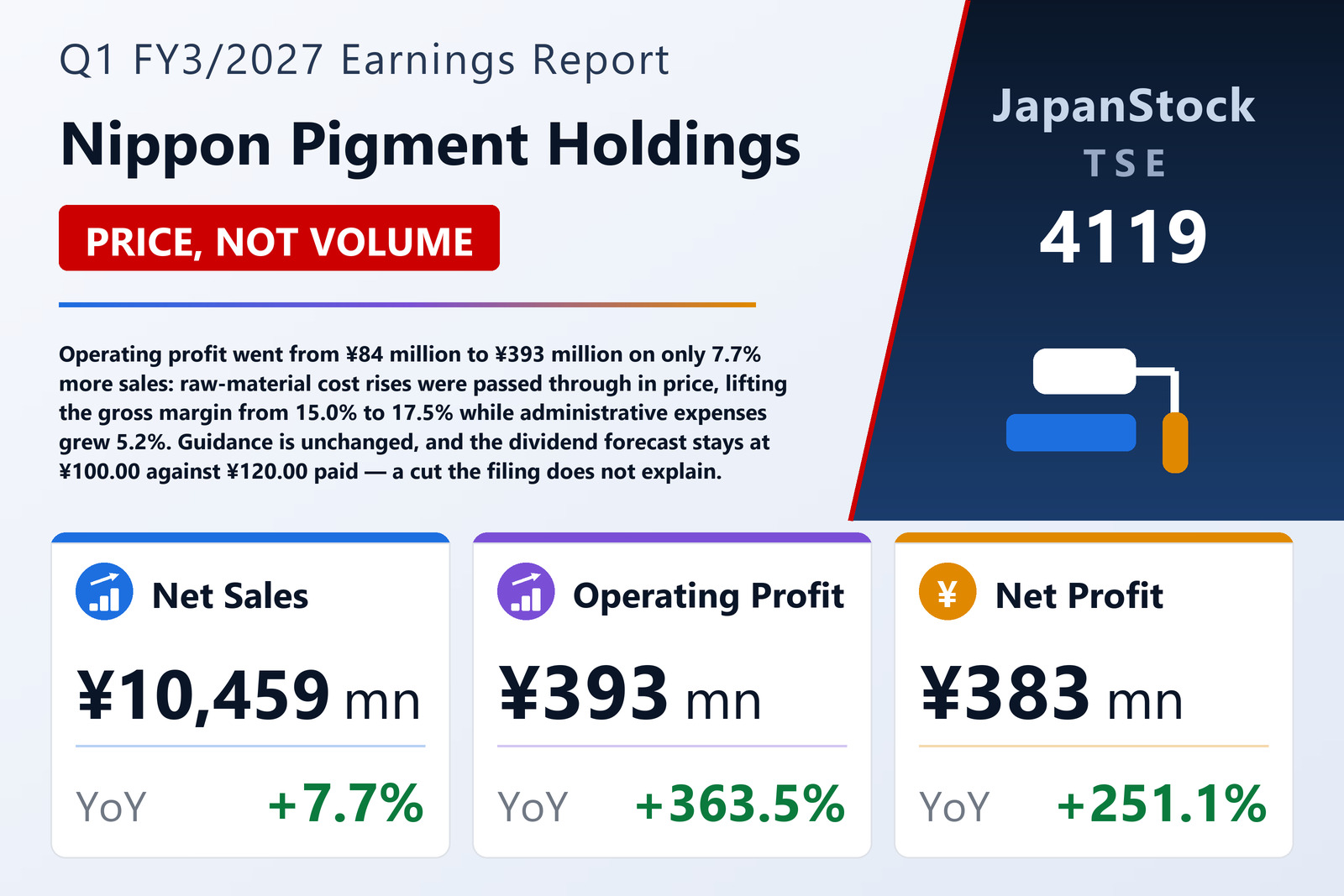
Nippon Pigment Holdings Company Limited (TSE: 4119), the holding company for a group that makes pigments, colorants and functional compounds for plastics, published consolidated results for the three months to June 30, 2026 on August 10, 2026 under Japanese GAAP. Net sales rose 7.7% to ¥10,459 million, operating profit 363.5% to ¥393 million, ordinary profit 275.5% to ¥524 million and net profit attributable to owners of the parent 251.1% to ¥383 million, for earnings per share of ¥244.65 against ¥69.68. Comprehensive income was ¥798 million against a negative ¥470 million a year earlier.
Those percentages are large mainly because the base is small. Operating profit of ¥84 million on ¥9,713 million of sales a year ago was a margin of 0.9%, and the filing's own cover table shows it was itself up 7.2% on the quarter before that — so the thin base is the group's normal run rate, not a one-off collapse. What actually changed is gross profit, which went from ¥1,453 million to ¥1,832 million; on those two figures that is ¥379 million more, or 26.1%, against sales up 7.7%, and the gross margin moved from 15.0% to 17.5%. The company attributes this to continued efforts to pass raw-material price increases through into selling prices and to compress the increase in expenses. Selling, general and administrative expenses rose only ¥70 million, or 5.2%, to ¥1,438 million, so almost the whole of the extra gross profit reached the operating line and the operating margin went from 0.9% to 3.8%. The company also names one demand effect it does not control: uncertainty over the Middle East led customers to bring orders forward, which flatters this quarter at the expense of later ones.
Japan made almost all of the profit
Japan is 62.6% of external sales but 88.6% of segment profit: sales of ¥6,548 million, up only 1.3%, produced segment profit of ¥348 million, up 165.5% from ¥131 million. All three domestic divisions improved their operating profit year on year, and in each case the company names a price revision as part of the reason. Resin compounds held firm on orders for domestic vehicle applications, helped by the orders customers brought forward, with price revisions delivering a degree of result; resin colorants saw steady orders from food- and beverage-related and textile-related customers, again alongside price revisions; and processed colour benefited from strong sales of building-material products such as sealants to a major customer. Note what this segment is not doing: with volume growth of barely 1%, the entire Japanese profit improvement is margin, which makes it dependent on holding those prices rather than on demand.
The weak yen helped Southeast Asia's sales and hurt its costs; China turned
Southeast Asia is the one segment where the same currency move works in both directions. Sales rose 8.3% to ¥2,791 million, but the company attributes the increase to the weaker yen and describes conditions as severe, centred on automotive and home-appliance applications, because its main customers — Japanese companies operating in the region — are struggling. On the cost side, raw-material and general price rises plus the currency effect on mainly US dollar-denominated expenses pushed costs up, and the operating loss widened to ¥64 million from ¥26 million. China is the opposite case and the quarter's clearest improvement: sales rose 67.4% to ¥1,119 million and the segment swung to an operating profit of ¥109 million from a ¥19 million loss, as steady expansion of sales to domestic Chinese companies more than offset a decline in business with Japanese firms. China is now 10.7% of external sales, against 6.9% a year ago.
Below the operating line, and a balance sheet that barely moved
Ordinary profit of ¥524 million grew faster than operating profit, and the reason is currency in the accounts rather than in the business. Non-operating income rose to ¥161 million from ¥134 million, with dividends received of ¥86 million against ¥77 million and a foreign-exchange gain of ¥26 million where a year ago there was none. Non-operating expenses fell to ¥30 million from ¥80 million: last year carried a ¥51 million foreign-exchange loss and this year none, interest paid fell to ¥19 million from ¥25 million, and a ¥10 million claim-compensation cost is new. Extraordinary items then almost disappeared — a year ago the group booked ¥24 million of extraordinary losses, of which ¥23 million was the cost of winding up an affiliate, against ¥4 million of gains; this quarter there is no extraordinary gain at all and only ¥188 thousand of fixed-asset disposal loss. Pre-tax profit was ¥524 million against ¥120 million, tax ¥126 million against ¥29 million, and quarterly net profit ¥397 million against ¥90 million, of which ¥13 million went to non-controlling interests where a year ago they absorbed a ¥18 million loss.
Total assets rose ¥1,948 million to ¥47,442 million. Current assets added ¥1,452 million, mostly ¥658 million more raw materials and supplies and ¥400 million more notes and accounts receivable; fixed assets added ¥496 million, mostly ¥426 million more investment securities. Liabilities rose ¥1,339 million to ¥22,603 million on ¥1,115 million more notes and accounts payable, ¥157 million more bonus provision and ¥133 million more deferred tax liabilities. Net assets rose ¥609 million to ¥24,839 million on ¥281 million of unrealised gains on securities, ¥195 million of retained earnings and ¥106 million of foreign-currency translation adjustment. That retained-earnings figure is the one to read carefully: attributable profit was ¥383 million but retained earnings rose only ¥195 million, and the ¥188 million difference is consistent with the FY3/2026 year-end dividend of ¥120.00 on the 1,569,390 shares outstanding. The equity ratio slipped to 48.4% from 49.2% — assets grew faster than equity, not the reverse. Cash and deposits of ¥6,340 million still exceed total borrowings of ¥4,803 million. No quarterly cash-flow statement was prepared; depreciation was ¥182 million against ¥169 million.
Guidance untouched, and a dividend forecast ¥20.00 lower with no reason given
Guidance is unchanged from the forecast published on May 14, 2026. For the first half the company still expects net sales of ¥21,200 million (+5.7%), operating profit of ¥600 million (+47.9%), ordinary profit of ¥800 million (+88.8%) and net profit of ¥600 million (+72.9%), for earnings per share of ¥382.27. For the full year it expects net sales of ¥43,500 million (+3.0%), operating profit of ¥1,700 million (+12.6%), ordinary profit of ¥1,900 million (+5.7%) and attributable net profit of ¥1,300 million (+12.2%), for earnings per share of ¥828.26. Against those figures the first quarter has already delivered roughly two thirds of the half-year operating-profit and ordinary-profit forecasts, and 23.2% of the full-year operating profit, 27.6% of ordinary profit and 29.5% of attributable profit on 24.0% of the sales. The company left the forecast alone anyway, which is defensible given how much of the quarter rests on pulled-forward orders and on a foreign-exchange line that reversed.
The dividend moves the other way. FY3/2026 was paid as a year-end-only dividend of ¥120.00; the FY3/2027 forecast is a year-end-only dividend of ¥100.00, ¥20.00 lower, and it is flagged as unrevised from the previously announced forecast rather than as a new decision. The filing gives no reason for the reduction. There is no commemorative- or special-dividend note against the FY3/2026 payment that would explain it away, and no payout-policy statement anywhere in the document. On the company's own guided earnings per share of ¥828.26, ¥100.00 is a payout ratio of 12.1%, so the cut is not a question of what the guided year can afford. No first-quarter dividend is being paid and no payment start date is given.
| Metric | Q1 FY3/2027 | Q1 FY3/2026 | Change |
|---|---|---|---|
| Net sales (¥ million) | 10,459 | 9,713 | +7.7% |
| Gross profit (¥ million) | 1,832 | 1,453 | +26.1% |
| Gross margin | 17.5% | 15.0% | +2.5 pt |
| SG&A expenses (¥ million) | 1,438 | 1,368 | +5.2% |
| Operating profit (¥ million) | 393 | 84 | +363.5% |
| Operating margin | 3.8% | 0.9% | +2.9 pt |
| Ordinary profit (¥ million) | 524 | 139 | +275.5% |
| Net profit attrib. to owners of parent (¥ million) | 383 | 109 | +251.1% |
| Comprehensive income (¥ million) | 798 | −470 | loss to profit |
| EPS (¥) | 244.65 | 69.68 | +251.1% |
| Japan — revenue (¥ million) | 6,548 | 6,467 | +1.3% |
| Japan — segment profit (¥ million) | 348 | 131 | +165.5% |
| Southeast Asia — revenue (¥ million) | 2,791 | 2,577 | +8.3% |
| Southeast Asia — segment profit (¥ million) | −64 | −26 | loss widened |
| China — revenue (¥ million) | 1,119 | 668 | +67.4% |
| China — segment profit (¥ million) | 109 | −19 | loss to profit |
| Total assets (¥ million) | 47,442 | 45,493 | +4.3% |
| Net assets (¥ million) | 24,839 | 24,229 | +2.5% |
| Shareholders' equity (¥ million) | 22,961 | 22,388 | +2.6% |
| Equity ratio | 48.4% | 49.2% | −0.8 pt |
| FY3/2027 guidance — revenue (¥ million) | 43,500 | — | +3.0% |
| FY3/2027 guidance — operating profit (¥ million) | 1,700 | — | +12.6% |
| FY3/2027 guidance — ordinary profit (¥ million) | 1,900 | — | +5.7% |
| FY3/2027 guidance — net profit (¥ million) | 1,300 | — | +12.2% |
| FY3/2027 guidance — EPS (¥) | 828.26 | — | n.m. |
| Annual dividend per share (¥) | 100.00 | 120.00 | −16.7% |
JapanStockPulse provides informational content only and does not constitute investment advice. Figures are taken from the company's published earnings short report and may be subject to subsequent revision.