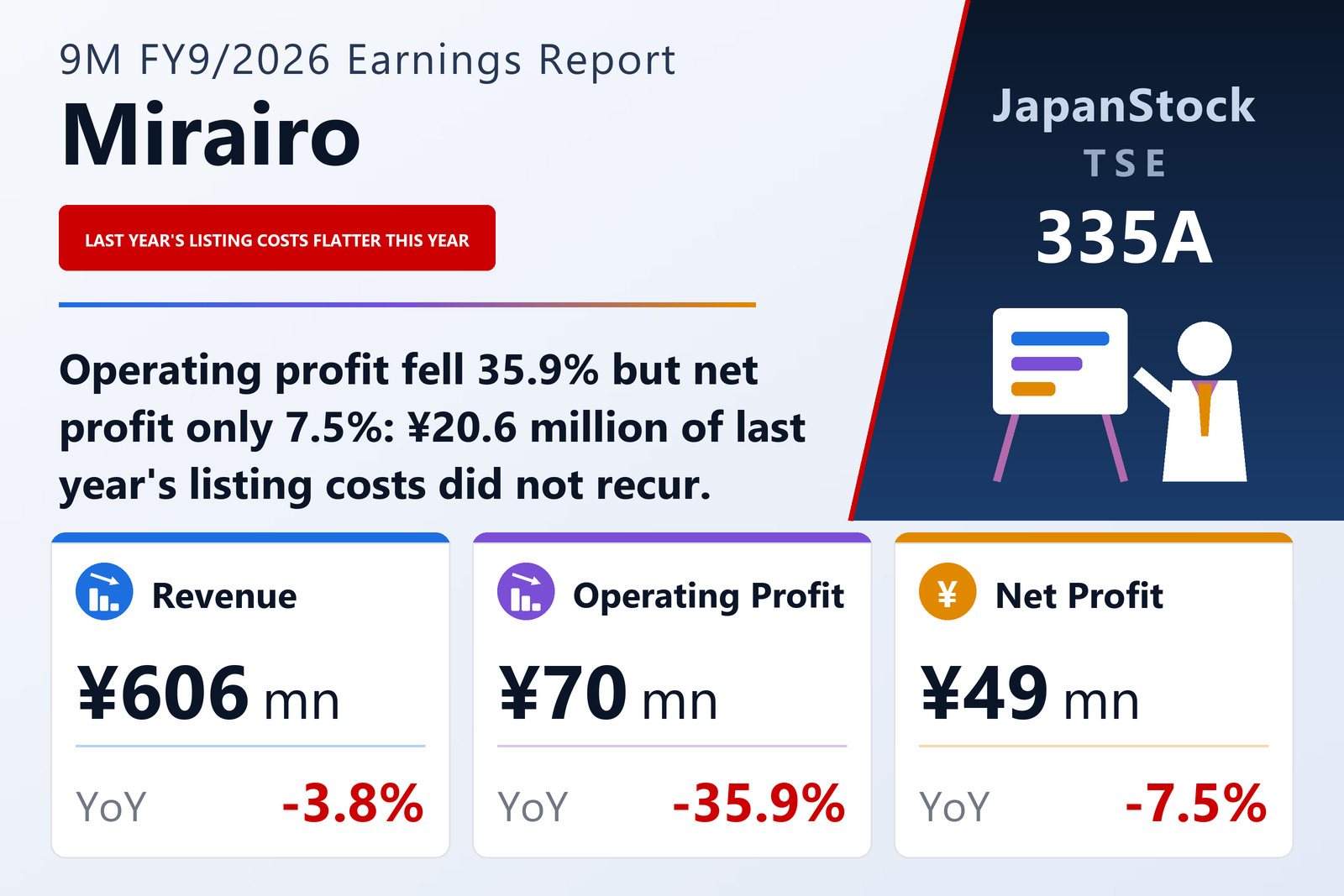
Revenue fell 3.8%, and the largest service line fell by more than the total
Mirairo Inc. (TSE: 335A), the Osaka company whose corporate philosophy is “barrier value” — バリアバリュー, its own coined term for turning the barriers faced by people with disabilities into value — published non-consolidated results for the first nine months of FY9/2026 on August 13, 2026 under Japanese GAAP. Revenue for the nine months to June 30, 2026 fell 3.8% to ¥606 million, operating profit 35.9% to ¥70 million, ordinary profit 18.3% to ¥71 million and net profit 7.5% to ¥49 million. Basic earnings per share were ¥4.46 against ¥6.46; diluted earnings per share fell much less, to ¥4.41 from ¥5.27, because last year's calculation carried 1,861,727 potential shares from stock options against 146,572 this year. Mirairo listed on the Tokyo Stock Exchange's Growth market on March 24, 2025, and because it prepared no quarterly statements for the third quarter of FY9/2024, last year's nine-month report showed no year-on-year change at all — this is the first one that could.
The company runs a single reportable segment, the Barrier Value business (バリアバリュー事業), so there is no segment note; the revenue-recognition note disaggregates the top line instead. Universal Manner training and certification (ユニバーサルマナー研修及び検定), the largest service, fell 9.6% to ¥257 million from ¥284 million. That decline of ¥27 million is larger than the ¥24 million by which total revenue fell, so the rest of the business grew in aggregate: Mirairo ID solutions rose 3.1% to ¥205 million while Communication Support (コミュニケーションサポート) fell 2.1% to ¥143 million. Split by timing rather than by service, revenue recognised at a point in time fell 7.9% to ¥526 million and revenue recognised over time rose 36.3% to ¥79 million, lifting the over-time share of the top line from 9.2% to 13.1%. The filing states only the amounts; every percentage in this paragraph is arithmetic on its own thousand-yen figures.
Last year's listing costs are why each profit line falls by less than the one above it
Operating profit fell ¥39.5 million, ordinary profit ¥16.0 million and net profit ¥4.0 million, and the income statement itemises where the gaps open. A year ago non-operating expenses were ¥24.7 million, of which ¥7.5 million was share issuance cost (株式交付費) and ¥13.1 million listing-related expense (上場関連費用) — ¥20.6 million of one-off charges from the March 2025 flotation. Both lines are nil this year, leaving non-operating expenses of ¥1.7 million, almost all interest on borrowings. Non-operating income rose to ¥2.2 million from ¥1.5 million, mostly on interest received of ¥1.2 million against ¥0.2 million. Net of everything, the non-operating lines swung ¥23.6 million in the company's favour, which is the whole of the difference: ordinary profit sat ¥23.1 million below operating profit last year and ¥0.4 million above it this year.
Below that, tax did the rest. Neither period carried extraordinary items, so pre-tax profit equals ordinary profit, and total income tax expense fell to ¥21.9 million from ¥33.8 million — current tax of ¥9.4 million and deferred tax of ¥12.5 million, against ¥14.6 million and ¥19.3 million a year ago. The effective rate on pre-tax profit therefore fell from 38.9% to 30.8%, a ratio computed from those figures; the filing offers no tax reconciliation. Those two steps are the whole reason a 35.9% fall in operating profit arrives at the bottom of the income statement as a 7.5% fall in net profit. The narrowing comes from items outside the operating business, not from the operating business itself.
The filing names personnel costs; its own income statement puts most of the fall higher up
Mirairo attributes the decline in profit to an increase in selling, general and administrative expenses, driven by the people it hired to roll out Mirairo Career and to develop new Universal Manner content. Its income statement is more precise than that. SG&A rose only 0.7%, to ¥311 million from ¥309 million. What moved was gross profit, which fell 8.9% to ¥382 million as cost of sales rose 6.3% to ¥224 million on 3.8% less revenue — the gross margin went from 66.6% to 63.0% and the operating margin from 17.5% to 11.7%. Of the ¥39.5 million by which operating profit fell, ¥37.4 million is the gross-profit decline and ¥2.1 million the SG&A increase. Cost of sales is not broken down, so what sits inside that ¥13.3 million increase — delivery staff, content production, or the cost of the new career business before it earns — is not disclosed.
Mirairo ID is adding registered users faster than active ones
Mirairo ID, the digital disability certificate released in July 2019, is the infrastructure half of the business. At June 30, 2026 it was accepted by 4,298 businesses, 84 more than at the previous fiscal year end, and carried 655,000 registered users, up 103,000, with 217,000 monthly active users, up 9,000. Those counts mean the registered base grew 18.7% over the nine months while the active base grew 4.3%, so the share of registered users active in a given month fell from 37.7% to 33.1% — a ratio the company does not publish. On the public-sector side Mirairo joined a standardisation study on railway assistance requests within COMmmmONS, the regional-transport DX project promoted by the Ministry of Land, Infrastructure, Transport and Tourism, and signed a comprehensive business alliance with xID Inc. to co-develop administrative notification services. In solutions it began offering a Universal Manner certification aimed at employment (ユニバーサルマナー検定(雇用)) as employers respond to Japan's rising statutory disability-employment quota, and launched Mirairo Career (ミライロ・キャリア), a new business pairing job-placement support for people with disabilities with disability-employment consulting for the companies hiring them.
Four-fifths of the balance sheet is cash, and the year is now guided to shrink
Total assets rose ¥13 million to ¥1,185 million and net assets ¥49 million to ¥931 million, the latter almost exactly the nine-month profit arriving in retained earnings. Cash and deposits of ¥925 million are 78.0% of the balance sheet; set against ¥149 million of borrowings — ¥95 million short-term, ¥14 million of current maturities and ¥40 million long-term — that leaves roughly ¥775 million of net cash, a figure computed from the balance sheet rather than stated. Receivables fell ¥14 million while a ¥10 million contract asset appeared where there had been none; income taxes payable dropped ¥23 million and long-term debt amortised down ¥11 million. Capitalised software rose ¥14 million to ¥85 million on Mirairo ID and related development, and deferred tax assets fell ¥12 million. The equity ratio improved to 78.5% from 75.2%. No quarterly cash flow statement is prepared; the filing discloses depreciation of ¥26 million against ¥22 million.
Full-year FY9/2026 guidance was revised on the day of this report. The tanshin carries the new numbers and points readers to a separate release published the same day, “Notice of Revision to the Full-Year FY9/2026 Earnings Forecast”, for the reasons; it does not restate the previous forecast, so the size of the change is not visible in this document. The revised year is revenue of ¥810 million, down 2.7%, operating profit of ¥90 million, down 36.7%, ordinary profit of ¥90 million, down 26.8%, and net profit of ¥60 million, down 26.4%, for earnings per share of ¥5.44. Against the nine-month actuals that implies a fourth quarter of about ¥204 million of revenue and ¥19 million of operating profit: 74.8% of the guided revenue and 78.5% of the guided operating profit are already booked. The dividend forecast is ¥0.00, as it was for FY9/2025 — Mirairo pays none. The 100-for-1 stock split of November 8, 2024 is restated into the prior-year per-share figures, so the 31.0% fall in earnings per share is not a split artefact: it is a 7.5% fall in profit spread over a weighted-average share count that rose from 8,240,795 to 11,020,641 as the March 2025 listing came fully into the comparison period.
| Metric | 9M FY9/2026 | 9M FY9/2025 | Change |
|---|---|---|---|
| Revenue (¥ million) | 606 | 630 | −3.8% |
| Gross profit (¥ million) | 382 | 419 | −8.9% |
| SG&A expenses (¥ million) | 311 | 309 | +0.7% |
| Operating profit (¥ million) | 70 | 110 | −35.9% |
| Operating margin | 11.7% | 17.5% | −5.8 pt |
| Non-operating expenses (¥ million) | 1.7 | 24.7 | −93.0% |
| Ordinary profit (¥ million) | 71 | 87 | −18.3% |
| Income taxes (¥ million) | 21.9 | 33.8 | −35.3% |
| Net profit (¥ million) | 49 | 53 | −7.5% |
| EPS (¥) | 4.46 | 6.46 | −31.0% |
| Diluted EPS (¥) | 4.41 | 5.27 | −16.3% |
| Revenue — Universal Manner training and certification (¥ million) | 257 | 284 | −9.6% |
| Revenue — Mirairo ID solutions (¥ million) | 205 | 199 | +3.1% |
| Revenue — Communication Support (¥ million) | 143 | 146 | −2.1% |
| Revenue recognised over time (¥ million) | 79 | 58 | +36.3% |
| Total assets (¥ million) | 1,185 | 1,171 | +1.2% |
| Net assets (¥ million) | 931 | 881 | +5.6% |
| Equity ratio | 78.5% | 75.2% | +3.3 pt |
| Cash and deposits (¥ million) | 925 | 904 | +2.4% |
| Interest-bearing debt (¥ million) | 149 | 161 | −6.9% |
| FY9/2026 guidance — revenue (¥ million) | 810 | — | −2.7% |
| FY9/2026 guidance — operating profit (¥ million) | 90 | — | −36.7% |
| FY9/2026 guidance — ordinary profit (¥ million) | 90 | — | −26.8% |
| FY9/2026 guidance — net profit (¥ million) | 60 | — | −26.4% |
| FY9/2026 guidance — EPS (¥) | 5.44 | — | n.m. |
| Annual dividend per share (¥) | 0.00 | 0.00 | unchanged |
JapanStockPulse provides informational content only and does not constitute investment advice. Figures are taken from the company's published earnings short report and may be subject to subsequent revision.